

15 min 19 sec
Available in: English
Happiness: Lessons from a New Science
Explains why Western societies grew far richer without growing happier, and what the research says does raise well-being: family, meaningful work, friends and health, plus the policies that would put them first.
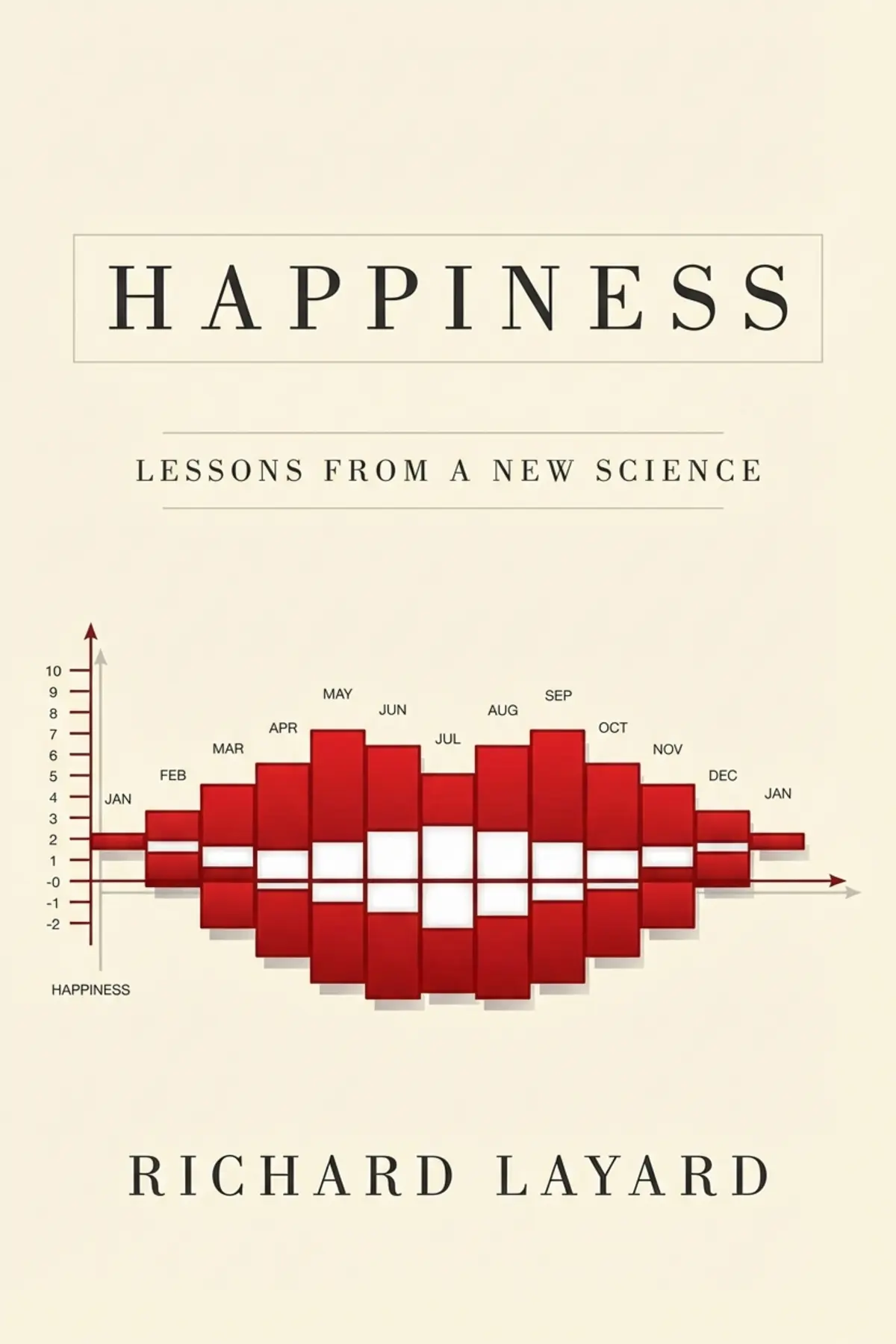
Table of Content
1. Introduction
1 min 03 sec
If the raises keep coming and the contentment never does, economist Richard Layard has an explanation. Americans now earn twice what they did in the 1950s on average, yet surveys show no rise in the share of people who call themselves happy. In Happiness: Lessons from a New Science, Layard, a British labor economist at the London School of Economics, gathers the research behind that puzzle.
His argument is that happiness can be measured, that it drives nearly every choice we make, and that in rich countries it depends far less on money than on family, work, friends and health. Two habits of the mind explain the gap. We compare our pay with other people’s, and we get used to every gain.
From brain scans and global surveys, Layard builds toward a bold case about taxes and government. Along the way you learn where extra effort actually adds to well-being, and where it only keeps the wheel turning.
2. Learn to measure happiness like a scientist
1 min 43 sec
Happiness feels too private and vague to put a number on. Yet researchers can read it from a simple question, from the brain’s electrical signals, and even from how a baby reacts to a taste.
3. A happier mind builds a healthier body
1 min 44 sec
We usually think of good health as the thing that makes us cheerful. The evidence Layard gathers runs the other way, and one study of film actors puts a striking number on it.
4. See the one motive behind every decision
1 min 43 sec
What to cook tonight and which job to accept seem like unrelated choices. Layard traces both to a single drive that our ancestors needed to stay alive, and that still steers us today.
5. Know when more money stops adding happiness
1 min 57 sec
Incomes doubled, homes grew bigger and jobs were plentiful. Over the same decades, depression, drinking and crime climbed. Layard finds the point where extra money stops paying off in well-being.
6. See how a raise fades and a rival's stings
1 min 55 sec
Most people would accept a lower salary if it meant earning more than everyone around them. That odd preference, and a reunification story from Germany, reveal what our paychecks really measure.
7. Spend your effort where happiness grows
2 min 02 sec
A survey of more than 350,000 people ranks what shapes well-being most. Money makes the list, but the top spot goes elsewhere, and one comparison with a lost income is hard to forget.
8. What a happiness-first government would change
2 min 00 sec
A small Himalayan kingdom swapped one national target for another decades ago. Layard goes further and argues that higher taxes could make people happier, a claim that sounds backward until you follow his reasoning.
9. Conclusion
1 min 12 sec
Layard’s book amounts to a correction of aim. For decades, rich societies treated income as the main road to a better life, and the measurements show that road flattened out long ago. Comparison turns every gain into someone else’s loss, and adaptation turns every gain into the new normal. What is left, once basic needs are met, is a list that never appears on a pay slip: the people you love, work that means something, a community you trust, and a body and mind in good health.
Acting on that starts with a stock-take. Before chasing the next raise or title, look at what you already have, and you may find most of what happiness requires is in place, which weakens the pull of the next hit. When a choice sets extra income against time with family or friends, remember that a divorce costs more happiness than losing nearly a third of your pay. And if your health worries you, treat your mood as part of the cure, starting with exercise.
The East Germans grew richer and felt poorer because their yardstick changed. Much of how happy you feel depends on where you look.
About this book
What is this book about?
Americans now earn twice what they did in the 1950s on average, yet the share who call themselves happy has not moved. Depression, drinking and crime rose during the same boom years. Economist Richard Layard sets out to explain how a society can gain so much and feel no better. He starts by showing that happiness is something researchers can measure, through long-running surveys and brain scans, and that it pays off in better health and longer lives. Then he points to two habits of the human mind. We judge our income against other people's, and we quickly get used to every gain. Above a modest level of income, more money mostly keeps us running in place. Drawing on the World Values Survey, Layard ranks what matters most: family relationships first, then money for those near poverty, work, community and health. He ends with a provocative case for governments to pursue the greatest happiness instead of economic growth, using progressive taxes, family-friendly work, jobs for the unemployed and serious spending on mental health. Readers get a clearer sense of where their own effort will actually make them happier.
Book Information
Who it's for
Rising earners
Professionals who keep earning more and wonder why it never feels like enough.
Happiness science learners
Readers curious how economists and neuroscientists measure happiness and what they found.
Growth policy skeptics
Policy-minded people who question whether economic growth should be a country's main goal.
About the Author
Richard Layard
Richard Layard, born in 1934, is a British labor economist who has worked at the Centre for Economic Performance at the London School of Economics and co-edits the World Happiness Report. His early career focused on cutting unemployment and inequality, and he was Senior Research Officer for the Robbins Committee on Higher Education. His mental health work, including The Depression Report of 2006, led to England's Improving Access to Psychological Therapies program.
Ratings & Reviews
Ratings at a glance
What people think
Listeners find the writing exceptionally clear and engaging, offering a superb examination of the various elements that impact happiness. They value its robust philosophical grounding and economic lens, as one listener highlights that it provides a fresh viewpoint on economic policy.
Top reviews
Sirinat
After hearing about Layard for years, I finally dug into his work on utilitarianism and found it deeply moving. He makes a compelling case for shifting our focus toward collective well-being rather than just chasing higher GDP growth. To be fair, some critics find his approach a bit clinical, but I found his economic slant provided a necessary grounding for such an abstract topic. The writing is clear and accessible, making complex social theories easy to digest for a general audience. I particularly appreciated the discussion on how our "keeping up with the Joneses" mentality actively erodes our internal peace. This is an essential read for anyone who believes that government should actually care about how its citizens feel. It changed how I view economic success and the purpose of public service. Every politician should have a copy of this on their desk.
Show moreCholada
Ever wonder why societal progress is measured in dollars rather than smiles? Layard dives into this disconnect with a sharp, analytical eye and a heart for social reform. He provides a brilliant review of the various factors that contribute to human satisfaction, ranging from family stability to the quality of our community life. Not gonna lie, some of the data visualizations were a bit clunky to parse, but the core message shines through. The book is well written and manages to bridge the gap between academic economics and practical philosophy beautifully. It offers a truly new perspective on how we should structure our taxes and public services to maximize happiness for the many. While he does get a bit preachy about certain educational values, his heart is clearly in the right place. A very readable and thought-provoking volume for the modern reader.
Show moreJom
Layard makes a brilliant case for why feeling good should be our primary societal metric moving forward. This is not just a book about being "cheerful"; it is a serious look at how we have failed to turn our wealth into genuine satisfaction. The writing is excellent and incredibly accessible, which is a feat for a subject that touches on both neuroscience and macroeconomics. I particularly liked his focus on the "Big Seven" factors that shape our happiness. Gotta say, it is refreshing to see an author treat mental health as a priority for government intervention rather than just a personal struggle. While some of the content is a bit dated now, the fundamental philosophy remains incredibly relevant in our high-stress world. Highly recommended for any thoughtful reader looking for a deeper understanding of human flourishing.
Show morePhimwan
Look, if you are tired of the fluffy self-help genre and want a meaty, economics-based exploration of satisfaction, this is your book. Layard isn't interested in telling you to smile more; he’s interested in how we can structure our entire society to reduce misery. The way he ties together Bentham's utilitarianism with modern brain science is genuinely fascinating. It provides a new perspective on economic policy that feels human-centric rather than profit-centric. Is the book a perfect masterpiece without any flaws? Certainly not. Some of his views on the soul and "established truths" in education might rub secular readers the wrong way. But the core argument—that we are measuring the wrong things—is impossible to ignore. It is well written and provides an excellent review of what actually makes a life worth living. I finished this book feeling like I had a much better understanding of the factors that drive our collective well-being.
Show moreTitiluck
Picked this up to understand the policy implications of well-being, and in that regard, Layard delivers a solid review. He effectively argues that our current obsession with material wealth has reached a point of diminishing returns for most developed nations. The chapters on how public policy can be reshaped to favor mental health are the strongest parts of the book by far. Personally, I found the economic perspective a refreshing change from the typical "mindset" books that flood the self-help section. My only gripe is that some of the scientific studies cited feel a bit cherry-picked to support his specific worldview. Nevertheless, it is an excellent foundational philosophy for anyone interested in why we need a new metric for societal progress. It is definitely worth a read for the policy suggestions alone, even if you disagree with his utilitarian roots.
Show morePla
This book provides a solid foundational philosophy for anyone interested in how public policy affects our moods and general life satisfaction. Layard is an economist, so he naturally treats happiness as a measurable unit, which provides a fascinating, if occasionally emotionless, perspective. He draws interesting parallels between modern science and ancient traditions like Buddhism, though these sections could have been more deeply explored for the reader. I found his arguments for a "new science" of happiness to be largely persuasive, even if the individual studies he cites are sometimes questionable in their causality. It is a highly readable text that avoids the fluff of standard self-help titles. It is particularly strong when discussing the social factors that lead to misery, such as broken trust and extreme income inequality. A worthy addition to any policy-wonk’s bookshelf for the coming year.
Show moreVipawan
The central premise—that we should prioritize collective happiness over GDP—is a noble goal that I wholeheartedly support. However, the execution of this book is a mixed bag of brilliant economic insights and frustratingly thin philosophy. Layard draws heavily on Jeremy Bentham’s utilitarianism, which is a fine starting point, but he fails to address the deeper complexities of the human condition. Everything is reduced to a binary of "feeling good" versus "feeling bad." While the book is highly readable and well-written, it often ignores the nuance between temporary pleasure and long-term fulfillment. I also found the charts quite difficult to interpret, which is disappointing given the author's background in data. It is a good foundational text for looking at economics through a new lens, but it lacks the depth required to be truly transformative. Use it as a starting point rather than a final word.
Show moreCamila
As someone who appreciates data, I found the charts and correlations in this volume frustratingly opaque and occasionally misleading. Layard often confuses correlation with causation, assuming that because happy people live longer, happiness must be the magical cure. Frankly, the science felt a bit "thin" compared to other books on the market that explore the neurology of emotion. The second half of the book also felt a bit like a lecture, with the author advocating for certain moral truths to be taught in schools. Despite these flaws, the book does raise important questions about the limitations of economic growth in the modern age. It is an interesting read if you want to understand the origins of the happiness policy movement, but take the scientific "proofs" with a large grain of salt. It is a middle-of-the-road experience for me.
Show moreAubrey
Not what I expected at all, especially considering this was published in 2005. While some of the economic theories are interesting, the social commentary feels incredibly dated, particularly regarding gender roles in the workplace. To suggest that men’s unhappiness stems from women having less time to cater to them is a bizarre and retrograde take for any century. Truth is, the book feels like a collection of personal opinions dressed up in manipulated statistics and questionable charts. The few "exercises" for improving mental health are blink-and-you-miss-them moments, tucked away near a weirdly supportive section on pharmaceuticals. It is readable, but you must keep your skepticism high throughout the chapters. I would recommend Daniel Gilbert’s work over this if you actually want to understand the psychology of joy. This felt more like a lecture from a distant era than a modern scientific inquiry.
Show morePatchara
Frankly, the lack of scientific rigor here is staggering for a work written by an economist of this high stature. Layard leans heavily on correlations—like the study of nuns or Oscar winners—and treats them as definitive proof that happiness directly extends life. Is it not more likely that healthy people are simply happier to begin with? I found his dismissal of eudaemonia in favor of just "feeling good" to be a shallow interpretation of human existence. The underlying science feels incredibly lazy and unconvincing. While he attempts to bridge the gap between economic output and human satisfaction, his failure to account for complex well-being makes the project feel like a missed opportunity. To be fair, his intentions to improve public policy are noble, but his methodology is sloppy and the tone frequently veers into the preachy. The section on drugs as a solution felt particularly rushed. If you want a serious look at utilitarianism, there are much better resources available.
Show moreQuestions about this book
What is the main idea of Happiness by Richard Layard?
Layard argues that Western societies have grown much richer since the 1950s without becoming happier. Happiness can be measured, he says, and above a modest income it depends mostly on family, work, community and health. Because people compare their pay with others and adapt to every gain, more money keeps them running in place, so individuals and governments should aim at the things that actually raise well-being.
Does money make you happier according to Layard?
Only up to a point. In poor countries, extra income relieves real suffering, and happiness rose as nations such as India, Brazil and South Korea grew wealthier. But the studies Layard cites suggest that above an annual salary of about 20,000 US dollars, happiness stops rising with income. Comparison and adaptation explain why: a raise feels good briefly, then becomes normal, and earning less than peers still stings.
What factors matter most for happiness in the book?
Drawing on the World Values Survey, which since 1981 has polled over 350,000 respondents across fifty countries, Layard ranks five factors: family relationships first, then finances for those near poverty, work, community and friends, and health. A divorce hurts happiness twice as much as losing 30 percent of income. Personal freedom and personal values also add to well-being.
Why does Layard support higher taxes?
He argues that higher, progressive income taxes would lead people to work less and spend more time with family, which reliably raises happiness. They would also make chasing small raises seem pointless and slow the rat race of income comparison. Since that competition is zero-sum, with one person’s gain in rank being another’s loss, curbing it costs society nothing in overall happiness.
How can I apply the ideas in Happiness?
Start by taking stock of what you already have, such as family, friends, meaningful work and health, instead of chasing the next raise or title. Weigh choices about extra hours against time with the people you love. And use exercise to lift your mood, since Layard links happiness to lower stress, a stronger immune system and a longer life.
Readers also enjoyed


A Splendid Exchange: How Trade Shaped the World
William J. Bernstein

Acting with Power: Why We Are More Powerful Than We Believe
Deborah Gruenfeld




Age of Propaganda: The Everyday Use and Abuse of Persuasion
Anthony Pratkanis


AUDIO SUMMARY AVAILABLE
Listen to Happiness in 15 minutes
Get the key ideas from Happiness by Richard Layard, plus 5,000+ more nonfiction titles.
- 5,000+ titles
- Listen as much as you want
- 7-day free trial
- Cancel anytime









