
14 min 13 sec
Available in: English
Happiness: A Guide to Developing Life’s Most Important Skill
Explains why money, status and pleasure barely move your long-term happiness, and how to build a steady inner well-being by loosening the ego, dropping needless worry and working directly with anger and pain.
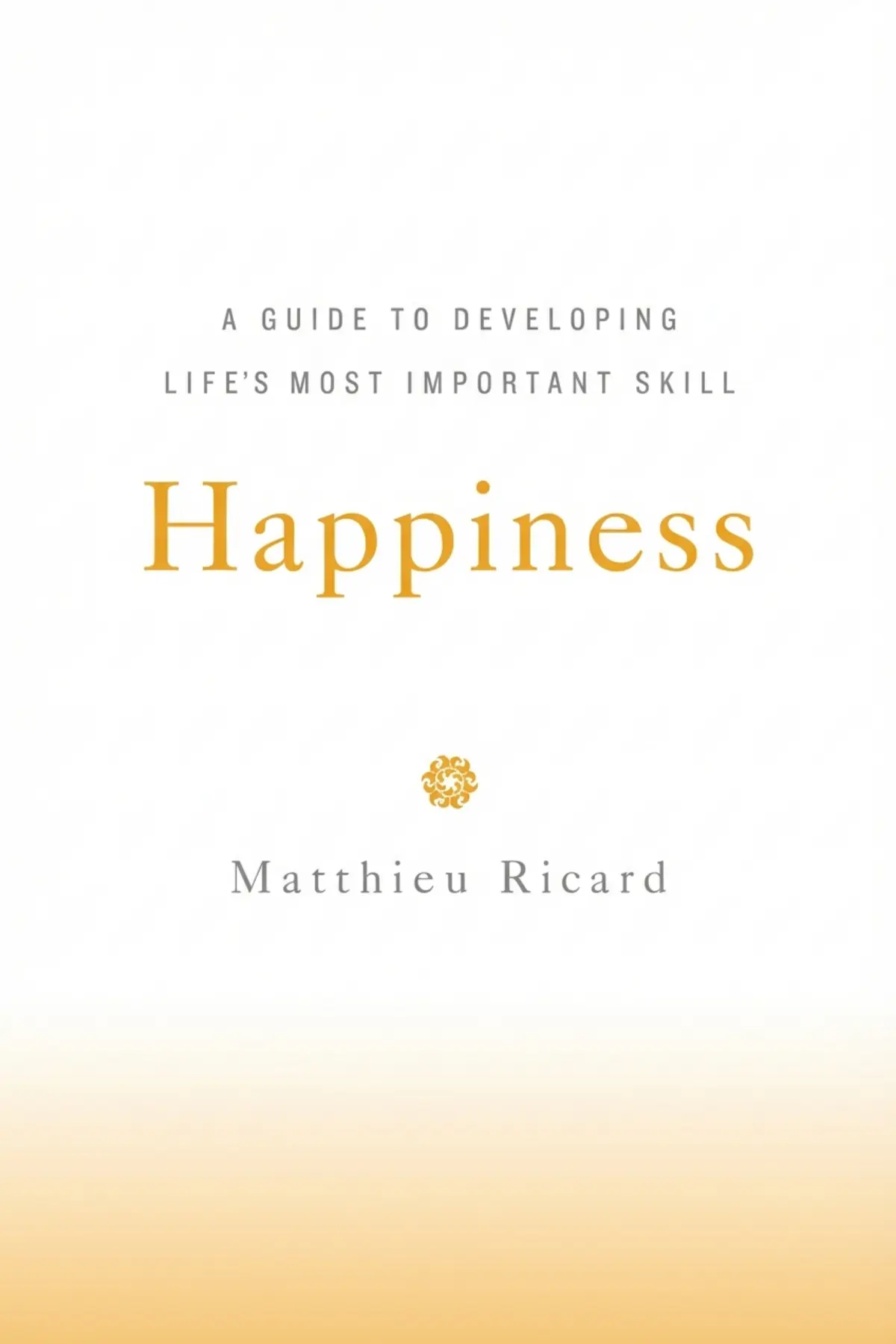
Table of Content
1. Introduction
1 min 02 sec
Most of us wait for happiness to arrive from outside: the promotion, the partner, the paid-off loan. In Happiness, Matthieu Ricard, a molecular geneticist who left the lab to practice Tibetan Buddhism in the Himalayas, argues that the waiting itself is the mistake. Wealth and social status, he notes, explain only about 10 to 15 percent of how happy we are.
Ricard’s case is that lasting happiness is a skill. It is a trained state of mind that outside events cannot break, and you build it by seeing through pleasure, letting go of needless worry, loosening the grip of the ego and working directly with painful emotions. He calls that state by its Sanskrit name, sukha.
Along the way he explains why a lottery win fades, why a small joke at work can feel like an attack, and why no one can feel love and hate for the same person in the same instant. What you get is a practical way to stop letting circumstances decide your mood.
2. Treat happiness as a skill you can train
1 min 25 sec
Most people describe happiness as something that happens to them on good days. A different tradition treats it as something you build, and the research Ricard cites suggests far more of it is in your hands than you think.
3. Escape the new car trap and find lasting joy
1 min 34 sec
People often have everything they once wanted and still feel flat. Two psychologists named the trap, and a writer facing the worst of the twentieth century showed what it looks like to step off it.
4. Tell pleasure and happiness apart
1 min 30 sec
A great meal, a big win, a shopping trip: each feels like happiness while it lasts. Ricard explains why mistaking one for the other leads to disappointment, and what lottery winners reveal about the difference.
5. Separate the loss from the worry you add
1 min 36 sec
Most people in rich countries say they are satisfied with their lives, yet unhappiness stays stubbornly high. Ricard locates the gap in a habit almost everyone has when something goes wrong.
6. Stop a small joke from wounding you
1 min 32 sec
A colleague’s offhand remark can ruin a whole afternoon, though nothing real was lost. Buddhism explains this by splitting the self in two, and only one of those selves gets hurt.
7. Humility builds confidence that holds
1 min 29 sec
We are usually told that confidence comes from a strong sense of self. Ricard argues the reverse, and he points to some of history’s most admired figures to show where real inner strength comes from.
8. Catch your triggers before anger becomes habit
1 min 30 sec
The worst sources of distress are often not the ones we would guess, and a wartime statistic hints at where they really sit. Ricard shows how a small burst of temper can grow into a way of life.
9. Answer anger with its opposite
1 min 33 sec
Pushing a bad feeling down rarely makes it go away, and letting it run wild is worse. Ricard offers two other routes, one built on a simple fact about how emotions work.
10. Conclusion
1 min 02 sec
Ricard’s book asks for a trade. You give up the hope that the next purchase, title or relationship will finally settle things. In return you get a happiness that does not leave when they do. Pleasure fades, possessions get replaced, the ego cracks under pressure and anger grows when you feed it. What stays is the mind itself, and on Ricard’s figures most of its capacity for happiness is yours to train.
He does not promise speed. Sukha is built the way any skill is built, slowly and with practice. The practice can start small, though. When something goes wrong, separate the event from the worry you pile on top of it. When a remark stings, check whether it hit you or only your image. When anger rises, meet it with kindness, or look at it closely until it loses its shape.
Etty Hillesum found a freedom that no fence could take from her. Ricard’s argument is that the same freedom is open to anyone willing to turn and look inward.
About this book
What is this book about?
Most people wait for happiness to come from outside: a promotion, a new car, the right partner. Matthieu Ricard argues that this waiting is the core mistake. In his reading, wealth and social status explain only a small share of how happy we are, and a pleasure that peaks on the first day fades as soon as something newer appears. Drawing on Buddhist thought and on psychological research, Ricard separates fleeting pleasure from sukha, a lasting state of well-being that comes from a healthy mind. He explains the hedonic treadmill, shows how worry rather than loss creates most of our pain, and describes two kinds of self, one natural and one imagined, the second of which turns small slights into wounds. The book's promise is that happiness can be learned like a skill. Readers get a clear account of why their past gains faded and practical ways to build a calmer mind: using humility as a base for confidence, spotting emotional triggers, answering anger with its opposite and looking straight at pain until it loosens its grip.
Book Information
Who it's for
Professionals with shifting moods
Professionals whose mood rises and falls with each promotion, purchase or setback.
Worried after a loss
People recovering from a job loss or breakup who feel worry has taken over.
Curious about Buddhist happiness
Anyone curious about Buddhist ideas of happiness, explained in plain, practical terms.
About the Author
Matthieu Ricard
Matthieu Ricard was born in France in 1946 and earned a doctorate in molecular genetics from the Pasteur Institute in 1972. He then left science to practice Tibetan Buddhism, living mainly in the Himalayas, and now lives at a monastery in Nepal. Since 1989 he has been the French interpreter for the 14th Dalai Lama. He sits on the board of the Mind and Life Institute, co-founded the humanitarian non-profit Karuna-Shechen, and has contributed to scientific studies of how meditation affects the brain.
Ratings & Reviews
Ratings at a glance
What people think
Listeners find this book enlightening, commending its thorough exploration of meditation and practical ideas. They value how accessible the writing is, with one listener noting it's written for the modern Western mind. Listeners appreciate the spiritual depth, especially its enlightened view of Buddhism, and find it easy to understand. The work receives positive feedback for its high-quality research, with one listener highlighting its mix of experiments backed by science, and its compassionate tone, with one review mentioning its emphasis on altruistic love.
Top reviews
Plernpiriya
Can we actually rewire our brains for joy? This book argues a resounding yes, and it backs it up with fascinating scientific rigor. As someone who appreciates both logic and spiritual depth, I found Ricard’s dual background as a molecular biologist and a monk to be the perfect combination for this subject. He explains brain plasticity in a way that makes enlightenment feel less like a mystical myth and more like a tangible skill that can be developed through 10,000 hours of practice. It isn't about some fleeting pleasure or a temporary mood boost. Instead, it is about a fundamental shift in how we process stress, anger, and envy. The research quality here is top-notch, blending EEG studies of meditators with ancient wisdom. Truth is, this is the most comprehensive guide to the 'science of happiness' I have ever read. It’s a thick, meaty read, but every page offers a new perspective on how to achieve internal harmony regardless of what the world throws at you.
Show moreSirirat
The chapter on altruistic love changed how I look at my morning commute and my annoying neighbors. Ricard argues that selfish whimsy is the root of much of our misery, and honestly, it’s hard to disagree after reading his breakdown of the ego. This isn't your typical 'feel-good' self-help book filled with empty platitudes. It’s a deep dive into the mechanics of suffering and how we can systematically dismantle it. The focus on compassion and empathy as tools for personal liberation is powerful. I found the discussion on how the ego reacts to being 'hurt' particularly eye-opening—we experience a minute of pain and then choose to suffer for an eternity. By letting go of that fixed 'I,' we find a much broader sense of interconnectedness. This book is a masterclass in spiritual practice. It’s challenging, beautiful, and deeply practical for anyone willing to put in the mental work. It feels like a lifetime of wisdom distilled into a single volume.
Show moreNim
Finally got around to reading this during a particularly dark period, and it served as a lighthouse. It's not just for people struggling with mental health, but for literally anyone who wants a more meaningful existence. Ricard explains that happiness is a state of being, not a fleeting emotion tied to pleasure. This distinction is crucial. I loved how he integrated his scientific background to explain why our brains default to certain negative patterns and how we can break them. The writing is elegant, and despite the author's impressive credentials, the core message is quite simple: nourish the positive, apply antidotes to the negative. It helped me realize that my internal world is the only thing I truly have power over. By freeing ourselves from the grip of the ego, we gain the strength to actually help others. This is one of the most important books I’ve ever owned. It’s the real thing—a manual for the soul in a chaotic world.
Show moreLeila
Wow. This is easily one of the most comprehensive books on the human condition I have encountered. Ricard’s insights into the 'skills' of happiness are game-changing. He doesn't just tell you to be happy; he explains the mechanics of how to get there through mind training. The data on how meditation affects the brain's electrical activity is staggering and provides a great hook for those of us who need 'proof' before we commit to a practice. But beyond the science, there is a deep, resonant heart to this book. The emphasis on altruism as a path to joy is something our individualistic society desperately needs to hear. It’s a long read, and it requires focus, but the payoff is a completely shifted perspective on what it means to live well. I found the Tibetan proverbs scattered throughout to be a highlight—they add a touch of poetic wisdom to the more analytical sections. Truly a life-altering piece of work.
Show moreAhmed
Matthieu Ricard manages to bridge the gap between ancient Eastern wisdom and the skeptical Western mind with remarkable ease. I bought this during a particularly stressful month, hoping for some peace, and it delivered exactly that. The book functions like a grand panorama of smiling faces and deep thinkers, pulling in everything from Schopenhauer to the Dalai Lama to illustrate its points. I especially loved the section on 'mental poisons' and how we can use specific antidotes to neutralize things like malice and pride. My only real gripe is that he sometimes takes shortcuts, throwing out quotes from famous philosophers without fully exploring their context just to prove a point. However, the overall effect is incredibly calming. I’ve even started trying to extend a bit more compassion to my more difficult colleagues at work. It turns out that viewing happiness as a skill rather than a lucky accident changes everything about how you approach your day. It’s a solid, enlightening read.
Show moreKru
Wait, so happiness isn't just something that happens to lucky people? That was my biggest takeaway from this profound work. Ricard’s articulation of Buddhist philosophy is incredibly clear, making the case that we can train our minds just like we train our muscles. I’ve always been skeptical of meditation, but seeing it described as 'mind-training' supported by scientific experiments made it much more accessible to me. The book outlines how we can cultivate positive emotions like loving-kindness while letting negative ones float by like clouds in the sky. It’s written for a modern audience, yet it never feels like it’s 'dumbing down' the spiritual aspects. While some of the French philosophical references went over my head, the core message remained clear. Personal change is possible for anyone. This book provides the roadmap, though the actual journey of meditation still feels a bit daunting. I’m definitely inspired to try, even if I’m not ready to move to a monastery just yet.
Show moreSomboon
Not what I expected, but in a good way. I thought this would be a light read about mindfulness, but it’s actually a very thorough synthesis of Buddhist thought and cognitive science. Ricard’s perspective is unique because he understands the Western craving for evidence while living a life dedicated to Eastern practice. The result is a book that feels both ancient and cutting-edge. He tackles topics like envy, desire, and pride with a level of surgical precision that you don't often see in the 'meditation' subgenre. I did find the frequent mentions of his past at the Pasteur Institute a bit repetitive, as if he's constantly trying to prove he's 'one of us' (the scientists). However, the actual content is so rich that I can overlook the occasional pomposity. It’s a book that demands you stop and reflect after every chapter. It’s not a quick fix, but a slow-burn transformation of the way you view your own mind.
Show moreAim
Look, if you're expecting a quick-fix guide to smiling more, you might be frustrated by the philosophical weight of this book. It is a 'Plaidoyer pour le bonheur'—a plea or a case for happiness—and it reads like a well-argued legal defense. Ricard pulls from a vast array of sources, and while the pacing can be slow, the depth is undeniable. I personally appreciated the lack of 'storytelling' fluff; I’d rather have the raw theory and the scientific backing than a series of made-up anecdotes. The idea that we are often 'slaves' to our emotions until we learn to observe them was particularly resonant for me. My only criticism is that the author’s tone can occasionally feel a bit lofty, as if he’s speaking from a great height. But when the advice is this good, you listen. It’s an enlightened view of Buddhism that feels perfectly tailored for the modern, stressed-out Westerner. It has certainly helped me find a bit more peace in the daily grind.
Show moreBenjamin
To be fair, this is more of a dense philosophical treatise than a 'story' style self-help book. If you are looking for relatable characters or anecdotes about people overcoming struggles, you won’t find much of that here. I found myself getting a bit bored in the middle sections because the tone is very clinical and academic. It felt like I was studying for a degree in Happiness rather than being inspired to feel it. That said, the information is undeniably good. Ricard makes complicated concepts like samsara and neuroplasticity relatively easy to grasp for a layperson. I appreciated the reminder that happiness has nothing to do with what society tells us to buy or achieve. But the 'patting himself on the back' vibe that other reviewers mentioned is definitely there, and it can be a bit distracting. It’s a useful reference book to keep on the shelf, but it’s a bit too dry to be a page-turner for me.
Show moreSue
The author’s background at the Pasteur Institute is mentioned so frequently that it starts to feel like a credential check rather than a relevant detail. Frankly, for a monk, Ricard comes across as remarkably attached to his French intellectual heritage and his father's philosophical status. This 'peacocking' in the introduction set a sour tone that I struggled to shake off. While he claims happiness is independent of circumstances, he spends his days photographing Tibetan mountaintops, which feels a bit disconnected from the reality of someone working a nine-to-five in a cubicle. The writing is often affected and lacks the humble, down-to-earth wisdom I’ve found in other Zen or Buddhist texts. Instead of finding peace, I found myself annoyed by what felt like a high-brow lecture from someone who is quite full of himself. It’s a very clinical, 'expert-led' approach that prioritizes his own pedigree over actual, relatable insight into the human condition.
Show moreQuestions about this book
What is the main idea of Happiness by Matthieu Ricard?
Ricard argues that lasting happiness, which Buddhists call sukha, is a trained state of mind and not a reward from outside events. Wealth and status explain only about 10 to 15 percent of how happy we are, and pleasures fade quickly. By letting go of needless worry, loosening the ego and working directly with negative emotions, he says anyone can build a well-being that setbacks cannot break.
What is the hedonic treadmill?
The term comes from psychologists Philip Brickman and Dan Campbell. It describes how people keep chasing new and exciting things while their happiness stays at the same level, like running hard on a treadmill without moving forward. Ricard’s example is a new car whose thrill disappears once a newer model appears. He cites a study showing that even lottery winners return to their earlier level of happiness.
What is the difference between pleasure and happiness according to Ricard?
Pleasure, in Ricard’s view, is tied to a specific moment and set of conditions, so it soon turns neutral or unpleasant: a good meal becomes sickening if you keep eating. Happiness in his sense is a lasting, healthy state of mind that does not depend on circumstances. Mistaking one for the other leads people toward distractions like shopping or alcohol, which leave them more disconnected.
How does the ego cause unhappiness?
Buddhism, as Ricard explains it, separates a natural I, the one that feels hungry, from an imagined I built around how we want others to see us. That second self makes small slights, like a joke at work, feel like attacks, and it sticks fixed labels on people. Ricard recommends humility: admitting your limits removes the need for approval and gives you a sturdier confidence.
How can I apply Ricard's ideas to anger and pain?
Ricard suggests two routes. Because opposite emotions cannot arise at the same moment, getting familiar with kindness leaves less room for hate. And when anger comes, look inward and trace it to its roots until you see it as a passing state you are reacting to. For physical or emotional pain, he advises bringing it into focus rather than avoiding it.
Featured in
Readers also enjoyed

A New Earth: Awakening to Your Life’s Purpose
Eckhart Tolle


Aflame: Learning from Silence
Pico Iyer

59 Seconds: Change Your Life in Under a Minute
Richard Wiseman





A Guide to the Good Life: The Ancient Art of Stoic Joy
William B. Irvine
AUDIO SUMMARY AVAILABLE
Listen to Happiness in 15 minutes
Get the key ideas from Happiness by Matthieu Ricard, plus 5,000+ more nonfiction titles.
- 5,000+ titles
- Listen as much as you want
- 7-day free trial
- Cancel anytime









