

A History of Iran: Empire of the Mind
Michael Axworthy
 English
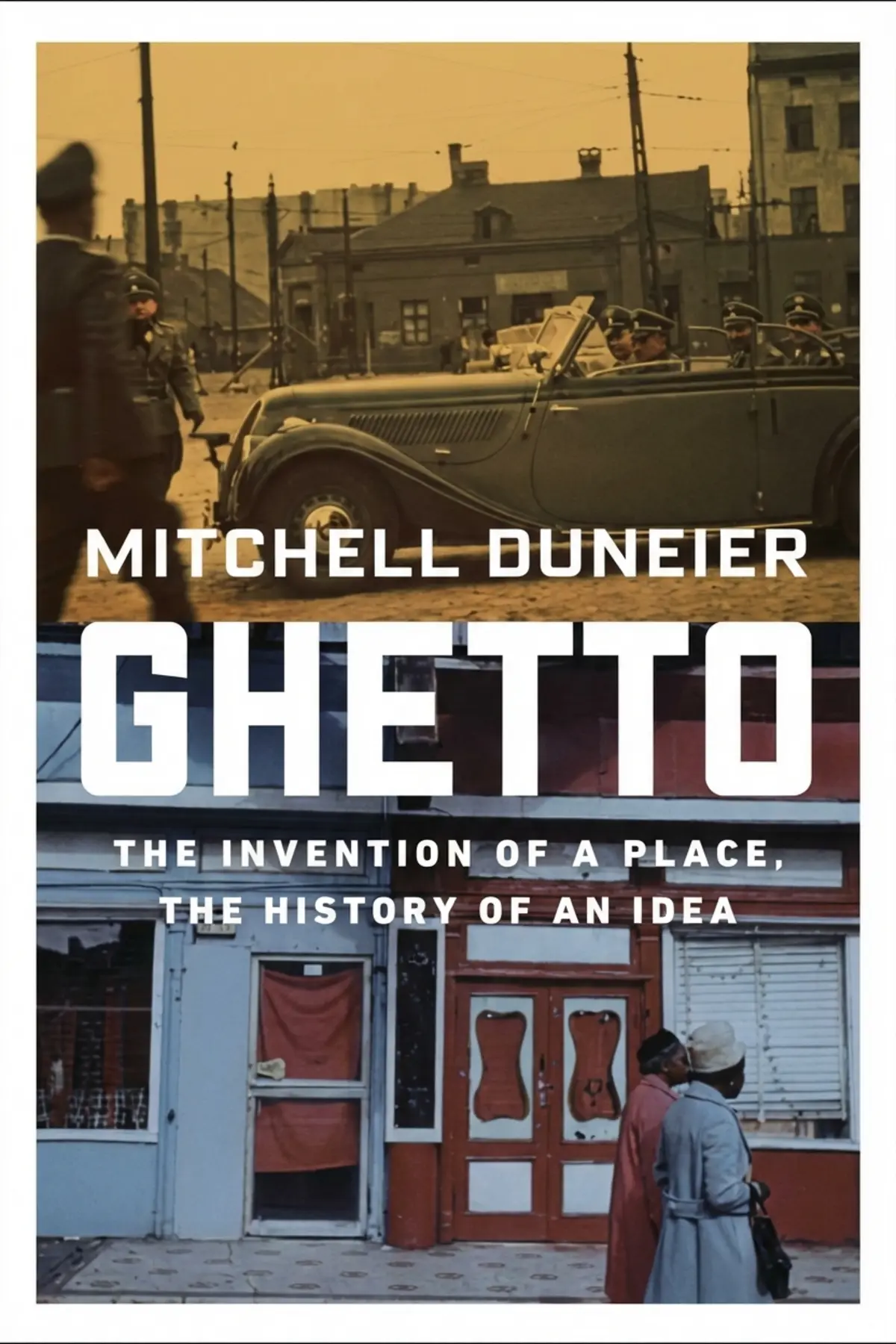
Follows the word ghetto from sixteenth-century Venice to modern America. It shows how separation creates poverty that is then used to justify it, and how black scholars who exposed this were repeatedly ignored.
58 sec
Most people hear the word ghetto and picture a poor, mostly black neighborhood in an American city. Yet that meaning covers less than a tenth of the word’s 500-year history. In Ghetto, Princeton sociologist Mitchell Duneier traces the word from Jewish quarters in sixteenth-century Venice to Chicago, the White House and the welfare debates of the 1990s.
Along the way he exposes an argument that keeps coming back: push a group into a crowded, separate district, then read the bad conditions as proof the group belonged there. His throughline is that the ghetto’s hardships have been blamed again and again on the people inside it. The rules imposed from outside were ignored, and so were the black scholars who described those rules most clearly. What the history gives you is a sharper eye for any place called a problem: who drew its borders, and who gains from forgetting that.
1 min 35 sec
Christians in Renaissance Italy looked at the crowded Jewish quarter and saw proof of a divine order. Duneier argues they had the cause and the effect backwards, and the mistake has outlived the walls.
1 min 54 sec
Between the world wars the word meant something almost harmless, then something monstrous. Two young researchers in Chicago chose it deliberately, and their choice carried an accusation that their city did not want to hear.
1 min 52 sec
No city law drew the color line in postwar Chicago. Something more ordinary did the job, signed by neighbors and backed by an industry, and it produced the very decline it claimed to prevent.
1 min 51 sec
The most respected book on American race relations was cited by the Supreme Court and written with a first-class team. It still left out the thing Chicago’s researchers had just documented, and the gap was avoidable.
1 min 47 sec
New parks, concert halls and hospitals sound like progress for any neighborhood. A psychologist famous for an experiment with dolls looked closer at who was moved out to make room, and where they were sent.
1 min 53 sec
A White House adviser gathered statistics on black families and reached a conclusion that shaped a president’s speech. Duneier argues the numbers were real but the explanation pointed in exactly the wrong direction.
1 min 52 sec
A respected sociologist proposed a way around racial politics that he hoped white voters would support. The programs he asked for never arrived, and what arrived in their place would have surprised him.
1 min 10 sec
Five centuries separate the copper foundry in Venice from the welfare law of 1996, yet Duneier finds the same reasoning at both ends. Separate a people, let crowding and poverty do their work, then point at the results as proof of who they are. The word kept changing its meaning: walled Jewish quarter, immigrant enclave, Nazi prison, black American neighborhood. The loop survived every change. So did the habit of sidelining the people who saw it most clearly, from Cayton and Drake to Kenneth Clark.
The book, by its own account, offers no easy fix, since politics, race and poverty are tangled together. What it offers is a way of looking. When a neighborhood is described as a problem, ask what covenants, lending rules or housing projects shaped it before anyone judged the people there. When a report explains poverty through family life alone, look for the history it skips.
The walls in Venice came down long ago. The habit of blaming the people they enclosed has proved much harder to remove.
Today the word ghetto usually brings to mind a poor, mostly black neighborhood in an American city. Yet that meaning covers less than a tenth of the word's 500-year history. Mitchell Duneier goes back to the beginning, to the walled Jewish district Venice created in 1516, and follows the idea through immigrant enclaves, Nazi-occupied Europe and postwar Chicago. His central finding is an argument that keeps coming back. Force a group into a separate, crowded district, and the squalor that results gets read as proof of what the group is like. Duneier shows this loop at work in restrictive covenants, real-estate codes, redlining and urban renewal. He also traces a second pattern: black scholars such as Horace Cayton, St. Clair Drake and Kenneth Clark described the ghetto as a structure, while the most influential voices, from Gunnar Myrdal to Daniel Patrick Moynihan, explained it some other way. Readers come out with a clear history of a loaded word and a sharper way to judge any claim that a neighborhood's problems come from its residents.
Readers who use or hear the word ghetto and want to know where it really came from.
Students of sociology, history or urban policy looking for a clear account of how segregation was built.
Professionals in housing, policy or diversity work who want to recognize arguments that blame residents for structural problems.
Mitchell Duneier is an American sociologist and ethnographer who holds the Maurice P. During professorship in sociology at Princeton University. He earned his doctorate at the University of Chicago in 1992 and has taught at UC Santa Barbara, the University of Wisconsin-Madison and the CUNY Graduate Center. His books Slim's Table and Sidewalk won major prizes. Ghetto was named a New York Times Book Review Notable Book, and he was elected to the American Academy of Arts and Sciences in 2021.
Listeners commend the exceptional blend of sociological expertise and deep intellectual history found here, with one listener drawing attention to its nuanced details of the concept's emergence. Additionally, the prose is skillfully written, as one listener observes the author's great precision. Listeners also find the material compelling and significant; one listener explains that it relates the history and transformation of GHETTO, while another values the layered narrative structure.
Picked this up thinking it would be a straightforward history, but it’s actually a deep dive into how an idea evolves over centuries. Duneier is incredibly precise with his language, showing exactly how the term 'ghetto' was transformed from a site of Jewish containment into a tool for racial segregation in America. The stories about the Chicago School of sociology were a highlight for me; I never knew how much internal politics influenced these theories. It’s fascinating to see how well-meaning liberals often ended up reinforcing the very structures they tried to study. My only gripe is that it skips over about 300 years of history rather quickly to get to the U.S. context, but the American sections are so strong I didn't mind much. It's an important book that makes you rethink the geography of our cities.
Show moreThis book is a powerhouse of sociological insight. Look, many people complain that it focuses too much on the American experience, but that's clearly where the 'idea' of the ghetto took its most complex and enduring form. Duneier’s precision is what sets this apart from other history books. He doesn't just give you dates; he gives you the evolution of thought. The way he connects 16th-century Venice to the Warsaw Ghetto and then to the South Side of Chicago is brilliant, showing a continuity of exclusion that is often overlooked. It's a dense tome, but every page feels necessary to understand the structural forces at play. Personally, I think the deep dive into the lives of Clark and Wilson was the best part. It’s a fascinating, nuanced look at a word we use every day without thinking. Definitely an important read.
Show moreFinally got around to reading this and I’m honestly blown away by the depth of the intellectual history here. Duneier takes a word we all think we know and peels back layers of history I never even considered. The connection between the forced isolation of Jews in the Middle Ages and the systemic segregation of African Americans is handled with such care and precision. It’s a fascinating, layered narrative that doesn't shy away from the darker parts of academic history, especially regarding how black researchers were often sidelined by their white counterparts. The book is well-crafted and feels very relevant to today’s conversations about urban planning and racial justice. Some parts are a bit slow, but the overall impact is powerful. It’s easily one of the most important sociology books I’ve read in years.
Show moreDuneier provides a masterclass in intellectual history by tracing the 'ghetto' from its Venetian roots to the modern American metropolis. The way he weaves together the lives of seminal scholars like Kenneth Clark and Horace Cayton adds a human dimension to what could have been a dry sociological text. While the transition from 16th-century Italy to 20th-century Chicago feels a bit abrupt at times, the precision of his prose keeps the reader engaged. I found the sections on the Warsaw Ghetto particularly haunting, as they serve as a chilling bridge between old-world exclusion and new-world segregation. It is a dense read, certainly, but the layered narrative structure rewards those who stick with it. Some might find the focus too narrow, yet the depth of research here is undeniable. This is an essential resource for anyone looking to understand the mechanics of urban isolation.
Show moreAs someone who appreciates urban sociology, I found this to be a compelling look at the intersection of race, space, and policy. Duneier’s exploration of the intellectual giants like Gunnar Myrdal and William Julius Wilson is top-tier and provides a necessary look at how social science is crafted. Truth is, the book does suffer from a slight identity crisis, as the early chapters on Venice and the Nazi era feel like a prologue that never quite connects to the massive sections on Chicago. To be fair, the research is impeccable, and the writing is clear throughout. However, the lack of attention to the West Coast or the South makes it feel more like a regional study than a definitive global history. Still, the precision of the argument makes it a very valuable read for anyone in the field.
Show moreEver wonder how the places we live in define the people we become? Duneier tackles this head-on with a layered narrative that is both heartbreaking and intellectually stimulating. He doesn't just look at the walls and the buildings; he looks at the scholars who tried to make sense of the chaos. The dynamic between Myrdal and Cayton was particularly revealing, exposing the hidden biases even within 'progressive' academic circles. It's a well-crafted piece of work that centers the Black experience in a way that feels both urgent and historically grounded. I do wish there was more about the current colloquial use of 'ghetto' as a slang term, as that feels like a missed opportunity in the 'history of an idea.' Still, the level of detail regarding the 1940s and 50s is incredible. It makes the invisible walls of our current cities feel much more visible.
Show moreAfter hearing so much about Duneier's work, I finally dove into this 'History of an Idea.' The truth is, it’s an incredibly well-researched study of how white society has historically managed 'undesirable' populations through spatial restriction. The author’s strength lies in his ability to weave together intellectual history with physical reality. His analysis of the Chicago School and the subsequent shifts in sociological thought is where the book truly shines. It’s not just about the places; it’s about the theories that allowed those places to exist and persist. While I agree with other reviewers that the European history is a bit thin, the American section is so detailed it almost makes up for it. The writing is precise, if a bit dry. It’s a solid read for anyone interested in the intersection of race and space.
Show moreThe chapter on the Venetian origins of the ghetto started the book on such a high note, but it never quite recaptured that magic for me. It’s a decent enough book that raises some vital points about segregation, yet it feels overly focused on a handful of individuals. Duneier leans heavily on the work of others, which sometimes makes the book feel like a very long, very expensive book report. I appreciated the nuance he brought to the discussion of the 'Negro Problem,' but the lack of geographic diversity—nothing on the West Coast or the South—is a glaring omission. It’s a good overview for beginners, but seasoned urban scholars might find it lacking in fresh perspectives. A bit too much rehashing of Clark and Wilson for my taste.
Show moreNot what I expected at all, and frankly, quite disappointing in its scope. The title promises a 'history of an idea,' yet it spends almost no time on the five centuries of European history that shaped the word before it ever reached American shores. Instead of a comprehensive global history, we get what feels like a recycled syllabus for an African-American studies course. Don't get me wrong, that history is vital, but the book ignores Asian enclaves, Latino neighborhoods, and even the indigenous reservations which fit the 'ghetto' criteria perfectly. It feels like Duneier had a very specific thesis about white-on-black racism and ignored any evidence that didn't fit that narrow frame. The writing is academic and dry, often reading more like a series of book reports than an original narrative. If you want a full history of the ghetto, this isn't it.
Show moreWow, talk about a letdown. I was looking for a comprehensive history of the ghetto as a global concept, but this felt like it was written in a vacuum. The author spends hundreds of pages on a few specific sociologists in Chicago while almost entirely ignoring the Jewish history he teased in the first chapter. To call this a 'history' is a stretch when it ignores 90% of the timeline. It’s more like a critique of 20th-century American social science. Also, the tone is so academic that it becomes a chore to get through. Not gonna lie, I almost put it down halfway through because the narrative just stalls in these endless descriptions of old research papers. If you’re a sociology student, you might like it. If you’re a general history buff looking for a broad perspective, look elsewhere.
Show moreDuneier traces the word ghetto from Venice’s walled Jewish district of 1516 to black American neighborhoods. He shows a recurring circular logic: forced separation creates crowding and poverty, and those conditions are then used to justify the separation. He also argues that black scholars who described the ghetto as a product of structural racism were repeatedly overshadowed by influential voices who explained it in other ways.
It comes from Venice. The city confined its Jews in 1516 to a high-walled district named the Ghetto Nuovo, after the ghèto, the Venetian term for a copper foundry. Rome soon followed with its own ghetto. Later the word described voluntary Jewish neighborhoods, then Nazi enclosures, and only after World War II did black Americans start using it for their own urban neighborhoods.
Cayton and Drake documented restrictive covenants in which white owners agreed not to sell or rent to black people, capping non-white residents at two percent and renewing automatically for two decades. Homes of new black neighbors were bombed and burned without a single arrest, and a powerful realtors’ association told members not to bring in minorities whose presence would clearly hurt property values. Black families were packed into a few districts, which then declined.
Moynihan’s report used statistics on black families, such as female-led households and births outside marriage, to argue that black communities were decaying and that family breakdown drove welfare dependency. Duneier calls this classic victim-blaming, because it placed the cause of ghetto conditions inside black homes and ignored the covenants, redlining and relocation that black scholars had already documented.
The book suggests a habit of questioning. When a neighborhood is called a problem, look for the covenants, lending rules, housing projects and job shifts that shaped it before judging its residents. When an explanation of poverty points only at family life or personal responsibility, ask what history it leaves out. And when research becomes policy, check which parts of the original idea actually survived.
Michael Axworthy

Johny Pitts

Tom Standage


Ishmael Beah

bell hooks




William J. Bernstein
AUDIO SUMMARY AVAILABLE
Get the key ideas from Ghetto by Mitchell Duneier, plus 5,000+ more nonfiction titles.









