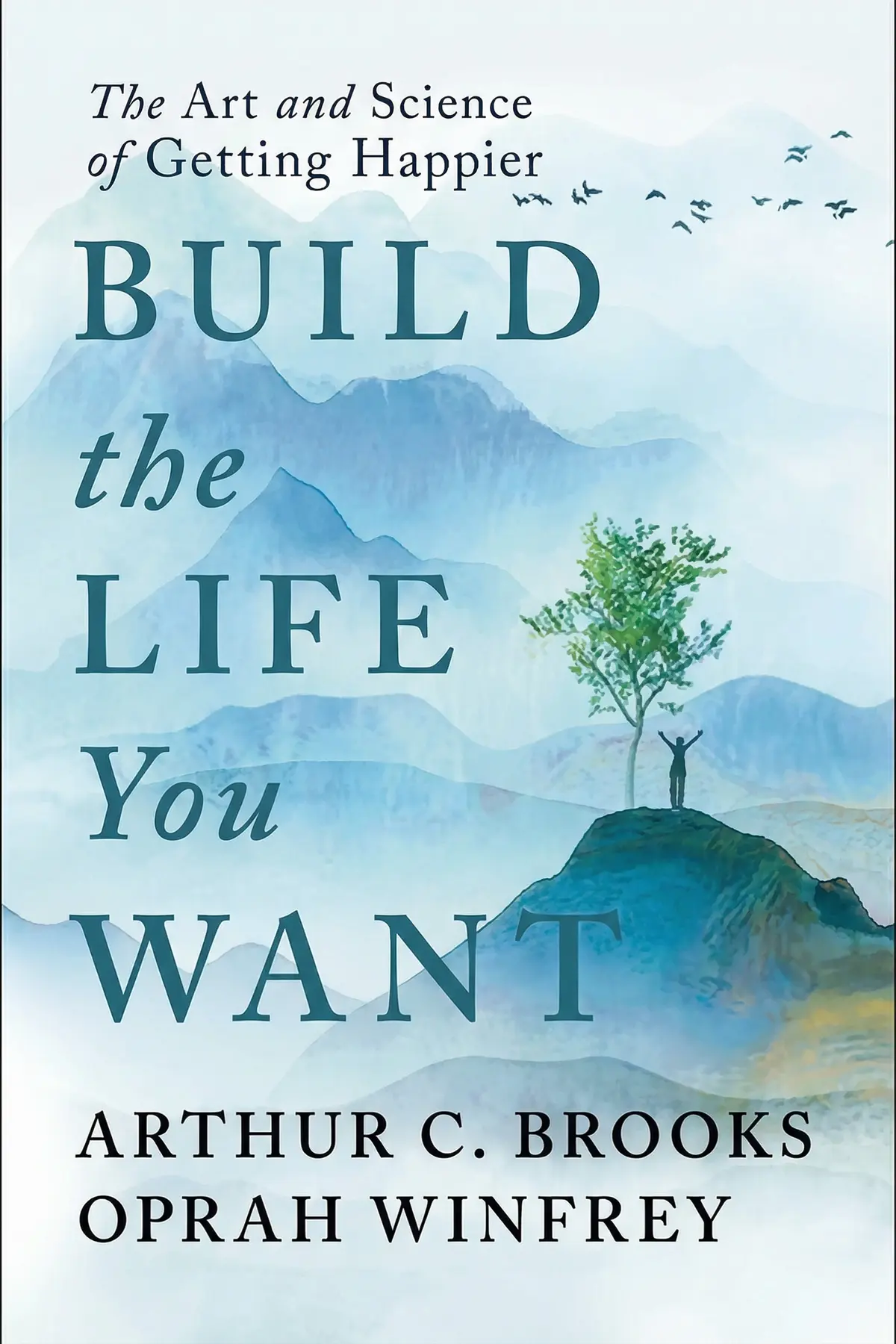
Build the Life You Want: The Art and Science of Getting Happier
Arthur C. Brooks
 English
 ไทย
Shows why ability in demanding careers fades in midlife and how to build a second act on experience, mentoring and character, so that success and happiness keep growing as quick thinking slows.
1 min 04 sec
If you have built a career on working harder than everyone else, Arthur C. Brooks has unwelcome news: in most demanding fields, ability starts slipping somewhere between the late 30s and the early 50s. In From Strength to Strength, the social scientist and former think tank president argues that this decline is normal, predictable and, handled well, the start of something better. The research he gathers shows one kind of intelligence fading with age while another keeps rising for decades.
That split is the heart of the book. Brooks’s case is that the second half of life goes well for people who stop chasing their old peak, move toward work that runs on experience, know when to let go, and stop depending on applause to feel happy. Along the way come Charles Darwin’s unhappy final decades, a Roman leader who handed power back, and Brooks’s own lost dream of becoming the world’s best French horn player. What it adds up to is a plan for the decades when hard work alone stops paying.
2 min 19 sec
One of the most celebrated scientists in history spent his last two decades feeling like a failure. Research across many professions suggests his experience was far from unusual, and it may arrive for you sooner than you expect.
2 min 04 sec
A psychologist found that the mind holds two different kinds of intelligence, and they age in opposite directions. Which one your work depends on may decide whether your fifties feel like a slide or a rise.
1 min 49 sec
An ancient Roman had a clear view of what older age is for, and it had little to do with money or rank. His idea fits a modern startup’s boardroom surprisingly well.
2 min 18 sec
A Roman leader won a war and then gave up absolute power almost at once. Centuries later, a young musician on the edge of his dream learned the same hard lesson the painful way.
1 min 50 sec
The rush of a promotion or a big win fades faster than most high achievers admit. For people whose identity rests on results, the changes of midlife can turn that fading into a crisis.
1 min 48 sec
Two kinds of praise might be spoken about you one day, and only one of them survives the end of a career. Driven people tend to pick the wrong one, for reasons that once served them well.
1 min 13 sec
Brooks’s book is, in the end, a case for changing what you measure. The first half of life rewards speed, specialization and wins that can be ranked. The second half rewards something else: knowledge turned into judgment, judgment passed on to others, and a character people will describe warmly long after the job titles are forgotten. Darwin had every honor and still felt finished, because he kept measuring himself against his younger mind. Brooks, forced off the concert stage at 31, found a better life because he let the old measure go.
The book supports a few concrete moves. Be gentle with yourself when quick thinking starts to slip, because it will, and treat that as a signal to lean on what you know. Look for a place to teach, advise or mentor, where experience is the asset. Go through your bucket list and move the items about lasting happiness to the top. And when something you love is fading despite your best work, remember Cincinnatus walking back to his farm.
Leaving at the right time did not end his story. It is the reason anyone still tells it.
Hard work carries most ambitious people through their first decades of adult life. Then, often somewhere between the late 30s and the early 50s, it stops paying the way it used to. Arthur C. Brooks argues that this slide is normal and that, handled well, it opens a better stage of life. Brooks draws on research about the aging brain, including psychologist Raymond Cattell's split between fluid intelligence, which fades early, and crystallized intelligence, which keeps rising for decades. He pairs that science with stories: Charles Darwin's unhappy final years, the Roman leader Cincinnatus giving power back, and Brooks's own loss of his dream of being the world's best French horn player. Readers get a clear explanation of why their peak arrives when it does and a way to plan for what follows. That means moving toward work that rewards judgment, teaching and advising others, knowing when to leave, and resting happiness on family, friendship, faith and character in place of the next professional win.
Professionals in their 40s and 50s who feel their edge slipping and fear what comes next.
High achievers whose happiness rises and falls with their latest win.
People weighing a career change who want to build on experience, not start from zero.
Arthur C. Brooks is an American author and academic, a professor at Vanderbilt University who has also taught at Harvard. Before that he served as the 11th president of the American Enterprise Institute. He has written sixteen books, including Build the Life You Want with Oprah Winfrey. He writes a column for The Free Press, contributes to CBS News and hosts the podcast Office Hours with Arthur Brooks.
Arthur C. Brooks
Listeners find this book to be profound, noting that its research-based content highlights the value of crystallized intelligence and makes it a vital read for middle age, particularly for high achievers. Offering actionable guidance, the work assists in enhancing one's purpose and daily living through its beautiful prose. Listeners express differing views regarding the work’s flow and overall coherence.
Picked this up during a particularly grueling month at the office, and the concept of the 'striver's curse' hit home harder than I expected. Brooks argues that our early-career edge—what he calls fluid intelligence—eventually fades, but we can pivot to crystallized intelligence to find lasting fulfillment. It’s a research-driven wake-up call that doesn’t just offer platitudes; it provides a roadmap for anyone terrified of their own professional decline. While some might find the religious mentions a bit heavy-handed, I felt the blend of social science and ancient wisdom was exactly what I needed. It’s rare to find a book that addresses the specific anxiety of high achievers with such empathy and clarity. Truly, this is essential reading for anyone over forty who feels like they’re running on a treadmill that’s only getting faster.
Show moreWow, this was the exact perspective shift I needed as I approach my fiftieth birthday and start questioning my long-term career path. The author’s vulnerability about his own transition from a professional musician to a think-tank president adds a layer of authenticity that many self-help books lack. He masterfully connects the dots between biological decline and spiritual growth, showing that our later years can actually be our most impactful if we change our metrics for success. I particularly loved the 'Aspen grove' metaphor for human connection; it really shifted how I view my relationships with colleagues and family. It’s a profound, life-affirming book that helps you stop mourning your youth and start embracing your wisdom. Highly recommended for any 'striver' who feels like they’re hitting a wall.
Show moreThe chapter on the 'reverse bucket list' changed my entire outlook on my career goals and what I actually want for my future. Instead of constantly chasing the next promotion or accolade, I’m learning to strip away the clutter and focus on the relationships that actually sustain me. Brooks provides a brilliant synthesis of history, art, and science to prove that our value doesn't end just because we aren't the 'young phenoms' anymore. This isn't just a book about aging; it's a book about living a more intentional and virtuous life regardless of your birth year. Frankly, I think every ambitious person in their 30s should read this now to avoid the crisis that usually hits a decade later. It is a masterpiece of practical philosophy that I've already recommended to five friends.
Show moreAs someone who has spent decades defining myself by my resume, the chapter on 'self-objectification' was a massive gut punch. Brooks writes with a sophisticated yet accessible tone, drawing on everything from Bach to Buddhist philosophy to explain why we get so miserable as we age. To be fair, the second half of the book meanders a bit into his personal faith, which might not resonate with everyone looking for a strictly secular self-help guide. However, the 'reverse bucket list' idea—the notion of chipping away at desires rather than accumulating them—is a game-changer for my mental health. It’s a solid 4-star read that offers a refreshing perspective on aging that isn't just about 'staying young.' Instead, it's about getting better at being old, which is a much more sustainable goal.
Show moreEver wonder why the things that used to make you happy now just leave you feeling exhausted and hollow? This book explores the shift from 'fluid' to 'crystallized' intelligence, suggesting we should move toward roles that involve teaching and mentoring as we age. Personally, I found the data on professional decline quite alarming—apparently, even mathematicians peak in their late 20s—but the author’s optimism provides a necessary counterbalance. The writing is polished, though the pacing slows down significantly in the middle chapters when he pivots toward more spiritual themes. Still, the core message about prioritizing 'eulogy virtues' over 'resume virtues' is something I will be thinking about for a long time. It’s a thoughtful guide for anyone navigating the 'second half' of their life journey.
Show moreNot what I expected, but in a good way, especially regarding the deep dive into how we can find joy after our 'peak' productivity years have passed. Brooks makes a compelling case for shifting our focus from 'doing' to 'being,' and his advice on building a stable foundation of faith and family is timely. I appreciated the practical tips, like the seven predictors of happiness, even if some of them (like 'don't smoke') seem fairly obvious to most adults. The writing style is conversational but intelligent, making complex sociological theories easy to digest during a commute or before bed. My only real gripe is that he occasionally treats his specific path—becoming a teacher—as the only valid way to use crystallized intelligence. Overall, it's a valuable resource for anyone feeling the 'mid-life slump' and looking for a way out.
Show moreIn my experience, books that try to mix religion and social science often fail, but Brooks manages to weave them together with a surprising amount of grace. He doesn't shy away from the hard truths of human decline, yet he manages to leave the reader feeling empowered rather than depressed. I found the section on 'success addiction' particularly convicting, as it forced me to confront how much of my identity is tied to my job title. The book can be a bit 'preachy' in spots, and his focus on the elite 'striver' class is definitely a narrow lens, but the underlying truths are universal. It’s a thoughtful exploration of how to age with dignity and purpose in a culture that worships youth above all else. A very solid and helpful read for the soul.
Show moreAfter hearing Brooks on a podcast, I had high hopes for a revolutionary take on retirement, but the actual book felt a bit like a recycled collection of Atlantic articles. While the distinction between different types of intelligence is fascinating, the author spends way too much time beating that one drum before descending into some fairly standard self-help tropes. You'll find the usual suspects here: the Harvard Study of Adult Development, mindfulness, and the importance of friendships. Don’t get me wrong, it’s a well-written and pleasant enough read, but it lacks the 'aha' moments I was craving. It’s basically a high-brow version of 'stop and smell the roses,' wrapped in some academic jargon to make it feel more prestigious than it actually is.
Show moreFinally got around to reading this after seeing it on several 'best of' lists, and I have to say, my feelings are pretty mixed. On one hand, the science behind how our brains change as we age is genuinely illuminating and helped me understand my own frustrations at work. On the other hand, the book is incredibly repetitive, and a good editor could have easily trimmed fifty pages without losing any of the core message. It also leans very heavily into the author’s personal religious journey toward the end, which felt a bit jarring compared to the data-heavy opening chapters. Look, it’s a decent read if you’re in the target demographic of high-achieving professionals, but for the average person, it might feel a bit out of touch. It’s an okay book with a few great insights.
Show moreThe premise started strong, but the elitism throughout the narrative eventually made it impossible for me to finish with any enthusiasm. Brooks seems to be writing exclusively for CEOs and Ivy League professors who can afford 'walking retreats' and have the luxury of worrying about their 'legacy' while sitting in their second homes. If you aren't part of the top 1% of earners, much of this advice feels detached from the reality of working-class survival. Furthermore, the constant name-dropping of famous friends and the sudden shift into Catholic proselytizing felt like I was being cornered at a dinner party by someone very impressed with their own Rolodex. Truth is, there’s a decent 20-page article buried in here about shifting your career focus, but the rest is just fluff and ego.
Show moreArthur C. Brooks argues that decline in demanding careers is normal and usually begins between the late 30s and early 50s. That decline does not have to mean unhappiness. By shifting toward work that draws on accumulated knowledge, teaching and advising others, knowing when to leave, and building character over achievement, people can make the second half of life more fulfilling than the first.
Brooks draws on psychologist Raymond Cattell. Fluid intelligence means reasoning, thinking flexibly and solving new problems; it reaches its peak in early adulthood and declines from the 30s and 40s. Crystallized intelligence is knowledge gathered through learning and experience; it keeps rising through the 40s, 50s and 60s. Younger people think fast, while older people are better at understanding and applying what they know.
Résumé virtues are professional achievements, such as an Olympic medal or a huge funding round, and they only matter in comparison with others. Eulogy virtues are ethical and spiritual qualities, like kindness and generosity, that people mention at your funeral. Brooks argues résumé virtues fade with age while eulogy virtues grow stronger and bring more lasting fulfillment.
Brooks suggests reviewing your bucket list and lowering the priority of items that only bring worldly rewards. Look for chances to mentor, teach or advise, where experience counts most. Be kind to yourself as quick thinking fades, and rest your happiness on family, friendships and faith. If something you love keeps slipping, consider whether it is time to walk away, as Cincinnatus did.
It suits ambitious professionals approaching or past midlife who sense their abilities changing, workaholics whose mood depends on their latest success, and anyone thinking about a second career. Brooks writes from experience: he gave up a career as a professional French horn player at 31 and went on to become a social scientist, think tank president, professor and author.


William B. Irvine


Andrew D. Thompson


Deepak Chopra


Robin Ryan


AUDIO SUMMARY AVAILABLE
Get the key ideas from From Strength to Strength by Arthur C. Brooks, plus 5,000+ more nonfiction titles.