

14 min 46 sec
Available in: English
Frames of Mind: The Theory of Multiple Intelligences
Howard Gardner argues that intelligence comes in seven fairly independent kinds, from musical and spatial to interpersonal. He shows how recognizing them could change the way people are tested, taught and encouraged.
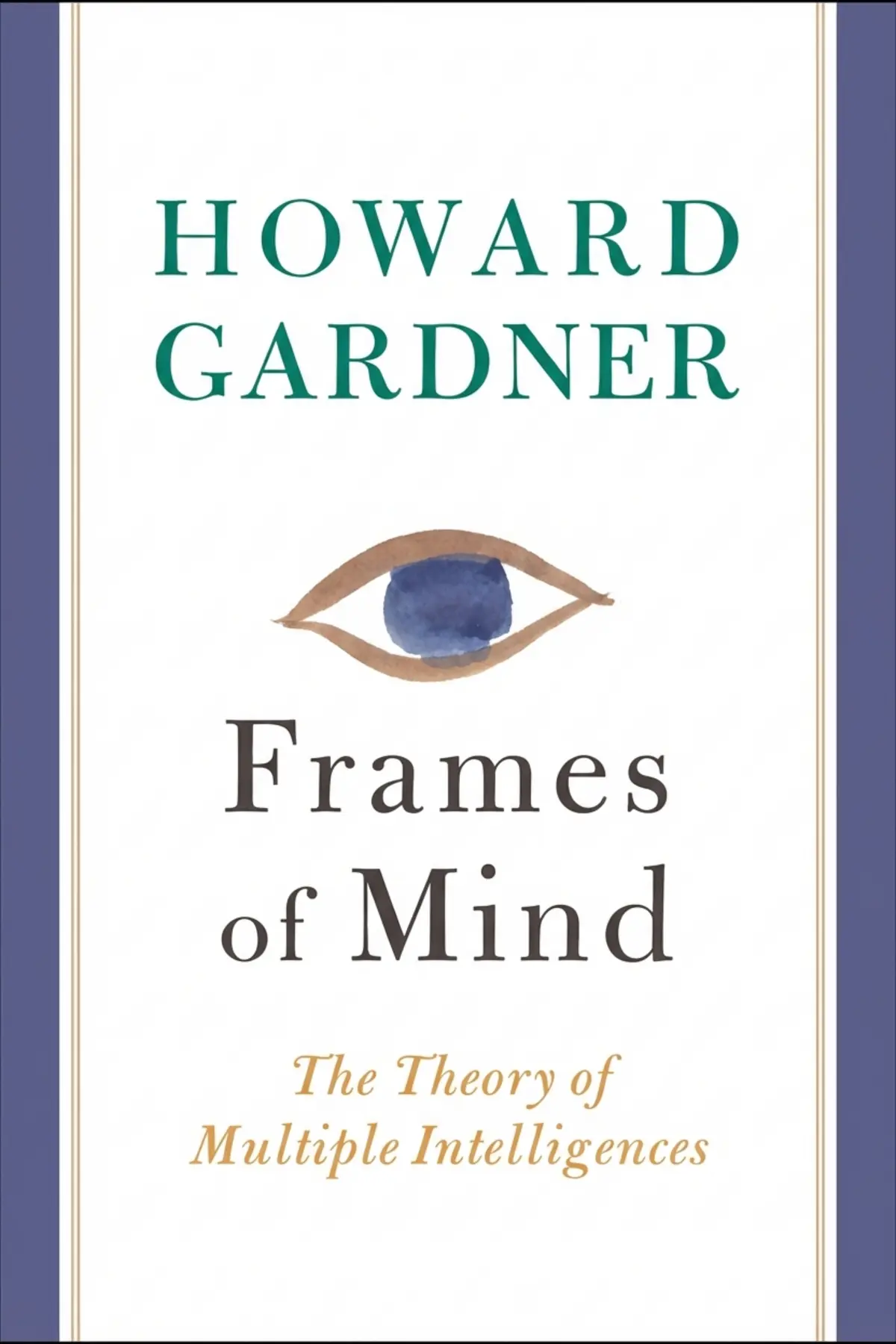
Table of Content
1. Introduction
1 min 04 sec
A single test score can make a capable person feel ordinary, and it can hide what a gifted child is actually good at. In Frames of Mind, Harvard developmental psychologist Howard Gardner argues that intelligence comes in several separate kinds, and that the familiar IQ test mostly checks only two of them, language and logic. He lists seven: linguistic and musical abilities, then logical-mathematical, spatial and bodily-kinesthetic ones, and finally the intrapersonal and interpersonal kinds.
The claim running through the book is that each of these works with some independence. Each has its own footing in the brain and its own uses in culture, and each deserves to be noticed and trained on its own terms. The evidence ranges from a poet hunting for one word to a hockey player who held the puck a split second longer on purpose. What you gain is a sharper eye for strengths that one number hides, in yourself, your children or your team, along with concrete ways to teach to them.
2. Spot the abilities an IQ test never sees
1 min 46 sec
Three teenagers, a young navigator, a religious scholar and a composer, are all clearly gifted, yet the usual tests would miss every one of them. Gardner explains why, and why face recognition fails his test for an intelligence.
3. Give early promise the setting it needs
1 min 53 sec
Scientists disagree wildly about how much intelligence is inherited. Gardner sidesteps the fight with a different idea of talent, and a striking fact about children’s brains shows why the early years matter so much.
4. Hear words and music as separate gifts
1 min 48 sec
A poet agonized over a single word, and a memory experiment showed that the brain treats a melody very differently from a sentence. Together they point to two gifts that are easy to confuse.
5. See that logic is only one way to think
1 min 55 sec
Western culture treats logic as the master key to the mind. A paper-folding puzzle, a famous chemist and children of the tundra suggest that another kind of thinking deserves equal respect.
6. Treat skilled movement as real intelligence
1 min 41 sec
A hockey legend was tired of hearing his skill called instinct. Gardner sides with him, and a puzzling brain condition shows how much thinking is hidden inside movement.
7. Know yourself and read others as two skills
1 min 43 sec
A brief encounter between Freud and William James in 1909 points to two kinds of personal insight. Cultures from Bali to Morocco train them in very different ways, and being strong in one says little about the other.
8. Teach to every kind of mind
1 min 43 sec
Teaching computer programming through music sounds odd until you follow Gardner’s reasoning. His plan for schools also carries a warning from Iran about what happens when a system ignores culture.
9. Conclusion
1 min 13 sec
Frames of Mind is, finally, an argument about what we choose to count. Western societies settled on one number, built mostly from language and logic, and took it for the whole mind. Gardner puts seven capacities in its place, each traceable in the brain, each shaped by culture, each a way of solving real problems. Graves weighing one word, Gretzky holding the puck and Gandhi reading a crowd are all doing intelligent work, though only the first draws on the abilities a standard test mostly checks.
What follows is a way of looking. When you size up a colleague, a student or yourself, ask which of the seven you are actually seeing and which you are skipping. When you teach anything, state a goal specific enough to break into skills, then offer a second way in: a diagram, a rhythm, a model to handle or a partner. With young children, remember the chessboard, because promise needs material while the brain is most flexible.
The Puluwat boy reading the stars has no score that captures him. What he needs is people who can see what he is good at.
About this book
What is this book about?
Most people grow up believing intelligence is one general trait that a test can measure and a single number can express. Howard Gardner argues that this picture is far too narrow. IQ tests predict success at school, but they mostly check language and logic and miss every other way a person can excel. Gardner offers seven in its place: spatial, musical, linguistic, bodily-kinesthetic, logical-mathematical, interpersonal and intrapersonal. To qualify, an ability has to be separable by brain damage and useful for solving problems, which is why recognizing faces does not make the list. He supports each one with evidence from brain science, child development and culture, from a memory study on musical tones to tundra children who excel at spatial tasks. Readers get a new way to see strengths in children, students, colleagues and themselves. They also get Gardner's proposals for putting the theory to work: assessment that tests several abilities at different ages, specific teaching goals, more than one route into any skill, and close attention to the culture a school serves.
Book Information
Who it's for
Educators and parents
Teachers and parents who suspect a child's real strengths never show up on report cards.
Managers and trainers
Managers and trainers who want to teach new skills through more than one route.
Once labeled not smart
Anyone once labeled not smart by a test who wants a fuller account of ability.
About the Author
Howard Gardner
Howard Gardner, born in 1943, is an American developmental psychologist and a research professor of cognition and education at Harvard University. He helped found Harvard Project Zero in 1967 and held leadership roles there from 1972 to 2023. He received a MacArthur Fellowship in 1981 and set out his theory of multiple intelligences two years later in Frames of Mind. He has written more than thirty books and hundreds of research articles, has co-directed The Good Project since 1995, and published his intellectual memoir, A Synthesizing Mind, in 2020.
Ratings & Reviews
Ratings at a glance
What people think
Listeners find that the work provides a comprehensive breakdown of multiple intelligence theory and broadens our perspective on human capability. Reactions to the prose are varied, as some consider the writing high-quality while others label it as poor. It is a dense and challenging read, though listeners appreciate the sections concerning linguistic and interpersonal elements.
Top reviews
Nan
As an educator who spent years in the classroom, this book remains the foundational text that shifted my entire perspective on student potential. Gardner’s breakdown of the seven initial intelligences—from linguistic to intrapersonal—challenges the narrow IQ-based metrics that have dominated our schools for a century. While the prose is undeniably academic and dense, the core message is revolutionary. It encourages us to look at the 'whole' student rather than just their ability to solve a math problem or write an essay. To be fair, some of the scientific grounding feels a bit dated forty years later, but the philosophical shift it demands is still necessary. I frequently return to the sections on spatial and musical intelligence to remind myself that brilliance isn't a singular lane. If you can push through the technical jargon, you'll find a blueprint for a more compassionate and effective educational system. It’s essential reading for anyone serious about how we learn.
Show moreElan
Forty years later, this classic still holds more truth than most modern 'self-help' nonsense. I finally got around to reading 'Frames of Mind' and was struck by how much of our current educational vocabulary started right here. Gardner isn't just offering a 'feel-good' theory that everyone is special; he provides a rigorous, well-supported analysis of the biological and cultural roots of different capacities. I found the commentary on the 'right-brain' capabilities and the undervaluation of the arts particularly poignant. To be fair, the book is quite dense and takes a very 'theorist' approach to the subject, which can be taxing. But the depth of research is what makes it credible. It’s a serious piece of social science that forces you to re-evaluate how we identify talent. We are still beggaring ourselves as a society by ignoring the trades and the arts, and Gardner called it out decades ago. A foundational text that deserves the shelf space.
Show moreKom
Truth is, many people talk about Gardner’s theory without ever actually cracking the spine of this book. If they did, they’d find a much more nuanced argument than the 'learning styles' myths often propagated in schools. Gardner looks at the intersection of the individual, the domain, and the culture. He even touches on the 'soul of learning' and the mystery of motivation, which I found fascinating. How do we produce another Picasso or Miles Davis? Gardner doesn't have all the answers, but he asks the right questions. The book is definitely an 'aging classic' and the writing is quite formal, but the insights into how we might personalize education are still cutting-edge. It’s about more than just skills; it’s about the natural life course of our abilities. A deep, challenging, and ultimately rewarding read for anyone interested in the philosophy of the mind.
Show moreJonathan
Finally finished this behemoth, and I have mixed feelings about the delivery. The theory itself is a masterpiece of cognitive psychology, expanding our narrow definitions of human talent into something much more inclusive. However, Gardner seems intent on making the reader work for every single insight. He uses ten words where three would suffice, often veering into territory that feels more like a vocabulary challenge than a scientific explanation. Why use words like 'quadrivium' repeatedly if you’re trying to reach a broad audience? It’s a bit ironic that a book championing different ways of knowing is written in such a strictly formal, linguistic style that might alienate those with different strengths. Despite the 'wordiness' and the occasional slog through the final chapters, the logic holds up. It makes a strong case for why we undervalue artistic and kinesthetic gifts in Western culture. It's a dense read, but ultimately rewarding for those with the patience to mine the gold.
Show moreHiroshi
The concept of 'at promise' students is perhaps the most moving part of this entire study. Gardner’s work is less a 'how-to' guide for teachers and more a serious social science inquiry into the diverse ways the human brain processes reality. I appreciated his deep dive into how different cultures value certain intelligences over others, though I wish he had been even more critical of our own society’s obsession with economic utility. The writing is definitely formal and requires a high level of concentration, but the way he delineates spatial and bodily-kinesthetic intelligence is fascinating. Look, it’s not an easy weekend read, but it provides a necessary framework for understanding why some people excel in ways that standard testing can't capture. The chapters on the 'personal' intelligences—interpersonal and intrapersonal—were particularly eye-opening for me. It’s a seminal work that, despite its age, still offers a lot of clarity on the 'gestalt' of human capability.
Show moreJack
Picked this up to better understand the 'science' behind my own learning style. As someone who has always leaned more toward the creative and kinesthetic side, I found Gardner’s validation of these 'frames' incredibly affirming. He explores how the brain isn't just one big computer, but a collection of distinct modules. While I know there’s been a lot of pushback regarding the lack of empirical evidence for these separate 'intelligences'—and I can see those gaps while reading—the logic remains persuasive. The chapter on spatial intelligence was a highlight for me, especially the discussion on how it matures and shifts as we age. My only real gripe is the tone. It is undeniably academic and, at times, feels like it’s going in circles just to sound more authoritative. It’s a commitment to get through, but if you care about human development, it’s a hurdle worth jumping.
Show moreSuphan
Wow, this was a project. I’m proud I finished it, but I’m not sure I’d recommend the full text to everyone. Gardner’s theory is one of the most interesting concepts in modern psychology, but he writes with an unnecessary complexity that makes the reading feel like a chore. As a creative writer, I struggled with the dry, verbose style and the way he seems to make things complicated just because he can. That being said, the interpersonal and intrapersonal sections are gold. They completely changed how I think about social 'smarts' and self-awareness. It’s a dense, linguistically heavy book that occasionally contradicts its own premise of diverse intelligences by being so inaccessible. Still, the impact this book has had on the world is undeniable. Four stars for the theory, even if the prose is a bit of a nightmare.
Show moreStella
Ever wonder why some 'geniuses' can't read a room or fix a faucet? This book provides the answers, but boy, is it a struggle to get to them. I love the idea that being smart isn't just about high SAT scores, and Gardner’s categories make so much intuitive sense. However, the actual reading experience is incredibly dry. It’s one of those books that I was dying to start because the subject is so compelling, but once I was fifty pages in, I found myself checking the page count every five minutes. The writing is overly verbose and lacks the engaging narrative flow you find in modern non-fiction. Personally, it feels more like a report than a book meant for an audience. I appreciate the linguistic and logical-mathematical depth he goes into, but the delivery is just so 'textbook' that it drains the excitement out of the theory. I’m glad I read the key points, but I don’t think I’ll ever pick it up again.
Show moreEleanor
Not what I expected at all. I thought this would be a more accessible guide to the theory of multiple intelligences, but it’s actually a very heavy academic text. I’ve seen this condensed on various apps like Headway, and frankly, that might be the better way to consume it for most people. Gardner is clearly a genius in his field, but he writes like he’s trying to impress a board of directors rather than explain things to a student. The ideas are 5-star, but the execution is a slog. It’s great for writing a paper for a Master’s in Education, but as a casual read? It’s tough. There’s a lot of focus on linguistic and abstract proficiency, which is ironic given the subject matter. It’s an important book, but be prepared for a very slow burn.
Show moreOmar
What a massive disappointment this was. I came into this expecting an enlightening look at human potential, but instead, I got a dry, bloated doctorate thesis that could have been summarized in a twenty-page pamphlet. Gardner is clearly a brilliant theorist, but he is a terrible writer for the general public. He makes simple concepts unnecessarily complex, buried under mountains of notes that feel like they were added just to hit a page count. I frankly found it a chore to get past the first few chapters because the tone is so detached and academic. It felt like I was reading a textbook from the 80s that someone forgot to edit. If you're interested in multiple intelligences, save yourself the headache and just read a summary or watch a lecture online. I’m moving on to David Shenk’s work instead, hoping for something that doesn’t treat the reader like they’re sitting for a PhD defense. Life is too short for books this poorly paced.
Show moreQuestions about this book
What is the main idea of Frames of Mind?
Howard Gardner argues that the mind holds several intelligences that work fairly independently of one another. He names seven: intrapersonal, interpersonal, linguistic, musical, spatial, logical-mathematical and bodily-kinesthetic. Standard IQ tests, he says, mostly measure language and logic, so they predict school grades but miss many other forms of competence, such as a young sailor’s knowledge of the stars or a young composer’s ear.
How did Howard Gardner decide what counts as an intelligence?
He used several criteria. One is that brain damage can isolate the ability, weakening it sharply while leaving other skills largely intact. Another is that the ability must help people find and solve problems. Face recognition meets the first criterion but not the second, so it is excluded. Gardner says his criteria are not definitive, because he looks at several levels of analysis at once.
Is intelligence inherited according to Gardner?
Gardner notes that scientists’ estimates of heritability range from as much as 80 percent to about 20 percent, and some reject it entirely. He prefers to call people genetically at promise for a talent, which still needs the right environment, like a chessboard for a future chess player. Because young brains are especially plastic, he sees early childhood as the best time to build on a child’s leanings.
How can teachers apply the theory of multiple intelligences?
Gardner proposes a set of tests given at different ages, specific teaching goals such as reading a newspaper, and using each intelligence both as a route to learning and as a skill in itself. A struggling reader might learn letter shapes through movement, and programming could be introduced through a composing program, a flow chart or teamwork. He also warns that methods must fit the local culture.
Readers also enjoyed


A Liberated Mind: How to Pivot Toward What Matters
Steven C. Hayes


Acting with Power: Why We Are More Powerful Than We Believe
Deborah Gruenfeld


Age of Propaganda: The Everyday Use and Abuse of Persuasion
Anthony Pratkanis


AUDIO SUMMARY AVAILABLE
Listen to Frames of Mind in 15 minutes
Get the key ideas from Frames of Mind by Howard Gardner, plus 5,000+ more nonfiction titles.
- 5,000+ titles
- Listen as much as you want
- 7-day free trial
- Cancel anytime









