
13 min 44 sec
Available in: English
Four Seconds: All the Time You Need to Replace Counter-Productive Habits with Ones That Really Work – Simple Pause Techniques for Focus and Better Performance
Shows how a single four-second breath can interrupt stressed reactions like yelling, arguing or overprotecting, and gives you replacements for them: focus areas, listening, spoken appreciation, room to fail and calm ways to take criticism.
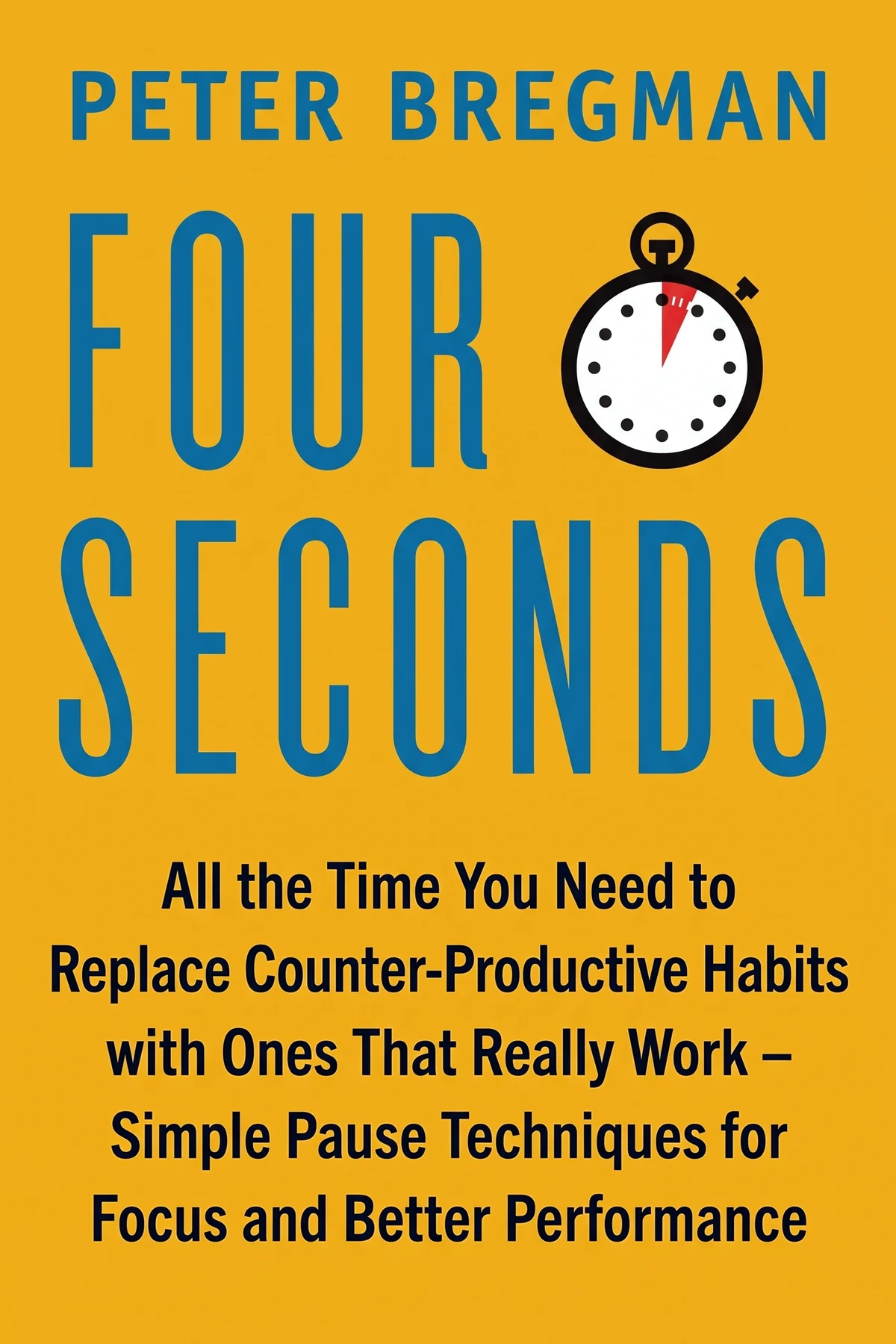
Table of Content
1. Introduction
58 sec
Most of the habits that hurt us at work and at home fire in the first second of stress: the raised voice, the defensive reply, the snap at a colleague. In Four Seconds, leadership adviser Peter Bregman argues that the fix lasts about as long as one deep breath, in and out. That pause, he says, is enough to step back from a reflex and choose a response that actually serves you.
Bregman takes that breath into many everyday moments: a child refusing to brush their teeth, a sales team bending the truth, a rejection that arrives by email, a group of employees stuck in gloom. Each time, the move is the same. Stop, breathe, then swap the old reaction for a better habit. By the end, you will have concrete replacements for yelling, arguing, overprotecting and bristling at criticism, and every one of them starts with four seconds.
2. Breathe once before you react
1 min 27 sec
A stressed parent is one second away from shouting on a school morning. What happens next depends on something so small that most people never think to use it.
3. Trade hard targets for a focus that stays honest
1 min 26 sec
A shop owner pushed for higher revenue and got staff who lied to customers. One year the owner stopped chasing the number, and the number moved anyway.
4. Prepare a process for problems you can't predict
1 min 48 sec
No amount of planning covers the meeting you forgot you were chairing or the storm that catches you at sea. Bregman’s answer is to prepare for something other than the event itself.
5. Hear the message, not the way it's said
1 min 50 sec
A rejection by email feels like a slap, and an argument feels like something you must win. Both reactions block the one thing that would actually help you get your point across.
6. Stronger relationships through fair expectations and spoken thanks
1 min 42 sec
Picture a bonus left on your desk in an envelope with no note. It is generous, and it still misses something. Bregman explains what people actually need in order to feel valued.
7. Let people stumble, then share the win
1 min 40 sec
A parent who catches a child every time the bike wobbles seems kind, yet weeks later the child still can’t ride. Many managers repeat the same mistake, and then make another one when success arrives.
8. Calm gloom around you and take criticism well
1 min 43 sec
One manager tried cheerful talk about bonuses with his negative team, then tried complaining about their mood. Neither worked. Bregman offers a third way, plus a calm routine for the moment criticism lands on you.
9. Conclusion
1 min 10 sec
Four Seconds makes a modest claim with a wide reach. Most of the habits that cost us, the yelling, the arguing, the rescuing, the brushing off of criticism, are reflexes that fire under stress. Beating them takes a gap more than willpower, and one deep breath is long enough to open it.
What fills the gap is a better habit. A focus on customers can replace a revenue target that tempts people to lie. A clear process can replace panic when a storm, or a forgotten meeting, arrives. Listening can replace a fight neither side can win, and a spoken word of appreciation can replace an envelope with no note.
Start where stress shows up most often for you. When someone’s words make your blood rise, breathe, then listen for what they meant instead of how they said it. When your team wins, tell each person, face to face, what they added. And when you feel the urge to catch someone before they wobble, let them wobble.
The habits that work against you get their first four seconds for free. Bregman’s argument is that you can take those seconds back.
About this book
What is this book about?
When pressure rises, most people make things worse. They shout at their kids, argue with colleagues, show up unprepared, catch every mistake before it happens and bristle when someone criticizes them. These reactions feel automatic, and over time they turn into habits that waste time and wear down relationships. Peter Bregman, who advises CEOs and leadership teams, argues that you need very little time to break the pattern. One deep breath in and out takes about four seconds. That pause lets you step back from a reflex and pick a response that helps you. From there he offers replacement habits for everyday trouble spots. These include an area of focus in place of a target that tempts people to cheat, and a three-step process for decisions nobody saw coming. He also covers listening in place of arguing, appreciation said out loud in place of an envelope with no note, letting people fail so they can learn, sharing credit widely, calming a gloomy colleague and treating criticism as a gift. Each habit is short and practical, and each one starts with the same pause.
Book Information
Who it's for
Professionals under pressure
Professionals who snap, argue or freeze under pressure and want a quick reset.
Team managers
Managers who chase targets, rescue struggling staff or praise only their stars.
Couples and parents
Parents and partners tired of the same stressful moments ending in a fight.
About the Author
Peter Bregman
Peter Bregman advises CEOs and their leadership teams through Bregman Partners, the management consulting firm he founded in 1998. He first taught leadership on wilderness and mountaineering expeditions, then worked as a consultant at the Hay Group and Accenture. His earlier book, 18 Minutes, was a Wall Street Journal bestseller and won a Gold Medal at the Axiom Business Book Awards, and Four Seconds was a New York Post career pick in 2015. He writes regularly for Harvard Business Review and studied at Princeton and Columbia.
Ratings & Reviews
Ratings at a glance

What people think
Listeners find the book to be highly readable and well-crafted, containing functional strategies that actually produce results. They like how the relatable advice benefits both home and workplace relationships, with one listener pointing out that the suggestions are perfectly suited for contemporary life. The content is very hands-on, pushing people to pause before they react, and listeners describe the concepts as very easy to follow.
Top reviews
Kae
Peter Bregman has a knack for taking complex interpersonal dynamics and boiling them down into actionable steps. I loved the section on how to handle a two-faced friend by adjusting expectations rather than harboring anger. Truth is, many of us spend too much energy fighting reality when we should be focusing on what we can actually control. The book feels like a series of wise mentors sharing coffee with you. It’s well-written and simple to understand, which is exactly what I need in a world full of over-complicated self-help manuals. Definitely a keeper for the nightstand that you can revisit whenever you feel your fuse getting short.
Show moreNoppadol
Finally got around to reading this and I’m genuinely impressed by how much it helped me navigate some recent family drama. We often think we have a motivation problem, but as the book points out, it’s usually a follow-through problem. This shift in perspective is subtle but powerful. I’ve started implementing the no powerpoint rule in my own team meetings, and the energy shift is palpable. It’s rare to find a book that offers such practical suggestions tailored specifically to the messy, unpredictable nature of today’s life. Highly recommended if you want to be a more intentional person without reading a 500-page textbook.
Show moreLena
Frankly, the simplicity of the advice is its greatest strength. While some reviewers call it simplistic, I find the actionable nature of these bite-sized lessons to be exactly what’s missing from most self-help books. Bregman doesn't just tell you to be better; he tells you to stop, breathe, and think for four seconds. I especially liked the section on timing the save and learning how to avoid the pitfalls of micromanagement. It’s a collection of rituals that can be done quickly but have a long-lasting impact on your performance and your peace of mind. I’ve already recommended it to several colleagues who are feeling overwhelmed.
Show moreRatthapong
The chapter on timing the save changed my perspective on how I manage my team. It’s the perfect balance between micromanagement and neglect, and honestly, it’s a skill I hadn't mastered before reading this. This book is full of these small, thoughtful shifts that make a big difference in the long run. Whether he’s talking about boardroom politics or teaching a child to ride a bike, the core lesson remains the same: stay present and choose your response. It’s written with warmth and clarity. I’ve already bought copies for several of my friends who are struggling with work-life balance and burnout. It's a quick, refreshing read.
Show moreTak
Picked this up after seeing a recommendation for 18 Minutes. I found it incredibly easy to digest because of the short, blog-style chapters. While some of the anecdotes about his kids—like the daughter learning to ride a bike—feel a bit repetitive, the underlying message hits home. It's about that critical four-second window where you decide whether to react impulsively or act intentionally. For me, the advice on avoiding knee-jerk responses during high-pressure work meetings was the most helpful part. It isn't a deep scientific study, but it offers realistic strategies for modern life. I noticed an immediate improvement in my patience levels after just a few days of practicing the pause.
Show moreNit
The core concept of taking a breath before you ruin a relationship is something we all need to hear periodically. I particularly appreciated the workplace examples, like the boss who realized he was destroying his corporate culture by being overly demanding on an employee's wedding day. Bregman writes with a certain humility, acknowledging his own flaws and the insufferable distractions of daily life in a way that feels authentic. My only gripe is that it can feel a bit light on substance if you're looking for academic research or data. It’s more of a lived experience guide, which has its own unique value for busy professionals seeking immediate changes.
Show moreHenry
Ever wonder why you snap at your spouse even when you know better? This book dives into the emotional roller coaster of daily interactions and offers a way off the ride. Bregman’s style is conversational and easy to read, making it a perfect choice for someone with a packed schedule. I didn't love every chapter—some felt a bit like he was reaching to make a point out of a minor event—but the hits far outweigh the misses. The advice to validate feelings first before trying to turn someone’s negativity around has already saved me three arguments this week. It is a thoughtful, useful collection for anyone looking to improve their interpersonal skills.
Show morePornthip
As someone who struggles with knee-jerk reactions, I found the central premise of this book quite grounding. The idea of pausing for four seconds to let your prehistoric caveman brain cool down is useful, even if it’s mostly common sense. However, the structure is a bit disjointed. Since it’s a collection of blog posts, some chapters feel much stronger than others. The bits about SMART goals being counterproductive were fascinating, but then you get hit with a story about a cheerful old man at the gym that feels like a Hallmark cliché. It’s a quick read that serves as a good reminder, but it’s not exactly a life-changing masterpiece.
Show moreYaowaluk
Not what I expected based on the title, which implies a focus on productivity or time management. Instead, it reads like the author’s personal therapy journal where every minor family spat becomes a profound life lesson. Do I really need to read five pages about a man not packing shampoo for vacation? The advice is often inane and sometimes contradictory—one minute he says to listen to rude people, the next he’s talking about the necessity of boundaries. To be fair, there are a few decent nuggets about process goals versus outcome goals, but they are buried under too much fluff and filler. It was a fast read, but ultimately unsatisfying.
Show moreHiroshi
Look, I really wanted to like this, but it felt like paying for a series of mediocre LinkedIn posts. I'm a freelancer without children, so the constant trials and tribulations of his daughter’s swim team or skiing lessons felt completely irrelevant to my life. I was hoping for verifiable analysis or scientific studies on habit formation, but instead, I got anecdotes about a friend’s weight loss surgery and trivial marital spats over dinner. In my experience, if you promise a quick fix and give people common-sense advice like 'meditation is good,' you aren't really adding value. Save your money and find something with more substance than this drivel.
Show moreQuestions about this book
What is the main idea of Four Seconds by Peter Bregman?
Bregman argues that counter-productive habits, such as yelling, arguing or reacting badly to criticism, are often set off by stress. One deep breath, about four seconds long, interrupts that reflex and gives you time to think about the outcome before acting. In that pause you can choose a better habit, whether in decisions, communication, relationships or the way you lead a team.
Why does Bregman prefer an area of focus to a goal?
He argues that goals can tempt people to cheat or take needless risks, because hitting the target becomes the only thing that matters. His example is a store whose staff lied about product features to meet revenue targets. When the owner switched to a focus on talking more with customers, revenue had risen by the end of the year, credited to that customer focus rather than a push for sales.
How should you handle criticism according to Four Seconds?
Bregman suggests treating criticism as a gift. Admit to yourself that you feel hurt or angry, then set the feeling aside. Focus on the message instead of how it was delivered, since the critic may not communicate well. Stay neutral, listen and gather information, then take a short break before deciding whether to change, what to change and how.
How can managers apply Four Seconds at work?
Bregman’s advice for managers includes letting employees struggle and learn instead of blocking every failure, much as a child learning to ride a bike needs room to wobble. He also says to share credit with everyone who contributed, in person and not through faceless rewards. With a negative employee, show you understand their feelings, share a similar experience and focus on what they feel positive about.
Readers also enjoyed


A High-Performing Mind: Strengthen Your Mind and Live Your Best Life
Andrew D. Thompson


Abundance: The Inner Path to Wealth
Deepak Chopra


59 Seconds: Change Your Life in Under a Minute
Richard Wiseman




AUDIO SUMMARY AVAILABLE
Listen to Four Seconds in 15 minutes
Get the key ideas from Four Seconds by Peter Bregman, plus 5,000+ more nonfiction titles.
- 5,000+ titles
- Listen as much as you want
- 7-day free trial
- Cancel anytime









