

14 min 20 sec
Available in: English
 ไทย
EnglishไทยFounders at Work: Stories of Startups’ Early Days
Founders behind PayPal, Yahoo, Hotmail, Flickr and others describe their early days. Their stories show how to start before your idea is finished, spot the better idea when it appears and keep control as you grow.
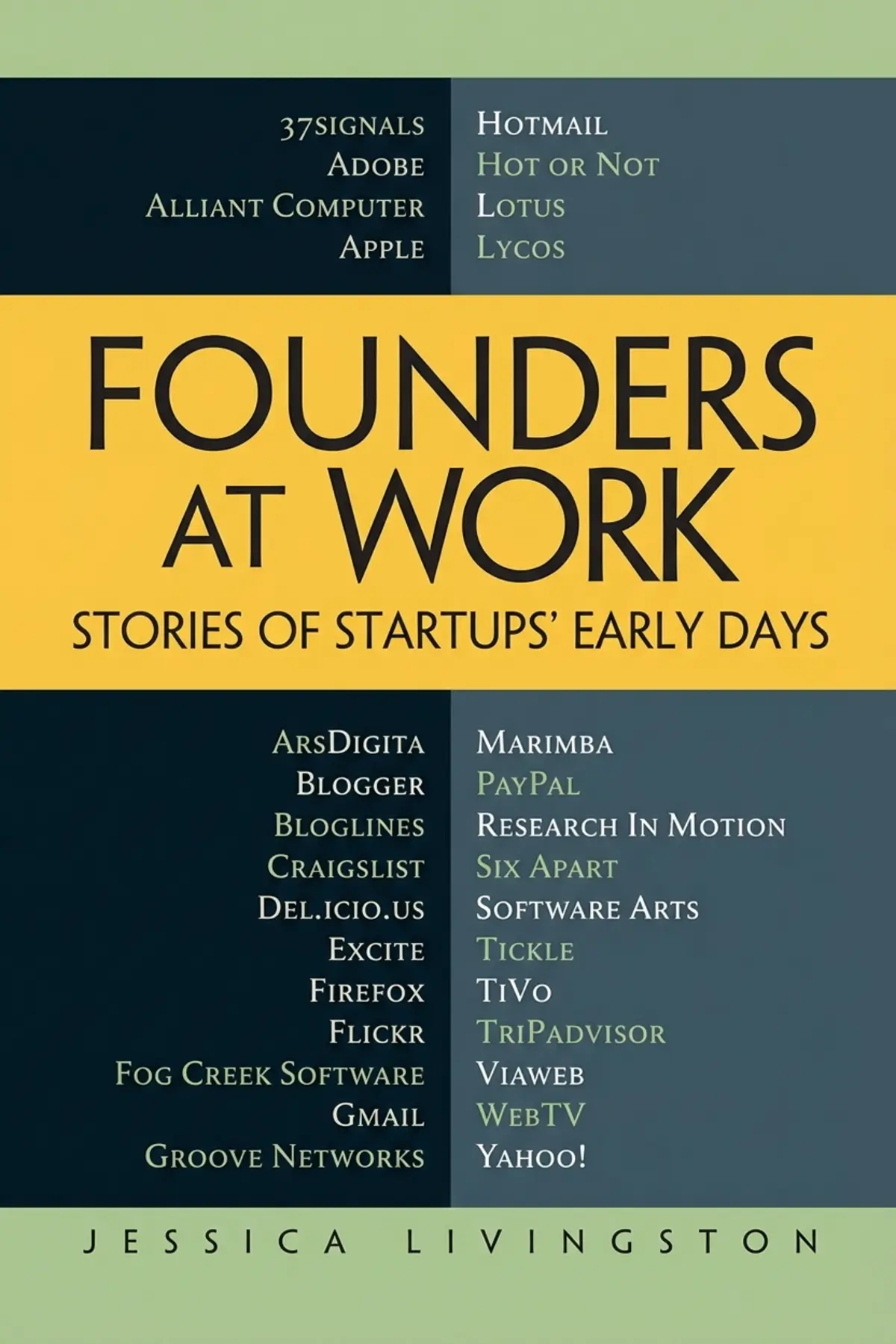
Table of Content
1. Introduction
54 sec
Most would-be founders wait for the perfect idea, yet many of the founders in this book did their best work after their first idea failed. In Founders at Work, Jessica Livingston, a founding partner of the startup firm Y Combinator, collects frank conversations from around 2006 with the people who built companies from Apple to Flickr. PayPal began as security software for handheld organizers. Flickr began as one feature of an online game.
Those stories point to a single lesson. The startups that grew large rarely started with a flawless plan. They had capable teams who solved real problems simply, spent little, told customers the truth and followed what people actually used. Listen through and you will have a working method for starting before your idea is finished, and for spotting the better idea when it arrives.
2. Back a strong team before a perfect idea
1 min 28 sec
Six Stanford friends started a company with no business idea, and four Java engineers did the same a few years later. Both bets paid off, for a reason that changes how you should choose the people you build with.
3. Turn your own frustration into a product
1 min 25 sec
Two graduate students organizing their thesis references built Yahoo, and a bank analyst tidying his bookmarks later sold his site to it. Their path suggests where your own most valuable idea might already be sitting.
4. Let your users tell you what you built
1 min 46 sec
PayPal’s Palm Pilot money-beaming software stalled at about 12,000 users while a web demo on the company’s site drew around 1.5 million. What they did next is a lesson in reading the evidence your customers leave behind.
5. Early doubters can be a sign you are ahead
1 min 45 sec
A respected Apple veteran and two founders with a simple email idea were both told no again and again. How they answered the skeptics turned rejection into deals with Microsoft.
6. Read the moment before trusting market research
1 min 25 sec
Flickr’s founders were building a video game when a minor feature took off. Caterina Fake believes careful market research at the time would have killed it, and her reasons say a lot about timing.
7. Build with fewer parts and fewer bugs
1 min 31 sec
A teenage Steve Wozniak took gadgets apart for an unusual reason, and a web design firm grew about 500 percent a year on a similar instinct. Both point to a habit any builder can practice.
8. Stay cheap and keep control of your company
1 min 36 sec
One fast-growing company collapsed after taking investor money, while a small software firm raised its price from $199 to $999 and sold more. Their contrast shows how some founders deliberately kept investors at a distance.
9. Win clients by telling them only the truth
1 min 27 sec
Paul Graham never felt like a natural salesman, yet he won clients for his online store software. His approach needs no charm at all, only a promise that has to be earned before it can be spoken.
10. Conclusion
1 min 03 sec
The companies in these conversations span roughly three decades, from Wozniak’s apartment in the late 1970s to the blogs and photo sites of the early 2000s, and most of their technology now looks old. How the founders worked has lasted better. Hardly any of them knew where they would end up. Kraus had friends and no plan. Levchin had a password tool with only a small market. Fake had a game. Each let real users, real behavior and real timing edit what they started with.
That suggests a few things to try this month. Choose partners you would trust through a failed first idea. Study the fixes you have built for your own frustrations, and notice which small feature people keep using. Before courting investors, see how far a simple product and a small budget can take you.
Yahoo began as footnotes to two theses. Your next company may already be sitting in a side project you have not taken seriously.
About this book
What is this book about?
Starting a company can feel impossible without a brilliant idea, a polished plan and investors ready to write checks. Founders at Work suggests that many famous startups had none of these at the beginning. Around 2006, Jessica Livingston sat down with founders behind companies from the early Apple to Web 2.0 names like Flickr and Blogger, and let them describe the early days in their own words. Their stories share some surprising patterns. PayPal and Flickr succeeded with products their founders never set out to build. Excite and Marimba began as teams with no idea at all. Yahoo and deli.icio.us grew out of personal projects. WebTV and Hotmail were dismissed by skeptics before WebTV earned $1.3 billion in revenue and Hotmail sold to Microsoft for $400 million. Readers get practical lessons drawn from those founders: choose a team that can change course, start from a problem you have yourself, keep the product simple, think hard before taking venture capital, listen to customers and sell honestly.
Book Information
Who it's for
First-time founders stuck waiting
First-time founders who are stalled waiting for the perfect idea or the right co-founders.
Builders with side projects
Engineers and product people with a side project they suspect could become a business.
Early-stage operators weighing VC
Early-stage operators deciding whether to take venture capital or grow on their own revenue.
About the Author
Jessica Livingston
Jessica Livingston, born in 1971, is an investor, writer and podcaster. She is a founding partner of Y Combinator, which funds and advises very young companies; Dropbox and Airbnb are among those it has backed. She also organizes Startup School. Earlier in her career she ran marketing as a vice president at Adams Harkness, an investment bank. She holds a BA in English from Bucknell, and in 2015 she became a financial backer of OpenAI, at the time a nonprofit focused on artificial intelligence.
Ratings & Reviews
Ratings at a glance
What people think
Listeners find this work both thought-provoking and a pleasure to experience, especially valuing the personal accounts from founders and the deep expertise shared by those interviewed. Additionally, the material is thoroughly researched, making listeners view it as a helpful resource for anyone starting a business. On the other hand, opinions are divided concerning the specific industries covered, as one listener pointed out that the focus remains largely on hardcore software firms.
Top reviews
Kenji
Picked this up during a long weekend and it turned out to be the perfect companion for a quiet afternoon. Jessica Livingston manages to pull back the curtain on the early days of tech giants in a way that feels incredibly intimate. Frankly, the recurring theme that most founders were essentially winging it is both terrifying and deeply encouraging for any aspiring entrepreneur. You get the sense that success isn't about having a perfect map, but rather having the stamina to keep walking when you're lost in the woods. While it leans heavily into the software world, the human elements of doubt and discovery are universal enough to keep anyone engaged. It’s a thick volume, so don’t try to power through it in one go or you’ll miss the nuance of the individual journeys.
Show morePacharapol
The chapter on Adobe really hit home for me because it shows that even legends have to 'shoot where the duck is going.' This book is an absolute masterclass in the reality of the startup grind. Livingston has a knack for getting these high-profile founders to open up about their failures and uncertainties. I loved how the book dispels the myth of the 'superhuman' founder. Most of these people were just persistent engineers who hated broken software and wanted to fix it. It's the best kind of bedtime reading—instructive, entertaining, and deeply human. I found myself highlighting dozens of quotes about risk-taking and the importance of the second idea over the first. If you want to know what it’s actually like to build a company before the PR teams take over, read this.
Show moreCee
Not what I expected at all, as I thought it would be a dry business manual. Instead, I found a collection of deeply personal narratives that are both invigorating and educational. The interview with Paul Buchheit about Gmail and risk-taking was a particular highlight for me. It’s fascinating to see how the 'power of thought' can drive the whole world economy from a small office in Silicon Valley. Frankly, I felt more inspired by this than any traditional motivational book because the advice is grounded in real-world technical challenges. The focus on software might be heavy for some, but the underlying principles of hiring and building for the user are universal. It truly captures the spirit of an era where anything seemed possible if you just kept coding.
Show moreNew
Building something millions of people will use is the ultimate dream, and this book maps that journey perfectly. Each interview reveals that most founders didn't have a master plan; they just refused to give up when things broke. I was particularly struck by the idea that the first idea is often just a catalyst for the second, more important one. This book is a must-read for anyone who feels like they don't have it all figured out yet. It turns out, nobody did! The casual, conversational tone makes it feel like you're getting the inside scoop on the tech world. It’s a great reminder that the 'magic wand' of industry is just a combination of math, science, and relentless effort. I'll be recommending this to every developer I know.
Show moreMalee
Ever wonder how the legends of the early web actually stumbled into their fortunes? This collection of interviews serves as a brilliant, if slightly one-sided, history of the boom years in Silicon Valley. To be fair, the book is unapologetically focused on hardcore software development, which might alienate readers looking for broader business advice. However, the insights into the minds of people like Paul Graham and the Adobe founders are priceless for those who speak the language of code. In my experience, the best way to consume this is one chapter at a time before bed, treating each story as a separate lesson. It’s fascinating to see how many multi-billion dollar ideas started as mere accidents or side projects that just refused to die. The interview style is candid, making it feel less like a textbook and more like a coffee-shop conversation with a mentor.
Show moreUdom
As someone who just launched their own venture, these transcripts are like gold dust for the soul. The book hits on a vital truth: determination is the single most important quality a founder can possess. Livingston does an excellent job of letting the interviewees speak for themselves without injecting too much authorial bias. Not gonna lie, some of the technical jargon regarding early computer systems went over my head. But the core lessons about recruiting, persistence, and the 'accidentality' of success are worth their weight in gold. It’s refreshing to hear that even the most successful people had no idea what they were doing at the start. This book doesn't just teach you about business; it teaches you about the psychological endurance required to build something from nothing.
Show moreTang
Finally got around to reading Livingston’s collection and I’m struck by the sheer volume of persistence on display. These aren't just success stories; they are survival stories. Not every chapter is a masterpiece, as some founders are definitely more articulate than others. Look, the book gets a bit repetitive around the midpoint when the themes of venture capital and long hours start to blur together. But then you hit a quote from someone like Ron Gruner about the necessity of doing things three times to get them right, and it all clicks again. It’s a dense read, yet the Q&A format keeps the energy high enough to prevent it from feeling like a chore. If you want to understand the DNA of a startup, start here.
Show moreChaiwat
After hearing so much hype about the Y Combinator scene, I finally tackled this beast of a book. It’s a solid resource, but the truth is, it feels a bit like a repetitive gossip column for tech nerds after you get halfway through. The focus is almost exclusively on the US market and software, which leaves a lot of the entrepreneurial world unexamined. If you aren't interested in the nitty-gritty of how Gmail or TiVo were coded, you might find yourself skimming large sections. To be fair, there are some incredible nuggets of wisdom buried in here about how to handle VCs and the importance of user experience. However, the sheer density of the Q&A format can be exhausting. It’s a great reference for the history of the internet, but maybe not the revolutionary manual I was expecting.
Show moreDimitri
This book acts as a fascinating time capsule for the dot-com era, though it shows its age in parts. In my experience, the heavy concentration on hardcore software companies makes it less applicable to modern service-based or hardware startups. The stories are well-documented and offer a great inside look at companies like Craigslist and Excite, but the lack of diversity in the industry focus is noticeable. Gotta say, the interview format is a double-edged sword; you get the authentic voice of the founder, but you also get a lot of rambling about technical specs that no longer matter. It’s a valuable read for the historical context, but don’t expect a step-by-step guide for the current market. Still, the lessons on determination remain timeless.
Show morePracha
Wow, talk about a concentrated dose of the Silicon Valley 'hero' mythos. While there is plenty of information here, it often reads like a PR-approved gossip rag for the Y Combinator crowd. The truth is, the book tends to gloss over the systemic advantages these founders had, focusing instead on the cult of personality and 'grit.' If you aren’t interested in the hyper-specific details of early computer design or software specs, large chunks of this will be a slog. Personally, I found the tone a bit too reverent for my liking, as if every founder interviewed was a borderline genius rather than just being in the right place at the right time. It’s an okay historical document, but be prepared for a very narrow, US-centric view of what it means to build a company.
Show moreQuestions about this book
What is Founders at Work by Jessica Livingston about?
It collects conversations Livingston had around 2006 with startup founders, ranging from the early days of Apple to Web 2.0 firms such as Flickr and Blogger. The founders describe their early days, setbacks and lessons. Common patterns emerge: many companies changed their idea along the way, some teams started with no idea, several grew from personal projects and many founders were wary of investor money.
What does Founders at Work teach about finding a startup idea?
The stories suggest the first idea is rarely the final one. PayPal moved from Palm Pilot software to web payments after its website demo drew around 1.5 million users. Excite’s founders had no idea until a brainstorm at a taco shop. Yahoo and deli.icio.us began as personal collections of links. The lesson is to start with a strong team and watch what users actually do.
Does Founders at Work recommend taking venture capital?
Many founders in the book are cautious. ArsDigita grew around 500 percent a year, but after it took venture capital all but one founder were pushed out and the company collapsed. Joel Spolsky avoided investors at Fog Creek by selling his FogBugz software, and Paul Graham argues that every bit of investor money costs founders some freedom, so he advises staying cheap.
Who should read Founders at Work?
It suits first-time founders who feel they need a perfect idea before starting, engineers with a side project that might become a business and early-stage operators weighing whether to raise money. The lessons come from real founders, including Max Levchin, Evan Williams, Steve Wozniak and Paul Graham, which makes them easy to remember and apply.
Readers also enjoyed


7 Powers: The Foundations of Business Strategy
Hamilton Helmer



Alibaba: The House That Jack Ma Built
Duncan Clark

Bad Blood: Secrets and Lies in a Silicon Valley Startup
John Carreyrou
AUDIO SUMMARY AVAILABLE
Listen to Founders at Work in 15 minutes
Get the key ideas from Founders at Work by Jessica Livingston, plus 5,000+ more nonfiction titles.
- 5,000+ titles
- Listen as much as you want
- 7-day free trial
- Cancel anytime









