


14 min 02 sec
Available in: English
Forest Bathing: How Trees Can Help You Find Health and Happiness
By Qing Li
Shows how slow time among trees lowers stress, lengthens sleep and strengthens immunity. It explains what in forest air does the work and gives a sense-by-sense method you can use in any park or at your desk.
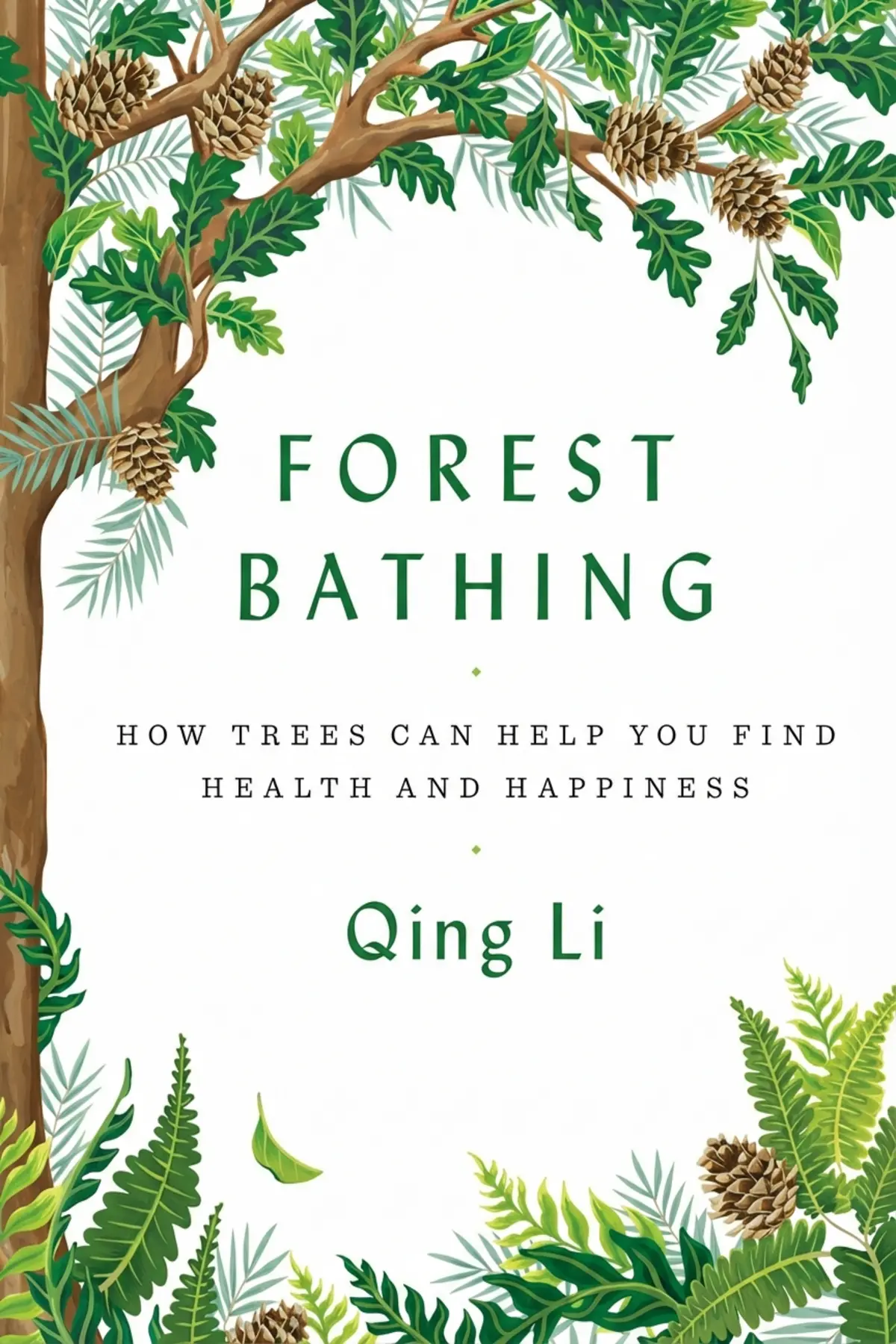
Table of Content
1. Introduction
59 sec
If your days run from desk to screen to commute, you are probably among the people who spend about 90 percent of their time indoors. In Forest Bathing, immunologist Qing Li shows what a trip among trees can do about that: longer sleep, calmer moods and more of the immune cells that attack viruses and tumors. The Japanese call the practice shinrin-yoku, and Li helped turn it from a hunch into a field of medicine.
His case is that time in nature, taken slowly and with all five senses open, works as real medicine, in a city park as much as in a mountain forest. Li explains what in forest air does the healing, gives a sense-by-sense method for practicing it, and shows how plants, scents and sounds can carry the effect into a bedroom or office. He also offers a reason to care beyond your own health: people who feel close to nature tend to protect it.
2. Trade indoor stress for an old Japanese remedy
1 min 48 sec
A country covered in forest, with gods living in its trees, still found its people falling ill from city life. The name it gave to the cure began as a hunch, decades before anyone measured it.
3. Sleep an hour longer after a forest walk
1 min 41 sec
For twenty years, people bathed in forests purely because it felt right. Then a research group put that feeling to the test, and the biggest result had nothing to do with mood.
4. Breathe forest air to boost your immunity
1 min 36 sec
Trees produce something to protect themselves from insects and fungi, and it turns out to protect us too. A second ingredient lives in the soil and acts on mood in an unexpected way.
5. Let sounds, colors and scents calm your nerves
1 min 50 sec
You do not need a wilderness, a guide or special gear. You need a few trees and a willingness to notice what your ears, eyes and nose usually ignore, including patterns that cut stress sharply.
6. Touch and taste the forest for the full effect
1 min 37 sec
Looking at nature is like admiring a meal you never eat. Li wants your hands, your bare feet and even your taste buds involved, and he explains what he believes the ground itself gives back.
7. Bring the forest into your home and office
1 min 37 sec
Work and family keep most people far from the woods on an ordinary weekday. Li’s answer reverses an old saying, and it starts with what grows in a pot by your bed.
8. Protect what heals you by learning to love it
1 min 43 sec
The world loses a huge stretch of forest every year. Li argues that the same sensory habit that lowers your stress also changes how you treat the land, and that children are where it matters most.
9. Conclusion
1 min 11 sec
Forest Bathing makes a modest-sounding claim with large consequences. The calm people feel among trees can be measured: longer sleep, lower stress hormones, more and busier natural killer cells, carried by oils the trees release and bacteria in the soil. What looks like a pleasant stroll is, in Li’s account, a form of preventive medicine available to anyone who lives near a park.
The method asks mostly for attention. Go slowly, breathe deeply, and let every sense in: listen for natural silence, rest your eyes on fractal patterns, touch bark and water, and stand barefoot on grass when you can. On days when you cannot get outside, keep a plant by the bed and a pine scent on the desk. And if the gym keeps losing you, take your exercise outdoors. Research at the University of Essex found that working out in green spaces feels easier and less tiring, and people enjoy it more, so they keep it up.
Someone who spends 90 percent of life indoors has lost touch with something Japan built a whole culture around. One unhurried hour under trees is enough to start getting it back.
About this book
What is this book about?
Most people now spend about 90 percent of their time indoors, between homes, offices, commutes and screens. Stress follows, and with it a higher risk of serious illness. Immunologist Qing Li argues that one of the best remedies grows in the nearest park. In Japan the practice is called shinrin-yoku, or forest bathing: spending unhurried time among trees and connecting with nature in a way that heals. Li helped turn it from a cultural instinct into a research field. His studies found that forest trips lengthen sleep, lower stress hormones and raise the number and activity of natural killer cells, the immune cells that fight viruses and tumors. He traces the effect to phytoncides, oils that trees release, and to a harmless soil bacterium that seems to lift mood. The book then becomes a practical guide. Li shows how to bathe in nature through sound, sight, smell, touch and taste, how to bring the forest into a bedroom or office with plants, oils and recordings, and why people who feel close to nature are more likely to protect the forests the world is losing.
Book Information
Who it's for
Indoors nearly every hour
Office workers and commuters who spend almost every hour indoors and feel the stress in their sleep.
Always catching colds
People who keep catching colds or feel run down and want a simple, natural habit for their health.
Urbanites and parents
City dwellers and parents who want to reconnect themselves, or their children, with nature.
About the Author
Qing Li
Dr. Qing Li is an immunologist who specializes in forest medicine, the study of how time in nature affects human health. He helped found the Japanese Society of Forest Medicine and serves as vice president and secretary general of the International Society of Nature and Forest Medicine. He teaches at Nippon Medical School in Tokyo and has been a visiting fellow at Stanford University.
Ratings & Reviews
Ratings at a glance

What people think
Listeners find the book deeply informative about forest bathing and value its detailed insights, with one listener highlighting that it is backed by scientific research. Additionally, the text is straightforward and contains striking imagery, providing a swift and delightful experience. Listeners also prize how the book improves mood and wellness, with one specifically citing its effectiveness in reducing anxiety.
Top reviews
Lars
Picked this up during a particularly stressful month at work, and it felt like a deep breath in paper form. Dr. Li manages to capture that elusive feeling of being under a canopy of green and translates it into something both practical and poetic. The photography is simply stunning; I found myself just staring at the dappled light on the pages when I couldn’t get to a park. It’s more than just a coffee table book—it’s a reminder to slow down and let the fractal patterns of nature soothe your nervous system. While some might find the 'sixth sense' talk a bit much, for me, it was exactly what my anxiety needed. Truly a life-changing perspective on how we interact with our environment and a quick read that stays with you.
Show moreSkylar
This book is a sensory masterpiece that effectively argues for the preservation of our natural world by showing us how much we need it. Dr. Qing Li explains the physiological benefits of forest bathing, like reduced blood pressure and improved immune function, in a way that feels incredibly encouraging. I specifically enjoyed the chapter on the different scents of trees and how they impact our mood differently. Frankly, just flipping through the lush photography lowered my heart rate. It’s a profound look at our ancestral connection to trees. I’ve started taking my lunch breaks in the local park instead of at my desk, and the difference in my mental clarity is night and day. A must-read for city dwellers.
Show morePia
Finally, a book that validates what I’ve felt every time I step into the woods! Dr. Li is clearly an expert in his field, and his passion for the forest shines through every sentence. I was particularly fascinated by the discussion on phytoncides—the natural oils trees release—and how they actually boost our 'natural killer' cells. It’s a fascinating blend of ancient wisdom and modern research. The book is easy to navigate and doesn't demand hours of your time; you can dip in and out for a quick dose of serenity. It has definitely motivated me to be more mindful during my weekend hikes. A must-read for the modern, over-stimulated soul who needs to reconnect with the earth.
Show moreUbolrat
Wow. This book actually made me change the way I walk. Instead of rushing through the woods with my headphones on, Dr. Li’s advice helped me engage my 'sixth sense' and actually listen to the wind and smell the damp earth. It’s a very restorative read that manages to be both informative and incredibly soothing. The data on how even just looking at a tree through a window can help healing is mind-blowing. It’s the kind of book you want to keep on your nightstand to flip through whenever the world feels a bit too loud. I highly recommend this to anyone looking to reduce their stress and reconnect with the world around them in a meaningful way.
Show moreTippawan
After hearing so much about the Japanese concept of Shinrin-Yoku, I finally got around to reading the 'official' guide. It’s surprisingly accessible and doesn’t get bogged down in overly academic jargon, which I appreciated. I loved the practical tips on how to bring the forest indoors through essential oils and houseplants, especially since I live in a cramped apartment. The book is heavily visual, which makes it a very quick read, but the message sticks with you. There are some editing quirks and a few 'woo-woo' moments that I glossed over, but the core advice—get outside and use your five senses—is solid. It’s a lovely, calming companion for anyone feeling burnt out by tech and looking for a way to improve their mood.
Show moreViroj
As someone who struggles with chronic anxiety, finding ways to ground myself is a constant battle. This book offered a very gentle, persuasive argument for why I should be spending more time among the trees. The concept of 'drinking in the forest' through all five senses is beautiful, and I’ve actually started practicing the breathing techniques mentioned. I do think the author oversimplifies some systemic issues by suggesting trees are the answer to everything, but the individual health benefits are hard to argue with. It’s a very knowledgeable guide that feels like a warm hug. It might be a bit 'New Age' for some, but the underlying message is undeniably healthy and backed by a surprising amount of research.
Show moreElias
Not what I expected, but in a good way. I thought this would be a dry manual, but it’s actually a very artistic exploration of the relationship between humans and forests. The focus on Japanese traditions, like the tea ceremony and onsen baths, provides a wonderful cultural context that I haven’t seen in other 'nature therapy' books. While I agree with other reviewers that the science can feel a bit exaggerated—especially the bits about essential oils—the overall sentiment is uplifting. The book itself is high quality, though some of the black and white photos felt a bit out of place compared to the vibrant color ones. It’s a great gift for a nature lover who values aesthetics as much as information.
Show moreManika
Ever wonder why a simple walk in the woods feels so restorative? This book attempts to bridge the gap between that intuition and actual data, but it’s a bit of a mixed bag. On one hand, the layout is gorgeous and the sections on Japanese culture are fascinating. On the other, the 'science' can feel pretty thin at times. Dr. Li talks a lot about negative ions and phytoncides, but some of the claims—like nature being a cure-all for complex conditions—left me skeptical. To be fair, it’s a beautiful object to own, even if many pages feel a bit 'empty' or repetitive. It’s great for inspiration, just don’t expect a rigorous, peer-reviewed textbook. The editing could have been tighter, but the sentiment is lovely.
Show moreRuangrat
Transitioning from a rural area to a big city was a shock to my system, and I bought this hoping for a way to cope. It’s a stunning book to look at, no doubt about that. However, the writing style is very simplistic, almost like a children's book for adults. While the photographs are phenomenal, they take up about 70% of the book, leaving the actual information feeling a bit sparse. I found the sections on bringing the 'forest' into the office with pictures of trees a bit silly, to be honest. It’s a nice 'mood' book that looks great on a coffee table, but I was hoping for more practical, depth-oriented advice rather than just being told to go to a park.
Show moreGrace
Look, I wanted to love this because the photos are undeniably beautiful, but the content is lacking. There are some wild claims here, like the suggestion that nature can essentially make ADHD symptoms disappear, which feels irresponsible without more robust citations. It often veers into pseudoscience territory with talk of 'charging' yourself with ions, and the prose can be quite repetitive. It feels like a high-end magazine expanded into a book, but with way too much white space and not enough substance. If you want a pretty book to decorate your shelf or use as a meditation aid, this is it. If you want a deep dive into the actual biology of nature’s impact on health, you might want to look elsewhere.
Show moreQuestions about this book
What is forest bathing according to Qing Li?
Forest bathing, or shinrin-yoku in Japanese, means spending slow, attentive time among trees and connecting with nature in a healing way. The term was coined in Japan in the early 1980s. Li, an immunologist who specializes in forest medicine, treats it as a practice of the senses: you take in the forest through all five of them, listening, looking, smelling, touching and tasting.
What are the health benefits of forest bathing?
In studies by the Forest Therapy Study Group, which Li helped found, forest trips lengthened participants’ sleep by more than an hour on average, lowered stress, anger, anxiety and depression scores, and reduced stress hormones. The most important finding was a rise in the number and activity of natural killer cells, immune cells that attack virus-infected and tumor cells, lasting up to 30 days.
Why does forest air improve health?
Li points to two ingredients. Trees give off oils called phytoncides as a defense against insects, fungi and bacteria, and breathing them in boosts natural killer cells, raises anti-cancer protein activity and lowers stress hormones. Soil contains Mycobacterium vaccae, a harmless bacterium that supports immunity, and a Bristol University study found it has an effect on mood similar to antidepressants.
How can I practice forest bathing if I live in a city?
Li says any place with trees works, from a city park to a garden. Sit, breathe deeply and notice natural sounds, look at greens, blues and repeating patterns, and stand barefoot on grass for about 20 minutes. Indoors, add plants such as succulents or orchids, use conifer essential oils, and play forest recordings while you work.
Featured in
Readers also enjoyed








AUDIO SUMMARY AVAILABLE
Listen to Forest Bathing in 15 minutes
Get the key ideas from Forest Bathing by Qing Li, plus 5,000+ more nonfiction titles.
- 5,000+ titles
- Listen as much as you want
- 7-day free trial
- Cancel anytime









