

13 min 36 sec
Available in: English
Foolproof: Why Safety Can Be Dangerous and How Danger Makes Us Safe
By Greg Ip
Shows why protections like helmets, bank rules and firefighting can encourage bolder behavior and bigger disasters, why feared activities such as flying stay safe through caution, and how distance and restraint keep real risk in check.
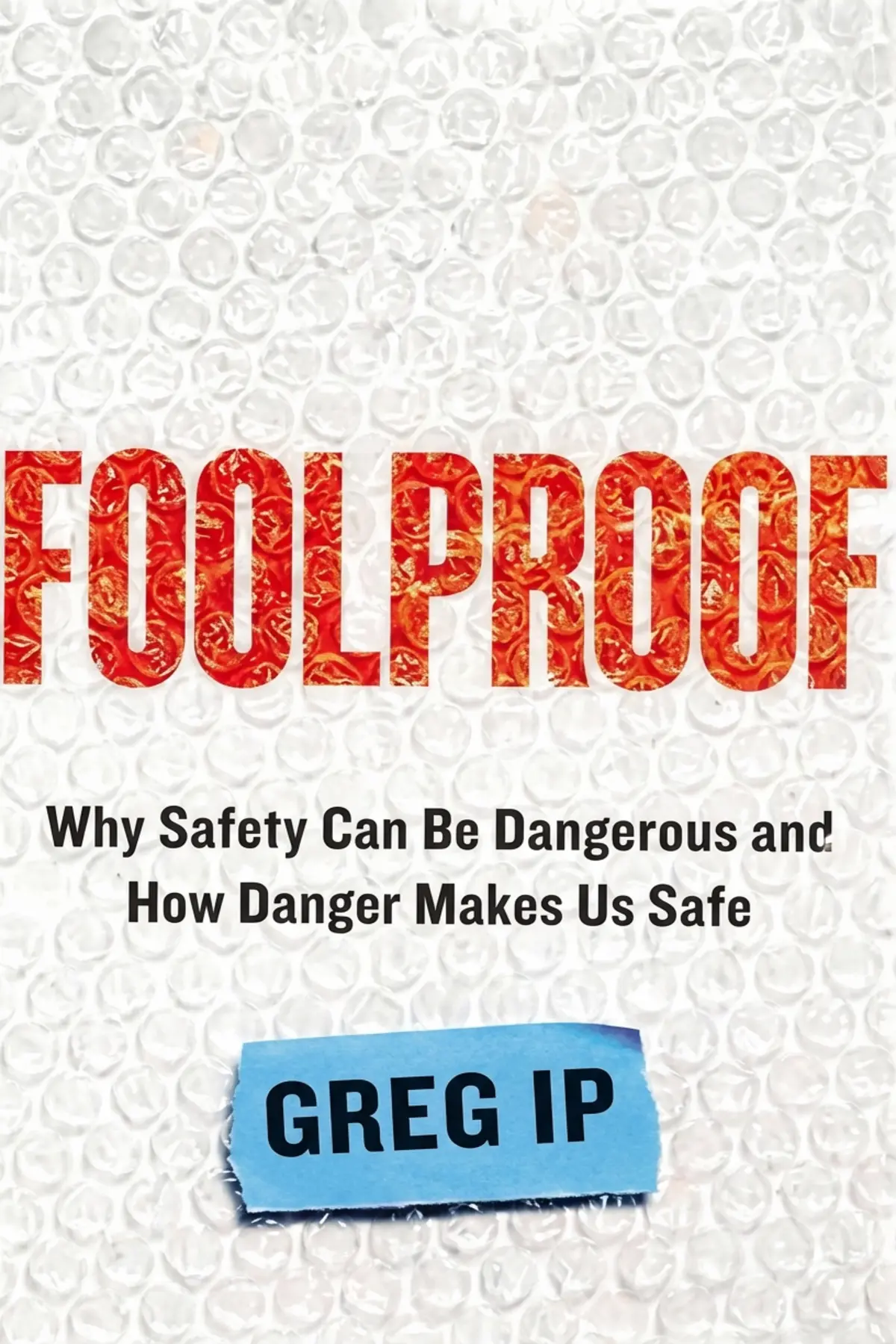
Table of Content
1. Introduction
1 min 00 sec
If you trust the airbag, the guardrail or the bank regulator to keep you safe, Greg Ip has an unsettling finding for you: protection changes behavior, and often for the worse. In Foolproof, the economics journalist shows that when German cars got anti-lock brakes, drivers responded by going faster and braking harder.
The same pattern, he argues, runs through football fields, forests, housing markets and the euro. His throughline is easy to state and hard to live by. The safer we feel, the more risk we take, while the dangers we fear most often become the safest things we do, because fear keeps us careful.
That reversal has practical stakes. It explains why a calm economy can be a warning sign, why putting out every small fire feeds a bigger one, and why airlines tolerate almost no risk at all. By the end, you will have a way to judge your own safety nets, and one habit of distance you can start using on the drive home.
2. Spot the safety net that makes you reckless
1 min 59 sec
German officials expected new brakes to save lives, and football expected helmets to prevent injuries. Both predictions ran into the same stubborn feature of human nature, and the injury numbers that followed surprised everyone involved.
3. Calm markets can hide the next crash
2 min 00 sec
For years, the banking system looked steadier than ever, and most experts relaxed. A shift in who was lending money told a different story, and Europe’s shared currency set up a similar surprise of its own.
4. Learn how stopping small disasters breeds bigger ones
1 min 58 sec
After a deadly fire in Australia, politicians and the media agreed on a culprit. One political scientist went back to an older blaze and found a cause much closer to home, with a lesson for anyone choosing where to live.
5. Accept small crises to come out ahead
1 min 49 sec
One country kept its economy on a tight leash while another let foreign money pour in and paid for it with a crisis. Two decades later, the scoreboard between them looked nothing like most people would predict.
6. Let healthy fear build a zero-tolerance culture
2 min 00 sec
A jet lost its engines on a 1982 flight from Kuala Lumpur to Auckland, and decades later a volcano grounded flights across Europe at enormous cost. An oil company learned a similar lesson and walked away from a project worth millions.
7. Keep distance as your margin for error
1 min 44 sec
A Canadian bank chief made a decision in 2005 that, in retrospect, proved to be smart thinking. Australian builders and airline pilots follow a related rule every day, and it applies to anyone behind the wheel of a car.
8. Conclusion
1 min 06 sec
Ip’s book turns a familiar instinct upside down. We usually measure safety by how protected we feel, yet the cases he gathers, from German brakes to Victoria’s forests to the American credit market, show that feeling protected is often when people push hardest. And the activities we dread, flying and nuclear power among them, stay safe largely because dread keeps everyone checking.
That gives a simple way to look at your own life. When a new safeguard arrives, a warranty, an insurance plan or a reassuring forecast, notice whether you have quietly started taking bigger chances because of it. When something has been calm for years, ask where the risk went. When a risk is large and the reward depends on it, consider doing what TD did and stepping away entirely.
And where danger cannot be avoided, give yourself room. A football helmet invites a harder hit. A three-mile gap in the sky asks nothing of anyone’s courage; it simply leaves space for things to go wrong without anyone getting hurt. The safest margin is often the empty one.
About this book
What is this book about?
We add safety features, regulations and rescue plans expecting fewer accidents and crises. Greg Ip argues that this often backfires. When people feel protected, they push harder, and the risk they thought was gone returns in a larger form, sometimes years later. Ip follows that pattern across very different worlds. Anti-lock brakes in Germany and helmets in American football and ice hockey brought new kinds of harm. A steadier banking system in the United States pushed lending into lightly regulated corners before the crisis of 2007 and 2008, and the euro's calm let Greece and Spain put off their problems. Fighting every small forest fire left more fuel for huge ones. On the other side, flying and nuclear power, which many people fear, turn out to be remarkably safe, partly because that fear drives strict precautions. Readers get a way to judge their own safety nets: notice what a new protection makes you do, ask where hidden risk has moved during calm years, walk away from risks that cannot be tamed, and leave generous space wherever danger remains.
Book Information
Who it's for
Curious when safeguards backfire
Managers and founders who rely on rules, insurance or backups and want to know when those safeguards breed carelessness.
Puzzled by financial crises
Investors and professionals puzzled by how calm economies tip into financial crises.
Curious about real danger
Curious readers who fear flying or nuclear power and want to understand where real danger lies.
About the Author
Greg Ip
Greg Ip is a Canadian-American journalist who serves as chief economics commentator for The Wall Street Journal and has won awards for his reporting. His reporting has won awards. Born in Canada, he studied economics and journalism at Carleton University in Ottawa, a pairing that suits a book explaining financial crises and risk to general readers. He lives in Bethesda, Maryland.
Ratings & Reviews
Ratings at a glance

What people think
Listeners find this title both stimulating and accessible, praising the high quality of the writing. They value the narrative structure, with one listener observing that the content is enhanced by individual stories and interviews. The book’s economic themes are well-received, as one listener points to its exceptional analysis of the recent financial melt down. While many listeners believe it is a rewarding book, views on the specific concept of "foolproofness" remain divided.
Top reviews
Gor
Greg Ip has a real gift for connecting seemingly unrelated fields like aviation safety and central banking. I was particularly fascinated by the chapter on the curse of ubiquitous normalcy in the airline industry. It’s a chilling thought that flying has become so safe that pilots might lose their edge during rare emergencies. The book brilliantly weaves behavioral psychology into discussions about how we manage risk. Even the complex parts about the Eurozone crisis felt more approachable thanks to Ip's narrative style. It’s a thought-provoking read that challenges the idea that safer is always better. I’d highly recommend it to anyone interested in human nature.
Show moreVera
Wow, this book really resonated with my personal experiences lately. I recently went through a minor financial setback and was feeling quite depressed about it. Ip’s explanation of the Endowment Effect helped me understand exactly why I was hurting so much. We value things more once we own them, and losing them feels disproportionately painful. This psychological insight alone was worth the price of the book for me. Beyond that, the stories about aviation and Dutch levees are absolutely gripping and well-told. It’s rare to find a book that combines high-level economics with relatable human emotion. I couldn't put it down.
Show moreTanawan
Ever wonder why safety measures often seem to backfire in the long run? Greg Ip explores this paradox through the lens of engineers versus ecologists in a way that is intellectually stimulating. Engineers want to fix every small problem with technology, like building massive levees to stop floods. Ecologists, however, argue that these fixes just encourage people to take bigger risks in dangerous areas. I found the discussion of the risk thermostat particularly enlightening. It explains why we drive faster when we have better brakes or more airbags. The writing is clear, though some of the financial sections are quite technical.
Show moreRatree
As someone who follows financial news closely, I found this to be an excellent summary of the last decade's meltdowns. Ip’s background as a journalist shines through in his clear prose and high-level access to industry leaders. He manages to turn complex topics like subprime bonds and CDOs into a compelling story about human hubris while simultaneously providing a clear-eyed look at systemic failures. The book isn't just about money; it’s about the fundamental way we try to foolproof our lives. I especially liked the sections on how anti-usury laws changed the lending landscape. It is a very informative and worthwhile read.
Show moreRotjanee
Picked this up on a whim, and I’m glad I did. The book provides a great overview of the Peltzman Effect, which is the idea that we adjust our behavior to maintain a certain level of risk. The examples involving football helmets and anti-lock brakes were eye-opening and easy to understand. I do agree with other reviewers that the book leans heavily into finance toward the end. If you aren't interested in the Fed or the European debt crisis, you might get bored. However, the writing style is smooth and the narrative flows well between the different case studies.
Show moreNarongrit
Finally got around to reading Foolproof, and I think it’s a solid exploration of human behavior and risk management. The book is structured around various disasters and the well-intentioned actions that often make them worse, providing a narrative that is both educational and deeply unsettling. Ip’s prose is accessible and he has a knack for finding the right individual to profile for each chapter. I found the discussion about disaster myopia particularly relevant to our current world. The balance between technical economic analysis and general interest stories is mostly successful. It is a worthwhile addition to your bookshelf.
Show morePun
Not what I expected based on the catchy title. I was looking for a broad study on how safety regulations across all industries fail. Instead, nearly three quarters of the text zooms in on the 2008 financial crisis. To a non-economist, those banking chapters felt incredibly dense and dry. There are definitely some compelling outside examples, like the bits on forest fire management and aviation. However, the heavy focus on macroeconomics makes the narrative feel a bit lopsided. It’s worth a read if you enjoy the Wall Street Journal style of reporting. Just be prepared for a deep dive into bank capital requirements.
Show moreWin
The core thesis here—that stability can be destabilizing—is definitely an interesting concept to chew on. Ip uses the analogy of forest fires to explain why preventing small crises can lead to massive catastrophes. If you never allow small fires to burn, the undergrowth builds up until the entire forest explodes. This logic is applied to the financial world, which occupies the bulk of the book's runtime. While the analogy is strong, it feels a bit stretched over nearly 300 pages. Some chapters are brilliant, but others feel like a collection of interviews that don't quite cohere.
Show moreGrace
Frankly, the book’s attempt to bridge the gap between forestry and high finance is a bit of a stretch for me. While Greg Ip is a talented writer, his understanding of banking mechanics seems a bit simplistic at times. He treats capital as a universal solution without really digging into the specific details that actually matter. The analogy between Yellowstone Park and the global economy starts to break down after the first fifty pages. I did enjoy the section on page 212 about hedging and the stadium effect. It’s a decent primer, but experts might find the analysis a bit shallow.
Show moreFon
This started off with such a fascinating premise, but it quickly became an absolute slog to finish. I was promised a wide-ranging look at safety, yet I ended up buried under a mountain of financial data that felt disconnected from the book's original hook. The chapters regarding the 2008 meltdown are painfully repetitive and incredibly dry for a casual reader. While the author includes a few interesting anecdotes about forest fires, they feel like mere window dressing for a lecture on banking. I truly struggled to stay awake through the middle sections.
Show moreQuestions about this book
What is the main idea of Foolproof by Greg Ip?
Ip argues that safety measures can make us less safe, because people who feel protected take bigger risks. Anti-lock brakes led German drivers to go faster, and football helmets coincided with more than a 400 percent rise in broken necks. Meanwhile, activities people fear, such as flying, stay remarkably safe because fear drives strict precautions. His answer is a balance between limiting danger and accepting risk.
How does Foolproof explain the 2008 financial crisis?
Ip argues that efforts to stabilize the economy helped cause it. From the early 1980s, the US Federal Reserve kept tighter control of banks, which pushed lending toward less regulated mortgage companies and investment funds. Traditional banks’ share of credit fell from 46 percent in 1979 to 20 percent in 2007. Because the banking system looked safer, most observers ignored high household debt and overvalued homes.
Why does Greg Ip say fear can make us safer?
Fear pushes people to demand strong precautions. About a third of American adults fear flying, and aviation responded with zero tolerance for risk. After volcanic ash knocked out the engines of British Airways Flight 9 in 1982, flying near eruptions was banned. When Iceland’s Eyjafjallajokull erupted in 2010, grounded flights cost an estimated $4.7 billion, but nobody was injured.
How can I apply the ideas in Foolproof?
Ip’s most direct advice is to use space. Pilots keep 1,000 feet vertically and three miles sideways from other aircraft, and drivers can likewise leave a generous gap around their car. He also suggests watching how a new safeguard changes your own behavior, and stepping away from risks that are dangerous by nature, as Toronto Dominion Bank did when it stopped trading derivatives in 2005.
Readers also enjoyed

A Splendid Exchange: How Trade Shaped the World
William J. Bernstein




Adults in The Room: My Battle With Europe’s Deep Establishment
Yanis Varoufakis


1929: Inside the Greatest Crash in Wall Street History--and How It
Andrew Ross Sorkin

23 Things They Don’t Tell You About Capitalism
Ha-Joon Chang
AUDIO SUMMARY AVAILABLE
Listen to Foolproof in 15 minutes
Get the key ideas from Foolproof by Greg Ip, plus 5,000+ more nonfiction titles.
- 5,000+ titles
- Listen as much as you want
- 7-day free trial
- Cancel anytime









