

13 min 37 sec
Available in: English
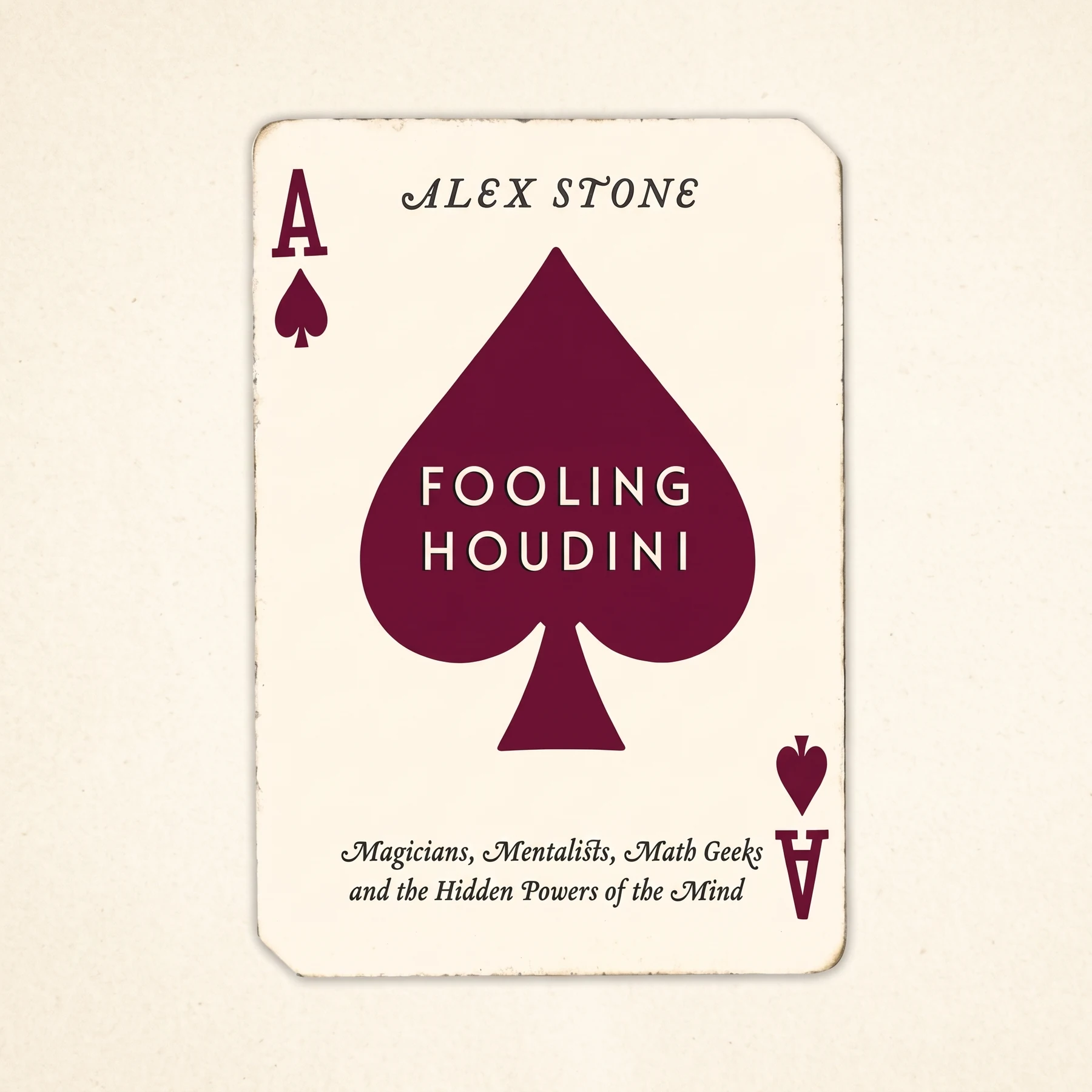
Fooling Houdini: Magicians, Mentalists, Math Geeks, and the Hidden Powers of the Mind
By Alex Stone
Uses the craft of magicians to show how attention, touch, flattery and logic can be steered, and how knowing those tricks protects you from deception and opens a playful route to new ideas.
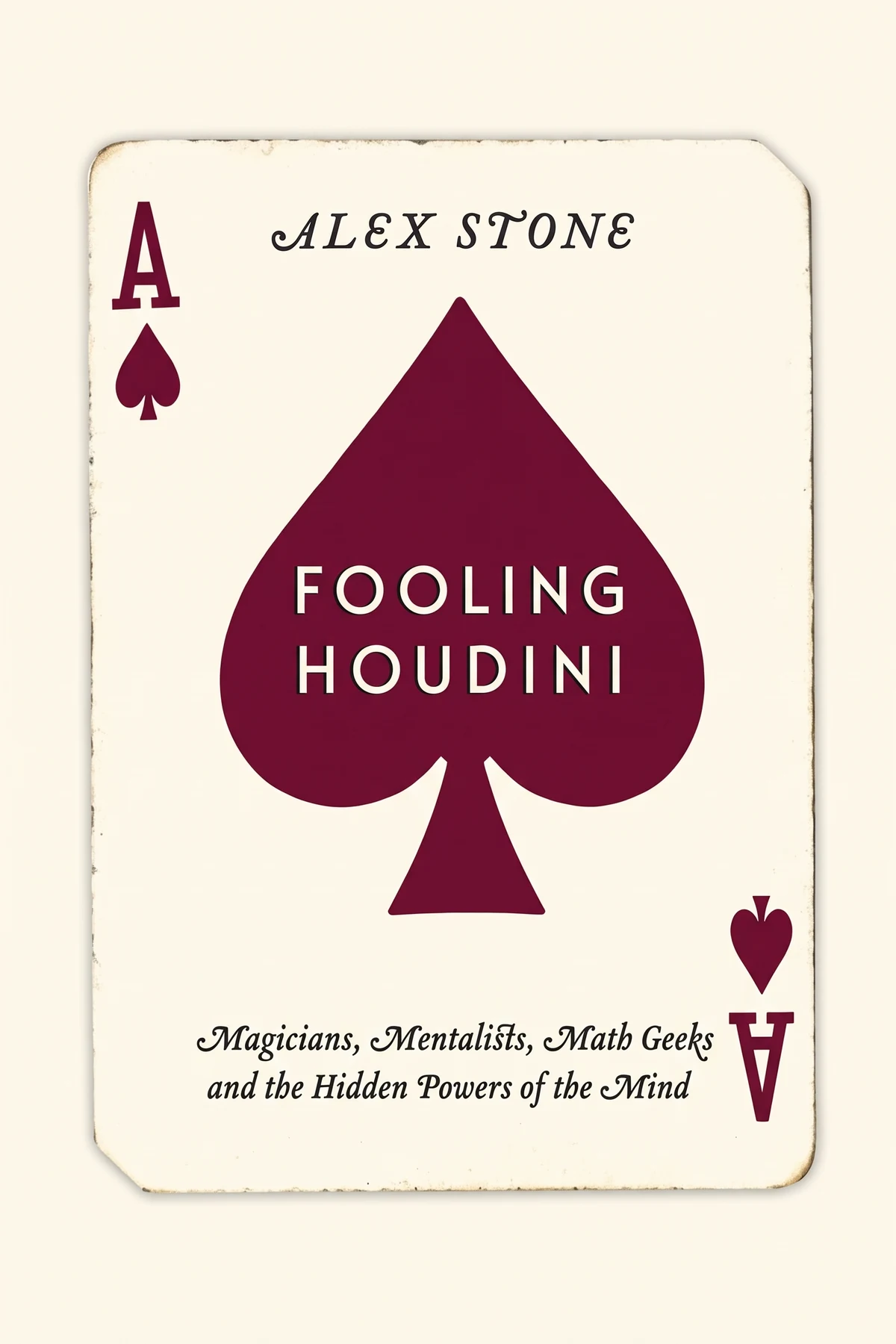
Table of Content
1. Introduction
1 min 06 sec
Most of us trust our eyes, yet in a University of Illinois experiment, viewers who were tallying ball passes in a brief film failed to notice someone dressed as a gorilla strolling across the middle of the game. In Fooling Houdini, Alex Stone, who got his first magic kit at five and later competed at the Magic Olympics, argues that magic lives in gaps exactly like that one.
His case is that a trick is a working model of the mind. It shows where attention fails, how far touch can be trained, why we believe vague statements about ourselves, and how closely the craft is tied to gambling, finance and science. Grown-ups usually file magic under childish things once they learn there is no real sorcery. Stone suggests the opposite. Learn how a trick is built and you gain a sharper eye for deception in sales pitches and markets, a few habits for holding an audience, and a reason to start playing again.
2. See the gaps in your own attention
1 min 58 sec
A film error in a famous romantic comedy goes unnoticed by almost everyone who watches it. The reason has less to do with poor eyesight than with how focus works, and magicians count on it.
3. Train your fingers to read what eyes miss
1 min 39 sec
In the few seconds a card magician seems to shuffle carelessly, something precise is happening out of sight. The skill behind it says a lot about the brain, and anyone can build it.
4. Stay one step ahead of what people expect
1 min 49 sec
Card sharps, con artists and some investment sellers share a habit with stage magicians. It flatters people into feeling smarter than they are, much like a pitch that sells an investment as safe.
5. Spot how vague statements feel personal
1 min 55 sec
A fortune teller says something about you that seems impossible to know. Houdini had a simple routine for producing that chill, and the psychology behind it shows up in every horoscope column.
6. Share your methods and still stay ahead
1 min 51 sec
Houdini claimed no one could fool him three times with the same trick. One card routine beat him again and again, and today anyone can look it up. Its survival says something about keeping an edge.
7. Use math and play to spark new ideas
2 min 03 sec
A performer hands out three cards without looking and names the rest of the hand from who stands up. It feels like mind reading. The real source is a Dutch mathematician and a habit most adults abandon.
8. Conclusion
1 min 16 sec
Fooling Houdini turns out to be a book about how minds get steered, guided by people who steer them for a living. A card that changes suit unnoticed, a reading that seems to know you, a deck that obeys a mathematical pattern: each works because perception, belief and logic have predictable habits. Magicians simply study those habits harder than the rest of us, and Stone finds the same study running through card tables, trading floors and laboratories.
That knowledge cuts both ways. It makes you a harder mark, because when a pitch flatters your intelligence or a prediction feels uncannily personal, you can ask whether the ego hook or the Barnum effect is doing the work. It makes you a better performer, someone who trains hands and tools until skill becomes feel, and who knows that an idea delivered with character and a laugh travels further than a bare fact. It also offers adults a way back to play, an often innovative mindset shared by children and by Leonardo, who loved puzzles, games and tricks.
Children are hard to fool because their attention wanders. Keeping a little of that wandering may be an adult’s best defense, and the best source of new tricks.
About this book
What is this book about?
Most adults stop caring about magic once they learn there is no real sorcery behind it. Alex Stone argues that this is exactly when magic gets interesting. A good trick shows, with uncomfortable precision, where human perception and judgment break down. Stone, a physics graduate who was drawn into New York's underground magic scene, follows magicians, mentalists and mathematicians to explain how their methods work. He covers the gorilla experiment and the limits of attention, the trained fingers of card handlers, the flattery magicians and salespeople share, and the vague statements that make a fortune teller seem to know your secrets. He tells how Dai Vernon fooled Houdini seven times with one card routine, and how a mathematical pattern lets a performer appear to read minds. The result is a tour of the hidden links between magic, gambling, finance and science. Readers learn to spot when their own attention or ego is being steered, pick up habits for holding an audience, and see why play remains one of the best tools for discovery.
Book Information
Who it's for
Hoping to spot flattery
Professionals who want to spot flattery and misdirection in sales pitches, investments and negotiations.
Wanting to hold attention
Presenters and team leads looking for ways to hold attention and tell a better story.
Curious how showmanship works
Curious readers drawn to the overlap of psychology, math and showmanship.
About the Author
Alex Stone
Alex Stone studied English at Harvard University and later earned a master's degree in physics from Columbia University. A magic kit from his father at age five started a lifelong interest, and in New York City he joined an underground magic scene and went on to compete at the Magic Olympics. He grew up in Wisconsin, Texas and Spain and lives in New York City.
Ratings & Reviews
Ratings at a glance
What people think
Listeners find this book both amusing and deeply researched, offering strong insights into the overlap between magic and the scientific world. Both the writing and storytelling are praised, with one listener remarking on how easily the science integrates into a fascinating narrative. The peek into the lives of magicians is appreciated, and one listener specifically notes the mathematics involved in cool tricks. Pacing draws varied opinions, and several listeners suggest the title is misleading.
Top reviews
Paiboon
I've been fascinated by magic since I was a kid, so this was a total treat. The chapter on Richard Turner, the blind card mechanic, is absolutely mind-blowing and worth the price of the book alone. Stone does a fantastic job of explaining that the hand is not actually quicker than the eye; rather, it’s the mind that fails to keep up. I loved how he connected his physics background to the mechanics of shuffling and deck manipulation. It made me look at a standard pack of 52 cards as a mathematical universe. While some critics say he reveals too much, I think he provides just enough to make you appreciate the sheer effort required to master these illusions. This is a brilliant, multi-layered look at what it means to be obsessed with perfection. I couldn't put it down.
Show moreParichat
The truth is, I didn't expect to be so moved by a book about card tricks. Stone captures the soul-crushing dedication required to master an art form that most people view as a birthday party gimmick. His descriptions of the 'Magic Castle' and the eccentric characters who inhabit it are vivid and often hilarious. I was particularly struck by the idea that magic is essentially theater disguised as a challenge to the audience's intelligence. The mathematical beauty he finds in a simple shuffle changed how I look at everyday objects. It’s a book about obsession, failure, and the ultimate joy of finally getting it right. Some might find him arrogant, but I saw it as the raw honesty of someone who has failed publicly and lived to tell the tale. This is a fascinating, beautifully written memoir that transcends its subject matter. Highly recommended.
Show moreKoi
This book provides a captivating look at the intersection of psychology and sleight of hand. Stone manages to weave complex mathematical concepts into a narrative that feels both personal and academic. I particularly enjoyed the sections on how our brains parse visual information, which made the magic feel like a legitimate field of study rather than just a hobby. However, some of the anecdotes felt a bit self-indulgent, and the pacing dragged during the middle chapters about his specific practice routines. Despite the occasional ego trip, the exploration of what Stone calls the 'honest liar' remains a highlight for anyone interested in the mechanics of deception. It is an insightful journey into a secretive subculture that most of us will never see from the inside. The writing is sharp, even if the author's personality is sometimes polarizing.
Show moreEye
Picked this up on a whim and was pleasantly surprised by the depth of the mathematical explorations. Alex Stone is a physicist, and that perspective shines through when he discusses the probability involved in card stacking and shuffles. It’s not just a book about tricks; it’s a study of human nature and why we enjoy being fooled. The narrative flow is generally good, though it meanders a bit during the historical segments. I appreciated his willingness to look like a fool during his early competitions at the Magic Castle. It humanized a story that could have otherwise felt like a lecture. The truth is, magic is a lonely, obsessive pursuit, and Stone captures that vibe perfectly. If you want to understand the 'why' behind the 'how,' this is a solid choice. Great for science buffs and casual fans alike.
Show moreMatteo
After hearing so much about the drama surrounding this release, I expected something far more scandalous. What I found instead was a well-researched and engaging look at the psychology of deception. Stone’s journey from a disqualified amateur to a competent performer is a classic underdog story, even if his personality is a bit polarizing at times. He manages to explain the 'Mandolin-backed' deck and the neuroscience of misdirection without making it feel like a dry textbook. My only real complaint is the pacing, as some of the workshop descriptions felt repetitive. Still, the way he describes the 'mob' of a street con is masterfully done. It’s a rare peek behind the curtain that manages to keep the sense of wonder intact. Definitely worth a read if you're curious about the 'magician’s mindset.' It’s a fun, fast-paced ride through a very strange world.
Show moreUdom
Finally got around to reading this, and it’s a beautiful tribute to the obsession required to master a craft. Stone captures that childlike sense of wonder while simultaneously dismantling the illusions with cold, hard logic. The way he describes his failures—especially the disqualification in Stockholm where he hid his hands—makes his eventual progress feel earned rather than given. I was particularly fascinated by the 'Touch Analyst' chapter, which makes the card mechanics sound like superheroes of the gaming table. The narrative shifts from street hustlers to high-stakes competitions without ever losing the reader's interest. It is a brilliant, multifaceted look at the psychology of belief. Despite some minor factual errors mentioned by the magic community, the book succeeds as an entertaining piece of popular science. It’s a fascinating look at the world of people who live to deceive us.
Show moreSun
Ever wonder how much practice goes into a single card trick? Alex Stone answers that with agonizing detail, though the book struggles to find a consistent tone between a science journal and a memoir. One moment you are learning about the neuroscience of inattention with experts like Macknick and Martinez-Conde, and the next, you are reading about Stone’s embarrassing disqualification at what he calls the 'Magic Olympics.' While the information on street grifters was genuinely fascinating, the book felt like it was padded with unnecessary fluff to reach its page count. To be fair, the prose is quite good, but the author’s tendency to name-drop every famous magician he met became exhausting. It’s an okay read for a plane ride, but it lacks the depth of a truly definitive work on the subject. I enjoyed the math, but found the personal drama a bit thin.
Show moreSupranee
Honestly, the book is a bit of a mixed bag. On one hand, the writing is polished and the stories about the underground magic scene are entertaining enough to keep you turning pages. On the other hand, the author comes across as a bit of a 'douchebag'—to borrow a term from other reviewers—especially regarding his attitude toward the magic community that eventually shunned him. The title is also somewhat misleading, as Houdini is barely a factor in the narrative. It’s more of a personal quest for validation after a public failure. I found the science bits interesting, but they often felt like they were pulled from a Google search rather than deep investigative reporting. It’s a decent enough anecdotal history, but it doesn't quite reach the heights of other narrative non-fiction in this genre. It's fine, just not groundbreaking.
Show moreDimitri
Look, the title 'Fooling Houdini' is a bit of a marketing stretch since the book is really about Stone's own journey. While the science flows smoothly into the story, the author’s tendency to reveal trade secrets feels a bit like a vendetta against the clubs that rejected him. Some of the technical descriptions were a bit off, which might annoy the purists, but for a casual reader, it’s entertaining enough. I just wish the narrative had a bit more heart and a bit less ego. It’s an okay weekend read.
Show moreNatnicha
As a longtime magic enthusiast, I found Stone’s approach incredibly frustrating and frequently inaccurate. He refers to FISM as the 'Magic Olympics' and mislabels basic techniques like the center deal, calling it a 'middle deal' instead. These errors suggest a lack of deep research that undermines his claims of having unprecedented access to the community. Furthermore, his descriptions of women are often creepy and feel entirely out of place in a modern non-fiction work. The writing is technically proficient, but the underlying arrogance and factual sloppiness left a very bitter taste in my mouth. Frankly, there are much better books on the market if you actually want to learn about the craft without the ego. He spends more time revealing secrets to look smart than actually honoring the art form he claims to love. Disappointing.
Show moreQuestions about this book
What is Fooling Houdini by Alex Stone about?
Alex Stone uses the world of magicians, mentalists and mathematicians to show how the mind can be fooled. He explains inattentional and change blindness, trained touch, the ego hook, the Barnum effect and mathematical card tricks. He also links magic to gambling, finance and science, arguing that knowing how tricks work sharpens your eye for deception and revives a playful way of thinking.
How did Dai Vernon fool Houdini?
Houdini claimed no one could fool him three times with the same trick. In 1922 Dai Vernon did his ambitious card routine for Houdini, who picked a card and put it back in the deck without anyone seeing it, and after Vernon shuffled, the card kept rising to the top. Houdini was fooled seven times before giving up. Today the routine can be found online, yet experts still fool each other with new versions.
What is the ego hook in magic?
Stone describes the ego hook as flattering people so they feel smarter than they really are. Once someone believes they have figured something out, their urge to prove it makes them easier to lead. Magicians use it to set up surprises, and Stone compares it to persuading someone that an investment is safe. A sudden feeling of cleverness is a good moment to slow down.
Why are children harder to fool with magic than adults?
According to Stone, children’s attention is less focused than adults’ because their brains have not yet learned what to pay attention to. Magic often relies on directing focus so that people miss something obvious, as in the gorilla experiment. Because a child’s attention wanders more freely, misdirection works less reliably, and they are more likely to notice what the magician hoped to hide.
How can I apply the ideas in Fooling Houdini?
Assume that intense focus on one detail hides something obvious, and ask others what they noticed. Test any uncanny personal statement by asking whether it would fit a stranger. Treat flattery in a sales pitch as a warning sign. When presenting, give your idea a clear character and some humor. And set aside time for puzzles and play, which Stone links to discovery.
Readers also enjoyed

Acting with Power: Why We Are More Powerful Than We Believe
Deborah Gruenfeld


Age of Propaganda: The Everyday Use and Abuse of Persuasion
Anthony Pratkanis




59 Seconds: Change Your Life in Under a Minute
Richard Wiseman


AUDIO SUMMARY AVAILABLE
Listen to Fooling Houdini in 15 minutes
Get the key ideas from Fooling Houdini by Alex Stone, plus 5,000+ more nonfiction titles.
- 5,000+ titles
- Listen as much as you want
- 7-day free trial
- Cancel anytime









