
15 min 15 sec
Available in: English
Focus: The Future of Your Company Depends on It
By Al Ries
Shows why chasing size through new products, new industries and new countries often weakens a company. It also explains how specializing in one field makes customers see you as the expert worth paying for.
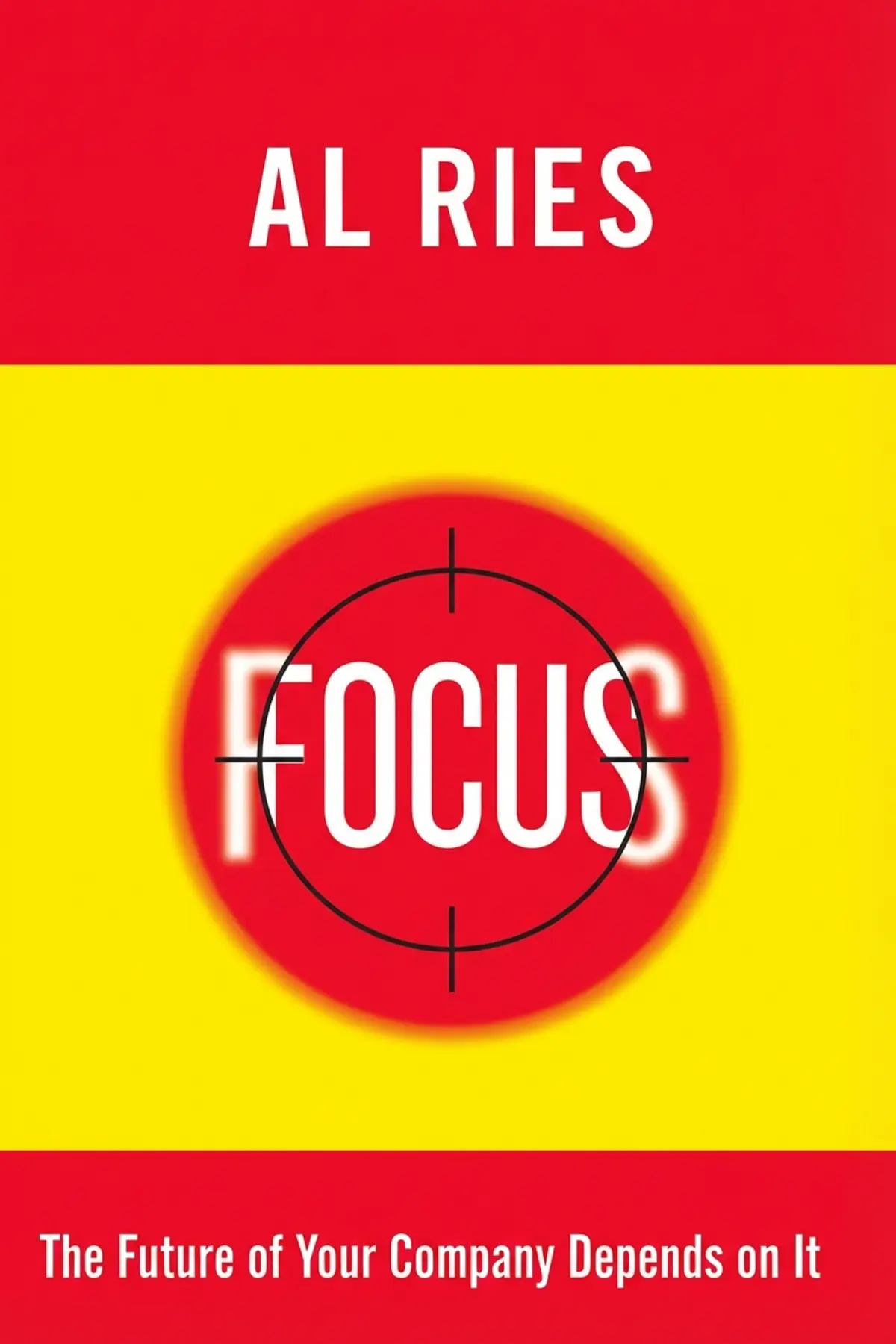
Table of Content
1. Introduction
1 min 15 sec
If your company keeps adding products, markets and countries and still feels stuck, Al Ries has an uncomfortable diagnosis: the growth itself may be the problem. In Focus, the marketing strategist who helped announce the Positioning Era in 1972 points to two soft drink giants. In the same year PepsiCo sold far more than Coca-Cola, yet the stock market valued Coca-Cola at more than twice as much.
The difference, Ries argues, is focus. A company that narrows itself to one field, and moves that field when technology shifts, becomes the expert customers trust. A company spread across everything becomes hard to manage and easy to pass over.
Along the way come the cost math that makes size so tempting, the three expansion habits that blur a business, the case for specializing, a hard lesson from Kodak and the way General Motors ran many brands without chaos. What stays with you is a question to put to any product, team or plan: does this sharpen what we stand for, or dilute it?
2. The bakery math that makes growth so tempting
1 min 34 sec
A single oven and a few hundred loaves of bread explain why nearly every manager on Earth wants a bigger company. The logic is sound, which is exactly what makes its blind spot so easy to miss.
3. Bigger sales can still mean a smaller company
1 min 43 sec
One soft drink company sold almost twice as much as its rival, yet investors valued it at less than half. The explanation says a lot about what managers can and cannot run well.
4. Spot the expansions that blur your brand
1 min 34 sec
Putting a famous name on a new product feels like free sales. A group that owns an airline put its brand on cola and vodka, and that move shows the hidden cost of every extension and where it comes from.
5. Go global without losing what you do best
1 min 43 sec
Falling trade barriers made selling abroad easier than ever. For one well-known typewriter maker, the open world market became the place where a clear, profitable business turned into years of losses.
6. Grow stronger by cutting your product range
1 min 23 sec
A children’s store only became a big success once its founder dropped the furniture and sold nothing but discount toys. His decision runs against every growth instinct, and it explains why some famous department stores kept sliding into bankruptcy.
7. Get seen as the expert customers trust
1 min 34 sec
Most buyers cannot tell which product is technically best, so what do they rely on instead? A heart patient’s choice of doctor holds the answer, and it reshapes where a company should spend its effort.
8. Move your focus before technology moves the market
1 min 36 sec
In 1992 Kodak led the analog photography market as a $20 billion corporation. By 1995 it was down to a $13 billion company, as buyers turned to a new kind of camera and one executive’s reluctance to embrace it cost the company dearly.
9. Run many businesses without competing against yourself
1 min 36 sec
General Electric and Dover Corporation operate in dozens of markets and still succeed. An early crisis at General Motors shows the discipline that separates a well-run collection of brands from a costly mess.
10. Conclusion
1 min 17 sec
Ries turns a familiar ambition upside down. Growth promises lower costs and bigger profits, and the bakery math is real. Yet every route to size he examines, from new brands to unrelated businesses to global markets, tends to spend the one asset that made the company worth growing: a clear answer to what it does. Coca-Cola, with less revenue, was worth more than twice as much as PepsiCo. Toys R Us became famous only after it threw out the furniture.
The practical habit is subtraction. Before launching a product or entering a market, list the new rivals it brings and ask whether customers will still see you as the specialist. Look at your range and decide what you would cut to be known for one thing, the way Lazarus did. Keep watching the technology that could make your field obsolete, so your focus moves before the market does, a lesson Kodak learned too late. And if you must run many businesses, give each its own customer and its own price, as Sloan did at General Motors.
Bigger is easy to measure. Ries’s case is that being the obvious choice in one field is worth more, to customers and to the market alike.
About this book
What is this book about?
Almost every company wants to grow, and the logic seems solid: spread fixed costs over more output, cut prices and win more customers. Al Ries argues that this pursuit of size often destroys the thing that made a company worth growing in the first place, which is a clear focus. Ries follows the ways companies lose it. Line extension puts one brand name on unrelated products, diversification pushes into businesses with no link to the core, and globalization tempts focused firms to fight established rivals on every front. He sets these failures beside companies that narrowed and won. Coca-Cola, smaller in sales than PepsiCo, was worth more than twice as much. Toys R Us took off only after it dropped furniture. Kodak shows the other side, a leader that held on to film while customers moved to digital cameras. Readers get a clear test for any growth plan. Will it sharpen what the company stands for, or blur it? Ries adds a way to specialize, a reason customers trust specialists, and the method General Motors used to run several brands without them competing against each other.
Book Information
Who it's for
Tempted to keep expanding
Founders and owners tempted to add products, brands or countries to keep sales rising.
Deciding what to cut
Managers and strategists deciding which projects to cut and which specialty to defend.
Marketers curious about specialists
Marketers who want to understand why customers trust specialists over generalists.
About the Author
Al Ries
Al Ries (1926 to 2022) was a marketing strategist born in Indianapolis, Indiana. He co-founded the Atlanta consulting firm Ries and Ries, which he chaired while working alongside his daughter Laura Ries. In 1972 he co-wrote a three-part series in Advertising Age magazine announcing the arrival of the Positioning Era. His 12 books are reported to have sold more than 6 million copies worldwide, and they include The 22 Immutable Laws of Marketing and, with Laura, The 22 Immutable Laws of Branding.
Ratings & Reviews
Ratings at a glance

What people think
Listeners find the writing accessible and value the author’s delivery, with one listener pointing out the engaging examples. Feedback is divided regarding how well the material has aged; one listener claims it is still relevant, whereas another feels it has become dated.
Top reviews
Tippawan
Al Ries hits the nail on the head regarding why so many massive corporations eventually crumble under their own weight. The central premise is that narrowing your focus is the only way to build a truly dominant brand in the long run. Truth is, many companies try to be everything to everyone and end up becoming nothing to nobody. Ries uses a ton of case studies to prove his point, and while some might feel repetitive, they drive the message home effectively. I found the writing style punchy and very easy to get through in a few sittings. Even if you aren't in marketing, the logic applied here is useful for any career path where you need to stand out. It’s a classic for a reason.
Show moreJiraporn
Stop everything you are doing and read this if you are trying to scale a brand in a crowded market. The mantra 'Focus or Die' might sound extreme, but Ries makes a compelling case for why it is the fundamental law of branding. I love how he breaks down the dangers of growth for growth's sake. So many businesses get greedy and start slapping their name on everything, which just dilutes their power. This book teaches you the discipline required to say 'no' to opportunities that don't fit your core mission. It's a quick read but the mental shifts it triggers are profound and lasting. I've already started applying these principles to my own small business and the clarity it provides is refreshing. Definitely a must-read for entrepreneurs.
Show moreSombat
After hearing about Ries for years, I finally see why he is considered a titan in the marketing world. This book is a masterclass in staying disciplined when the market is screaming at you to diversify. I think the comparison to 'The E-Myth' is spot on because both books emphasize the importance of a clear, repeatable system. The way Ries explains that 'doing everything' is actually a competitive disadvantage changed my perspective on our company's roadmap. The writing is incredibly readable and lacks the dry, academic tone of most business books. I actually finished it in one afternoon because I couldn't put it down. It’s one of those rare books that provides immediate clarity on why certain brands win and others fade away.
Show moreChokdee
Simple truths are often the hardest to implement, and this book proves it on every single page. Ries challenges the conventional wisdom that bigger is always better. Instead, he advocates for being the best in a very specific category. In my experience, the businesses that struggle most are the ones that have lost their identity by trying to please everyone. This book is the cure for that identity crisis. The author’s tone is confident and persuasive, making it a joy to read. Even though the technology mentioned is old, the human psychology of how we perceive brands is timeless. This is going on my shelf of books to revisit every couple of years. It’s a vital reminder to stay narrow and stay deep.
Show moreYam
Picked this up during a weekend getaway and found it surprisingly digestible for a marketing text. The author’s style is conversational and bold, never shying away from making definitive statements about what works and what doesn't. My favorite part was the discussion on how companies lose their way by trying to chase every new trend. Look, we see this constantly in the modern era with tech giants overreaching into sectors where they have no business being. While the specific company names in the book might be dated, the behavior patterns are exactly the same. The only reason I’m not giving it five stars is that it lacks deep statistical data to back up some of the more controversial claims. It relies heavily on news clippings and anecdotes.
Show moreLuckana
While some critics argue that the examples are stuck in the nineties, the underlying logic remains incredibly potent. You have to be able to filter out the references to defunct computer companies and see the evergreen marketing strategy beneath. Ries writes with a clarity that is rare in business books today. He doesn't use jargon to sound smart; he uses plain English to explain complex market dynamics. I particularly enjoyed the sections on how to defend a niche against larger, more unfocused competitors. Not gonna lie, some of the chapters feel a bit 'samey' after a while, but the reinforcement helps the message stick. It’s a solid 4-star read that provides a great framework for anyone looking to understand brand positioning.
Show moreKanchana
The perpetual battle between diversification and specialization is the heartbeat of this entire book. Ries argues that the biggest threat to a successful company is actually its own desire to expand into new territories. It’s a counter-intuitive idea because we are always told that growth is the ultimate goal. But he shows, through dozens of examples, how that growth can lead to a slow death of mediocrity. The prose is sharp and the pacing is excellent. I found myself nodding along to his critiques of 'line extension' traps. My only gripe is that it feels a bit light on the 'how-to' side of things. It tells you what to do, but the execution steps are a bit vague. Still, it’s a foundational text for any strategist.
Show morePete
It is quite a trip reading these business predictions decades after the ink has dried. Some of the calls Ries makes, especially concerning Apple and the future of converged technology, are laughably wrong in hindsight. However, if you can look past the outdated tech references, the core principle of avoiding line extension still feels valid today. The book reads a bit like an extended magazine article, which makes it perfect for a lazy Sunday afternoon read on the sofa. I did find the sheer volume of examples a bit overwhelming after a while, though. It’s worth a look for the historical perspective, but maybe pair it with something more modern to see how these ideas evolved. To be fair, the basic psychology of branding hasn't changed that much.
Show moreBrooklyn
Is it possible for a book to be both brilliant and incredibly repetitive at the same time? Ries has a fantastic core thesis, but he beats you over the head with it until you’re almost tired of hearing the word 'focus.' To be fair, the examples are interesting from a historical standpoint, even if some of the predictions didn't age well. It’s the kind of book you can skim and still walk away with 90% of the value. I wouldn't call it a waste of time, but it certainly could have been a long essay instead of a full-length book. If you are new to the world of branding, this is a decent entry point. Just don't expect a lot of variety in the arguments presented.
Show moreOm
Frankly, this felt more like a collection of cherry-picked corporate anecdotes than a serious business study. The author has one single point—focus is good, diversification is bad—and he spends 200 pages repeating it with different company names. There is zero statistical rigor here, just a series of 'I told you so' moments based on headlines from the 90s. If a company failed, Ries blames a lack of focus; if they succeeded, he finds a way to credit their focus. It feels like a very simplistic way to view the complex world of global economics. I think you could read the first chapter and get everything you need from this book. Save your time and read something with more substance and less infotainment vibes.
Show moreQuestions about this book
What is the main idea of Focus by Al Ries?
Ries argues that chasing growth often costs a company its focus, and focus is what makes it valuable. Line extension, diversification and going global all spread a business across more products and more competitors. Narrowing to one field makes the company easier to manage and leads customers to see it as the expert. His headline example is Coca-Cola, which sold less than PepsiCo but was worth more than twice as much on the stock market.
Why do specialized companies perform better, according to Al Ries?
Most customers cannot judge technical quality themselves, so they look to experts, and in business the experts are the companies that specialize. Ries compares it to choosing a cardiologist over a general practitioner for heart disease. IBM’s position in mainframes in the 1970s and Coca-Cola’s reputation for tasting better both reflect this. What matters is whether customers perceive higher quality, because products seen as high quality sell better.
What does Focus say about Kodak and digital photography?
Kodak’s chief executive in the 1990s, George Fisher, believed digital photography would not replace film for many years. Digital soon took most of the market. Kodak went from a $20 billion company in 1992 to $13 billion in 1995 and was among the last to sell digital cameras. Ries says Fisher should have watched technology earlier and moved Kodak’s focus from analog to digital in time.
Can a conglomerate with many brands still be focused?
Yes, Ries says, if it uses a multi-step focus: each business gets its own market and the units are kept from competing with each other. General Motors once had seven brands with overlapping prices that took each other’s customers. In 1921 Alfred Sloan cut the list to five, from Chevrolet to Cadillac, and gave each its own price range and type of customer.
How can I apply the ideas in Focus to my business?
Before adding a product or entering a market, list the new competitors it brings and ask whether customers will still see you as a specialist. Look for what you could remove, as Charles Lazarus did when he dropped furniture to make Toys R Us a discount toy store. Name the technology that could make your core product unnecessary. If you run several offers, give each a separate customer and price.
Readers also enjoyed


A Year with Peter Drucker: 52 Weeks of Coaching for Leadership Effectiveness
Joseph A. Maciariello



Acting with Power: Why We Are More Powerful Than We Believe
Deborah Gruenfeld

All In: How Great Leaders Build Unstoppable Teams
Mike Michalowicz



7 Powers: The Foundations of Business Strategy
Hamilton Helmer

AUDIO SUMMARY AVAILABLE
Listen to Focus in 15 minutes
Get the key ideas from Focus by Al Ries, plus 5,000+ more nonfiction titles.
- 5,000+ titles
- Listen as much as you want
- 7-day free trial
- Cancel anytime









