
12 min 29 sec
Available in: English
 ไทย
EnglishไทยThe 22 Immutable Laws of Marketing: Violate Them At Your Own Risk!
By Al Ries, Jack Trout
Shows why customers buy what they believe is best, and how to win that belief by being first in their minds, creating your own category, owning one word and keeping your brand narrow.
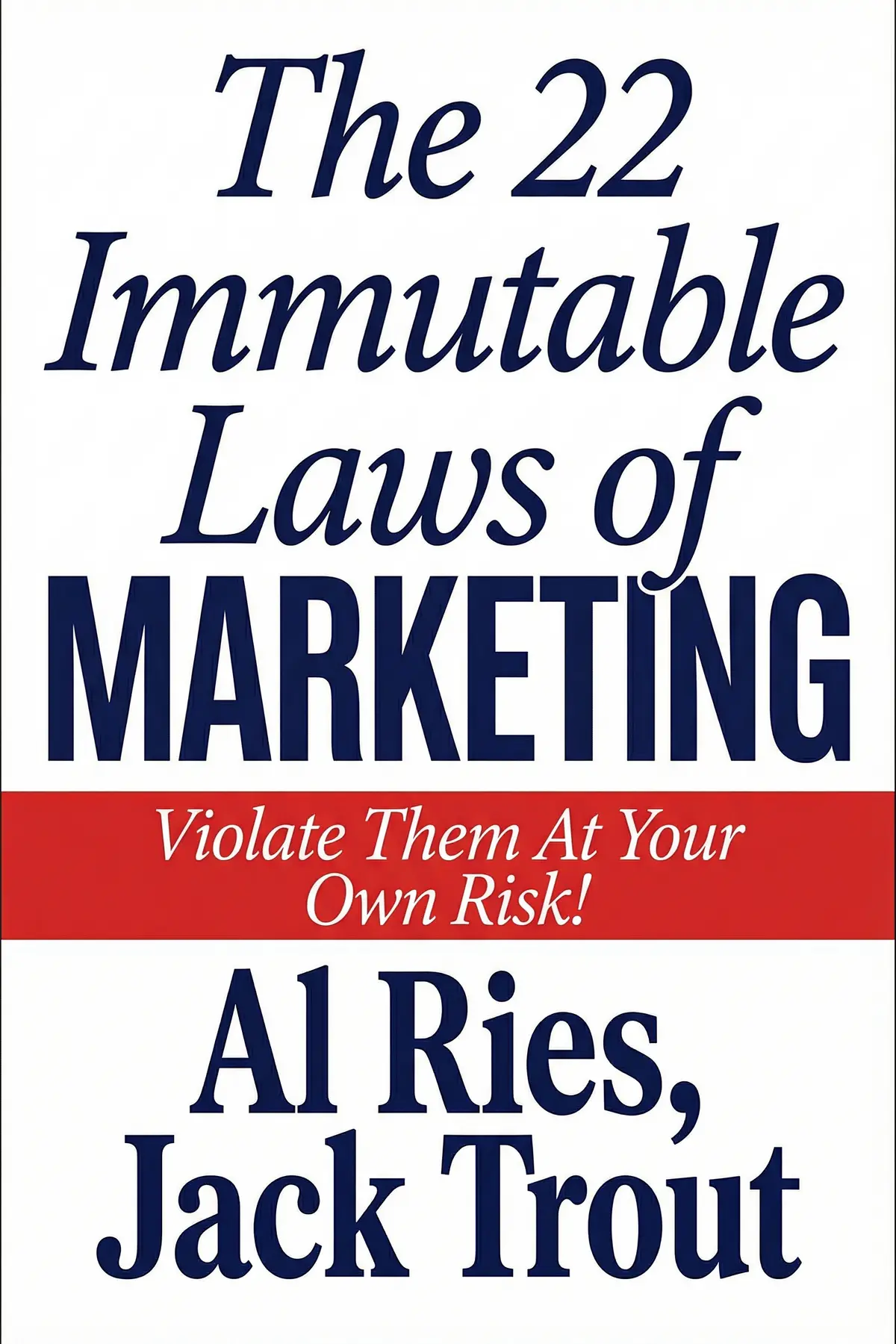
Table of Content
1. Introduction
54 sec
Most companies facing falling sales spend millions improving the product, when the real problem sits in the customer’s head. In The 22 Immutable Laws of Marketing, advertising veterans Al Ries and Jack Trout argue that people buy what they believe is better, and that belief outweighs the facts. Honda shows it plainly. At home in Japan it is seen as a maker of motorcycles, so few Japanese buy its cars, while in the United States the same cars rank among the best-selling imports.
The throughline is simple. Marketing is a contest of perceptions, and it is won by getting into the customer’s mind first, in a category or a single word you can own, and then guarding that spot against your own pride. The laws ahead show where to aim when someone else got there first, what to give up so a brand stays sharp, and how to answer a rival who catches you out.
2. Get into the customer's mind first
1 min 34 sec
Some brand names have stopped being names at all and turned into ordinary words for the thing itself. Once that happens, a competitor with a better product faces an opponent that features alone cannot beat.
3. Invent a category you can lead from day one
1 min 47 sec
A latecomer entered a field already crowded with look-alike firms and still ended up on top within a few years. The move he made works for any company stuck behind a leader it cannot outrun.
4. Own one word in the customer's mind
1 min 45 sec
A battery maker poured money into a lovable television mascot to win one simple idea from its rival. However many funny ads ran, the campaign still failed, since buyers kept linking the idea with Duracell. The reason sets a hard limit on every brand.
5. Grow stronger by offering less
1 min 51 sec
Customers say they love choice, so a longer product line looks like the obvious path to growth. Retailers, a soft drink giant and a carmaker show when adding more makes a brand weaker and when it does not.
6. Keep success from blinding your judgment
1 min 52 sec
A computer company at the top of its field was offered a seat in a brand new category and said no. The decision felt safe at the time, and it shows how winning can set up a fall.
7. Turn a rival's attack into a reason to buy
1 min 40 sec
A competitor ran ads mocking a mouthwash for its terrible taste, and the charge was true. The company answered without a single denial, and customers came looking for it as a result.
8. Conclusion
1 min 06 sec
Ries and Trout keep returning to one small place: the space a brand takes up in a customer’s head. Honda’s reputation in Japan, Heinz and ketchup, Volvo and safety, the computer DEC refused to build, each turns on what buyers believe, and money poured into the product rarely shifts that belief. The authors’ larger claim is that a big marketing budget matters less than knowing the rules the game follows.
That changes where you look for answers. Their own advice is to leave the office. Before your next change of strategy, put the charts aside and talk to the people you want to sell to. Ask them which brand pops into their heads at the mention of your category, and their replies will reveal your position on the ladder, untouched by what your ego would like to hear. If the name they give is someone else’s, the work is clear: find a category where you can be first, a single word nobody owns, and the nerve to drop whatever blurs it.
The Japanese shopper who walks past a Honda car is not judging the engine. She is remembering a motorcycle.
About this book
What is this book about?
When sales fall, many companies spend heavily to improve the product. Al Ries and Jack Trout argue that this usually misses the real problem. Customers buy what they believe is superior, so the fight takes place in their minds, and a better product rarely changes a belief that has already formed. The authors set out a series of laws for that fight. Be first in the customer's mind, or invent a category where you are first by definition. Position yourself against the leader instead of copying it. Own a single word, and never chase one a rival already holds. Give up products and audiences that blur your brand, and give new categories their own names. Their cases range from Charles Schwab's discount brokerage and Pepsi's youth campaign to Energizer's failed bunny and General Motors' separate car brands. The book also covers the threats that come after success: arrogance, faith in long-range forecasts, refusal to admit mistakes, and panic over a rival's press coverage. Readers get a plain set of tests for judging where their brand stands and a candid way to answer a competitor who exposes a real flaw.
Book Information
Who it's for
Up against better-known brands
Founders and small business owners competing against a bigger, better-known brand.
Marketers and product managers
Marketers and product managers deciding whether to extend a product line or launch a new name.
Moving into marketing
Professionals moving into marketing who want a short set of rules for judging strategy.
About the Author
Al Ries
Al Ries co-founded the Atlanta consulting firm Ries & Ries, which he chaired alongside his daughter Laura. In 1972 he co-wrote a three-part Advertising Age series announcing the Positioning Era, and his 12 books are reported to have sold more than 6 million copies. Jack Trout was an advertising executive and an owner of the consulting firm Trout & Partners. He is credited with pioneering both positioning theory and marketing warfare theory, and he wrote or co-wrote many bestselling books.
Ratings & Reviews
Ratings at a glance

What people think
Listeners consider this marketing guide a fantastic resource for those in the business world, providing useful ideas and accessible information. The work breaks down fundamental marketing theories and shares beneficial tips for strengthening marketing strategies, proving especially helpful for beginners. While listeners praise the book's transparency and overall worth, they mention that the examples and advice are notably out of date.
Top reviews
Wichai
This book is essentially the marketing bible for a reason. Even though the examples like IBM and Hertz feel like ancient history, the psychological principles are timeless. I loved the emphasis on being first in the mind rather than just being first to market. Truth is, many people try to "better" their way to success when they should be trying to be "different." It’s a slim volume, barely 130 pages, but every chapter hits like a hammer. If you can look past the outdated references to minicomputers, the core logic about perception is invaluable for any modern business professional.
Show moreRoydao
Picked this up during my first week at a startup and it completely rewired how I think about our competition. The authors hammer home the idea that trying to be "better" is a losing game; you have to be the first in a new category. It's an easy-to-grasp philosophy that cuts through the noise of modern "growth hacking" buzzwords. Not gonna lie, some of the charts and examples feel like they were pulled from a 1970s archive. But if you can look past the age, the strategy of owning a single word in the customer's mind is pure gold for anyone building a brand.
Show moreSakura
The chapter on the Law of Division alone makes this worth the purchase price. Watching how categories split into sub-categories over time is exactly what we are seeing with the internet today, even if the authors were looking at minicomputers back then. This book simplifies core marketing concepts so effectively that a high schooler could grasp them, yet the implications for multi-million dollar brands are huge. I especially appreciated the Law of Sacrifice. You can't be everything to everyone. If you try to chase every customer, you end up standing for nothing at all. It's a mandatory read for my team.
Show moreValentina
Marketing isn't a battle of products; it's a battle of perception, and Ries and Trout prove it on every page. I found the Law of Candor particularly fascinating because it flies in the face of traditional "perfect" corporate messaging. By admitting a weakness, you gain the prospect's trust, which is a rare commodity these days. Gotta say, the writing is quite monotone at points, but the insights are sharp enough to keep you engaged. It’s a foundational text that every newcomer should read at least once to understand how the "big players" established their dominance in the mind of the consumer.
Show moreDaranee
After hearing my boss quote 'the law of leadership' for the tenth time, I finally grabbed a copy to see what the fuss was about. It is an incredibly quick read that simplifies high-level business concepts into digestible nuggets. Personally, I found the Law of the Ladder to be a total eye-opener regarding how customers rank brands in their heads. My only gripe is that the authors treat their observations like gravity, even when modern tech companies prove them wrong daily. Still, for the price, it provides a great framework for anyone new to the field who needs to understand the basics of positioning.
Show moreChanpen
Can you really distill an entire creative industry into 22 rigid rules? Ries and Trout certainly think so, and they write with a level of absolute certainty that is both refreshing and slightly annoying. The Law of Focus stood out to me as the most practical advice in the book. Owning a single word in the prospect's mind is a powerful goal, even if the examples provided—like Xerox—are a bit long in the tooth. Frankly, the book is a bit of a time capsule. Despite the dated feel, the fundamental logic regarding human perception remains surprisingly relevant for any small business owner today.
Show moreCarter
Wow, talk about a punchy read that doesn't waste a single second of your time. This book is a wonderful resource for business professionals who want to understand the "why" behind successful branding without wading through a 500-page textbook. The concept that perception is reality is the golden thread that ties everything together. While I agree with other reviewers that the data is severely outdated, the psychological triggers they describe haven't changed. It’s a low-investment, high-reward book that provides a solid mental model for evaluating any marketing plan, making it great value for money.
Show moreBank
As someone transitioning from sales into a marketing role, I found this to be the perfect introductory text. It gives you a clear vocabulary to discuss strategy with your team. To be fair, the lack of citations is a bit concerning, and some of the "facts" feel more like personal anecdotes from the authors' consulting days. However, the value for money here is undeniable. You get a distilled version of decades of experience in an afternoon. It’s not a scientific journal, but as a collection of rules of thumb for enhancing marketing plans, it’s practically unbeatable for newcomers.
Show moreNarong
Look, the core logic here is solid, but you have to filter out the 90s corporate examples to find the modern utility. The authors argue that the "Law of Extension" is a guaranteed failure, yet we see successful brand stretching every single day in the modern economy. It feels like they found a few case studies that fit their narrative and ignored everything else. In my experience, these are more like "22 helpful suggestions" rather than immutable laws of the universe. It’s a decent overview of basic principles for a beginner, but take the dogmatic, monotone tone with a massive grain of salt.
Show moreWoravit
Maybe these were "immutable" in 1993, but in the age of digital dominance, this felt like reading a manual for a rotary phone. The authors make these sweeping, arrogant claims without a single citation to back up their "facts." They scream about the Law of Extension being a death sentence, yet companies like Amazon and Google have built empires by doing exactly that. To be fair, the writing style is punchy and easy to follow. However, the blatant contradictions between chapters made me want to pull my hair out. It’s a relic that belongs in a museum, not on a modern strategist’s desk.
Show moreQuestions about this book
What is the main idea of The 22 Immutable Laws of Marketing?
Al Ries and Jack Trout argue that marketing is a battle of perceptions. People buy what they believe is superior, so success depends on being first in the customer’s mind. The authors set out laws for winning that position: create a category you can lead, own a single word, stay narrow, avoid arrogance and long-range forecasts, and admit flaws openly. Honda, seen in Japan as a motorcycle maker, illustrates how perception shapes sales.
What does it mean for a brand to own a word?
A brand owns a word when customers hear that word and think of the brand at once, as with Heinz and ketchup or Volvo and safety. The authors say the strongest words name one focused benefit. They also warn against chasing a word a rival already holds: Energizer’s bunny ads tried to take long-lasting batteries from Duracell, and consumers kept linking the idea with Duracell.
What can a company do if it is not first in its market?
The book offers two routes. The Law of Category says to invent a new category where you are first by definition, as Charles Schwab did in 1975 with the discount brokerage. The Law of the Opposite says to position yourself against the leader, turning its strengths into weaknesses, as Pepsi did by casting Coca-Cola as the drink of older generations and appealing to young people.
How should a company respond when a competitor exposes a flaw?
According to the Law of Candor, admit it. Ries and Trout argue that conceding a negative earns trust, while denial damages credibility. After Scope’s ads ridiculed the bad taste of Listerine, the company embraced the flaw and turned it into a tagline: “The taste you hate twice a day.” Customers concluded that a medicinal taste meant the product worked especially well, and they sought it out.
Featured in
Readers also enjoyed








AUDIO SUMMARY AVAILABLE
Listen to The 22 Immutable Laws of Marketing in 15 minutes
Get the key ideas from The 22 Immutable Laws of Marketing by Al Ries, plus 5,000+ more nonfiction titles.
- 5,000+ titles
- Listen as much as you want
- 7-day free trial
- Cancel anytime









