

14 min 43 sec
Available in: English
Flat Earth News: An Award-Winning Reporter Exposes Falsehood, Distortion, and Propaganda in the Global Media
By Nick Davies
Shows why so much news is recycled, sensational or planted. Davies traces how corporate cost cutting lets wire agencies, public relations firms and intelligence agencies shape what you read, and gives you a simple way to check a story yourself.
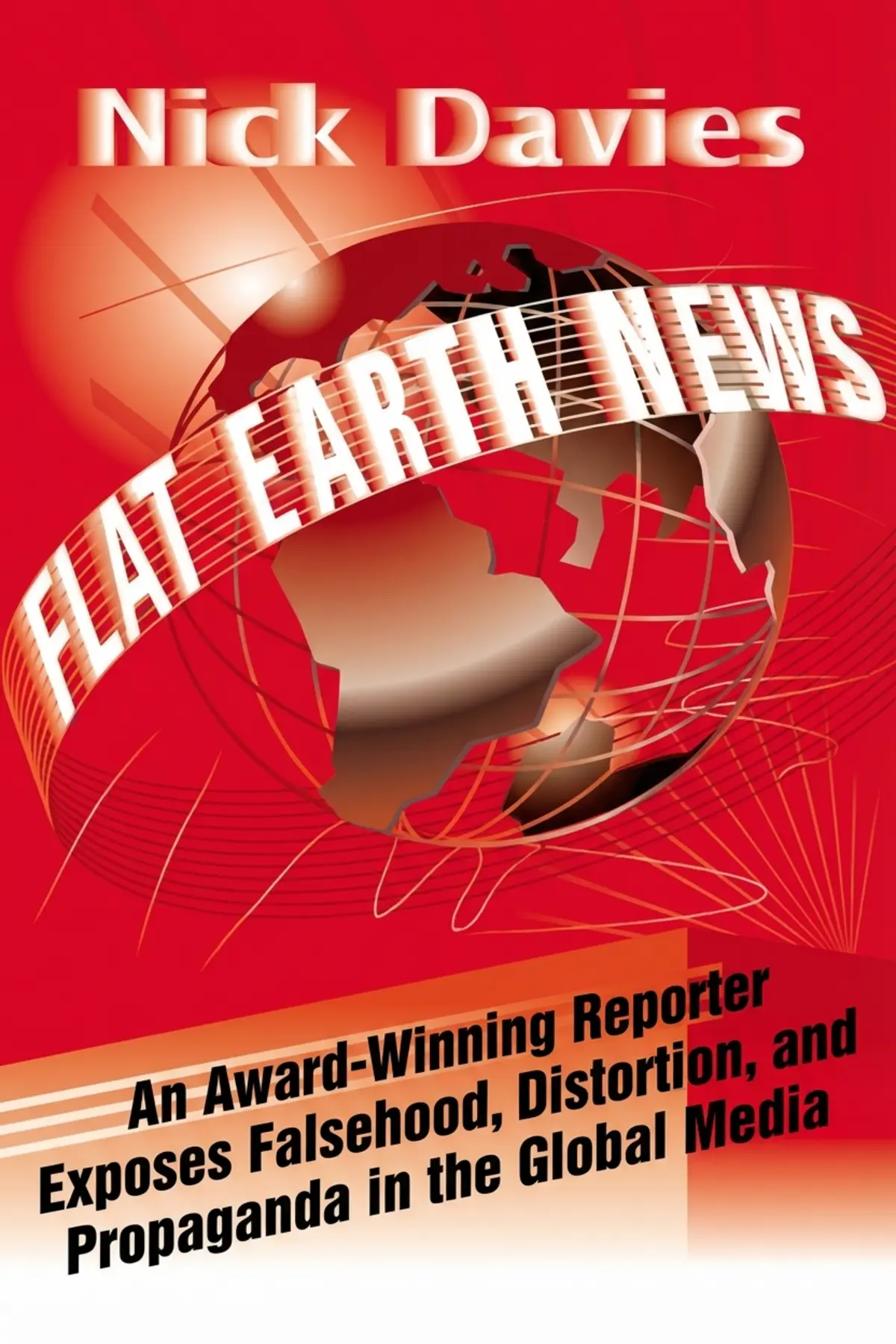
Table of Content
1. Introduction
54 sec
If you read the news every day and still feel you are missing what matters, Nick Davies has an explanation. In Flat Earth News, the veteran journalist cites a Cardiff University study of Britain’s most respected outlets. It found that only 12 percent of their stories came from a reporter’s own research. Most of the rest was recycled from wire agencies and press releases.
Davies argues that once large corporations took over the news, it began to favor what is cheap, popular and safe over what is true or relevant. That shift opened the door to anyone with a ready-made story to sell, from public relations firms to the CIA. Follow his argument and you will be able to look at any headline and ask three things: where it really came from, why it got the space it did, and what was left out to make room for it.
2. Spot the recycled story behind the headline
2 min 01 sec
The picture of a reporter racing to a scene and interviewing witnesses is mostly out of date. A count of more than two thousand British news stories shows what fills the pages instead.
3. Spot how one trusted source can mislead newsrooms
2 min 04 sec
Some newsrooms treat a single agency report as enough proof to publish. That trust feels sensible until you see how the agencies themselves gather the news, and at what hour of the morning.
4. Notice when emotion crowds out what matters
2 min 06 sec
A single train crash can fill the front pages while a hundred deadly car accidents pass unnoticed. The logic behind that choice also explains how a newspaper can change its mind about a war.
5. The easiest story to cover gets the most space
2 min 06 sec
Two hurricanes struck in the same year with similar force, yet one became a household name and the other almost vanished. The reason had more to do with where the reporters already stood than with the suffering.
6. Recognize staged events and hired experts
2 min 08 sec
Some interviews are staged by PR advisers rather than conducted by reporters, and some supposedly independent experts are linked to the companies they talk about. A timing trick sends much of this material straight into Monday’s paper.
7. What Cold War spies teach about today's headlines
2 min 04 sec
The neighbor who insists that intelligence agencies shape the news may be less paranoid than he sounds. Davies documents invented atrocity stories and secretly funded magazines, some in countries that were America’s allies.
8. Conclusion
1 min 20 sec
Flat Earth News adds up to a portrait of a pipeline with no filter. Corporations cut the staff who once checked facts. The people left write too many stories to verify any of them, and the agencies they rely on are stretched just as thin. That leaves an open door, and whoever has a ready story walks through it: a drug company with a hay fever press release, the flour industry’s chosen nutritionist, a president on an aircraft carrier, a spy agency with an invented atrocity. In Davies’ account, the manipulators rarely need to force anything. They only need to offer a juicy, accessible story to a newsroom with less than an hour per article.
The defense starts with your own reading. Davies suggests a simple check: take a story from your favorite paper and find the same story from Reuters, the Associated Press or another wire agency. If the two versions are nearly identical, the paper most likely took the agency’s text and changed a few words. Beyond that, keep asking who supplied a poll or an expert, and why one disaster filled the front pages while another, like Stan in Guatemala, barely appeared.
Much of the news is a press release that nobody questioned. You can still question it.
About this book
What is this book about?
Most readers assume that a story in a respected newspaper was gathered and checked by a reporter. Journalist Nick Davies argues that this is rarely true anymore. Research at Cardiff University found that six in ten stories in leading British outlets simply repeated wire copy or press releases. Just 12 percent came from reporters' own work. Davies blames the business model. The corporations that own the media want as many stories as possible at the lowest cost. So they cut staff, overload the journalists who remain and favor stories that are popular, cheap to cover and unlikely to bring a lawsuit. That is why British papers mentioned Hurricane Katrina 3,105 times and Hurricane Stan just 34 times, and why some papers changed their line on Iraq to match public opinion. The same weakness makes newsrooms easy targets. Public relations firms stage events, fund supposedly independent experts and time their releases for slow news days. The CIA has planted agents, invented stories and funded magazines. Readers get a sharper eye for where a story comes from, and a simple test for spotting news that nobody investigated.
Book Information
Who it's for
Doubting your daily news
Readers who suspect their daily news is shallow or one-sided and want to know why.
Journalism and media students
Students of journalism and media who want an insider's account of how newsrooms really work.
Communications and business professionals
Professionals in communications or business who deal with reporters, agencies and press releases.
About the Author
Nick Davies
Nick Davies, born in 1953, is a journalist, writer and documentary maker. His work has appeared in The Observer and The Guardian, and he has also worked freelance. He has won British Press Awards as reporter, journalist and feature writer. At The Guardian he exposed hacking at the News of the World, and in July 2011 he broke the news that someone had hacked the voicemail of Milly Dowler, a murdered schoolgirl. His other books are White Lies, Murder on Ward Four and Dark Heart.
Ratings & Reviews
Ratings at a glance
What people think
Listeners find this deep dive into the media industry to be a revelatory experience, even if some feel the storytelling gets redundant and bogged down by excessive details. Even so, listeners value the logical breakdown of "churnalism" and the way corporate goals result in the distribution of unverified reports. Additionally, they appreciate Davies’s viewpoint as a veteran reporter unmasking the questionable ties connecting the political sphere, public relations, and news outlets. They also point to the book’s relevant look at why speed is frequently prioritized over precision, with one listener describing it as an "excellent discourse on why you shouldn't believe everything you read."
Top reviews
Bua
Wow. I thought I understood how the news worked, but Nick Davies completely shattered my naive assumptions with this book. This insider account reveals a decaying industry where "churnalism" has replaced actual investigative work. It is terrifying to realize how much of what we consume is just repackaged PR handouts from corporate entities or government departments. Davies writes with a passionate, almost desperate energy about the death of truth in the UK press. While the sheer volume of examples can feel overwhelming, they serve as a necessary weight to prove his case against the giants of the media world. To be fair, this should be mandatory reading for anyone who still picks up a newspaper or scrolls through a news app. It changed my media consumption habits overnight. Truth is, you will never look at a headline the same way again.
Show moreVimolwan
Finally got around to reading this classic of media criticism. Nick Davies, a veteran from The Guardian, provides a well-reasoned analysis of why accuracy is no longer the priority in modern newsrooms. He meticulously documents the "flat earth news" stories—falsehoods that everyone accepts as true because they are repeated so often by supposedly reputable sources. The concept of the "news factory" is a chilling metaphor for how our reality is manufactured by underpaid, overworked reporters who have no time for critical distance. I was particularly struck by the sections on how intelligence agencies manipulate the flow of information. Not gonna lie, it makes you want to throw your television out the window in frustration. This is a brilliant discourse on the pitfalls of for-profit journalism in the West.
Show morePang
After hearing about "churnalism" for years, I decided to go to the source. Nick Davies has produced an excellent discourse on why you shouldn't believe everything you read in the papers or see on TV. He digs into the systemic corruption and the biased reporting that results when profit becomes the only metric of success for a news organization. The way he describes the boundaries of acceptability slowly slipping backward is particularly haunting for anyone who cares about democracy. We have normalized a level of falsehood that would have been scandalous just a few decades ago. Personally, I found the detailed examples of media manipulation by the intelligence community to be the most shocking part of the book. It is a dense read, but the clarity of the argument makes every page worth the effort.
Show moreMax
The chapter on how PR firms manipulate the press is worth the price of the book alone. Davies shows how the truth is dying because we value speed over accuracy in our 24-hour news cycle. It is a real eye-opener for anyone active in the media sector or even just those who want to be informed citizens in an age of propaganda. He brilliantly illustrates the dubious links between politics and the press, showing how "safe" facts are prioritized over difficult truths. Frankly, the state of the media he describes is terrifying, but his analysis is well-reasoned and grounded in years of experience at The Guardian. It’s a heavy read that will leave you feeling a bit cynical, but it’s better to know the truth than to live in a world of manufactured consensus. Highly recommended.
Show moreMo
Ever wonder why every news outlet seems to report the exact same story with the same phrasing? Davies answers this by diving deep into the mechanics of the modern newsroom, where journalists are forced to produce more content with fewer resources. He coins the term "churnalism" to describe this soulless process of recycling unverified information for the sake of speed. The book is an exhaustive—perhaps too exhaustive—critique of how commercial pressures have gutted the Fourth Estate. Look, I found the middle chapters a bit of a slog because the examples started to feel redundant after a while. However, the core argument is so vital that I pushed through the repetitive sections. It is a depressing but essential look at the corruption of our information ecosystem that every citizen should consider.
Show moreEye
As someone who worked briefly in public relations, this book hit a little too close to home. Davies exposes the dubious links between the press and the PR industry with brutal precision. He explains how "information subsidies" allow companies to control the narrative by doing the lazy journalist's work for them. It is a fascinating examination of how truth is sacrificed on the altar of commercial objectives and corporate greed. My only gripe is that the book feels slightly dated now that social media and algorithms have completely overtaken traditional print journalism. Still, the underlying mechanics of how falsehoods spread remain incredibly relevant. In my experience, most people have no idea how much of their daily news is actually carefully constructed propaganda designed to protect the powerful.
Show moreArm
This book is a massive, detailed wake-up call for the casual news consumer. Davies explains the deplorable state of British journalism with the cynical eye of a man who has seen it all from the inside. He focuses heavily on the rise of "churnalism," where speed is valued over accuracy and critical distance is completely ignored. The result is a media landscape awash with unchecked facts and manufactured hysteria. Truth is, the book can be a bit repetitive as it hammers home the same themes through dozens of exhaustive case studies. But perhaps that repetition is necessary to show just how systemic the problem really is. It’s an eye-opener that will make you question every headline you see on your morning commute. We are being fed a diet of safe facts and official consensus.
Show moreWipada
Nick Davies doesn't pull any punches here. He provides a scathing critique of how modern media is corrupted by mass hysteria and corporate greed. The book reveals how the "news factory" operates, churning out stories without any real fact-checking to fill space and attract advertisers. It’s a fascinating, if somewhat long-winded, examination of the industry's decline. I particularly appreciated the focus on how PR firms have essentially hijacked the news cycle. However, the sheer quantity of examples did start to wear on me by the end of the text. I think you get the gist of his argument pretty early on, but he insists on providing exhaustive evidence for every single claim. Still, it’s a vital piece of investigative journalism about the failures of journalism itself.
Show moreBenjamin
Interesting, depressing, and a little repetitive. While I appreciate the insider perspective Nick Davies brings, the prose is often quite dull and starts to feel like a chore after the first few chapters. He makes a compelling case about how the media is being corrupted by mass propaganda and commercial goals, but he beats the reader over the head with it. I also felt that some of his personal tangents, like his views on drug legalization, felt entirely out of place in a book about media ethics. To be fair, a lot of this material has been overtaken by the rise of digital algorithms and social media since its publication in 2008. It’s a decent historical look at the decline of newspapers, but it feels slightly antiquarian in its outlook now.
Show moreWilliam
The book seems to favour quantity over quality where evidence is concerned. I found myself leafing through 'Flat Earth News' rather than actually reading it because the narrative becomes an endlessly long list of repetitive examples. Once you understand the concept of news being "churned" like bread to fill space, you don't really need five hundred more pages of the same point. Davies has a clear bias towards a bygone era of journalism that probably never existed in the way he imagines. Frankly, the writing style is quite dry and eventually becomes a chore to finish. While his points about PR influence and the lack of fact-checking are valid, the delivery is so bloated that the impact is lost. It feels like an angry lecture that refuses to end.
Show moreQuestions about this book
What is the main idea of Flat Earth News?
Nick Davies argues that media corporations treat news as a product to sell in volume at the lowest cost. Staff cuts leave journalists writing around ten stories a day with no time to check facts, so they recycle wire copy and press releases. Outlets also favor stories that are popular, cheap to cover and legally safe. That weakness lets public relations firms and intelligence agencies place their own stories in the news.
What did the Cardiff University study in Flat Earth News find?
Researchers went through 2,207 stories published by the most highly regarded outlets in Britain. Sixty percent mostly repeated wire-agency reports or press releases and added little new information. Only 12 percent were based on the reporters’ own research. The same researchers found public relations material in 54 percent of British news articles, so more than half.
How can I tell if a news story was independently reported?
Davies recommends comparing the story in your usual paper with the version from Reuters, the Associated Press or another wire agency. If the two are very similar, the outlet probably took the agency text and changed it slightly rather than investigating. It also helps to ask who supplied any poll, survey or expert quoted, and whether a named source or witness appears at all.
Why did Hurricane Katrina get more coverage than Hurricane Stan?
Both hurricanes struck in 2005 with comparable impact, Katrina in New Orleans and Stan in Guatemala. In the following months British papers mentioned Katrina 3,105 times and Stan only 34 times. Davies explains that Katrina was easy to cover because numerous Western correspondents were already on the spot and could send back reports and photos, while no such resources existed for Stan.
Who should read Flat Earth News?
It suits anyone who wants to understand why the news feels thin or sensational, including students of journalism and media. It is also useful for professionals who work with press releases or reporters, since it shows how easily ready-made material ends up in print, from staged interviews and paid experts to stories planted by intelligence agencies.
Readers also enjoyed

Abolish Rent: How Tenants Can End the Housing Crisis
Tracy Rosenthal

Abortion: Our Bodies, Their Lies, and the Truths We Use to
Jessica Valenti

Adults in The Room: My Battle With Europe’s Deep Establishment
Yanis Varoufakis

21 Lessons for the 21st Century
Yuval Noah Harari

A Different Kind of Power: A Memoir
Jacinda Ardern
Age of Anger: A History of the Present
Pankaj Mishra
A Higher Loyalty: Truth, Lies and Leadership
James Comey

Age of Propaganda: The Everyday Use and Abuse of Persuasion
Anthony Pratkanis
AUDIO SUMMARY AVAILABLE
Listen to Flat Earth News in 15 minutes
Get the key ideas from Flat Earth News by Nick Davies, plus 5,000+ more nonfiction titles.
- 5,000+ titles
- Listen as much as you want
- 7-day free trial
- Cancel anytime









