


15 min 20 sec
Available in: English
Falter: Has the Human Game Begun to Play Itself Out?
Shows why climate change is already damaging human life, how gene editing and artificial intelligence could end or warp it next, and why the cheap fixes stall when powerful interests resist.
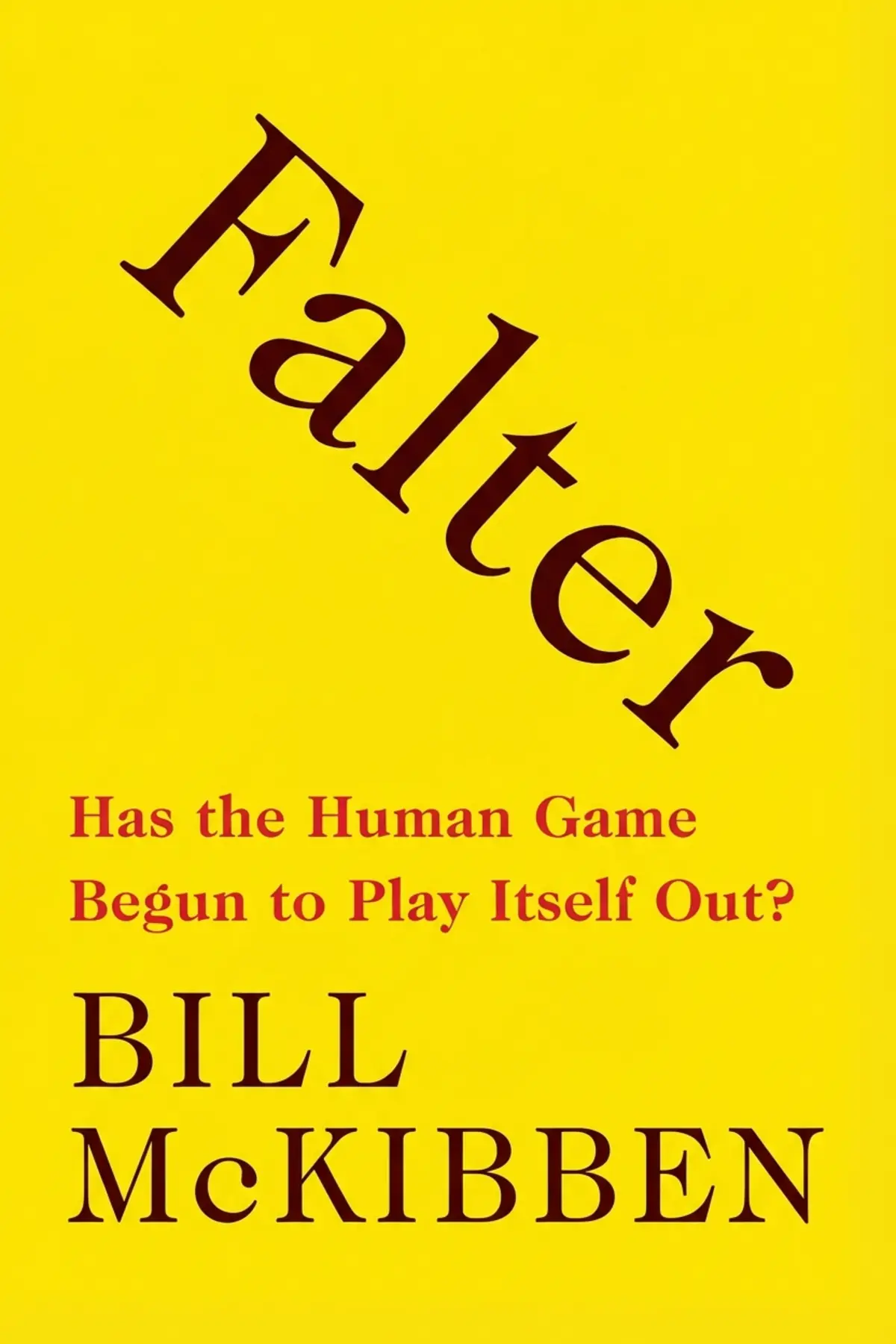
Table of Content
1. Introduction
58 sec
Climate warnings usually arrive as forecasts for the year 2100, which makes them easy to set aside. In Falter, environmental writer and 350.org founder Bill McKibben argues that the damage is already on the record: twenty of the last thirty years were the hottest ever measured. He calls the sum of human life, our cultures, companies, faiths and politics, the human game. We play it for its own sake, like children playing tag, and most of us want it to continue in a form that still feels human.
McKibben’s case is that three threats endanger that game: a warming planet first, then genetic engineering and artificial intelligence close behind. Each of the three has a practical answer, though only one is already within easy reach. What blocks them is the power of those who profit from delay. By the end, you will be able to explain each threat with real numbers, see why escape plans fail and recognize who is slowing the response.
2. Read climate change as today's news
1 min 27 sec
A warming of the sea so small it sounds like a rounding error helped a storm push a whole city into the ground. The trail from that degree to that flood changes how every climate headline reads.
3. Know the worst cases few people mention
1 min 41 sec
Beyond rising seas and hotter summers sit dangers almost nobody discusses, involving the air we breathe, a dead reindeer in Siberia and the weight of melting ice. Each one rewrites what a warming world could mean.
4. See how heat shrinks where people can live
2 min 07 sec
Even if every country keeps its climate promises, the map of livable land gets smaller. Follow McKibben’s numbers on harvests, coastlines and heat, and the next great question becomes where hundreds of millions of people will go.
5. See how designer babies could split the species
1 min 46 sec
A gene-editing tool that could erase inherited disease could also be sold as an upgrade to whoever can pay. McKibben follows that market to a future where rich and poor stop being the same kind of human.
6. Understand the machine that could outthink us
1 min 37 sec
Computers already win at chess, and that is not what worries McKibben. A survey of experts, a comparison of electrons and neurons, and one simple goal show how fast a helpful system could become a lethal one.
7. Stop counting on Mars to save us
1 min 21 sec
Leaving a ruined Earth for a fresh planet is a favorite fantasy of tech optimists. McKibben runs the numbers on radiation, bunkers and travel time, and the result makes the backup plan look very different.
8. The fixes cost less than you think
1 min 30 sec
For each of the three threats, McKibben points to a practical answer, and one of them, solar power, has fallen sharply in price. That leaves an awkward question about why so little has changed.
9. Spot who profits from doubt and delay
1 min 42 sec
An oil company raised its drilling platforms for higher seas while telling the public the science was unsettled. McKibben’s account of that decade explains why the hardest opponent in the human game is human.
10. Conclusion
1 min 11 sec
The universe, McKibben reminds us, does not care whether the human game goes on. We do, and Falter asks that caring turn into action. His three threats look unrelated: a hotter planet, an engineered split between rich and poor bodies, a machine that could outgrow us. Yet powerful industries stand behind each one, while only cheap solar is ready now; fail-safe switches and genetic rules still have to be built.
That changes what one person can usefully do. Read climate news in the present tense, and remember Harvey pressing Houston down by a couple of centimeters. Treat any promise of a new planet as the 180,000-year voyage it really is. When a company or commentator leans hard on uncertainty, ask who is funding the doubt, as Exxon’s memo shows someone often is. And join with others, since McKibben’s answer to concentrated power is organized people.
A planet stocked with everything we need is already under our feet. The game goes on only if we stop wrecking the board.
About this book
What is this book about?
Most people treat climate change as a forecast for 2100, something to worry about later. Bill McKibben argues that the damage is already on the record, from Hurricane Harvey's flood that pressed Houston into the ground to a Syrian drought that helped start a war and sent a million refugees toward Europe. McKibben calls the whole of human life, its cultures, companies, faiths and politics, the human game, and he asks whether it is starting to play itself out. He lines up three threats. Warming comes first. Genetic engineering could split humanity into an enhanced elite and everyone else. Artificial general intelligence could outgrow us in hours. He also takes apart the hope of escaping to Mars or a distant planet. The book is not only alarm. McKibben sets out practical answers, including fail-safe switches for AI, international rules on gene editing and a shift to solar power that has become dramatically cheaper. Then he names the real obstacle: powerful corporations, with Exxon as his main case, that spent years manufacturing doubt. Readers get a clear map of the threats, the fixes and the people standing between them.
Book Information
Who it's for
Professionals wanting climate numbers
Professionals who want to talk about climate change with real numbers rather than vague dread.
Curious about tech risks
Readers curious how gene editing and artificial intelligence fit into the same risk picture as warming.
Suspicious of corporate influence
Anyone who suspects corporate interests shape public doubt and wants to see how it works.
About the Author
Bill McKibben
Bill McKibben is an American writer, journalist and environmentalist who has written about global warming for decades, beginning with The End of Nature in 1989. He founded 350.org and Step It Up, is a leader of the Third Act Movement and is a scholar of environmental studies at Middlebury College in Vermont. He led 350.org's 2009 day of 5,200 simultaneous demonstrations in 181 countries and the 2011 and 2012 campaign against the Keystone XL pipeline. He received the Gandhi Peace Award in 2013 and the Right Livelihood Award in 2014.
Ratings & Reviews
Ratings at a glance
What people think
Listeners find the book well-crafted and clearly organized, with one review noting it provides a serious look at the future of humanity. Furthermore, the work is extensively researched and stands as a major contribution to climate change literature, with one listener describing it as a sobering review of the science. They also appreciate its readability and find it an engaging read. However, the political themes receive mixed reactions from listeners.
Top reviews
Komsan
Bill McKibben doesn't pull any punches in this terrifyingly necessary read. He masterfully connects the dots between environmental decay and the "predatory delay" orchestrated by the fossil fuel industry. I was particularly shaken by the statistic regarding the oceans—it is frightening to think that without them absorbing the excess heat, our planet would have warmed by 97 degrees Fahrenheit since 1955. While the shift into Silicon Valley's obsession with immortality and AI felt a bit unexpected, it highlights the same root of human arrogance that got us here. This is a clarion call for non-violent organizing and massive solar expansion. It is well-researched, deeply sober, and undeniably urgent.
Show moreGai
What does it mean to be human in an era of potential total collapse? That is the haunting question at the heart of this book. McKibben manages to bridge the gap between hard science—like the fact that we’re losing 270,000 sharks every day—and deep philosophical inquiry. The truth is, we are being held hostage by a small cadre of elites who prioritize endless growth over actual human survival. His call for a "steady-state economy" is exactly the kind of radical thinking we need, even if it feels politically impossible in our current climate. It is an emotional, sobering review of our trajectory that left me wanting to join the nearest protest.
Show moreDek
A sobering review of the science that left me feeling both terrified and strangely motivated to act. McKibben writes with a sense of urgency that is impossible to ignore, perfectly capturing the "faltering" of our species as we hit the limits of a finite planet. I particularly appreciated the discussion on how solar power has become so much cheaper, offering a genuine path forward if we can overcome the lobby of the 1%. It is a serious look at humanity's future that balances grim reality with a tiny, flickering candle of hope. This is well-researched and serves as a major work on the defining crisis of our time. Truly a must-read.
Show moreSupranee
Finally got around to reading this because of the author's reputation with 350.org, and it certainly lived up to the hype. McKibben remains our most important environmental voice, and he uses his platform here to call out the greed-based mindset that has led us to the brink. He makes the science accessible without dumbing it down, explaining complex issues like methane's heat-trapping efficiency compared to carbon dioxide. It is a call to action that reminds us that while the clock is running down, we still have a say in the final chapters of our story. It is a vital, timely, and deeply moving piece of nonfiction.
Show moreMoo
The section on the Koch brothers and the cult of Ayn Rand was a total eye-opener for me. McKibben explains how a specific brand of libertarian greed has effectively stunted our global response to a melting planet. He uses the term "the human game" to describe our collective history, and he makes a compelling case that the game is currently being sabotaged by a tiny elite. I appreciated the segments on vertical farming and the potential of solar power, though I do agree with some critics that he glosses over the massive problem of scale. Still, this is a major work on climate change that everyone should read to understand the forces working against our survival.
Show moreRatree
Ever wonder if we've actually passed the point of no return? McKibben doesn't offer a simple answer, but he provides the most up-to-date data available on our faltering planet. I was shocked to learn that Exxon knew about the destruction as early as the 1970s and chose to emphasize uncertainty instead of acting. That disinformation campaign cost us a decade we didn't have! The book is very topical and readable, though the political content regarding libertarianism might rub some readers the wrong way. Personally, I found the chapters on non-violent resistance to be the most hopeful part of an otherwise dark and heavy narrative. It's a serious look at where we are headed.
Show morePrayoon
The chapters on gene editing and the potential for a genetically enhanced elite were a curveball I didn't see coming. While some readers find it a distraction from the climate focus, I think McKibben is trying to show how we are losing our "humanness" from multiple angles at once. Whether it is through ecological collapse or technological hubris, the "human game" is changing rules mid-play. The writing is clear and the research is top-notch, especially regarding the rate of ice melt in Greenland. It is a bit of a hot mess in terms of structure, but the core message regarding our current crossroads is far too important to ignore.
Show moreWittaya
I’ve been following McKibben’s work since his early days, but this one left me feeling quite conflicted. The first half is classic Bill—sharp, data-driven, and urgent regarding the climate crisis and the disinformation campaigns of companies like Exxon. However, the pivot into AI and genetic engineering in the middle chapters felt like he was losing the thread. Why are we talking about Ray Kurzweil’s pills when the Greenland ice sheet is melting from below? To be fair, his writing is beautiful and the critique of Ayn Rand’s influence on the American Right is spot on. I just wish the narrative had stayed more grounded in the immediate ecological fight rather than wandering into transhumanism.
Show moreHannah
There's a lot of fascinating trivia here, like the fact that one barrel of oil is equal to 23,000 hours of human labor. It’s the kind of book that gives you great Jeopardy-style answers but sometimes fails to connect them into a cohesive strategy for the future. I enjoyed the critique of the Silicon Valley "Don't Be Evil" gang and their pursuit of cryonics while the world burns. However, I found the lack of discussion on the inherent failures of industrial capitalism to be a glaring omission. It's a good introduction for those new to the climate conversation, but seasoned activists might find the lack of focus on systemic overconsumption a bit frustrating.
Show morePop
Frankly, this felt like three different books mashed together into one disjointed mess. While I respect McKibben's legacy, the pivot into the quest for immortality and "designer babies" felt like a massive distraction from the urgent climate data. It is a sobering review of the science at times, but the focus is all over the place. He talks about "Naturals" and AI superlords in a way that feels more like a sci-fi pitch than environmental activism. Plus, the solutions offered—mostly solar panels and non-violent protest—feel incredibly superficial compared to the "predatory delay" he describes so well. I had high hopes, but this lacked the cohesive punch of his earlier work.
Show moreQuestions about this book
What is the main idea of Falter by Bill McKibben?
McKibben argues that the human game, the whole of human life and society, faces three threats: global warming, which is already doing damage, followed by genetic engineering and artificial intelligence. Practical answers exist for all three, from renewable energy to fail-safe switches and gene-editing rules. The biggest obstacle, in his view, is wealthy people and corporations who profit from delay, so the solution requires mass political organizing.
Why does McKibben say climate change is already here?
He points to damage already recorded. Twenty of the last thirty years were the hottest ever measured, a third of the Earth’s land has been degraded for animal life and land animal populations have halved since 1970. Hurricane Harvey dumped 127 billion tons of rain on Texas in 2017, and a Syrian drought helped spark a civil war that sent a million refugees toward Europe.
What does Falter say about genetic engineering and AI?
McKibben sees CRISPR as able to remove genetic conditions but also to create designer babies, splitting people into an enhanced GenRich class and unenhanced naturals who might one day become separate species. On AI, he cites experts expecting general intelligence between 2040 and 2075, which could become 170,000 times smarter than humans within hours and might remove people who stand in its way.
Can space travel save humanity from these threats?
McKibben says no. A trip to Mars exposes travelers to cosmic rays that make cancer a bigger risk than a spacecraft failure, and survivors would likely live in underground bunkers. The nearest promising planet, in the Trappist system, is 39 light years away, a trip of about 180,000 years at the speed of the Helios 2 probe.
How can I apply the ideas in Falter?
Read climate news by asking what has already happened, not only what is forecast. Judge any home, career or business plan by its exposure to heat, water, coastline and migration. When someone stresses uncertainty about a risk, ask who pays for that message, as Exxon did after 1988. And since cheap solar removed the cost excuse, McKibben urges joining organized efforts that push for change.
Featured in
Readers also enjoyed









AUDIO SUMMARY AVAILABLE
Listen to Falter in 15 minutes
Get the key ideas from Falter by Bill McKibben, plus 5,000+ more nonfiction titles.
- 5,000+ titles
- Listen as much as you want
- 7-day free trial
- Cancel anytime









