

14 min 21 sec
Available in: English
Existential Kink: Unmask Your Shadow and Embrace Your Power
A shadow-work method for recurring problems: find the hidden pleasure a painful pattern gives you, drop the shame around it, and use guilt rituals and a short meditation to loosen its grip.
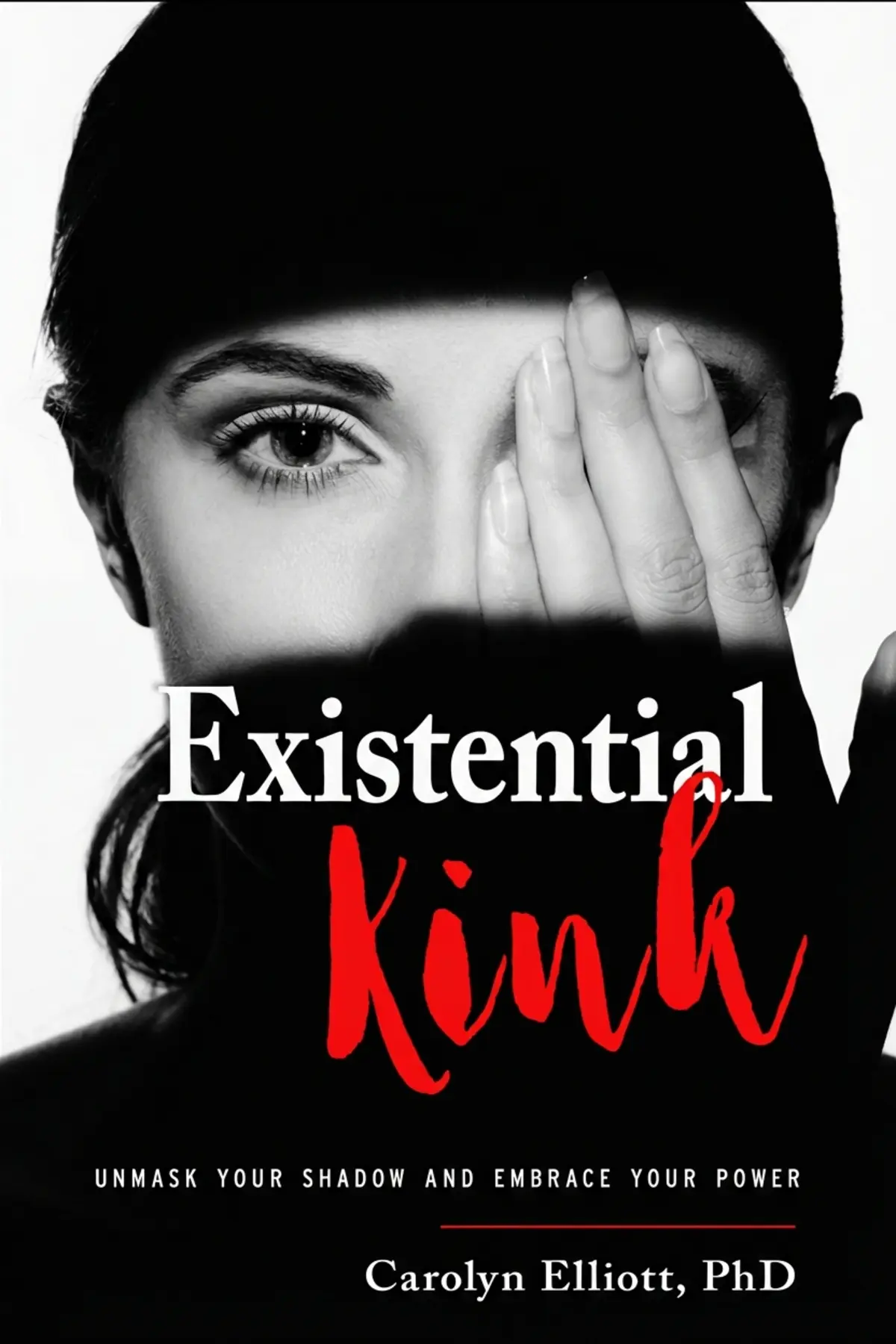
Table of Content
1. Introduction
59 sec
If the same painful situation keeps showing up in your life, the usual advice is to fight it harder. In Existential Kink, Carolyn Elliott, a coach with a PhD in critical and cultural studies, suggests the opposite: a hidden part of you may be enjoying the very thing you complain about. Her method is to find that secret pleasure, admit it without shame, and even savor it on purpose.
Once the unconscious want is out in the open, she argues, it stops running the show, and its energy becomes available for something better. That is the claim every idea here serves. Elliott builds it from her own recovery from heroin addiction, from seven principles she calls axioms, from a strange morning ritual at the mirror and from a short meditation. Expect to finish with a new question to ask of any pattern you hate, two practices to try this week, and Elliott’s own warnings about when to hold off.
2. Turn the feeling of being wrong into power
2 min 03 sec
Many people hide a constant sense of being broken behind work, approval or a drink. While recovering from heroin addiction in her twenties, Elliott noticed that part of her was secretly drawn to the destructive sides of her own life.
3. Read a repeating problem as a hidden want
2 min 00 sec
The same disappointing partner, the same crisis, the same fight. Elliott treats repetition as a clue, and her reading of it sounds like blame until you see what she actually asks you to do with it.
4. Choose how pain and pleasure land on you
1 min 55 sec
A vegetable some people love and others cannot swallow holds a lesson about suffering. Elliott pushes it all the way to childbirth and the world of BDSM, and asks what helplessness really rests on.
5. Let shameful desires run their course and change
1 min 59 sec
Most advice says to starve your worst urges. Elliott claims that is exactly what keeps them stuck, and she has a surprising suggestion for the moment you catch yourself wallowing in not being good enough.
6. Recite your secret guilt rules like a villain
2 min 03 sec
Guilt can swallow whole evenings, run by rules you never agreed to. Elliott’s cure involves a journal, a mirror and a cartoon laugh, and it works on a principle most people would never guess.
7. A fifteen-minute practice for patterns you hate
2 min 10 sec
A candle, a timer and one uncomfortable admission make up Elliott’s central meditation. Before any of that, though, she sets two conditions that decide whether the practice is right for you at all.
8. Conclusion
1 min 12 sec
Elliott’s book turns an old instinct inside out. Faced with a pattern we hate, most of us push against it, hide it or feel ashamed of it. She argues that the pushing is part of what keeps it alive, because somewhere underneath, a part of us is getting something from it. Her own life is the case she offers: a young woman in recovery who admitted she loved the importance an abusive relationship gave her, and who went on to build a marriage, a business and a community.
What she asks of readers is modest in size. Take one recurring problem and ask what it lets you feel, watching for a jolt of recognition when you answer honestly. Write out your private guilt rules and read them at the mirror for a week with a villain’s laugh, then spend the freed energy on one project. And when you are not in a depressive stretch and the loss is already grieved, sit for fifteen minutes by a candle and look for the part of you that enjoys the thing you resent.
None of this asks you to like your pain forever. It asks you to stop hiding from the part of you that already does, so that it can finally want something else.
About this book
What is this book about?
Some problems keep coming back: the same kind of partner, the same guilt spiral, the same sense that something is wrong with you. Carolyn Elliott's answer is unusual. She argues that a hidden part of us, which she calls the shadow, secretly enjoys these painful patterns, and that they keep their hold because that enjoyment stays unconscious and shamed. Elliott starts from her own life, recovering from heroin addiction while in an abusive relationship that, she realized, gave her a feeling of importance she loved. From there she builds seven principles she calls axioms, among them that having is evidence of wanting, that desires evolve through fulfillment, and that shame kills magic. The book then turns these ideas into practice. Readers write down the private rules they use to punish themselves and recite them in the mirror like a cartoon villain, and they learn a 15-minute meditation for finding the secret pleasure in a recurring situation they dislike. Elliott also states plainly who the practice may not suit, and when to hold off.
Book Information
Who it's for
Stuck in painful patterns
People stuck in the same painful pattern, in love, work or money, who are tired of fighting it head-on.
Weighed down by guilt
Chronic self-critics who lose hours to guilt over small mistakes.
Drawn to shadow work
Readers drawn to shadow work, psychology and the occult who want concrete exercises to try.
About the Author
Carolyn Elliott
Dr. Carolyn Elliott holds a PhD in Critical and Cultural Studies and blends shadow work with occult thought to help people make large changes in their lives. Besides writing books and essays, she coaches clients one-on-one, teaches an in-person coach training program built around Existential Kink, and leads an online community called WEALTH.
Ratings & Reviews
Ratings at a glance

What people think
Listeners find the book perceptive and simple to digest, with many praising its abundance of wise insights and actionable techniques. They portray it as a revolutionary take on shadow work that facilitates major breakthroughs and deep restoration, leaving people feeling more content and at harmony with themselves. Listeners prize its sincerity, with one listener pointing out its ability to lift the shame from inherent impulses and another underscoring how life-changing the material is.
Top reviews
Ingrid
This book is like a cold shower for the soul. While most self-help books desperately want you to manifest your 'best life' through endless positivity, Carolyn Elliott asks you to look at your current dumpster-fire situation and ask, 'How am I secretly enjoying this?' It sounds masochistic, but honestly, it’s the most liberating thing I’ve ever done. By identifying the 'shadow' parts of myself that actually crave the drama of being broke or the sting of rejection, I stopped fighting myself. The radical approach to shadow work here is not for the faint of heart, yet it brings a powerful transformation. I feel more at peace because I’ve finally stopped shaming my natural tendencies toward chaos. Truth is, once you own the 'kink' in your existence, you can actually start changing the pattern. This isn't just theory; the practical exercises provided me with nuggets of wisdom that I use daily.
Show moreEthan
I finally understand why I've been stuck in the same cycles for years. This book is a radical approach to shadow work that deeply heals by removing the heavy layers of shame we carry. For the first time, I don’t feel like a failure for having 'negative' emotions or repeating bad habits; I just see them as my shadow trying to have a good time. It’s amazing how much faster you can move through a problem once you stop judging yourself for having it. The practical exercises are easy to follow and brought me a deep sense of comfort in my own skin. I’ve already recommended this to three friends because the shift in perspective is just that powerful. It’s an insightful, easy-to-read guide that makes you feel happy and more at peace with the messy parts of being human.
Show moreDarawan
Existential Kink is easily the most radical approach to self-help I’ve encountered since I first discovered Jungian archetypes. It takes the idea of the Shadow and gives it a visceral, practical application that you can actually use in your bedroom or your boardroom. The book removes the shame from our natural tendencies to feel 'bad' things like scarcity or rejection. By leaning into the forbidden enjoyment of these states, they lose their power over us. It’s a paradox, but it works brilliantly. I’ve doubled my income and found a sense of peace I didn't think was possible just by stopping the war within myself. If you’re tired of 'The Secret' and want something that actually deals with the grit of reality, this is the book you’ve been looking for.
Show moreAkosua
After hearing about EK on a podcast, I decided to dive in with a healthy dose of skepticism. The central thesis—that 'having is evidence of wanting'—is a tough pill to swallow, especially when you’re looking at your credit card debt. However, I found that when I applied the EK method to my recurring arguments with my spouse, something shifted. I realized I was getting a weird, righteous rush out of being the 'victim' in those fights. It’s a bizarre yet useful concept for a specific audience. To be fair, the spiritual language and the talk of spell-casting were a bit much for me, and I found myself skimming the more 'woo' sections. But if you can get past the talk of the 'Unconscious Divine,' there’s a solid psychological core here that helps you regain agency over your life patterns.
Show moreMoo
Let’s talk about the 'woo' factor for a second. Yes, there is a lot of talk about Persephone, Pluto, and 'manifestation' that might make a pragmatist roll their eyes. But if you can translate the occult language into Jungian terms, this book is pure gold. Elliott’s PhD background shows in how she deconstructs the ego’s resistance to the shadow. I love the idea of EK as a tool for psychological integration rather than just another 'positive thinking' manual. The section headings are helpful, and the 15-minute timer method is a practical way to face your demons without getting overwhelmed. I gave it four stars instead of five because the writing can be a bit messy and needs a tighter edit, but the core idea is absolutely life-changing if you're willing to be brutally honest with yourself.
Show moreNora
The chapter on the Deep Fear Inventory was a lot to handle, but it was worth the effort. Carolyn Elliott has a unique way of blending high-level academic concepts with very raw, almost primal emotional work. While I think her interpretation of Greek myths is a bit of a stretch—mixing Roman and Greek names like Pluto and Persephone is a minor pet peeve of mine—the underlying point hits home. We are often the cause of our own suffering because we haven't made peace with our darker impulses. The success stories included were a bit hit-or-miss for me, but they served their purpose in showing how others have applied the EK method. Not gonna lie, some of the 'getting off' terminology is uncomfortable at first, but that’s kind of the point of shadow work, isn't it?
Show moreJulian
Gotta say, the writing style is... unique. It’s a mix of a PhD thesis and a late-night chat with a very intense witch. Some people will hate it, but I found it refreshing compared to the sterile tone of most self-help books. The book’s radical approach to integration helped me break through an ancient creative block that had been haunting me for a decade. By admitting I actually *enjoyed* the safety of being an 'unrecognized genius' who never finished anything, I was finally able to let that identity go. It’s not a universal solution, and I agree with the author’s own caveat that this shouldn't be used for fresh trauma. But for those nagging, annoying life patterns? This method is a total game-changer. It’s authentic, raw, and surprisingly effective.
Show morePlernpiriya
Does everyone need to read this? No. But for a very narrow audience of people who are familiar with BDSM or radical acceptance, this is a masterpiece. The idea is that we are autonomous people who have intentionally created sources of pain to break up the monotony of existence. It’s a wild thought! I’ve been practicing the EK statements—'I'm willing to stop pretending I don't enjoy this'—and the results are surprisingly fast. To be fair, the book could have used a stronger editor to cut down on the fluff in the first few chapters. However, the nuggets of wisdom found in the lessons are worth the price of admission. It’s a fascinating, messy, and ultimately healing journey for anyone brave enough to admit they’re a bit of a freak.
Show moreTim
Look, I wanted to love this because the title is so catchy and the premise of 'shadow kink' sounded fascinating. Unfortunately, the execution was a bit wooey for me. I didn't connect with the writing style, which felt like a lot of smart-sounding words strung together to mask a very simple, and potentially problematic, idea. While the author claims this isn't about blaming yourself, the implication that you created your own misery because you 'secretly enjoy it' is a slippery slope. I found the 'success stories' to be somewhat depressing, mostly featuring people just giving up on their goals and calling it 'integration.' There are some interesting ideas buried here, but they are shrouded in unhelpful spiritual language and repetitive mantras that felt more like self-hypnosis than actual therapy.
Show moreSomboon
Pseudo-psychology wrapped in a kinky bow is the best way to describe this mess. The author, who constantly reminds us of her PhD while dismissing scientific rigor for 'magic,' uses a butchered version of the Persephone myth to justify what essentially amounts to victim-blaming. Suggesting that a person in an abusive situation 'secretly desires it' or 'created it to experience the thrill' is dangerous and irresponsible. The writing is incredibly repetitive and filled with new-age gobbledygook that tries to sound profound but falls flat. If you’re looking for genuine healing, avoid this. It’s a continuous re-victimization of people who are already struggling, packaged as a 'solution' to make the author rich. Frankly, it’s insulting to anyone who has actually suffered from structural issues or trauma that they did not, in fact, 'manifest' for their own kinky pleasure.
Show moreQuestions about this book
What is the main idea of Existential Kink?
Carolyn Elliott argues that problems which keep repeating in our lives are partly shaped by unconscious desires, and that a hidden part of us, the shadow, secretly enjoys them. Instead of fighting or hiding that enjoyment, she suggests admitting it without shame and even savoring it on purpose. Once the desire is conscious and approved of, she says, it loses its grip and its energy can go toward positive change.
What are the seven axioms of Existential Kink?
Elliott’s axioms are: having is evidence of wanting; you can choose how you perceive sensations; find pleasure in every kind of experience; enjoyment grows with approval of your life; desires evolve through fulfillment rather than denial; shame kills magic; and deep truths are felt strongly in the body. Together they aim to open a channel between the conscious and unconscious mind.
How do you do the Existential Kink meditation?
Relax first with a bath, yoga or deep breaths. Light a candle and incense and set a 15-minute timer. Pick a recurring situation you dislike and have already grieved, name the emotions it brings up, then gently look for the part of you that secretly enjoys them, testing statements until one rings true. Finally, accept that shadow and consciously enjoy the situation. Elliott advises against the practice during depression.
What are operating instructions and reverse psychology affirmations?
Operating instructions are Elliott’s term for the unconscious rules we follow to make ourselves feel guilty, such as owing three hours of guilt to anyone we disappoint. She suggests writing them down without judgment, then reading them aloud at the mirror each morning for a week, with enthusiasm or a cartoon villain’s cackle. Consenting to the rules openly, she argues, drains their power and frees energy for a new project.
Does Existential Kink blame people for their suffering?
Elliott says it does not. Her first axiom, that having is evidence of wanting, is meant as a tool for finding hidden desires, and she stresses that the point is not to blame or shame yourself. She also asks readers to grieve a hard situation before working on it, and warns that the meditation may not suit someone currently struggling with depression.
Featured in
Readers also enjoyed

A New Earth: Awakening to Your Life’s Purpose
Eckhart Tolle

A Return to Love: Reflections on the Principles of a Course in Miracles
Marianne Williamson

Aflame: Learning from Silence
Pico Iyer

59 Seconds: Change Your Life in Under a Minute
Richard Wiseman

Alcoholics Anonymous
Alcoholics Anonymous World Services




AUDIO SUMMARY AVAILABLE
Listen to Existential Kink in 15 minutes
Get the key ideas from Existential Kink by Carolyn Elliott, plus 5,000+ more nonfiction titles.
- 5,000+ titles
- Listen as much as you want
- 7-day free trial
- Cancel anytime









