
13 min 41 sec
Available in: English
Essays In Persuasion
Keynes shows how economic choices, from a punishing peace treaty to spending in a slump, shape whole societies, and why he believed managed capitalism could bring shared prosperity and, one day, far more free time.
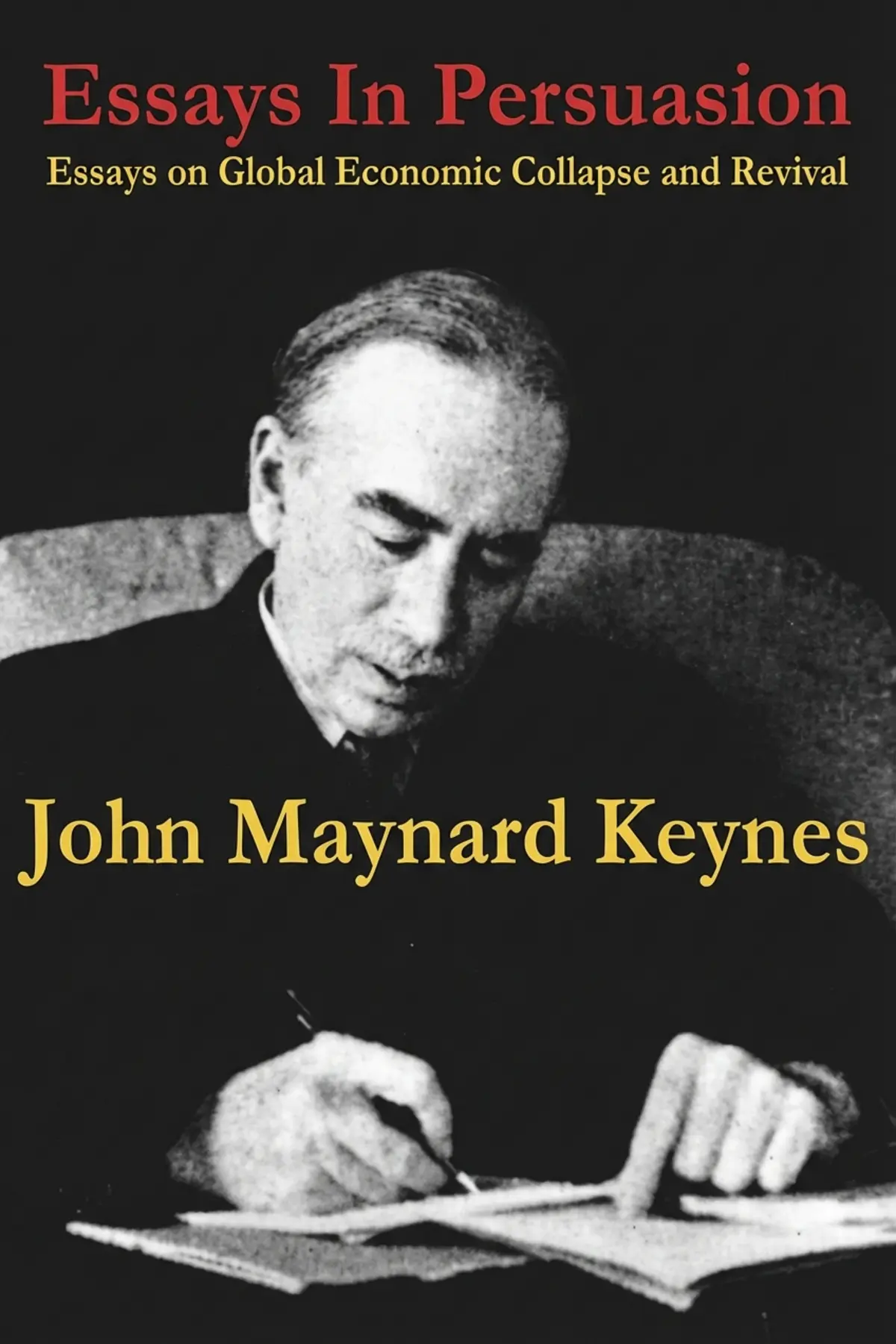
Table of Content
1. Introduction
1 min 07 sec
Economic news can sound like weather: inflation rises, budgets shrink, sanctions arrive, and it all seems to happen to us. In Essays In Persuasion, the British economist John Maynard Keynes argues the opposite, beginning with a warning he gave in 1919: squeeze a defeated Germany with crushing reparations, and resentment and instability will follow. The 1930s proved him right.
Across essays written between the end of the First World War and the Great Depression, Keynes returns to one conviction. Economic decisions are human choices with human consequences, and careful public policy can steer them toward peace and shared prosperity instead of leaving people at the mercy of the market.
Along the way he explains why falling prices can cost people their jobs, why a government might borrow to hire, and what he expected ordinary life to look like by 2030. A headline about stimulus, sanctions or a shorter working week becomes a decision someone made, with winners and losers you can name.
2. Spot when economic punishment breeds the next crisis
2 min 03 sec
The victors of 1919 wanted the loser to pay for a ruinous war. A 35-year-old economist at the table thought the bill itself was the real danger, and he explained exactly how it could backfire.
3. Learn how active policy beats waiting on prices
1 min 51 sec
After the war, the respectable response to wild price swings was to do nothing at all. Keynes saw a hidden trap in that patience, one that turns a simple fall in prices into a crowd of people without work.
4. A middle road between free markets and socialism
2 min 07 sec
For decades, the respectable view was that governments should keep their hands off markets entirely. Keynes rejected that view without joining the revolutionaries, and his alternative still shapes hospitals, highways and pensions across the Western world.
5. Spending in a slump puts people back to work
2 min 04 sec
Keynes claimed that paying people to do something useless could still beat doing nothing in a depression. The programs his thinking inspired went much further, and some of them left behind art and history that would otherwise be lost.
6. Picture the richer world Keynes predicted for 2030
1 min 44 sec
In the darkest years of the Depression, Keynes made a startlingly cheerful forecast about life a century later. One half of it has largely come true. The other half asks an uncomfortable question about how you spend your week.
7. Make freedom from work worth having
1 min 32 sec
Keynes imagined a future where nobody had to struggle for a living, then worried about what would happen next. His fear sounds very familiar today, and two problems he left open have only grown larger.
8. Conclusion
1 min 13 sec
What ties these essays together is a refusal to treat the economy as a force of nature. At Versailles, Keynes saw a treaty written by people and predicted the damage it would do to people. In a slump, he saw unemployment that waiting would only prolong, and spending that could end it. Looking toward 2030, he saw growth as raw material for better lives, and doubted we would know how to use it. The New Deal, the National Health Service, the International Monetary Fund and today’s arguments about a four-day week all carry pieces of that conviction: choices made with care can widen prosperity, and careless ones can poison a generation.
The habit carries into ordinary reading. When a policy is announced, look past the totals to the people who will feel it years later. When someone insists that hard times demand cuts, remember the workers Keynes saw stranded by wages that would not fall. And when your own income rises, ask whether some of it should come back to you as time.
Keynes wrote to persuade, and his case still stands: economies are made, so they can be made better.
About this book
What is this book about?
Inflation, budget cuts, sanctions and stimulus often feel like forces nobody controls. John Maynard Keynes spent the years after the First World War and through the Great Depression arguing that they are decisions, made by people, with effects that land on people for years afterward. In these essays he warns that the harsh reparations forced on Germany at Versailles would breed resentment and instability. He challenges the habit of waiting for markets to correct themselves and explains why falling prices can throw people out of work. He makes the case for a managed capitalism between laissez-faire and socialism, and for public spending to create jobs in a downturn. His ideas fed into the New Deal, Britain's National Health Service, the International Monetary Fund and the Bretton Woods system. He also looks a century ahead, forecasting far higher living standards by 2030 and a working week of about 15 hours, while worrying that people might not know what to do with their freedom. Readers get a clear way to read today's economic debates, from stimulus to the four-day week, as choices with winners and losers.
Book Information
Who it's for
Professionals following economic news
Professionals who follow economic news but struggle to judge debates on stimulus, austerity or sanctions.
Students of economic ideas
Students of economics, history or politics who want the ideas behind the welfare state and the IMF.
Rethinking the working week
Workers rethinking long hours who are curious about the four-day week and universal basic income.
About the Author
John Maynard Keynes
John Maynard Keynes (1883 to 1946) was born in Cambridge and studied mathematics at King's College, Cambridge. During the Great Depression he argued that total spending drives how active an economy is, and that too little of it can cause long stretches of high unemployment, ideas he set out in The General Theory of Employment, Interest, and Money in 1936. He advised the British Treasury, served as a director of the Bank of England, took part in the Bretton Woods Conference and was made Baron Keynes of Tilton in 1942.
Ratings & Reviews
Ratings at a glance
What people think
Listeners find this to be a compelling listen and value its straightforward case for public spending. Opinions on the author's prose are divided, with some highlighting the sophisticated language while others find the text quite challenging to comprehend.
Top reviews
Suthinee
Reading this nearly a century later, it is impossible not to be struck by Keynes’ terrifying prescience regarding the Treaty of Versailles. He saw the vengeful reparations for exactly what they were—a blueprint for future European collapse and the rise of fascism. The prose here is remarkably elegant, far removed from the dry, impenetrable academic jargon we expect from modern economists. While some of the specific monetary debates regarding the Gold Standard feel a bit dated, his core arguments for institutional spending to stimulate growth remain the gold standard for policy thought. Truth is, the man was a genius of rhetoric. He manages to turn complex balance sheets into a moral crusade for the survival of Western civilization. It’s not just a book on finance; it’s a masterclass in how to change minds when the world is burning.
Show moreSkylar
Ever wonder what happens when a genius is ignored? This book is the answer. Keynes calls these essays his ‘croakings,’ the warnings of a Cassandra who saw the Great Depression coming while the rest of the world was obsessed with pre-1914 normality. His argument for public works is revolutionary: why pay people to stand on street corners and draw the dole when you could pay them to build a better country? The logic is so simple, yet it still faces resistance today. I found his vision of the 15-hour work week particularly moving, even if we are nowhere near achieving it yet. He understood that the ‘economic problem’ is just a hurdle to get over so we can finally focus on the art of living. This is essential reading for anyone who thinks economics is just about greed.
Show moreLuckana
Finally got around to this collection and it blew me away. The way Keynes discusses inflation and deflation as moral issues—not just numbers—is something we’ve completely lost in modern discourse. He explains how changing the value of money redistributes wealth in ways that frustrate design and disappoint expectation. It’s brilliant. The book feels incredibly relevant to our current situation with sovereign debt and global sanctions. He reminds us that you can’t just isolate a major economy without the consequences rippling back to your own doorstep. The prose is elegant, the arguments are clear, and the sense of urgency is palpable throughout. It’s a heavy read, but every student of history needs this on their shelf. Wow.
Show moreAnawin
This is where the real sting is. Forget the dry equations of the General Theory; these essays show Keynes as the master polemicist. He writes with such vigor and wit that you almost forget you’re reading about the collapse of the international monetary system. His ability to distill a national crisis into a clear choice between progress and decay is unparalleled. I particularly loved the final section where he looks toward a future of leisure and culture—it’s a rare moment of pure optimism in a field often called the dismal science. To be fair, he was wrong about the 15-hour week, but he was right about almost everything else. If you want to understand the 20th century, you have to read these ‘croakings.’ He wasn’t just an economist; he was a architect of the modern world.
Show moreIce
Why did I wait so long to tackle Keynes? This collection of essays, spanning the aftermath of WWI to the edge of the Great Depression, reveals a man who was as much a philosopher as a statistician. The highlight for me was ‘The Economic Consequences of Mr. Churchill,’ which serves as a blunt reminder that even the most iconic leaders can be absolutely mugged by special interests and bad advice. Keynes’ critique of the return to the gold parity is sharp, biting, and unfortunately, proved entirely correct. My only gripe is that some sections, particularly on specific 1920s currency adjustments, require a deep historical context that isn’t always provided. To be fair, he was writing for his contemporaries, not for us. Still, his liberal optimism in the face of prevailing gloom is infectious and deeply needed today.
Show moreMoon
The sections on German reparations are chilling in their accuracy. Keynes basically predicted that by crushing Germany’s economy, the Allies were ensuring a second world war. It’s a powerful lesson in the human cost of economic policy. I also enjoyed his take on the psychology of the businessman versus the profiteer; he really gets into how inflation destroys the social contract. The writing style is quite dense in the middle, but if you push through the technical bits about the exchange rate, there are gems on every page. Personally, I think his defense of ‘managed capitalism’ is the most sensible middle ground ever put to paper. He wasn’t a socialist, just a realist who knew that unregulated markets eventually commit suicide. A very thought-provoking read that stays with you.
Show moreSamroeng
After hearing so much about ‘Keynesianism’ as a political slur, I was surprised by how moderate and nuanced this book actually is. This isn't a radical manifesto; it’s a series of practical, often conservative, attempts to save the liberal order from collapsing under its own weight. His critique of the Labour Party is just as sharp as his critique of the Tories. Look, the man just wanted things to work. His focus on ‘context’ is what makes these essays stand out—he knew that an economic policy that worked in the 1800s couldn't just be copy-pasted into the post-war world. Some of the language is a bit flowery, and yes, it requires a bit of focus, but the intellectual payoff is huge. He was a jolly good chap with a pen that could cut through any amount of political nonsense.
Show moreSakura
Keynes is undoubtedly a master of prose, but I found this collection to be frustratingly uneven. The early chapters on the peace treaties are gripping, but once he moves into the weeds of the Gold Standard and mid-20s Liberal party politics, the pace slows to a crawl. It’s clear why some people find his style difficult to understand; he often assumes the reader is as intimately familiar with the Bank of England’s daily operations as he was. I also found his ruminations on Soviet Communism quite strange—he seems to loathe the boorishness of the proletariat while simultaneously trying to save capitalism from itself. Not gonna lie, I skipped about forty pages toward the end just to get to his essay on ‘Economic Possibilities for Our Grandchildren.’ That final section is the only part that felt truly timeless to me.
Show moreNoah
It’s fascinating to see the seeds of the welfare state being planted here, but the elitism is hard to ignore. Keynes writes with the supreme confidence of an intellectual who believes he can manage the world’s problems from a comfortable study in Cambridge. Some of his observations on the Jewish people and the ‘Red’ bookshops of Russia are uncomfortable to read through a modern lens, even if they were typical for a man of his class in 1931. On a technical level, the book is a bit of a slog. To be frank, unless you have a passion for the intricacies of inter-war deflationary cycles, much of this will feel like homework. He’s a brilliant polemicist, but the ‘persuasion’ sometimes feels more like a lecture from a very talented, very condescending uncle. Three stars for the historical value alone.
Show moreLogan
Proceed with caution if you value sound money or market autonomy. While Keynes is a gifted writer, this book is essentially a manual for the very government overreach that has led to our current era of endless debt. He dismisses the Gold Standard as a ‘barbarous relic’ because it prevents politicians from meddling with the currency, which is exactly why we need it. To me, his logic is a labyrinth of clever fallacies. He argues for counter-cyclical spending as if governments have the wisdom to stop spending when the boom returns—which they never do. Frankly, the man is too persuasive for his own good. He makes reckless interventionism sound like common sense. If you want to understand why our current economic system is so fragile, read this to see where the wrong turn was taken. It’s an important historical document, but a dangerous economic one.
Show moreQuestions about this book
What is the main idea of Essays In Persuasion by John Maynard Keynes?
Keynes argues that economic decisions are human choices with lasting human consequences. He warns that the harsh reparations imposed on Germany after the First World War would breed instability, challenges the habit of waiting for markets to correct themselves, and makes the case for a managed capitalism in which the state controls the currency, directs investment and adjusts how income and wealth are shared. He also predicts a far richer, more leisurely future by 2030.
What did Keynes predict about life in 2030?
Keynes wrote in his essay Economic Possibilities for our Grandchildren that living standards in wealthy economies would reach between four and eight times their 1930 level, a prediction that has mostly proved right. He also expected people to work about 15 hours a week, spending the rest on leisure and self-improvement. That has not happened, and he worried that people freed from economic necessity might struggle to find purpose.
Why did Keynes think governments should spend more during a recession?
When businesses stop investing and households stop spending, demand drains from the economy, and cutting public spending only shrinks it further. Keynes argued the government should fill the gap, even by borrowing. He added that wages do not fall easily when prices drop, so waiting for markets to heal leads to long unemployment. He went so far as to say paying people to dig and refill holes would beat doing nothing.
How did Keynes's ideas shape the modern world?
His thinking fed into Franklin D. Roosevelt’s New Deal, with Social Security, unemployment insurance and public works such as the WPA. In Britain it influenced the postwar welfare state and the National Health Service, set up in 1948. His ideas also shaped France’s indicative planning, the Bretton Woods system, the World Bank and the International Monetary Fund, and they still inform modern inflation targets and fiscal stimulus.
How can I apply the ideas in Essays In Persuasion?
Use Keynes’s questions when you read the news. For sanctions or reparations, ask what they will do to ordinary people years later. When someone says a government must tighten its belt in a recession, ask who loses their job while everyone waits. And in your own life, if your income has grown but your free hours have not, consider whether some of that wealth should come back to you as time.
Readers also enjoyed



Adults in The Room: My Battle With Europe’s Deep Establishment
Yanis Varoufakis

1929: Inside the Greatest Crash in Wall Street History--and How It
Andrew Ross Sorkin

23 Things They Don’t Tell You About Capitalism
Ha-Joon Chang
A Little History of Economics
Niall Kishtainy

AUDIO SUMMARY AVAILABLE
Listen to Essays In Persuasion in 15 minutes
Get the key ideas from Essays In Persuasion by John Maynard Keynes, plus 5,000+ more nonfiction titles.
- 5,000+ titles
- Listen as much as you want
- 7-day free trial
- Cancel anytime









