

14 min 04 sec
Available in: English
Crowds and Power
Canetti explains how strangers become crowds, how packs gave rise to religions and nations, and where power over others really comes from, from the grip of a hand to the order you obey.
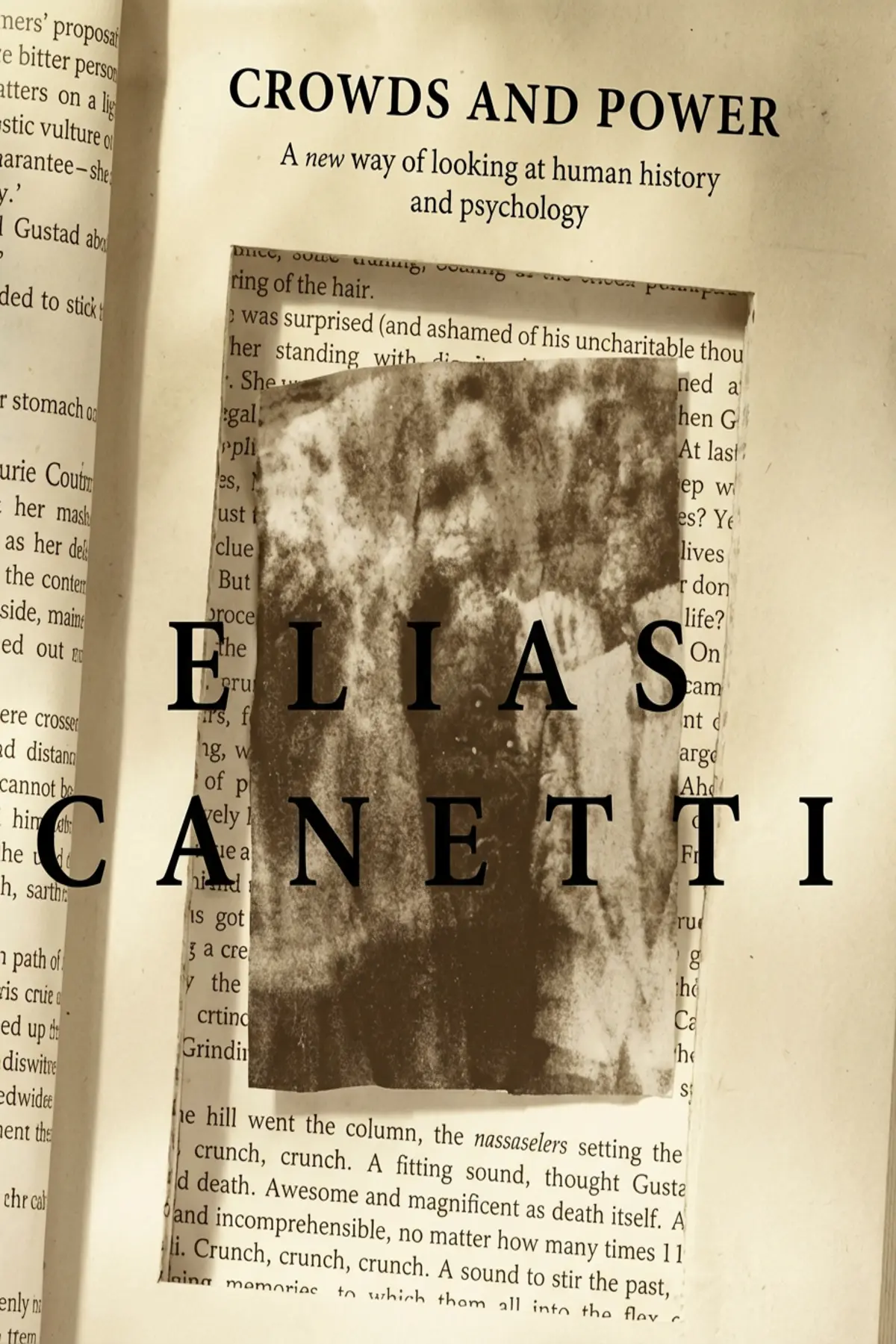
Table of Content
1. Introduction
52 sec
Most of us see ourselves as individuals, yet a train stalled between stations can turn a carriage of strangers, within seconds, into one body that wants one thing. In Crowds and Power, Nobel laureate Elias Canetti argues that this pull toward the crowd, and the power that grows beside it, are among the oldest forces in human life.
He follows the crowd from prehistoric hunting packs to world religions and modern nations, then takes power apart down to the grip of a hand and the bite of teeth. His case is that human history is the story of the groups we dissolve into and of the power that shapes us inside them. With his terms in hand, a rally, a strike, a funeral or a tense meeting becomes readable, and so does the question of who really holds power in the room.
2. Spot the moment a group becomes a crowd
1 min 46 sec
A carriage of tired commuters can become something else entirely in the time it takes a train to stop. Canetti names what changes, and why some crowds want to feast while others want blood.
3. Trace modern faith back to the mourning pack
1 min 49 sec
Long before cities, small bands hunted, fought and grieved together in the wilderness. Canetti finds those bands still alive in the prayers and pilgrimages of the great world religions, and one ancient feeling binds them most tightly.
4. Read a nation through its favorite symbol
1 min 40 sec
No one has ever seen a whole nation gathered in one place, yet millions feel they belong to one. Canetti explains how a ship, a forest or a bullfighter can hold that invisible crowd together.
5. Tell raw force apart from real power
1 min 48 sec
A cat that lets a mouse run free has not given up anything. Canetti uses that small cruelty to separate force from power, then traces power back to three very physical acts.
6. Learn what survival has to do with power
1 min 41 sec
The last man standing on a battlefield feels something dangerous, and the people watching him feel it too. Canetti follows that feeling into paranoid kings and the founding myths of peoples across the world.
7. See how orders turned from threats into bribes
1 min 39 sec
A parent asking a child to tidy up seems far from a predator hunting its prey. Canetti argues the two are related, and shows what replaced the threat inside everyday commands.
8. Notice power hiding in questions, masks and chairs
1 min 47 sec
The most effective power often makes no noise at all. Canetti finds it in a philosopher’s questions, a devil’s shape-shifting, the humble chair and an emperor’s name on the calendar.
9. Conclusion
1 min 02 sec
What Canetti leaves you with is a pair of lenses that fit almost any human scene. One shows the crowd: the instant strangers on a stalled train or a picket line stop being separate and start wanting one thing, an urge he traces back to packs that hunted and mourned together. The other shows power: the cat letting the mouse run, the survivor upright among the fallen, the roar that became a bribe, the man seated while everyone else stands.
Neither force feels like a choice from the inside, which is exactly why naming them helps. When a group you belong to presses toward a single goal, ask which feeling drives it and what would make it disperse. When someone holds power over you, look at what stands behind their orders, and decide which questions you actually owe an answer.
We are never only individuals. The freedom Canetti offers is knowing which crowd we have joined, and who is speaking to it.
About this book
What is this book about?
Every one of us feels the tug between staying an individual and losing ourselves in a group. A stalled train, a picket line, a funeral or a national anthem can turn separate people into one body that wants one thing. Elias Canetti set out to understand that pull, and the power that rises alongside it. He starts with the crowd: its four defining traits, the five feelings that drive different crowds, and its roots in the small packs of our nomadic ancestors. He then follows those old forms into Islam and Christianity, and into nations that hold their members together with symbols such as the sea, a marching forest or the Exodus. The second half takes power apart. Canetti traces it to seizing, killing and eating, to the glory of the survivor, to commands born from a roar and later tamed by bribery, and to quieter tools: questions, secrecy, masks, posture and calendars. Readers gain a vocabulary for what happens when groups form and a sharper eye for who holds power in any room.
Book Information
Who it's for
Curious about crowd behavior
Curious readers who want to understand why rallies, strikes and national feeling sweep people along.
Managers curious about authority
Managers and team leads who want to see how orders, questions and posture shape authority.
Students seeking crowd theory
Students of history, religion or politics looking for one framework linking ancient packs to modern nations.
About the Author
Elias Canetti
Elias Canetti (1905 to 1994) wrote novels, plays, memoirs and nonfiction in German. Born in Ruse, Bulgaria, to a Sephardic Jewish family, he studied in Vienna and fled to England to escape Nazi persecution, later living in Germany and Switzerland. Crowds and Power is his sociological study; his other works include the novel Auto-da-Fé and the memoir The Torch in My Ear. He received the Nobel Prize in Literature in 1981 and died in Zurich.
Ratings & Reviews
Ratings at a glance
What people think
Listeners find the book thought-provoking, with one review noting how it strips away the trappings of civilization. Furthermore, the anthropological material is praised, as one listener highlights the inclusion of examples from various cultures and history. The work is also viewed as a must-read for understanding the 1900s. However, the storytelling and content quality receive mixed reactions; one listener describes the book as full of conceptual nodes and holes, while another finds it less entertaining than informative.
Top reviews
Yaowares
Few books manage to peel back the veneer of civilization with such surgical precision as Canetti does here. It’s a staggering work that feels more like an excavation of the human psyche than a standard sociological text. By looking at how primitive packs evolve into modern crowds, Canetti reveals the raw, often terrifying mechanics of how power is actually maintained. It’s definitely not a light read, and you might find yourself disagreeing with his sweeping generalizations about different religions, but the sheer originality of his thought is undeniable. To be fair, it’s a dense 500-page journey that demands your full attention. If you want to understand why the 20th century was so bloody and irrational, this is the foundational text you need. The insights into the 'increase crowd' alone are worth the price of admission. It’s a masterpiece of observation that refuses to fit into any neat academic box.
Show moreSayan
Canetti’s 'Crowds and Power' is quite possibly the most essential book for anyone trying to decode the twentieth century. He spent decades refining these ideas, and that depth of thought shows on every page. The way he dissects the relationship between the leader and the led through the lens of history and biology is absolutely chilling. Truth is, his analysis of the 'survivor'—the one who stands among the dead to assert power—changed the way I view every political figure today. While some of the anthropological examples from remote cultures might feel dated or overly specific, the underlying logic remains sound. It’s a book that strips away our pretenses and forces us to look at the pack mentality we’ve never truly outgrown. If you have the patience to navigate its labyrinthine structure, you will be rewarded with insights that no other sociologist has the guts to provide.
Show moreKiattisak
The chapter on power and violence should be mandatory reading for every aspiring politician. Canetti manages to articulate the silent mechanics of control in a way that feels both ancient and urgently modern. He traces human behavior from the primitive pack to the sophisticated 'increase crowd' of corporate life, showing that our basic instincts haven't changed nearly as much as we'd like to believe. The sheer scale of his erudition is breathtaking; he moves from Australian aborigines to the Treaty of Versailles with total confidence. In my experience, very few books actually change the way you see the world, but this one does. It’s an astounding achievement that reveals the hidden architecture of human society. It’s dark, it’s demanding, and it’s utterly brilliant. We are all part of the crowds he describes, whether we like it or not.
Show moreGioia
Wow. This is one of those rare books that feels like it was written by a ghost who has seen all of human history at once. Canetti’s opening observation about how nothing terrifies us more than the touch of the unknown is worth the price of the book alone. From there, he builds a hauntingly beautiful and terrifying map of how we use crowds to escape that fear. It’s amazing how he strips away the trappings of civilization to show the raw animal pack beneath. To be fair, he’s got his biases and he’s not afraid to air them, but that just adds to the authentic, Montaigne-like quality of the essays. It’s a creative and literate masterpiece that manages to be both a sociological treatise and a work of art. I can see why he considered it his life's work; it is truly monumental.
Show morePloy
Picked this up after hearing about Canetti’s notorious reputation in literary circles, and it’s certainly an experience. It’s less a scientific study and more of a dark, sprawling poem about the nature of human aggregation. Canetti’s obsession with how the 'touch of the unknown' drives our fear is fascinating, especially when applied to the political horrors of the last century. I did find some of his classifications—like the distinction between 'open' and 'closed' crowds—to be incredibly helpful for making sense of modern social movements. To be honest, some chapters feel like they’re reaching a bit too far into esoteric anthropology, and the lack of a traditional narrative makes it hard to stay focused. However, the prose has this weirdly hypnotic, 18th-century quality that keeps you hooked even when you’re confused. It’s a flawed but brilliant investigation into the shadows of the human mind.
Show moreLandon
Ever wonder why people lose their individuality the moment they join a protest or a religious gathering? Canetti provides some of the most provocative answers I’ve ever encountered. He describes Christianity as a 'crowd of lament' and compares the nature of Islam to a religion of war, which is definitely controversial but makes for a stimulating argument. Personally, I found his use of cross-cultural examples to be the highlight of the book, as it grounds his abstract theories in real-world history. Not gonna lie, it’s a bit of a slog to get through the middle sections, and his tone can be a tad patronizing at times. But the core thesis—that the crowd is an entity with its own mind—is handled with such literate grace that it’s hard not to be impressed. It’s a sophisticated look at organization that avoids the boring jargon of modern social science.
Show moreNoo
As someone who usually sticks to modern sociology, this was a massive departure for me. Canetti doesn't bother with the usual scientific method; instead, he offers a phenomenology of the human experience. It’s stylistically experimental, drifting between anthropology and a weird kind of historical prose. Some of his comparisons, like likening mass phenomena to delirium tremens or schizophrenia, are incredibly bold, even if they feel a bit dated now. Gotta say, it’s a lot of work to keep up with his train of thought, and the book's structure is frequently labyrinthical. You have to be okay with getting lost in his anecdotes about the Sultan of Delhi or South American tribes. However, if you stick with it, you’ll find a wealth of arresting comments that make the struggle worthwhile. It’s a unique piece of 20th-century literature that defies easy classification.
Show moreGor
After hearing this was the book that basically won Canetti his Nobel Prize, I had to see what the fuss was about. It reminds me a lot of Frazer’s 'The Golden Bough' in its sheer ambition and the way it gathers an immense amount of material from every corner of the globe. Canetti’s focus on the 'pack' as the primitive unit of the crowd is a revelation, and his thoughts on how religions domesticate these masses through ritual are spot-on. Frankly, the organization of the book is a bit chaotic, and he definitely has some 'conceptual holes' where his personal prejudices take over his logic. But the insight into how Hitler or other authoritarian leaders manipulate these dynamics is too important to ignore. It’s a deep, challenging dive into the psychology of the 1900s. Definitely not for the casual reader, but highly rewarding for those who want a deeper understanding of power.
Show moreMoon
Is this a work of genius or just an elaborate series of essays masquerading as a grand theory? I’m still not sure. On one hand, the chapter on the 'parliamentary crowd' as bloodless warfare is a stroke of brilliance that explains so much about modern democracy. On the other hand, the book is full of conceptual nodes and holes that Canetti never quite bridges. Look, the guy clearly knows his stuff, but he’s incredibly dismissive of Freud and other thinkers, which makes his own arguments feel a bit isolated. The style is tedious in parts, and the constant diving into obscure rituals can feel more like a distraction than a proof. It’s more informative than entertaining, and at times it feels like a diletante playing with history. It’s a 3-star read for me because for every revelatory moment, there are fifty pages of dense, dry rambling.
Show moreHarper
This felt like being cornered at a party by a very intelligent, very drunk professor who refuses to let you speak. While Canetti is clearly a polymath, his tone is so patronizing and his theories so unsupported by actual research that it becomes exhausting. He presents his subjective opinions on 'the jews' or Islam as if they were divine revelations, yet offers little more than anecdotes and odd cultural sketches to back them up. I’ll admit the section on how power relies on secrecy was interesting, but the rest is a labyrinth of conceptual holes. Frankly, it’s a pretentious mess that values style over substance. I expected a psychological study, not a 600-page rant about his private prejudices emitted from a high horse of elaborate nothingness. It might have been revolutionary in 1960, but today it just feels like an ego-trip from a man who thought he was a god.
Show moreQuestions about this book
What is the main idea of Crowds and Power by Elias Canetti?
Canetti argues that human history is driven by two forces: the urge to lose ourselves in crowds, and power. He shows how crowds grew from small prehistoric packs into religions and nations, and how power grew from seizing, killing and eating into survival, commands, secrecy, disguise, posture and control over time. Both shape us as individuals and as members of groups.
What are the four traits of a crowd according to Canetti?
Every crowd, in Canetti’s account, wants to grow and draw in more people. Its members are equal, whatever their standing before. It is dense, with bodies pressed together and nothing dividing them. And it has a goal; once the goal is reached, the crowd dissolves, as the crowd that demanded the crucifixion of Jesus did once he was dead.
What is the difference between a crowd and a pack?
A pack is an older, smaller form of group from the time when our ancestors lived as nomads surrounded by wilderness. Unlike a crowd, it cannot grow, because nobody else is nearby to join, and it is much less dense. Canetti names four packs: hunting, war, lamenting and increase. The increase pack, which wants to multiply, is where he finds the roots of the crowd.
How does Canetti explain commands and obedience?
Every command, he argues, traces to a death threat, and the first of these was the order to flee carried by a lion’s roar. Commands always come from outside us, and each act of obedience adds to the giver’s power. Over time the threat retreated and bribery, mostly food, took its place. The army keeps the older chain of command, which is why it can never be a true crowd.
Readers also enjoyed

59 Seconds: Change Your Life in Under a Minute
Richard Wiseman




A Liberated Mind: How to Pivot Toward What Matters
Steven C. Hayes


Acting with Power: Why We Are More Powerful Than We Believe
Deborah Gruenfeld


Age of Propaganda: The Everyday Use and Abuse of Persuasion
Anthony Pratkanis
AUDIO SUMMARY AVAILABLE
Listen to Crowds and Power in 15 minutes
Get the key ideas from Crowds and Power by Elias Canetti, plus 5,000+ more nonfiction titles.
- 5,000+ titles
- Listen as much as you want
- 7-day free trial
- Cancel anytime









