

14 min 59 sec
Available in: English
Consciousness Explained
Daniel Dennett argues that no little observer sits inside your head. Awareness is a constantly edited story built from competing brain processes, shaped by language, and your sense of self grows out of that story.
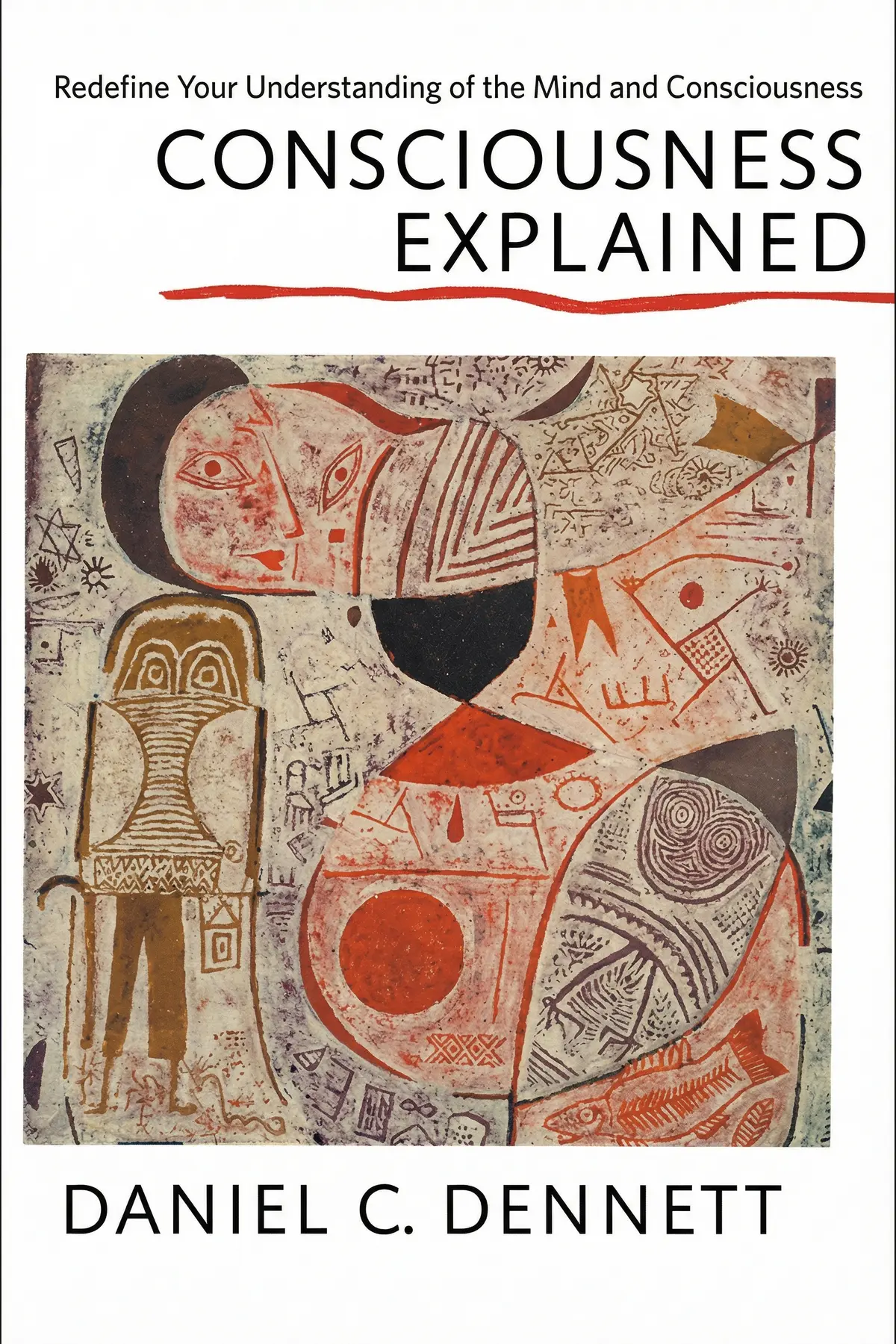
Table of Content
1. Introduction
57 sec
If you have always assumed there is a single you behind your eyes, watching and deciding, Daniel C. Dennett thinks your brain has fooled you. In Consciousness Explained, the Tufts philosopher argues that no inner viewer exists anywhere in the head. What feels like one unified stream of awareness is, in his account, a story the brain keeps assembling and revising from many processes running at once.
That single claim reaches a long way. It reframes the so-called hard problem of consciousness and gives language a leading role in making the human mind. It also offers scientists a way to study experience from the outside and recasts the self as a story. Follow Dennett’s case and you get a sharper way to think about your perceptions, your memories and your choices, plus a working answer to an old question: who, exactly, is doing the thinking?
2. Drop the picture of a tiny you inside
2 min 02 sec
Scientists spent centuries hunting for the spot where experience comes together and decisions get made. The search kept failing, and the reason says something uncomfortable about the observer you believe is reading this sentence.
3. See why your experience arrives already edited
2 min 07 sec
Two dots flash on a screen, and viewers report a color change that happens before the brain could possibly know the new color. That small oddity points to how every moment of awareness is actually produced.
4. See the hardest question as a magic trick
2 min 15 sec
Neurons pass electrical and chemical signals, yet you can almost taste a lemon you only imagine. Many thinkers call this gap unbridgeable. Dennett made a far more controversial suggestion about where the mystery really comes from.
5. Words build the inner life you live in
2 min 09 sec
Try planning next year or reflecting on last year without a single word. Dennett thought the difficulty is revealing, and it led him to a bold claim about what separates human awareness from that of other animals.
6. Treat inner reports as evidence to explain
2 min 15 sec
Experience is private, which seems to put it beyond the reach of science. Dennett borrowed a stance from anthropologists to get around that wall, and it carries an awkward lesson about how well anyone knows their own mind.
7. A self you can keep revising
2 min 01 sec
Your last big decision probably felt freely chosen by you. Dennett did not call that feeling false, but he offered a surprising account of what it is, borrowed from physics and from the act of writing an autobiography.
8. Conclusion
1 min 13 sec
Dennett asks you to give up a picture almost everyone carries: the small watcher behind the eyes. In its place he offers something stranger and, on reflection, more interesting. Awareness is a newsroom with no editor in chief, turning out drafts that compete, get revised after the fact and are narrated in words borrowed from a culture. The self sits at the center of that narration the way a center of gravity sits in a spinning object, real enough to use and impossible to find as a thing.
His critics think something has been left out, the raw feel of experience. Even so, the view earns its keep in ordinary life. When your memory of an event clashes with someone else’s, recall the phi dot that changed color too early, and allow that both of you may hold edited versions. When you feel certain about what is going on inside you, treat that report the way a careful anthropologist would, seriously and with a question attached. And when the story you tell about yourself stops fitting, revise it.
On Dennett’s account, you were always the author of that story. Nobody else was ever sitting in the theater.
About this book
What is this book about?
Almost everyone carries the same picture of the mind: a single self behind the eyes, watching the world like a film and deciding what to do. Since Descartes placed the meeting point of mind and body in the pineal gland, scientists have looked for that central seat of awareness. Brain research never found it. Daniel C. Dennett takes that failure as the starting point. He argues that the brain runs many interpretations of events at once. These drafts compete, the winners are edited into a smooth account after the fact, and what we call consciousness is that ongoing revision. From there he reframes the hard problem of consciousness as something like a magic trick. He gives language a central role in building human thought, and he proposes heterophenomenology, a way to study experience scientifically by treating people's reports as data. He ends by describing the self as a center of narrative gravity. Readers get a clear, provocative alternative to the inner theater picture, along with practical lessons: hold your certainties about your own mind more loosely, read other people's accounts of their experience with care, and see your identity as a story that can still be revised.
Book Information
Who it's for
Curious professionals
Curious professionals who sense their mind is less unified than it feels and want a clear, rigorous account.
Students of the mind
Students of psychology, philosophy or neuroscience looking for the classic case against the inner observer.
Rethinking memory and identity
Reflective readers rethinking memory, free will and identity.
About the Author
Daniel C. Dennett
Daniel C. Dennett (1942 to 2024) was the Austin B. Fletcher Professor of Philosophy at Tufts University and co-director of its Center for Cognitive Studies. Trained at Harvard and at Oxford, where he earned his D.Phil., he worked where philosophy of mind meets evolutionary biology and cognitive science. He gave the John Locke lectures at Oxford in 1983 and received the Jean Nicod Prize in 2001. His other books include Darwin's Dangerous Idea and Breaking the Spell.
Ratings & Reviews
Ratings at a glance

What people think
Listeners consider the work highly stimulating and thoughtfully crafted, noting that the intriguing concepts justify the energy required to get through it. Opinions on the prose are varied; while some listeners commend the writer’s style, others struggle to track the arguments. Although the text clarifies major aspects of consciousness effectively, some listeners feel the subject remains impossible to explain, and one review notes that the explanations are 5 times too long.
Top reviews
Pierre
Dennett’s 'Multiple Drafts' model is a total paradigm shift that dismantles the cozy 'Cartesian Theater' we all imagine in our heads. To be fair, he doesn't just explain consciousness; he fundamentally redraws the map of what it means to be a thinking thing. I found the sections on how we 'story' ourselves into existence to be particularly well-considered and deeply moving in a strange, mechanical way. While the prose can get dense, the payoff for sticking with his thought experiments is immense. He treats the mind not as a mysterious glow, but as a series of parallel processes that eventually coalesce into a narrative. This is easily one of the most provocative books I’ve encountered in years. It forces you to look at your own interior monologue as a byproduct rather than the driver.
Show moreJames
Ever wonder how a 1991 philosophy book would hold up in the age of ChatGPT? Reading this now is a trippy experience because Dennett’s descriptions of 'stupid machines' acting like a mind feel incredibly prescient. His argument that we are just biological information processors is bolstered by how modern AI generates 'reasoning' steps without having a soul. I love how he tackles the idea of the 'center of narrative gravity' as a pragmatic fiction. To be honest, I think this book is more relevant today than when it was first published. It’s a dense read, sure, but the intellectual sparks it flies are worth every minute of your time.
Show moreRod
Picked this up expecting a dry textbook and instead found a radical demolition of everything I thought I knew about my own mind. Dennett’s 'heterophenomenology' is a brave attempt to study the mind from the outside in, and it’s surprisingly convincing. The way he describes the brain as a 'parallel, multitrack' system rather than a single theater of action changed how I perceive my own thoughts. Not gonna lie, some of the scientific data is dated, but the underlying logic remains a powerhouse. It’s a thick, demanding read that requires your full attention. If you want to understand the modern materialist view of the soul, this is the definitive starting point.
Show moreJib
Is it possible to explain consciousness by simply pretending it isn't there? That’s the feeling you get halfway through this massive volume, which many critics have cheekily renamed 'Consciousness Explained Away.' Dennett is a master of the analytical school, using sharp logic to slice through our fuzzy intuitions about qualia and the self. Frankly, some of his metaphors feel like hand-waving, especially when he tries to bridge the gap between neural activity and actual feeling. Yet, even when I disagreed with his reductive approach, I couldn't stop thinking about the 'user illusion' he describes. The book is definitely a few hundred pages too long, but the core ideas remain essential for anyone interested in the hard problem.
Show morePhu
After hearing a friend rave about the 'human as novelist' concept, I finally dived into this classic. The idea that our consciousness is just a narrative we spin to make sense of brain data is fascinating and strangely plausible. Personally, I found the writing style a bit pompous at times, as if Dennett is daring you to be 'blinkered' enough to disagree with him. The book succeeds in breaking down the mechanics of perception, even if it leaves the actual 'feeling' of experience a bit hollow. Some chapters felt repetitive, and I think the work could have been far more concise without losing its intellectual punch. Still, it’s a brilliant exercise in rethinking the first-person perspective from the ground up.
Show moreAey
Gotta say, Dennett has a way of making you feel like a rank dogmatist if you dare to believe in the 'soul' or qualia. He is a fierce advocate for a purely physicalist world, and he defends his territory with impressive rhetorical flair. I found his discussion on 'figments' and how the brain fills in gaps to be the strongest part of the text. Truth is, the middle section drags significantly, and he could have made his point in half the page count. However, the concept of the self as an 'epiphenomenal construct' is so well-argued that it’s hard to ignore. It’s a polarizing book that will either enlighten you or make you very, very angry.
Show moreLiam
Not what I expected from a philosophy tome, as Dennett’s prose is surprisingly lively and filled with rhetorical pyrotechnics. He doesn't just present theories; he stages a full-scale assault on our intuitive 'common sense' about the mind. I particularly enjoyed the chapter on the reality of selves, where he uses the metaphor of a 'center of gravity' to explain the 'I.' To be fair, he does lean heavily on computational metaphors that might not satisfy those looking for a more 'human' explanation. But as a piece of rigorous scientific philosophy, it is absolutely top-tier. It's a fascinating journey, even if you end up disagreeing with his eliminativist conclusions in the end.
Show morePete
Look, there is no denying that the man is a genius, but this book is easily five times longer than it needs to be. I spent weeks wading through his various 'drafts' of the same argument before I felt like I actually grasped the central thesis. While his takedown of the Cartesian Theater is logically sound, the writing can be incredibly difficult to follow if you aren't already steeped in cognitive science. I often felt like the 'explanation' was just a series of increasingly complex computational metaphors. It’s a well-considered work, but the sheer verbosity makes it a chore for the casual reader. If you have the patience for 500 pages of rhetorical pyrotechnics, go for it. Otherwise, a summary might suffice.
Show moreFelix
The title is famously misleading; 'Consciousness Explained Away' would have been a far more honest branding choice for this work. Dennett essentially argues that our internal life is an illusion created by parallel neural processes, which feels like a bit of a cheat. In my experience, the analytical approach often ignores the 'lived experience' that continental philosophers like Derrida or Sartre prioritize. There’s a certain smugness in the way he dismisses the 'hard problem' as a mere linguistic confusion. While the biological details are fascinating, the philosophical conclusions left me feeling like the most important part of being human was missing. It’s a brilliant book, but one that seems to miss the forest for the trees.
Show moreApichat
Finally got around to finishing this, and frankly, I feel cheated by the promise of the title. Dennett spends hundreds of pages setting up a massive explanation, only to resort to hand-waving and 'golem' metaphors at the most crucial moments. He never actually explains how subjective experience emerges; he just tells us that it’s a 'user illusion' and we should stop worrying about it. The writing is incredibly repetitive and five times too long for the actual content provided. I found his dismissal of the phenomenology of lived experience to be arrogant and ultimately unconvincing. It felt more like a clever exercise in linguistic trickery than a genuine scientific breakthrough.
Show moreQuestions about this book
What is the main idea of Consciousness Explained?
Daniel Dennett argues that there is no central place in the brain where consciousness happens and no inner observer watching experience like a film. Instead, the brain processes information in parallel and produces many competing drafts of events. The winning drafts are edited into a coherent account, often after the fact, and that ongoing revision is what we experience as awareness. The self, in his view, is the story at the center of it.
What is the Cartesian theater?
It is the intuitive picture of a tiny self inside the head watching the movie of your life and making decisions. The name refers to René Descartes, who proposed that mind and body met in the pineal gland. Dennett rejects the picture because brain research shows sight, sound, emotion and memory being handled in different areas at once, with no single spot where everything comes together.
How does Dennett answer the hard problem of consciousness?
He argues the hard problem is a mistake. In his view, once science accounts for all the things consciousness does, including absorbing information, making decisions and reporting experience, no further puzzle remains. Likening consciousness to a magic trick, he says the sense that some ingredient is absent arises because we see our own mental processes only in a limited way. Critics reply that he sidesteps the raw feel of experience.
What is heterophenomenology?
It is Dennett’s method for studying consciousness scientifically. Researchers collect detailed descriptions from people, for example about what their fear of spiders is like, and treat them as data to interpret alongside other observable evidence, never as unquestionable truth. Dennett compared it to an anthropologist taking local beliefs seriously without assuming they are correct. The method also implies that people can be wrong about their own experiences.
Does Dennett say free will is an illusion?
He calls the feeling of free will a harmless illusion, like seeing the sun move across the sky while the earth actually turns. Decisions, he argues, emerge from competing processes in the brain rather than a central self, but they remain real and still matter. He describes the self as a center of narrative gravity, a useful fiction that keeps being revised, which raises open questions about responsibility.
Featured in
Readers also enjoyed

A Liberated Mind: How to Pivot Toward What Matters
Steven C. Hayes


Acting with Power: Why We Are More Powerful Than We Believe
Deborah Gruenfeld


Age of Propaganda: The Everyday Use and Abuse of Persuasion
Anthony Pratkanis


AUDIO SUMMARY AVAILABLE
Listen to Consciousness Explained in 15 minutes
Get the key ideas from Consciousness Explained by Daniel C. Dennett, plus 5,000+ more nonfiction titles.
- 5,000+ titles
- Listen as much as you want
- 7-day free trial
- Cancel anytime









