

Aflame: Learning from Silence
Pico Iyer
 English
Shows how to stop your self-worth from rising and falling with every compliment, setback or scroll, using Buddhist practices that build a steady, flexible confidence through pleasure, pain, praise, blame, fame and failure.
1 min 04 sec
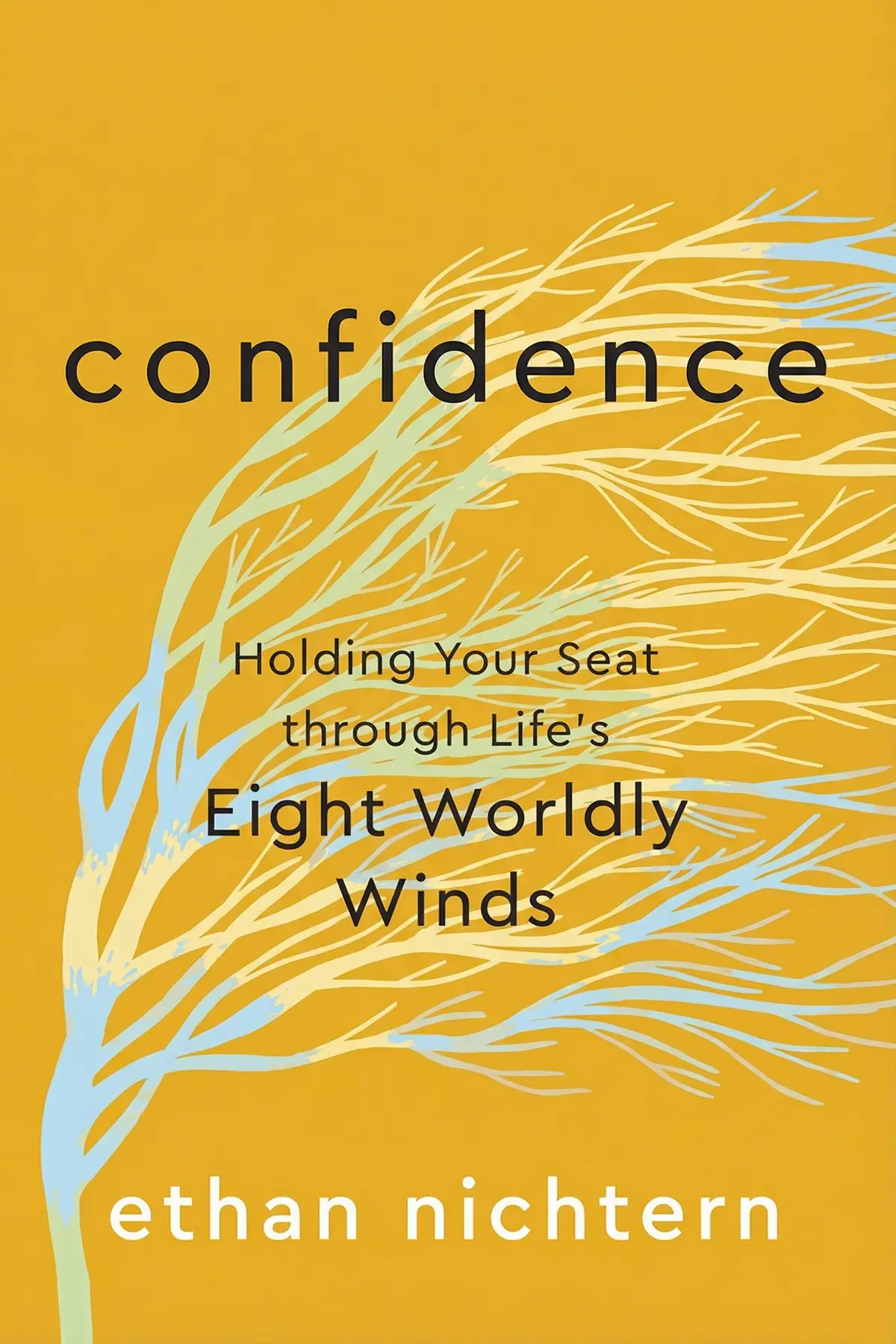
If your opinion of yourself climbs with every compliment and sinks with every critical comment, you are feeling what the Buddha, more than 2,500 years ago, called the eight worldly winds. In Confidence, teacher Ethan Nichtern, founder of the Interdependence Project, argues that these four pairs of forces still push people around today: pleasure and pain, success and failure, praise and criticism, fame and insignificance. The winds never stop blowing. What can change is how you meet them.
His case is that confidence is a skill of steadiness, built on self-awareness, compassion and the will to act, that no outside event can hand you or take away. Each pair of winds comes with its own practice, from labeling a moment as pleasant or unpleasant to deliberately sharing in someone else’s success. What you gain is a sense of worth that stays put on a bad day, with more room left over to care about other people.
1 min 44 sec
An inflatable figure flapping outside a car wash turns out to be a fair portrait of how most of us feel about ourselves. An ancient Buddhist word suggests a way to keep the figure without being thrown around by it.
2 min 01 sec
Your phone buzzes while you wait in line, and the pull to check it is hard to resist. A finding about experienced meditators hints that the pull, and pain itself, can be handled very differently.
1 min 40 sec
At your own art opening, every smile lifts you and every frown sends you down. Growing older teaches something about those reactions that most of us only half believe.
1 min 51 sec
A Disney film describes a second death that comes long after the first. Facing it squarely, Nichtern suggests, changes what you do with every follower, title or audience you ever gain.
1 min 51 sec
You land the job you wanted, and one message on the way upstairs makes it feel small. The habit behind that sinking feeling has a Buddhist antidote that sounds simple and feels surprisingly hard.
1 min 51 sec
The confidence that survives every wind looks nothing like swagger. It rests on three supports, and without the last one, the willingness to act, confidence stays only an idea.
1 min 03 sec
The eight winds are a list of everything that can make a person feel worthwhile one day and worthless the next. Nichtern’s book offers a different place to stand. Worth stops being a score kept by phones, audiences, bosses and old classmates, and becomes something you come back to, the way a meditator comes back to the breath after each lapse. The coming back is the skill. It never ends, and it never has to be finished.
The practices are small enough to start today. When your phone buzzes, name the feeling tone before you reach for it. When a friend wins, let yourself be glad for them on purpose, and if envy shows up instead, ask what it says you want. Once in a while, sit somewhere no one can see you and notice how that feels. If you have any platform at all, even a small team or a family, use it for someone else.
The tube man outside the car wash will always move with the air. A confident person moves too, and still knows where the ground is.
Many people feel their sense of worth swing wildly. A kind word lifts them, a critical comment flattens them, and a friend's success can spoil their own good news. Ethan Nichtern traces these swings to what the Buddha, more than 2,500 years ago, called the eight worldly winds: four pairs of experiences we either chase or run from. Nichtern's answer is upekkha, usually translated as equanimity, which he also reads as resilience. It means learning to respond with intention instead of reacting on autopilot. For each pair of winds he offers a practice: noting whether a moment feels pleasant, unpleasant or neutral, sitting with what it feels like when nobody is watching, deliberately enjoying other people's success and treating every wandering thought in meditation as a chance to begin again. Underneath these practices sits his model of real confidence, resting on self-awareness, compassion and agency. Readers get a way to stay grounded on bad days and good ones, and to turn that steadiness toward helping others.
Professionals whose mood rises and falls with every review, comment or social media count.
Ambitious people who find that a friend's success spoils their own good news.
Meditators and curious beginners who want Buddhist ideas turned into daily practices for staying steady.
Ethan Nichtern founded the Interdependence Project, a nonprofit that applies secular Buddhist study to activism, the arts, media and Western psychology. He has taught and lectured around the world. Confidence, published in 2024, joins his earlier books, including The Road Home, named one of Library Journal's Best Books of 2015, The Dharma of The Princess Bride and One City.

Listeners discover that this work provides insight via essential Buddhist principles, ensuring intricate subjects are approachable for everyone. They value its clear style, useful meditative practices, and authentic human touch, while one listener mentions its effectiveness in fostering a durable feeling of internal self-assurance. The title earns praise for its humorous and relatable tone, with one review emphasizing its capacity to articulate the human experience with clarity.
After hearing Ethan on a podcast, I knew I needed to grab a copy of Confidence. This isn't your typical "lean in" or "alpha male" manifesto, thank goodness. Instead, Nichtern delves into the Buddhist canon to explain how we can stay steady during the Eight Worldly Winds, like praise and blame. His writing style is remarkably accessible, blending ancient wisdom with a genuine sense of modern humanity that feels right for 2024. I particularly appreciated the practical meditation exercises scattered throughout, as they ground the more abstract concepts into something tangible. To be fair, some sections regarding the internal politics of Shambala felt a bit niche for a general audience, but they didn't detract from the overall message. This is a manual for anyone trying to navigate the messiness of being alive today with a bit more grace.
Show moreAny book that manages to weave Radiohead lyrics into a discussion on Buddhist tenets is an immediate win in my eyes. Nichtern is one of those rare spiritual teachers who doesn’t feel like he’s performing "holiness" for the reader; he’s just a guy who knows a lot about the mind. His exploration of the Eight Worldly Winds—especially the bit about influence versus insignificance—hit home for me in a way few books do. The tone is warm and witty, making the daunting task of "befriending oneself" feel like a goal that is actually achievable. Not gonna lie, I was worried it would be too academic, but it’s actually incredibly user-friendly and grounded. It offers a resilient sense of inner confidence that isn’t dependent on external success or constant praise.
Show moreWow, this might be the most "human" book on mindfulness I have ever encountered. Ethan's willingness to expose his own shadows and missteps makes the entire teaching feel much more authentic and attainable. I loved the distinction he makes between "alpha-human swagger" and the grounded, subtle confidence that comes from meditation and awareness. The meditation exercises are clear and concise, providing a useful toolbox for anyone feeling overwhelmed by the current state of the world. Look, we all stumble off the path sometimes, but this book acts as a gentle reminder of how to reclaim our seat. It feels like a conversation with a very wise, very funny friend who isn't afraid to be messy. This should be required reading for anyone struggling to find their footing in 2024.
Show moreAs someone who has followed Ethan’s work since The Road Home, I had high expectations for this one. It did not disappoint. He has a skillful way of meeting the reader exactly where they are, using language that preserves the integrity of the lineage while remaining accessible to a modern audience. The way he describes "holding our seats" through the winds of hope and fear is nothing short of brilliant. It provides a roadmap for developing a resilient sense of inner confidence that isn't easily shaken by the opinions of others. I found the inclusion of specific meditation practices to be a huge bonus, as they allow you to immediately apply the concepts he’s discussing. This is a kind, direct, and incredibly useful text for anyone navigating the complexities of the human experience.
Show moreEver wonder why some people seem so unshakable even when everything is going wrong? This book answers that question by diving into the heart of Buddhist psychology. Nichtern avoids the usual cliches of the genre, opting instead for a gritty, honest look at the challenges of 2024 and how we can use awareness to stay grounded. I especially loved the story about the difference between a monk and a person unfamiliar with mindfulness dealing with pain—it’s a simple but powerful illustration of the book's core message. The humor is subtle but effective, making even the heavier topics feel manageable and relatable. It’s a user-friendly toolbox for anyone wanting to be kinder to themselves while still doing the hard work of personal growth.
Show moreFinally got around to reading this and I’m already planning to give copies to several friends. Ethan writes with such clarity and care, making it feel like he’s right there in the room with you. It’s a manual on how to be a person, honestly. The insights on the Eight Worldly Winds helped me realize why I’ve been feeling so burnt out by social media and external validation lately. It’s about building a type of confidence that is quiet and internal, rather than loud and performative. The book is infinitely accessible, regardless of whether you’ve ever meditated before or not. A truly beautiful, timely piece of writing that I know I’ll be returning to for years to come whenever I feel myself losing my center.
Show moreThe chapter on the "Eight Worldly Winds" was exactly what I needed to read this week. Nichtern has this incredible ability to take complex dharma teachings and translate them into language that actually resonates with a secular reader. I’ve always struggled with the concept of "basic goodness," but he reframes it as the "seeds of awakening," which makes way more sense to my skeptical brain. While the book is mostly structured well, it does meander occasionally into personal anecdotes that feel slightly disconnected from the main thesis of confidence. That being said, the humor and relatability he brings to the table make the medicine go down much easier. It’s a thoughtful look at what it means to be a flawed, well-meaning person in a turbulent world. Definitely worth a read if you want something deeper than typical self-help.
Show moreThis book offers a refreshing departure from the toxic positivity that usually dominates the self-help shelf. Nichtern focuses on the "messiness" of existence, using the Buddhist framework to show how we can remain stable even when life feels like it's falling apart. The "windhorse" section was particularly illuminating, though I agree with other reviewers that it could have used a bit more introductory background for those of us new to these specific practices. His prose is clear and direct, yet he isn't afraid to let his sentences breathe and wander into some really profound territory. Truth is, I haven't felt this seen by a book in a long time, especially regarding the pain of trying to be "good" in a chaotic culture. It’s not a quick fix, but a meaningful manual for long-term growth.
Show morePicked this up hoping for a straightforward guide on building self-esteem, but it wasn't quite what I anticipated. Ethan makes it very clear from the jump that this isn't a traditional self-help book, and frankly, he’s right about that. There is a lot of focus on Buddhist lineage and the "windhorse" practice, which was interesting but felt a bit over my head at times without more context. I found myself getting lost in the sections about Shambala, wondering how the institutional issues there related back to my own personal sense of confidence. However, the metaphors he uses are quite sharp, and the meditation practices included at the end of chapters are legitimately helpful. It’s a bit all over the place, but there’s enough wisdom here to justify the time spent reading it.
Show moreNot what I expected at all, and to be honest, I struggled to finish it. I was looking for practical ways to feel more confident at work and in social settings, but this felt more like a series of essays on Buddhist philosophy and the drama within the Shambala community. It seems to meander far away from the title's promise, spending a lot of time on "worldy winds" and ancient traditions that didn't feel applicable to my daily life. While the author clearly knows his stuff, the writing felt "all over the place" and lacked the structure I need in a non-fiction book. If you're looking for a dharma study, you might enjoy this, but if you want actual self-help, look elsewhere. It just didn't land for me despite the occasional good metaphor.
Show moreNichtern argues that real confidence is a steadiness you train, not a feeling that depends on outside events. He builds on the Buddha’s eight worldly winds, four pairs of experiences we chase or avoid, and on upekkha, a Buddhist word for equanimity that he also reads as resilience. The goal is to keep feeling the winds while responding with intention instead of reacting on autopilot.
The Buddha described four pairs of forces more than 2,500 years ago: pleasure with pain, praise with criticism, fame with obscurity, and success with failure. One side of each pair is what we hope for and the other is what we fear. Nichtern argues they still shape modern life, often made stronger by phones and social media.
Nichtern suggests three practices. Cultivate mudita, or sympathetic joy, by deliberately enjoying other people’s successes until success stops feeling scarce. Look closely at your envy, since it reveals what you most want for yourself. And meditate, treating each moment your attention wanders as a small failure that gives you the chance to practice coming back.
Note the feeling tone of your experiences. Several times a day, label a moment as pleasant, unpleasant or neutral, for example when your phone buzzes while you wait in line. Nichtern says this simple habit exposes automatic reactions and helps you break them. A second practice is to sit still and alone, with nobody watching, and notice how your body and mind feel.
Pico Iyer


Daniel Goleman


Marianne Williamson

Deepak Chopra

Alcoholics Anonymous World Services

Eckhart Tolle

AUDIO SUMMARY AVAILABLE
Get the key ideas from Confidence by Ethan Nichtern, plus 5,000+ more nonfiction titles.









