
14 min 12 sec
Available in: English
Competing in the New World of Work: How Radical Adaptability Separates the Best From the Rest
Shows why most organizations only moved old work onto video calls, and gives teams tested habits for adapting ahead of change: decision boards, weekly sprints, energy check-ins and a monthly five minutes of foresight.
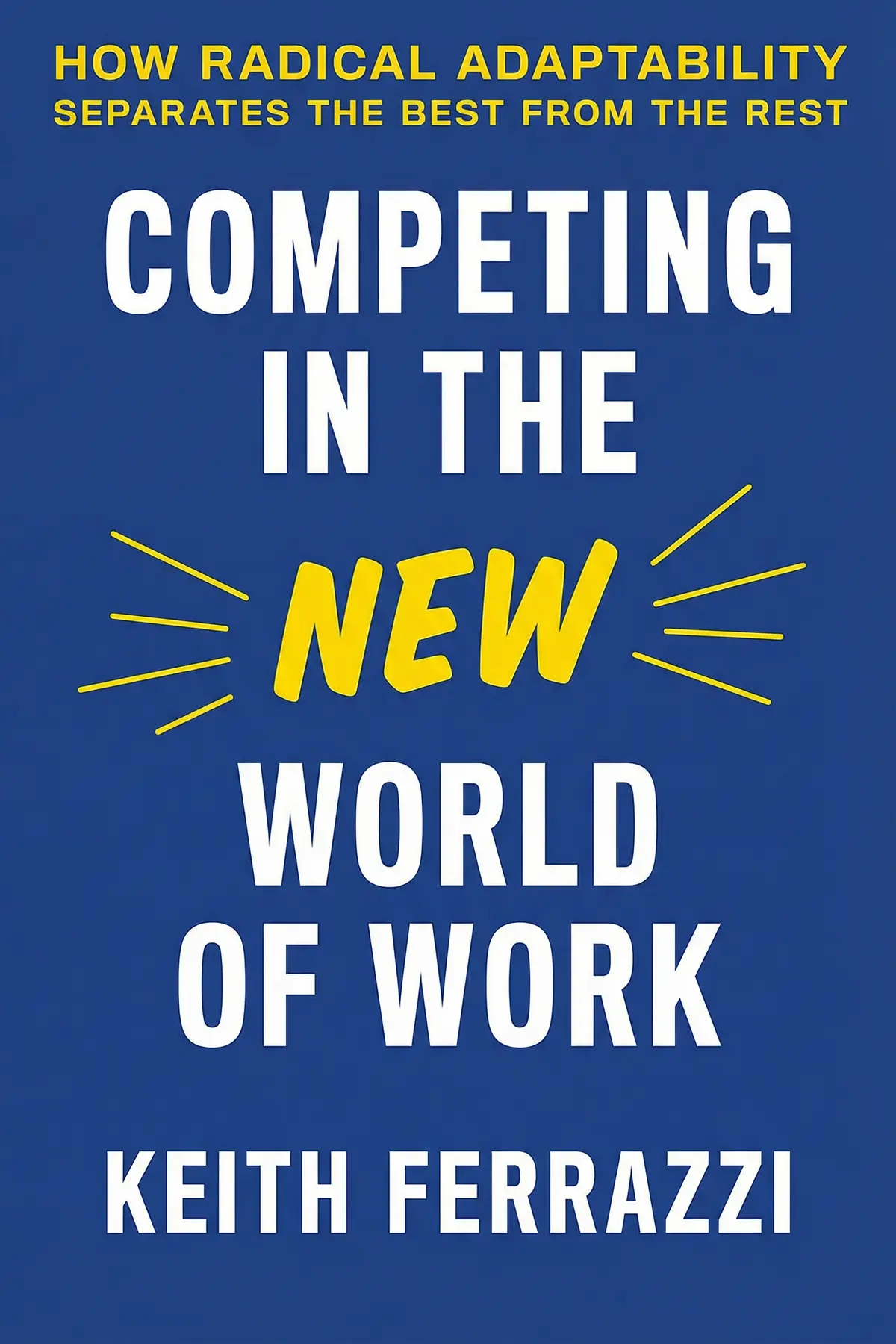
Table of Content
1. Introduction
1 min 02 sec
Plenty of teams went digital during the pandemic and now assume the hard part of change is behind them. Keith Ferrazzi’s research says otherwise: by his count, fewer than 15 percent of reasonably sized organizations truly reinvented their work, while the rest kept doing the same jobs from home.
In Competing in the New World of Work, written with Kian Gohar and Noel Weyrich, Ferrazzi argues that the crisis was a rare chance to rebuild how teams collaborate, decide and look after each other, and that most companies are letting it slip away. His answer is radical adaptability, a bundle of small, tested habits that let a team see change coming and shape it.
Those habits are practical. They cover how to settle a question without calling a meeting, how to plan in weekly sprints, how to keep a tired team strong and how to notice the next shock before competitors do. Each one is simple enough to try with your own team next week.
2. Stop doing old work on new screens
2 min 12 sec
Moving every meeting onto video felt like a revolution in 2020. Ferrazzi’s research across hundreds of companies suggests it was mostly an illusion, and it points to a sharper test of whether your team really changed.
3. Save meetings for problems the cloud can't solve
1 min 55 sec
At one company a problem meant booking a room. At another, booking a room was quietly frowned upon. The difference reveals two old beliefs about teamwork that cost companies time and good ideas.
4. Build plans from the bottom up with more voices
1 min 55 sec
Annual plans usually flow from the top floor down, and the people closest to customers are told their share. One global consumer company reversed the direction, and remote work makes the same move easier for any team.
5. Turn crisis speed into a weekly habit
1 min 58 sec
In the worst months of the pandemic, slow companies suddenly moved at startup pace. Ferrazzi thinks that speed was too valuable to lose, and he shows how to keep it without running every week like an emergency.
6. Build team resilience by sharing energy and well-being together
2 min 00 sec
Burnout is usually treated as a private struggle you fix on your own time. Ferrazzi’s research found the real drain somewhere unexpected, and a one-minute ritual involving puddles and unicorns turns out to be part of the cure.
7. See the next shock coming before others do
1 min 54 sec
A schoolgirl on a beach and a giant defense company share one trait: both read a warning sign early and acted on it. Ferrazzi turns that instinct into five minutes on a monthly agenda.
8. Conclusion
1 min 16 sec
The pandemic proved something most leaders had doubted: that a large organization could change how it works almost overnight. Ferrazzi’s case is that this ability was never meant to be a one-time emergency response. Kept alive in small, tested routines, it becomes a lasting advantage. Companies that let it fade, the authors warn, risk slipping back into the old normal, falling behind and eventually disappearing. The second half of the book applies the same thinking to the business itself, from experimenting with technologies such as robotic delivery to deciding which work to keep in-house and which to hand outside, and it closes by linking personal fulfillment to the changes ahead.
For most listeners, though, the starting point is one team and one week. Replace your next meeting with a decision board and watch who joins in. Open a meeting with an energy check-in and listen carefully to the twos. Put five minutes of foresight on the monthly agenda and give each person something to watch.
None of this requires a reorganization. It requires someone like Tilly Smith on that beach, willing to trust what the water is doing and to speak first.
About this book
What is this book about?
When the pandemic struck, almost every organization went digital. Keith Ferrazzi argues that very few actually changed. By his count, fewer than 15 percent of reasonably sized organizations reinvented how they worked, while the rest carried the old office routine onto a screen and called it transformation. To learn what the others did differently, Ferrazzi's research institute interviewed about 2,000 executives over two years, refined their best ideas in small peer groups and tested them in teams across 300 companies. The practices that worked, which he calls high return practices, add up to radical adaptability: a way of leading that anticipates change instead of reacting to it. The book makes that idea concrete. Readers learn to replace meetings with shared decision boards, to build plans from the bottom up, to run weekly agile sprints, to treat resilience as a team responsibility with a simple energy check-in, and to give each leader a lens for spotting risks early, while Lockheed Martin shows the value of crowdsourced foresight, having gone fully virtual by February, before the US shutdown.
Book Information
Who it's for
Leading a hybrid team
Team leads who moved to hybrid work and suspect their team only changed its tools.
Executives wanting tested practices
Executives who want tested practices for planning, foresight and agile work after the pandemic.
Managers wanting resilient teams
Managers worried about burnout who want a simple, open way to keep a team resilient.
About the Author
Keith Ferrazzi
Keith Ferrazzi founded Ferrazzi Greenlight, a Los Angeles-based team coaching and consulting firm, and leads its research institute. He coaches senior leadership teams on collaboration, redesigning how work gets done and teaming between people and AI. He was earlier Chief Marketing Officer at Starwood Hotels and at Deloitte Consulting, and studied at Yale and Harvard Business School. His books include the bestsellers Never Eat Alone and Who's Got Your Back?, and Thinkers50 named him a top 50 management thinker in 2025.
Ratings & Reviews
Ratings at a glance

What people think
Listeners find the writing highly accessible, with one noting it serves as an excellent manual for the contemporary business landscape. Furthermore, the book delivers useful perspectives on the modern professional era, with one listener highlighting its amazing observations regarding the current state of work. They also value the concentration on leadership, with one listener mentioning it provides practical guidance, and its stress on radical adaptability, with one noting how organizations and groups can adopt and become experts in it. The material is seen as both opportune and significant, with one listener characterizing it as a vital resource for those in management.
Top reviews
Book
Finally, a guide that actually understands how much the pandemic shifted our office dynamics forever. Ferrazzi breaks down the "lone genius" myth and explains why collaborative problem-solving is the only way forward in a volatile market. The advice on team resilience and mental health was particularly moving and felt much more authentic than your standard business fare. I have already implemented the monthly warning briefs with my department to keep us ahead of technological trends. This is an essential read for any leader who does not want to get left behind in the 2019 mindset.
Show moreFelix
Radical adaptability is the name of the game now, and Ferrazzi delivers a masterclass on how to embrace it. The way he describes the transition from authority-centric cultures to customer-centric ones is brilliant and totally necessary for the current era. I particularly appreciated the specific exercises designed for group study, as they helped my team open up about their remote work frustrations. It is rare to find a business book that balances high-level strategy with actual concern for team well-being. This is easily one of the most relevant leadership books I have picked up in the last five years.
Show moreSun
After hearing Ferrazzi speak on a podcast, I felt compelled to dive into his latest framework for the post-pandemic era. The concept of "Radical Adaptability" is more than just a buzzword; it is a necessary survival tactic for leaders navigating today's hybrid mess. While some of the case studies felt a bit distant from my daily reality, the focus on inclusive collaboration really hit home. It is a solid playbook for anyone trying to rebuild team culture when everyone is scattered across different time zones. To be fair, you have to ignore the occasional self-promotion for his consulting firm to get to the real meat of the strategies.
Show moreTee
Thriving in a post-COVID landscape requires a total mindset shift that most traditional managers are simply not prepared for. This book serves as a fantastic wake-up call, emphasizing that we cannot just go back to the way things were in early 2020. The strategies for creating a Lego block workforce are particularly relevant as we see more people moving toward fractional and freelance roles. My only gripe is that the writing style can be a bit dry and academic in the later chapters. Regardless, the actionable advice on fostering team resilience makes it a worthwhile investment for any director-level professional.
Show moreEthan
Picked this up because our HR department recommended it as a guide for our new "Agile" transition. The insights into how we can use asynchronous work to boost productivity were genuinely helpful for our project managers. However, the middle section drags significantly with repetitive anecdotes that do not always land. It is a three-star read for me because for every mind-popping insight, there is a chapter that feels like common sense dressed up in fancy new terminology. Truth is, you could probably skim the first half and get eighty percent of the value without reading every single word.
Show moreBird
The chapter on inclusion and asynchronous work was definitely the highlight for me, offering some real-world logic for the hybrid struggle. Ferrazzi’s expertise in networking shines through when he talks about building trust-based relationships in a digital-first environment. On the downside, some sections on future-proofing felt like they were included just to check a box on modern tech trends. It is a decent middle-of-the-road resource that provides a good vocabulary for discussing these changes with upper management. Personally, I think it works better as a reference book than a cover-to-cover read.
Show moreKae
As someone who works in a mid-sized tech firm, I found the advice a bit hit-or-miss depending on the chapter. The radical adaptability framework is great, but the execution of the book feels like it is swinging between extremely basic tips and high-level corporate strategy. I liked the focus on active foresight, yet I found the frequent mentions of the author's consulting company distracting and repetitive. It is a useful enough playbook for the new normal, even if it does not reinvent the wheel. Just be prepared for a lot of management lingo that might not translate well to smaller startups.
Show moreJob
Look, I wanted to love this because the premise is so timely, but it frequently felt like one giant advertisement for Ferrazzi’s consulting business. Every few pages, the solution to a complex corporate problem seemed to be hiring an outside expert like the author himself. The "Lego block workforce" concept is interesting in theory, yet the book spends way too much time in high-level abstractions. Frankly, it lacks the "boots on the ground" practicality I was expecting for my small team. If you are a CEO of a Fortune 500 company, you might find value here, but for the rest of us, it is a lot of management lingo.
Show moreFilm
Ever wonder if business books are just long-form brochures for the author’s speaking gigs? This one definitely falls into that trap, focusing way too much on the author’s own high return practices. While the enterprise agile chapter had a few decent takeaways regarding customer focus, the rest was buried under an avalanche of buzzwords. It felt like I was reading a script for a corporate retreat rather than a practical manual for growth. Not gonna lie, I expected something much more grounded given Ferrazzi’s previous work on networking and professional relationships.
Show moreValentina
This book aged poorly because it was written during a time of immense transition and the advice already feels quite stale. He paints incredibly difficult cultural shifts with a very simple brush, making it sound like a few Zoom breakout rooms will solve deep-seated systemic issues. In my experience, it was a struggle to finish because the tone is so relentlessly consultant-speak and corporate-heavy. I was looking for authentic human connection strategies, but instead, I got a brochure for a radically adaptable corporation. Skip this one unless you really love reading long-form sales pitches for consulting services.
Show moreQuestions about this book
What is the main idea of Competing in the New World of Work?
Keith Ferrazzi argues that most organizations wasted the pandemic, with fewer than 15 percent truly reinventing their work. His remedy is radical adaptability, a bundle of high return practices drawn from interviews with about 2,000 executives and tested in teams at 300 companies. The practices help teams anticipate change and transform through it: collaborating in writing before meeting, working in weekly agile sprints, sharing resilience and crowdsourcing foresight.
What is a decision board in Ferrazzi's book?
A decision board is a shared document that replaces a meeting. It lays out the issue, possible creative solutions, the risks and the people who should be involved. Recipients can forward it to colleagues with useful knowledge, and the discussion happens in the cloud. Ferrazzi, inspired partly by how the self-driving car company Cruise worked, suggests calling a meeting only when this written exchange fails to settle the question.
How does the energy check-in work?
Once or twice a month, at the start of a meeting, each team member rates their energy from zero to five, where zero is lying face down in a puddle and five is skipping on rainbows with unicorns. Low scores invite a gentle question. In the book’s example, Dave’s two reveals that his teething twins kept him awake, and Ferrazzi notes the ritual can surface far heavier struggles that people would otherwise hide.
Who should read Competing in the New World of Work?
It suits team leaders and executives who want concrete practices for hybrid work, agile planning, team resilience and foresight. One reviewer said the first quarter of the book serves people leaders in general, while the rest speaks mainly to leaders of large corporations and includes many case studies, such as Unilever’s bottom-up planning and Lockheed Martin’s early move to fully virtual work.
Readers also enjoyed



A Year with Peter Drucker: 52 Weeks of Coaching for Leadership Effectiveness
Joseph A. Maciariello





Acting with Power: Why We Are More Powerful Than We Believe
Deborah Gruenfeld

All In: How Great Leaders Build Unstoppable Teams
Mike Michalowicz

AUDIO SUMMARY AVAILABLE
Listen to Competing in the New World of Work in 15 minutes
Get the key ideas from Competing in the New World of Work by Keith Ferrazzi, plus 5,000+ more nonfiction titles.
- 5,000+ titles
- Listen as much as you want
- 7-day free trial
- Cancel anytime









