
11 min 43 sec
Available in: English
Coming Alive: 4 Tools to Defeat Your Inner Enemy, Ignite Creative Expression & Unleash Your Soul's Potential
Shows how to spot the inner force that drains your energy and sabotages your goals, then meet it with four short exercises for cravings, fatigue, despair and old emotional pain.
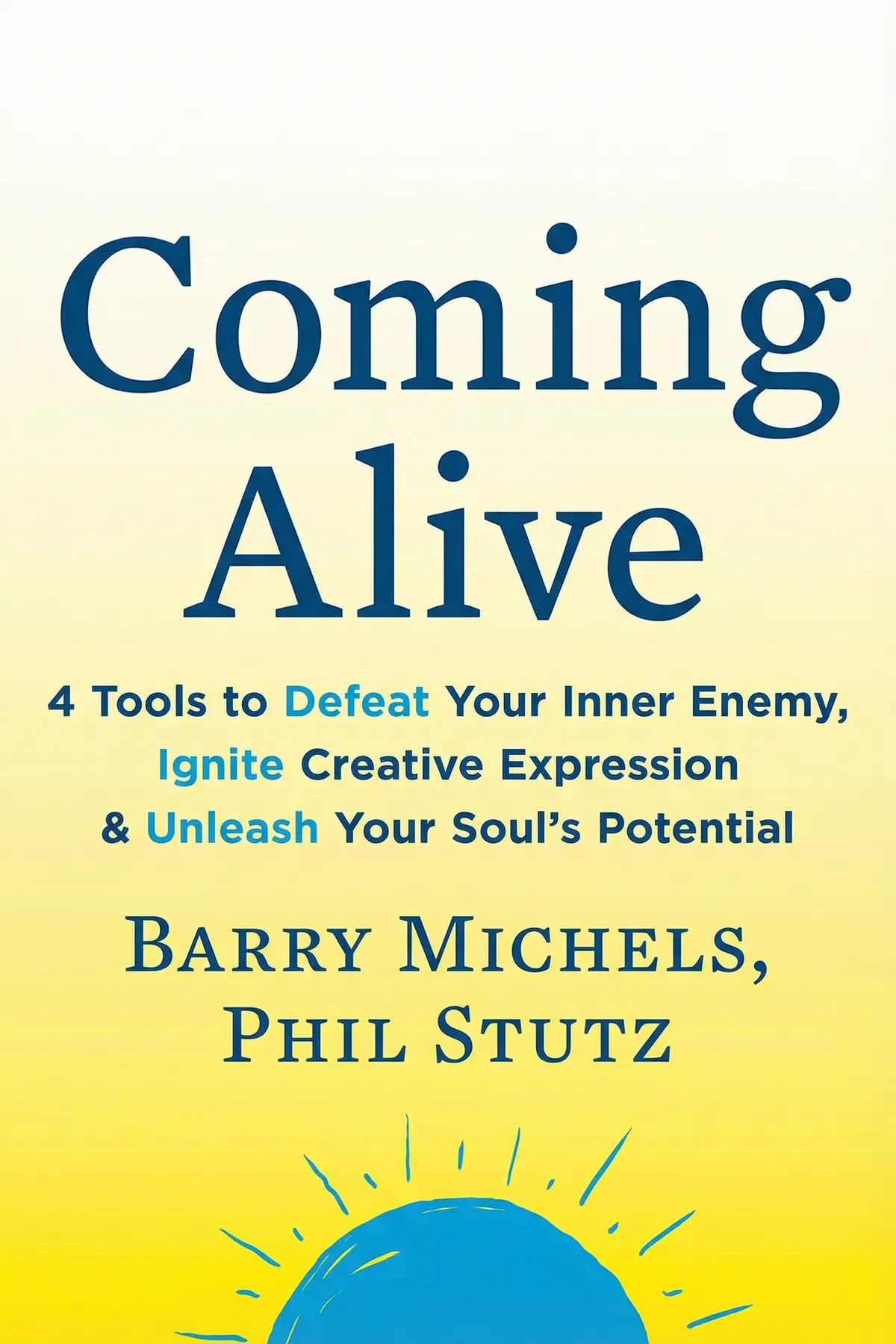
Table of Content
1. Introduction
58 sec
Most adults feel their energy drain away over the years and assume that is simply the price of growing up. In Coming Alive, psychiatrist Phil Stutz and therapist Barry Michels argue the opposite: the boundless force you had as a child is still there, and something inside you is working to keep it buried. They call the energy the Life Force and the opponent Part X, a negative presence with its own agenda that can even convince you that you have no say over your own actions.
Their claim is that you will never beat Part X for good, but you can win against it each day with four short inner exercises. Each tool targets a different way Part X wins: an impulse you cannot resist, a fatigue that keeps you stuck, a discouragement that kills motivation, and an old pain that keeps you a victim. By the end, you will be able to call the enemy by name and know which tool to reach for the moment it appears.
2. Give your inner enemy a name, then fight it
1 min 57 sec
A good morning run can still end with two lost hours on the sofa. The authors see more than weak will behind that slide, and they say the fight never ends, even once you spot it.
3. Stop a craving before it takes your evening
1 min 53 sec
A stressed man wants nothing more than the bar down the street. Instead of fighting the urge or giving in, he sits down and turns toward the very feeling he wants to escape.
4. Find fresh energy when your battery feels dead
1 min 58 sec
Some mornings a full night’s sleep changes nothing. The authors separate two kinds of energy, only one of which can run out, and offer a strange image for reaching the other.
5. Climb out of despair without false hope
1 min 57 sec
A man loses his partner and then his job within a single month. The authors argue the deeper problem was a false hope he had pinned his happiness on.
6. Turn an old wound into courage to take risks
1 min 45 sec
The last tool asks you to do the opposite of what comfort suggests with a painful memory. A booming voice, a hollow tower and an open sky follow, and so does a different relationship with your past.
7. Conclusion
1 min 15 sec
Coming Alive rests on a simple picture: two forces compete for your energy every day, and only one of them is on your side. The Life Force you rode as a child never left. Part X, the voice that pulls you toward the sofa, the bar, the false shortcut and the old wound, never leaves either. Michels and Stutz do not promise a final victory. What they offer is a way to win today’s battle, through the choices you make and four tools you can fold into your daily routine.
That changes what a bad day means. A craving, a dead battery, a collapse of hope or a memory that still hurts is no longer a verdict on you. It becomes a signal that Part X has arrived and that you have a tool for it. Start by naming your own Part X, whether it shows up as loneliness or as fear of something new. When an urge starts to take over, sit with the emptiness and let the Black Sun fill it. When you reach for rest, check whether you are recharging or escaping. And when your mood drops, go to the Mother tool early, before false hope moves in.
The enemy will always come back. So, every day, will your chance to choose against it.
About this book
What is this book about?
Children seem to run on endless energy. Adults mostly don't. Over the years emotional barriers build up, progress stalls and happiness slips away. Psychiatrist Phil Stutz and therapist Barry Michels argue that the energy is still there. They call it the Life Force, and they say something inside us works to keep it buried. That opponent is Part X, a negative presence with its own agenda that thrives on complacency and exhaustion and can even persuade us that we have no control over what we do. Their answer is a set of four inner tools, each built for a different way Part X wins. The Black Sun handles impulses you cannot shake. The Vortex goes after inertia and fatigue. The Mother tool lifts you out of discouragement without false hope. The Tower turns a painful memory into strength. Readers get a clear way to name their own inner enemy, step-by-step descriptions of each exercise, and examples of people using them: a man fighting the urge to drink, a woman choosing a book over her phone, and a man who lost his partner and his job in the same month.
Book Information
Who it's for
Sabotaging their own plans
People who keep sabotaging their own plans with scrolling, drinking or giving up.
Drained and stuck professionals
Professionals who feel drained and stuck even after a full night's sleep.
Weighed down by setbacks
Anyone weighed down by a setback or an old hurt who wants a short daily practice.
About the Author
Barry Michels
Phil Stutz is an American psychiatrist who trained at City College in New York and New York University. He began his career working in the prison on Rikers Island, ran a private practice in New York, and moved it to Los Angeles in 1982. Barry Michels studied at Harvard and Berkeley law school, worked as a lawyer, then retrained as a therapist and opened his practice in 1986. The two wrote the bestseller The Tools together, and their clients include writers, actors, producers and business leaders. Stutz also appears in the Netflix documentary Stutz.
Ratings & Reviews
Ratings at a glance
What people think
Listeners find this title both accessible and life-altering, especially for people seeking to break away from negative thought cycles. They also value its hands-on style, with one listener highlighting how it offers specific techniques for handling the pressures of life. Furthermore, the content is direct and empathetic, assisting individuals in reaching emotional liberation, and listeners prize the work’s overall sincerity.
Top reviews
Iff
This book acts as a manual for anyone who feels paralyzed by their own internal dialogue. Michels and Stutz don't just offer vague platitudes about happiness; they provide a specific, actionable framework for tapping into what they call the 'Life Force.' What I found most refreshing was the directness of their approach. Instead of spending years dissecting childhood trauma, you are encouraged to use these mental 'tools' the moment a negative thought pattern emerges. Frankly, it’s one of the few self-help books that feels like it was written by people who actually understand the gritty, day-to-day struggle of being human. While some of the imagery—like the Vortex—requires a bit of an open mind, the results are undeniable if you actually do the work. My perspective on discipline and creativity has shifted significantly since I finished the final chapter.
Show morePensri
Finally, a guide that doesn't just tell you to 'think positive' while you're drowning in a hole. This book is essentially a map for getting out of those holes we dig for ourselves. The authors are clearly experienced therapists who have seen it all, and their authenticity shines through in every chapter. I found the section on the 'Life Force' particularly moving; it reminded me that we have access to a much larger reservoir of energy than we realize. Some might find the language a bit 'woo-woo,' but to me, it felt like a necessary way to describe experiences that are usually hard to put into words. It’s a straightforward, life-changing read for anyone ready to stop being a robot and start actually living. It helped me find emotional freedom in a way that years of traditional talk therapy never did. I've already recommended it to three friends.
Show moreTakeshi
Ever wonder why you're your own worst enemy? This book explains exactly why that is and, more importantly, what you can do to stop it. The authors offer a very compassionate view of human nature, acknowledging that we are all constantly under attack from a part of ourselves that wants us to stay small and miserable. The 'Tools' they provide are like a can opener for the soul. They are simple to perform but have a profound impact on your emotional state. I especially appreciated the focus on 'The Life Force'—it’s an empowering concept that makes you feel like you’re part of something bigger. In my experience, this is one of the few books that actually lives up to the 'life-changing' blurb on the cover. It’s straightforward, authentic, and deeply practical for anyone looking to make a real change.
Show moreSophia
The concept of the 'Life Force' resonated deeply with me during a particularly dark season of my life. I’ve read a lot of self-development books, but most of them feel like they’re just scratching the surface. Michels and Stutz go much deeper. They acknowledge the reality of pain and evil, but they provide a way to use those obstacles as fuel for growth. The visualizations are psychedelic, yes, but they have a 'mental stickiness' that makes them easy to remember when you're actually in the middle of a crisis. I found myself using the tools almost immediately after reading about them. It’s a brilliant follow-up to their first book and offers a path toward a more creative and courageous way of existing. If you’re willing to suspend your disbelief and just try the exercises, you might be surprised by how quickly your perspective shifts. Truly a remarkable piece of work.
Show moreUraiwan
After watching the Netflix documentary about Phil Stutz, I knew I had to see what the actual methodology looked like on the page. Coming Alive is a fascinating, if sometimes bizarre, deeper dive into the concept of 'Part X,' which is essentially that self-destructive voice we all have. The authors use stories from their clinical practice to illustrate how these tools work in real life, which makes the more metaphysical elements much easier to swallow. I’ll admit, the sections on the 'Black Sun' and 'Twelve Suns' felt a little like a psychedelic trip, but the underlying psychology is sound. To be fair, you have to be willing to engage in some pretty intense visualization for this to be effective. It’s not a passive read. If you’re looking for scientific citations, you won’t find many here, but for those seeking emotional freedom through action, it’s a total game-changer.
Show moreBenjamin
Few self-help authors actually demand you *do* something while you’re reading, but Michels and Stutz are different. They insist that the tool is an action, not a thought. That distinction is everything. As someone who has struggled with chronic procrastination and negative loops, the concept of 'Part X' gave me a concrete enemy to fight. The tone is compassionate yet incredibly firm, which I appreciated. Not gonna lie, I felt a bit ridiculous silently screaming 'HELP' at an imaginary circle of suns, but the shift in my state of mind was immediate. It’s a very practical book wrapped in a very weird, metaphysical package. If you can get past the terminology, there is a lot of wisdom here about how to live a life that actually feels meaningful. It’s certainly more effective than just sitting on a therapist's couch for an hour every week.
Show moreTern
Picking this up after 'The Tools' felt like a natural progression, though it’s definitely a more intense experience. The focus here is on the long-term battle with our inner enemy, and the strategies provided are remarkably effective for breaking negative thinking patterns. I love how they emphasize that a great life requires you to go 'all in' rather than just dipping your toes in. The writing is clear and the format—using patient stories to lead into the tools—works perfectly. My only gripe is that they don't really credit where some of these ideas come from; a lot of it feels borrowed from Jung or Freud without any acknowledgment. Still, the practical application is what matters most to me. It’s a compelling read that provides a sense of hope without being overly sentimental. If you want to feel more alive and less like you’re just going through the motions, give this a shot.
Show moreWan
I’m stuck somewhere between thinking this is genius and thinking it’s absolute nonsense. On one hand, the practical advice regarding self-restraint and confidence is better than 90% of what’s on the market today. The way they frame problems as gifts is a perspective I’ve found genuinely helpful during a stressful month at work. On the other hand, the writing often veers into this strange, quasi-religious territory that I found hard to take seriously. They talk about 'Twelve Suns' and 'Vortexes' as if they are physical realities rather than just metaphors. Look, the 'Tools' themselves are great, but you have to wade through a lot of psychological babble and strange terminology to get to them. I liked their first book much better because it felt more grounded in reality. This sequel is a bit too 'out there' for my personal taste, even if the core message remains powerful.
Show moreGor
To be fair, there are nuggets of pure gold buried under a lot of psychological babble here. The authors have a great way of making the methods feel tangible through the use of patient dialogues, which kept me engaged when the theory got a bit dry. However, the terminology is just so strange. Calling your destructive impulses 'Part X' or imagining a 'Black Sun' might work for some people, but it felt a bit like a distraction to me. I found myself constantly trying to 'translate' their weird metaphors into something more grounded and scientific. It’s a bit of a slog at 300 pages, and I think a more concise version would have been more effective. That said, the actual advice on how to handle life's stressors is solid. It’s just a polarizing book that you’ll either love or find incredibly irritating depending on your tolerance for metaphysical imagery.
Show moreSebastian
Call me a skeptic, but I struggled to get past the pseudo-spiritual hallucinations presented as clinical advice. I picked this up because I liked the idea of practical tools for anxiety, but what I got was a lecture on 'The Vortex' and 'The Mother.' Page 124 actually tells you to imagine twelve suns over your head and summon a tornado-shaped vortex by screaming for help. I mean, really? It feels like the authors are trying to create a new religion rather than providing psychological insights. Personally, I found the tone to be quite patronizing at times, as if anyone who doesn't buy into their specific brand of visualization is just 'mindless' or 'robotic.' There are a few nuggets of wisdom about discipline, but they are buried under so much nonsense that it’s hardly worth the effort. It’s a shame because the first book had a lot of promise, but this feels like they’ve gone off the deep end.
Show moreQuestions about this book
What is the main idea of Coming Alive, the book written by Barry Michels and Phil Stutz?
The authors argue that everyone carries a Life Force, the boundless energy we had as children, and an inner opponent called Part X that works to drain it through distraction, exhaustion, false hope and victimhood. Part X can never be beaten for good, so the struggle lasts a lifetime. You can still win each day by naming your Part X and using four short visualization tools.
What are the four tools in Coming Alive?
The Black Sun helps you control impulses by turning toward the feeling of lack until an inner sun fills it. The Vortex taps unlimited spiritual energy through a spinning ring of twelve suns. The Mother tool lifts discouragement with an image of a loving figure who makes no false promises. The Tower turns a painful memory into strength by letting you die and rise again in your imagination.
What is Part X?
Part X is the authors’ name for a negative force inside each person with its own agenda. It feeds on complacency, thrives on exhaustion, loves shortcuts and wants you unhappy. It is skilled at deception and can even convince you that you have no control over your actions. It might show up as loneliness, a fear of trying new things or a fear of starting a relationship.
How do I use the Black Sun technique?
Use it the moment an unwelcome urge appears, before you start to dwell on it. Sit, close your eyes and breathe deeply. Focus on the feeling of being denied and stay still in it rather than escaping. Accept the emptiness, then picture a black sun growing until its warm energy fills you. Finally, send that energy outward as white light filling the room, and repeat a few times.
How do I know whether I am resting or escaping?
Michels and Stutz say the answer lies in context. Ask yourself whether you are really recharging or just trying to avoid what is in front of you. They treat rest as a pit stop before you get back to your life: a short nap is fine, but shutting down altogether is what Part X wants. When fatigue turns into avoidance, they suggest using the Vortex tool.
Readers also enjoyed






A Guide to the Good Life: The Ancient Art of Stoic Joy
William B. Irvine




A High-Performing Mind: Strengthen Your Mind and Live Your Best Life
Andrew D. Thompson
AUDIO SUMMARY AVAILABLE
Listen to Coming Alive in 15 minutes
Get the key ideas from Coming Alive by Barry Michels, plus 5,000+ more nonfiction titles.
- 5,000+ titles
- Listen as much as you want
- 7-day free trial
- Cancel anytime









