
12 min 20 sec
Available in: English
The Tools: 5 Tools to Help You Find Courage, Creativity, and Willpower--and Inspire You to Live Life in Forward Motion
Five quick mental exercises from a psychiatrist and a therapist for the moments that stall you: a dreaded task, an infuriating person, hidden insecurity, endless worry and the lack of will to start.
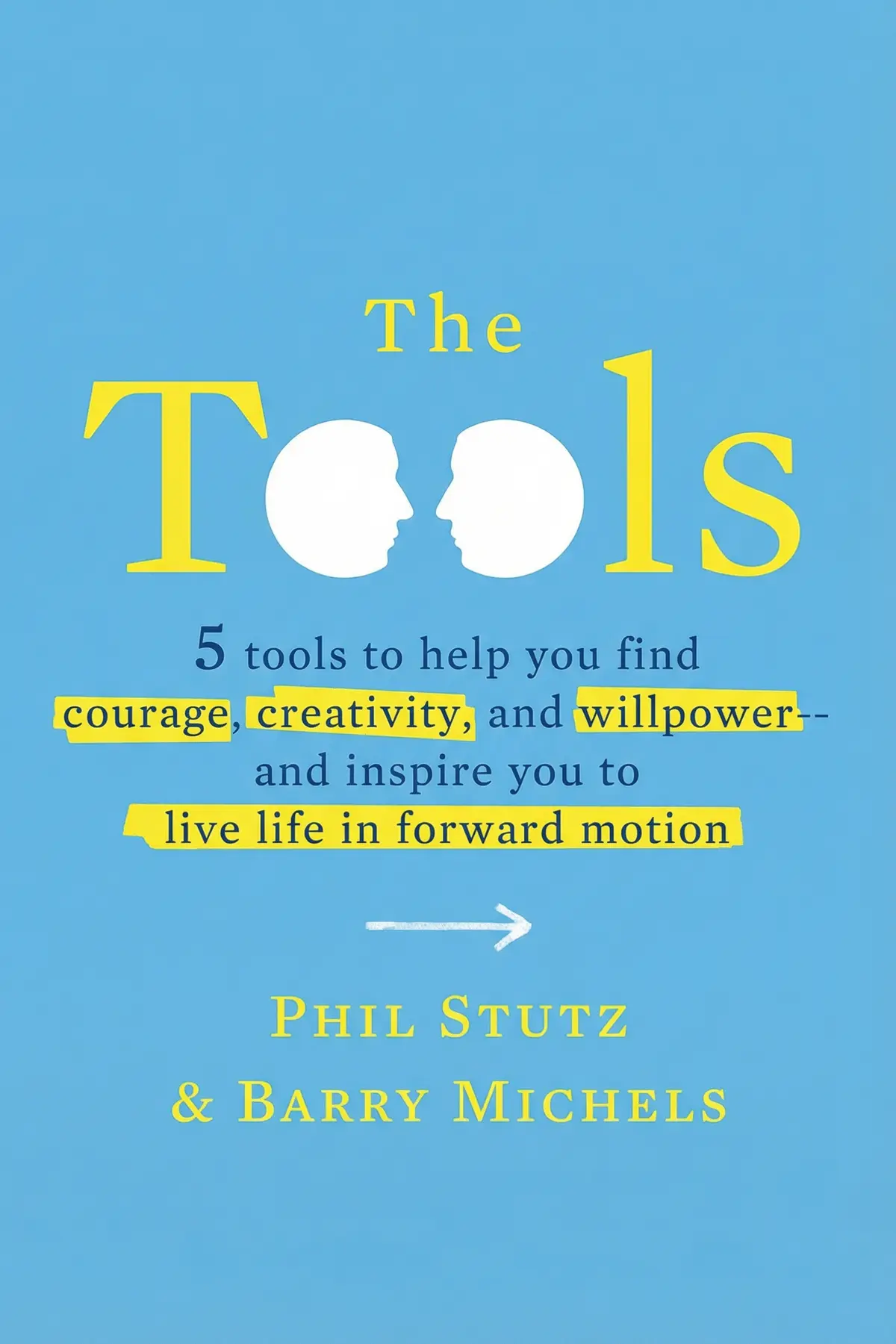
Table of Content
1. Introduction
59 sec
Many people leave therapy understanding their problems better and still not knowing what to do about them on Monday morning. In The Tools, psychiatrist Phil Stutz and therapist Barry Michels offer a different answer: five short mental exercises you can run in the middle of a hard moment, no appointment needed.
Their claim is that what keeps people stuck is rarely the difficulty itself. It is the habit of backing away from the next step. Each tool exists to keep you moving forward, which the authors treat as the force that keeps life going. Like a real toolbox, it only helps if you pick the right one and do the work yourself.
The five cover the situations that stall most of us: a task we dread, a person who makes us furious, the insecure part of ourselves we hide, the worries that keep us awake, and the days when we simply cannot make ourselves begin. Each exercise is a quick mental practice, and each can be put to use straight away.
2. Turn the task you dread into forward motion
2 min 10 sec
The conversation you keep postponing feels like the obstacle. The authors say it isn’t, and their first exercise asks for something that sounds absurd: to feel glad when the painful moment finally arrives.
3. Stay out of the maze when people provoke you
1 min 55 sec
Some people seem designed to ruin your mood: the rude driver, the dismissive boss. Fighting the anger rarely works, so the authors suggest answering it with a feeling that sounds impossible in the moment.
4. Bring your insecure self into the room
2 min 05 sec
A mother worked hard to fit in among wealthier parents, yet they kept their distance. The reason surprised her, and it suggests that hiding your weak spots may be what makes others pull away.
5. Make gratitude louder than your worries
1 min 58 sec
A good life can still be swallowed by one worst case after another, from college rejections to rising seas. The authors’ fix starts with a surprisingly small thing, and the smaller it is, the better.
6. Picture your final days to get moving
1 min 53 sec
Knowing the right exercise is useless on the day you cannot make yourself do it. The authors’ last tool is deliberately unpleasant, and they reserve it for two moments when nothing else will work.
7. Conclusion
1 min 20 sec
What Stutz and Michels offer is a different view of where problems live. A dreaded task, an infuriating colleague, a hidden insecurity, a pile of worries: each looks like the obstacle, yet in their telling the real obstacle is the moment you stop. Every tool is a way to take one more step, and the step is what changes things, sometimes before the outcome does.
That makes the tools small enough for ordinary life. The next time a task makes you flinch, picture the feeling, let it surround you and walk through it expecting something good. When someone’s behavior sends you into the maze, send them the strongest love you can summon before you speak. Before a talk or a negotiation that frightens you, picture the self you are least proud of standing beside you, and let it come along. And when a goal is reached and the effort starts to slip, spend a few minutes imagining you have run out of time.
The beat cop had his stories all along. What he lacked was a way through the discomfort of sitting down to write them. Most of us are in the same position, holding something worth doing and waiting for the hard part to feel easier. It won’t, and the tools were built for exactly that.
About this book
What is this book about?
Plenty of people understand their problems in great detail and still freeze when the hard moment arrives. Psychiatrist Phil Stutz and therapist Barry Michels argue that traditional talk therapy often leaves patients right there, with insight but nothing to do. Their answer is five short mental exercises meant to be used on the spot. Each tool targets a different source of paralysis. One turns dread of a painful task into a reason to move. One answers anger at difficult people with deliberate love, to escape the endless replaying the authors call the maze. One brings the insecure self they call the Shadow into intimidating situations instead of hiding it. One builds gratitude strong enough to crowd out worry. The last, a stark exercise in imagining your own death, supplies the urgency to use the other four. Readers get concrete steps for each tool and stories from the authors' patients, including a beat cop who finally started writing and a mother who stopped coming across as a snob. One idea ties them together: forward motion is what changes a life.
Book Information
Who it's for
Freezing in hard moments
People who understand their problems but still freeze when the hard moment comes.
Professionals facing tough talks
Professionals facing dreaded talks, negotiations or difficult bosses and colleagues.
Chronic worriers and procrastinators
Chronic worriers and procrastinators who want short exercises they can use on the spot.
About the Author
Phil Stutz
Phil Stutz is an American psychiatrist who trained at City College in New York and New York University. He began his career working as a psychiatrist in the prison on Rikers Island, then ran a private practice in New York before moving it to Los Angeles in 1982. Barry Michels studied at Harvard and law school at Berkeley, practiced law for three years, then became a psychotherapist, opening his practice in 1986. He later studied with Stutz. Together they work with writers, actors, producers and business leaders, and Stutz appears in the Netflix documentary Stutz.
Ratings & Reviews
Ratings at a glance
What people think
Listeners find this work practical and accessible, offering sequential steps and useful techniques that yield instant results. They appreciate the encouraging material, with one listener noting the exercises for different issues and emotions, while another observes it turns hardships into bravery. The content is well-regarded for its readability and quality, with one listener calling it a manual for life. Even so, several listeners have reported receiving copies that are missing pages.
Top reviews
Fort
Wow. This isn't just another shelf-filler; it's a legitimate manual for life that actually delivers on its promise to transform problems into courage. Instead of just talking about your childhood trauma, Stutz and Michels provide step-by-step exercises that you can use the second you feel a negative emotion creeping in. I found the 'Reversal of Desire' tool especially potent for my procrastination. It forces you to move toward the pain rather than shrinking away from it. While some might find the talk of 'Higher Forces' a bit abstract, the practical results are undeniable. My only gripe is that I wish I had discovered these techniques ten years ago. It’s rare to find a self-help book that focuses so heavily on the 'how' rather than the 'why,' but that’s exactly what makes this work so well.
Show moreOrathai
Finally got around to reading this and it's unlike any other therapy book I’ve encountered. It completely flips the script on how we view discomfort; it teaches you to crave the sting of growth rather than the safety of a comfort zone. The 'Reversal of Desire' tool has been a game-changer for my fitness goals and my career because I no longer view fear as a signal to stop. These are easy-to-use techniques that don’t require you to sit on a couch for five years talking about your mother. It provides an immediate sense of agency. If you are tired of the 'all talk, no action' style of traditional counseling, this book is going to be your new best friend.
Show moreNew
This book provides a specific blueprint for when you're feeling stuck in a 'Maze' of resentment or a 'Cloud' of negative thinking. It’s not just about feeling better; it’s about becoming a more capable version of yourself through consistent practice. I’ve started using the 'Reversal of Desire' every morning when I want to hit the snooze button, and it actually works. It's amazing how much more energy you have when you stop trying to avoid everything that feels hard. The authors have managed to create a system that feels spiritual but remains deeply grounded in the reality of human struggle. For anyone looking for a way to take back control of their mental state, this is a must-read.
Show morePrapaiwan
As someone who’s always been skeptical of self-help, I found this approach surprisingly refreshing because it bridges Jungian psychology with immediate action. The concept of the 'Shadow'—that part of us we’re ashamed of—is handled with much more utility than your standard therapy session. By using the 'Inner Authority' tool, I’ve actually started to feel more grounded during public speaking engagements which used to terrify me. Truth is, the authors do lean heavily into spiritual language toward the end, which might alienate some strictly secular readers. To be fair, you don’t have to believe in a 'Higher Power' to see that the visualizations produce a physiological shift. It’s a solid addition to my toolkit even if I don’t subscribe to every metaphysical claim they make.
Show moreYulia
The chapter on Active Love alone was worth the price of admission for anyone struggling with lingering resentment or 'The Maze.' Instead of just telling you to forgive, they give you a specific visualization to move that stagnant energy out of your system. I've been using it whenever I get riled up by a work email, and the shift in my mood is almost instantaneous. Not gonna lie, the fifth tool, Jeopardy, felt a bit more depressing than the others because it uses the fear of death to motivate you. It's an effective stick, but I prefer the carrot of the earlier chapters. Overall, it's a very practical guide that avoids the usual fluff found in the genre, providing a clear path forward for those stuck in a loop.
Show moreNarongrit
Frankly, the authors have a knack for taking complex psychological concepts and turning them into digestible actions. As a practitioner myself, I appreciated how they rebrand things like radical acceptance into 'Active Love'—it makes it much more accessible for the average person. The 'Grateful Flow' is another standout because it forces you to generate the feeling of gratitude rather than just listing things you're thankful for. However, I did notice some self-contradictions where they dismiss positive thinking only to suggest replacing negative thoughts with love. It's a bit of a logical tangle, but if you focus on the results rather than the theory, there’s a lot of value here. The writing style is punchy and keeps you engaged throughout.
Show moreSupaporn
After hearing about Stutz's work with high-profile celebrities, I expected more fluff, but this is surprisingly dense with utility. The authors argue that traditional therapy focuses too much on causes and not enough on solutions, which is a sentiment I’ve shared for a long time. They identify four fundamental problems—like avoiding pain or negative beliefs—and offer a tool for each. Personally, I found the 'Jeopardy' tool a bit heavy-handed, but the rest of the book offers a great balance of Jungian depth and New Age practicality. It’s not a perfect read, especially with the 'Higher Power' terminology getting thick in the later chapters, but it’s a highly effective one. The exercises are simple enough to memorize and use anywhere.
Show moreYindee
Ever wonder why therapists focus so much on the 'why' and so little on the 'how'? This book attempts to fix that gap by offering five esoteric techniques designed to drive internal change through visualization. While the first four tools are elegant and genuinely helpful for daily stressors, the final sections of the book left me feeling a bit cold. The authors start to sound like those old-school preachers, claiming we are 'miserable animals' unless we use their methods 24/7. In my experience, the 'Higher Force' stuff is a bit forced and over-explained. I’d suggest reading the first half for the practical tips and keeping your critical thinking cap on for the rest. It’s good, but it’s definitely not the flawless 'manual' some fans claim it to be.
Show moreWyatt
Picked this up on a recommendation, but my physical copy actually had several missing pages in the middle of Chapter 4. That was incredibly frustrating given how much I was enjoying the content up to that point! From what I was able to read, the tools themselves are quite effective and provide a clear step-by-step guidance for emotional regulation. I especially liked the 'Inner Authority' tool for dealing with social anxiety. But honestly, the publishing quality on this batch seems hit or miss, so check your copy as soon as it arrives. It’s a shame because the information quality is high, but the physical product let me down. I’m hoping to exchange it so I can actually finish the 'Shadow' section.
Show moreUdom
Look, I really wanted to like this after seeing the Netflix documentary, but the book descends into some seriously questionable 'woo-woo' territory. The authors attempt to justify their methods through weird anecdotal evidence, like a dream about an earthquake that supposedly came true a year later. It’s hard to take two medical professionals seriously when they start dismissing the scientific method in favor of mysterious 'Higher Forces' that can't be measured. I’ll admit the first few tools like the 'Grateful Flow' are decent, but you can find similar techniques in basic Mindfulness or CBT for a lot less hassle. The tone eventually becomes a bit condescending, suggesting that if the tools don't work, you're just not being loyal enough to the process.
Show moreQuestions about this book
What is the main idea of The Tools by Phil Stutz and Barry Michels?
The authors argue that people stay stuck less because of their difficulties than because they avoid the next step. Traditional talk therapy can leave patients with insight but no action, so they offer five quick mental exercises for use in the moment: welcoming adversity, sending love to difficult people, bringing your insecure self along, building gratitude, and imagining your own death to create urgency.
What is the maze in The Tools?
The maze is the authors’ name for the loop of replaying an offense and rehearsing what you should have said to someone who wronged you. While you are in it, you cannot move forward. Their second tool gets you out: the moment you feel anger or resentment, you fill yourself with loving energy, send it to the person, imagine them receiving it, then return to the present and breathe.
What is the Shadow according to Stutz and Michels?
The Shadow is the part of yourself you are not proud of, often the insecure self you try to hide. The authors argue that denying it makes it shape your behavior anyway, as with a mother whose fear of judgment made other parents see her as a snob. Their tool has you picture that self beside you in hard moments and act with it present.
How do you use the tools from The Tools in daily life?
Match the tool to the moment. Before a dreaded task, picture the emotion, let it surround you and move through it expecting something good. When someone angers you, send them love. Before an intimidating talk, bring your insecure self along in your mind. When worry builds, list small things you are grateful for. When you cannot start, or have stopped after a success, imagine running out of time.
Who should read The Tools?
It suits people who already know what troubles them but freeze at the decisive moment: procrastinators, anxious speakers, chronic worriers and anyone stuck resenting a partner, boss or stranger. The authors, a psychiatrist and a psychotherapist who work with writers, actors, producers and business leaders, keep each exercise short enough to use in the middle of a hard day.
Readers also enjoyed

59 Seconds: Change Your Life in Under a Minute
Richard Wiseman





A Guide to the Good Life: The Ancient Art of Stoic Joy
William B. Irvine


A High-Performing Mind: Strengthen Your Mind and Live Your Best Life
Andrew D. Thompson


Abundance: The Inner Path to Wealth
Deepak Chopra
AUDIO SUMMARY AVAILABLE
Listen to The Tools in 15 minutes
Get the key ideas from The Tools by Phil Stutz, plus 5,000+ more nonfiction titles.
- 5,000+ titles
- Listen as much as you want
- 7-day free trial
- Cancel anytime









