

14 min 47 sec
Available in: English
Chokepoints: American Power in the Age of Economic Warfare
Shows how Washington turned the dollar, global banking and advanced chips into weapons against Iran, Russia and China, what those weapons achieved, where they failed, and why the world is now building hedges against them.
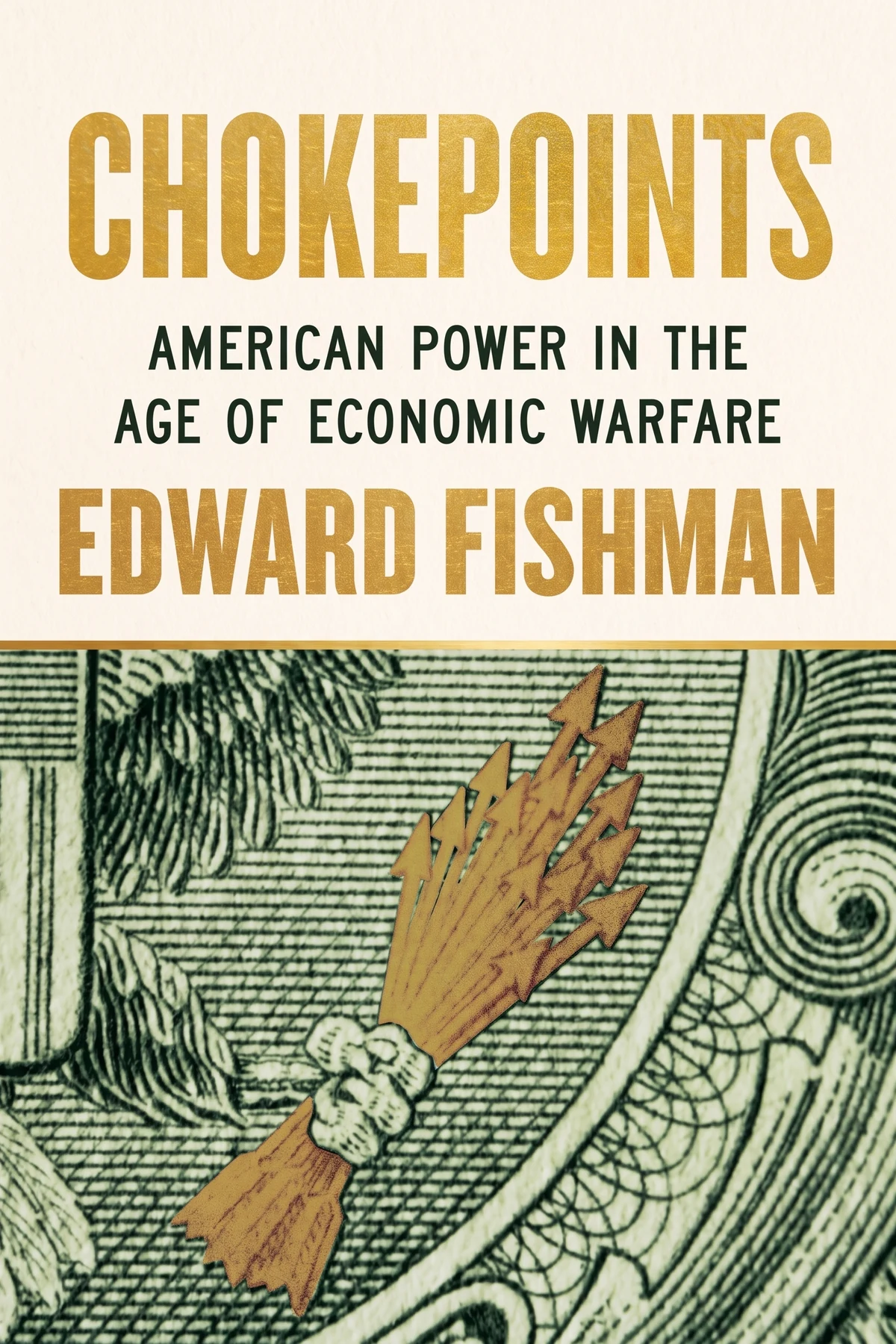
Table of Content
1. Introduction
1 min 06 sec
News about sanctions and export controls sounds like dry paperwork, but that paperwork now moves armies, markets and oil tankers. In December 2022, a line of tankers, some nearly a thousand feet long, sat stalled in the Bosphorus, the strait that splits Istanbul between Europe and Asia, because of a rule written in Washington.
In Chokepoints, Edward Fishman, a former State Department sanctions official, explains how a rule could do that. American power, he argues, now runs through a few economic chokepoints, chiefly the dollar and advanced chips, and every crisis since 2001 has taught Washington to squeeze them harder. These weapons forced a nuclear deal and broke a tech giant’s global plans. They could not stop a war, and they are teaching other countries to build escape routes.
Follow his cases from Iran to China and the next sanctions headline stops being noise. You will see which chokepoint is being squeezed, what it can realistically achieve, and what it means for prices, suppliers and peace.
2. See why every dollar payment passes through Washington
1 min 55 sec
When America gave up the gold standard, it looked like a retreat. Instead it set up a hidden advantage that a small bank in Macau discovered the hard way, years later.
3. Make other banks afraid to touch your target
2 min 06 sec
Iran barely traded with America, so how could American sanctions bring it to the table? The answer involved payments that crossed US banks for only a moment, and oil money Iran could see but never spend.
4. See why financial pain alone cannot undo a conquest
2 min 13 sec
Washington found Russia’s weak spot, and on one day the ruble lost half its value. Yet the map did not change. The Crimea episode shows exactly where economic weapons stop working.
5. Cut off the chips and the customers leave too
1 min 56 sec
America’s closest ally had just handed its 5G network to Huawei. London reversed that decision by mid 2020, after Washington changed who was allowed to sell the company one thing.
6. Cap the price instead of banning the product
2 min 02 sec
Europe could not live without Russian oil, and Russia’s war ran on oil money. The fix the West chose kept the oil flowing, briefly jammed a famous strait, and then cut deep into Moscow’s income.
7. Prepare for a world that builds escape routes
2 min 10 sec
Washington learned to strike before an invasion rather than after. But every new economic weapon also teaches bystanders to protect themselves, and Fishman sees two very different futures at the end of the road.
8. Conclusion
1 min 19 sec
Fishman’s story is about a country learning that the pipes of the world economy can be aimed like guns. A currency bargain with Saudi Arabia, a warning to one bank in Macau, a list kept by the Commerce Department and a price written into insurance contracts each turned ordinary infrastructure into pressure. The results were real: Iran came to the table, Russia lost much of its oil income, and Huawei was shut out of its allies’ 5G networks. So were the limits. Crimea stayed Russian, and the war in Ukraine went on.
That double record is what makes the book useful. When the next sanctions announcement appears, ask which chokepoint it squeezes, money, chips or shipping, and whether pain alone can change the decision it targets. Watch the hedges too, each new payment route or supply chain that lets a country step outside Washington’s reach, since every one blunts the tool a little. And if your own work runs on dollar payments or advanced components, know which of them could be caught in the next round.
The tankers in the Bosphorus waited days for letters from London. That is what power looks like now: paperwork in place of battleships, and for all its harm, far fewer dead.
About this book
What is this book about?
Sanctions headlines can sound like dry legal paperwork. Edward Fishman, who worked on sanctions at the US State Department, argues that this paperwork has become one of the main ways great powers fight. Because most of the world's money moves through the dollar, and because America leads in high-end semiconductors, Washington controls chokepoints that other countries cannot easily avoid. Fishman traces how those chokepoints were built and used. The story runs from Nixon's break with gold and a 1973 oil deal with Saudi Arabia to a small bank in Macau, then through four big tests: Iran's nuclear program, Russia's seizure of Crimea, the campaign against Huawei, and Russia's full invasion of Ukraine, where a $60 price cap on oil left tankers waiting in the Bosphorus. Readers get a clear account of what each tool did, from blocking sanctions and the Entity List to frozen central bank reserves. They also see the limits: Russia kept Crimea and kept fighting, and countries like Brazil and South Africa are hedging against American pressure. The book closes on a hard question. If these weapons lose their bite, what replaces them?
Book Information
Who it's for
World news followers
Professionals who follow world news and want to understand what sanctions and export controls actually do.
Business leaders trading internationally
Founders and managers whose suppliers, payments or markets could be caught in a clash between great powers.
Economics and geopolitics students
Students of economics and international relations who want clear cases instead of theory.
About the Author
Edward Fishman
Edward Fishman is an American international relations scholar and former diplomat who teaches at Columbia University and has led the Maurice R. Greenberg Center for Geoeconomics at the Council on Foreign Relations. At the State Department he served on the Secretary of State's Policy Planning Staff and the Iran sanctions team, and he was the first Russia and Europe lead in the Office of Economic Sanctions Policy and Implementation. He has also held roles at the Pentagon and the Treasury. He has been an editor at Foreign Affairs and has written for The New York Times and The Wall Street Journal.
Ratings & Reviews
Ratings at a glance

What people think
Listeners value the thorough and gripping analysis of how America employs international economic structures—spanning financial grids to tech supply routes—as contemporary instruments of conflict. Numerous listeners consider the author's background as a previous State Department staffer to be highly informative; one listener remarked that the book acts as an all-encompassing chronicle of how the U.S. uses its primary position to wield global power. Although some listeners believe the writing sometimes drifts into unnecessary specifics, they highlight that the "top-notch" sections regarding China and Russia offer essential background for today's headlines. Furthermore, they value how the text clarifies intricate geopolitical changes, turning heavy policy debates into an engaging and reachable narrative for those curious about the trajectory of international influence.
Top reviews
Pacharapol
Chokepoints is a terrifyingly lucid look at how the pipes of global trade have been turned into valves the U.S. can shut at will. Fishman writes with the authority of someone who was actually in the room at the State Department, and it shows. The breakdown of the TFI's early days under Stuart Levey was particularly gripping, illustrating how a single bank in Macau could bring a regime like North Korea to its knees. While the book leans heavily into American perspectives, it provides a masterclass on the subtle mechanics of the U.S. dollar's hegemony. It’s not just about sanctions; it’s about how the entire world’s plumbing—from SWIFT to maritime insurance—became a theater of war. Some chapters get a bit bogged down in the 'who-said-what' of policy debates, but the insights into the 2022 Russia sanctions make it worth the price of admission. If you want to understand why the 21st century looks the way it does, start here.
Show moreTun
Ever wonder how a few bureaucrats in D.C. can effectively cripple a global tech giant like Huawei without firing a single shot? Fishman’s narrative deconstructs this new era of 'economic arms races' with surgical precision. I was particularly fascinated by the sections on semiconductor supply chains and the strategic importance of TSMC. It’s a dense read at times, yet the author manages to make maritime insurance and banking rails feel as high-stakes as a thriller novel. To be fair, he occasionally skirts over the potential long-term blowback of these actions—like countries moving away from the dollar—but the 'moment-by-moment' account of the Russia-Ukraine crisis is top-tier. This is essential reading for anyone who thinks modern conflict is still just about tanks and territory. It’s about who controls the flow of everything we need to survive in a digital age.
Show moreHom
Wow, this was a massive wake-up call regarding the fragility of our globalized systems. Fishman describes 'chokepoints' not just as physical locations, but as the invisible software and financial nodes that keep the world spinning. The way the U.S. leveraged the Russian central bank sanctions was particularly eye-opening, showing a level of aggression I didn't fully grasp from just reading the news headlines. My only real gripe is that the book can feel a little dated in its optimism about these tools' effectiveness, especially as China builds out its own alternatives. Still, the prose is punchy and the anecdotes from the State Department inner circles are genuinely riveting. It transforms boring regulatory topics into a compelling story about power and its limits. I couldn’t put it down during the China chapters.
Show moreAhmed
In a world obsessed with military hardware, 'Chokepoints' reminds us that the most powerful weapons often live on a ledger or in a silicon wafer. Edward Fishman has written a masterful synthesis of history and strategy that feels both urgent and deeply researched. He manages to demystify the U.S. dollar's role as a tool of statecraft without making it sound like a dry textbook. The stories of diplomats and lawyers pioneering these strategies behind closed doors give the book a human element that is often missing from economic literature. Not gonna lie, I was skeptical about a 400-page book on sanctions, but the pacing is excellent. He captures the high-stakes atmosphere of the 2022 invasion of Ukraine perfectly. It’s a chilling look at the future of conflict where 'winning' means cutting someone off from the world.
Show morePat
Finally got around to reading Fishman's work and I'm genuinely impressed by how he handles such complex topics. This is a riveting exploration of the 'underground' levers of power that most people never see. From the way the U.S. uses banking 'rails' to block adversaries to the control of microchip technology, the book is a tour de force of modern statecraft. It’s also quite a sobering read, as it highlights the risks of overusing these tools and potentially fracturing the global system forever. The narrative is enriched by vivid anecdotes that make the policy discussions feel much more personal and immediate. It’s a must-read for scholars and curious minds who want to see the 'hidden' side of the news. Easily the most comprehensive book on sanctions I've encountered in years.
Show moreSarawut
As someone who has been following the work of Nicholas Mulder and Henry Farrell, I found this to be a vital companion piece that focuses more on the 'how' of American policy. Fishman brings a practitioner’s eye to the table, explaining the shift from the blunt, failed sanctions of the 90s to the surgical financial strikes we see today. The chapter on Iran’s nuclear program and the subsequent use of banking leverage was a highlight for me. However, I’ll admit the writing occasionally veers toward a bit of 'American savior' rhetoric that might grate on international readers. Despite that bias, the level of detail regarding the 2014 versus 2022 responses to Russia is incredibly informative. It helps bridge the gap between abstract economic theory and the messy reality of diplomatic negotiation. A solid four stars for the sheer volume of insider context.
Show moreLeila
The chapter on the 5G battle with Huawei alone makes this book a mandatory purchase for tech enthusiasts and policy students alike. Fishman does a great job of explaining how 'mundane' systems like shipping lanes and insurance markets are actually the front lines of modern geopolitics. I appreciated the non-partisan tone; he gives credit and criticism to the Bush, Obama, Trump, and Biden administrations where it’s due. It’s quite interesting to see how the Office of Terrorism and Financial Intelligence (TFI) evolved from a small experimental unit into a powerhouse. I do think he stops short of addressing the third-order effects—like what happens when the rest of the world finally gets fed up with American financial dominance—but as a history of how we got here, it’s unbeatable. Very educational and surprisingly accessible.
Show moreYaowares
Look, if you want to understand why sanctions didn't stop Putin but did cripple Iran, this is the book you need. It’s a very detailed, almost minute-by-minute account of how the U.S. weaponized its position at the center of the world's economy. I found the 'antibiotic' analogy for sanctions to be particularly apt—use them too much, and the world develops a resistance. While I enjoyed the insider perspective, some parts felt a little repetitive, as if the author was trying to hit a word count. But when he gets into the nitty-gritty of the TSMC chip plants and the 2014 Crimea response, the book really shines. It’s a fascinating look at the 'unraveling' of globalization we see today. Definitely helpful for understanding the current trade wars and why they aren't going away anytime soon.
Show moreBunyarit
Picked this up hoping for a deep dive into the theoretical future of economic warfare, but it felt a lot more like a long-form journalistic recap of the last twenty years. While Fishman clearly knows his stuff, the narrative gets stuck in the weeds of who was in which meeting during the Obama and Trump administrations. Frankly, it’s a bit too descriptive for my taste, lacking the broader systemic analysis you find in works like 'Underground Empire.' The focus on Iran and North Korea is excellent, but the Russia section felt hurried, almost like a play-by-play news report rather than a cohesive study. It’s a decent primer if you’re new to the subject, but seasoned policy wonks might find much of it to be old news. It’s informative, sure, but the 'extraneous fluff' makes it a bit of a slog to get through.
Show morePatchara
Truth be told, I had high expectations for this one given Fishman's background, but I found it a bit disappointing in its scope. The basic premise is brilliant—that our economic infrastructure is the new battlefield—but the execution felt a bit bloated. I kept waiting for more first-order questions to be addressed, like the actual long-term impact on global poverty or the classic economic theories behind these moves. Instead, we got a lot of 'moment-by-moment' reporting on sanctions that felt like a recap of the New York Times from five years ago. It’s better on the early 2000s history than it is on the current Russia-China axis. To be fair, it’s a very readable book and definitely educational for a beginner, but I was hoping for something a bit more technical and less focused on 'American savior' narratives.
Show moreQuestions about this book
What is the main idea of Chokepoints by Edward Fishman?
Fishman argues that the United States now projects power through economic chokepoints, mainly the dollar’s central role in global finance and America’s lead in advanced semiconductors. He follows these weapons through Iran’s nuclear program, Russia’s seizure of Crimea, the campaign against Huawei and Russia’s full invasion of Ukraine, showing what they achieved, where they failed, and how other countries are starting to hedge against them.
How did the oil price cap on Russia work?
Rather than ban Russian oil, which would have hurt Europe, the Biden administration barred Western firms from shipping, insuring or financing Russian oil sold above $60 a barrel. The cap sat under Russia’s budget break-even level, yet it was still high enough that oil kept flowing. By mid-2023, Russia’s oil revenues were down nearly 50 percent from a year earlier, and forecasters expected lost energy income to top $1 trillion by 2030.
Why did the dollar become such a powerful weapon?
After Nixon ended the dollar’s link to gold, a 1973 deal had Saudi Arabia reinvest oil earnings in US Treasury bonds, and other exporters followed. Oil stayed priced in dollars, so every major economy needs dollars that pass through American banks and payment systems. Fishman notes that 90 percent of foreign exchange transactions involve the dollar, which lets Washington shut targets out of global finance.
Did sanctions work against Russia and Iran?
Partly, in Fishman’s account. Against Iran, they collapsed the currency and pushed Tehran into the 2015 JCPOA, which stretched its path to a bomb from months to at least a year. Against Russia, they caused severe damage, including Black Tuesday in 2014 and frozen central bank reserves in 2022, but Russia kept Crimea and kept fighting in Ukraine.
What does Fishman think comes next for economic warfare?
He sees countries such as Brazil, Iran and South Africa hedging by diversifying supply chains and finance, while Janet Yellen urges America to pursue friendshoring with trusted partners. Fishman also wants Washington to offer rewards, not only punishments. He warns that if these tools lose their bite while rivalry continues, the world could drift back to bloodier forms of conflict.
Readers also enjoyed



A Warning
Miles Taylor

Adults in The Room: My Battle With Europe’s Deep Establishment
Yanis Varoufakis




Abolish Rent: How Tenants Can End the Housing Crisis
Tracy Rosenthal

Abortion: Our Bodies, Their Lies, and the Truths We Use to
Jessica Valenti
AUDIO SUMMARY AVAILABLE
Listen to Chokepoints in 15 minutes
Get the key ideas from Chokepoints by Edward Fishman, plus 5,000+ more nonfiction titles.
- 5,000+ titles
- Listen as much as you want
- 7-day free trial
- Cancel anytime









