

16 min 30 sec
Available in: English
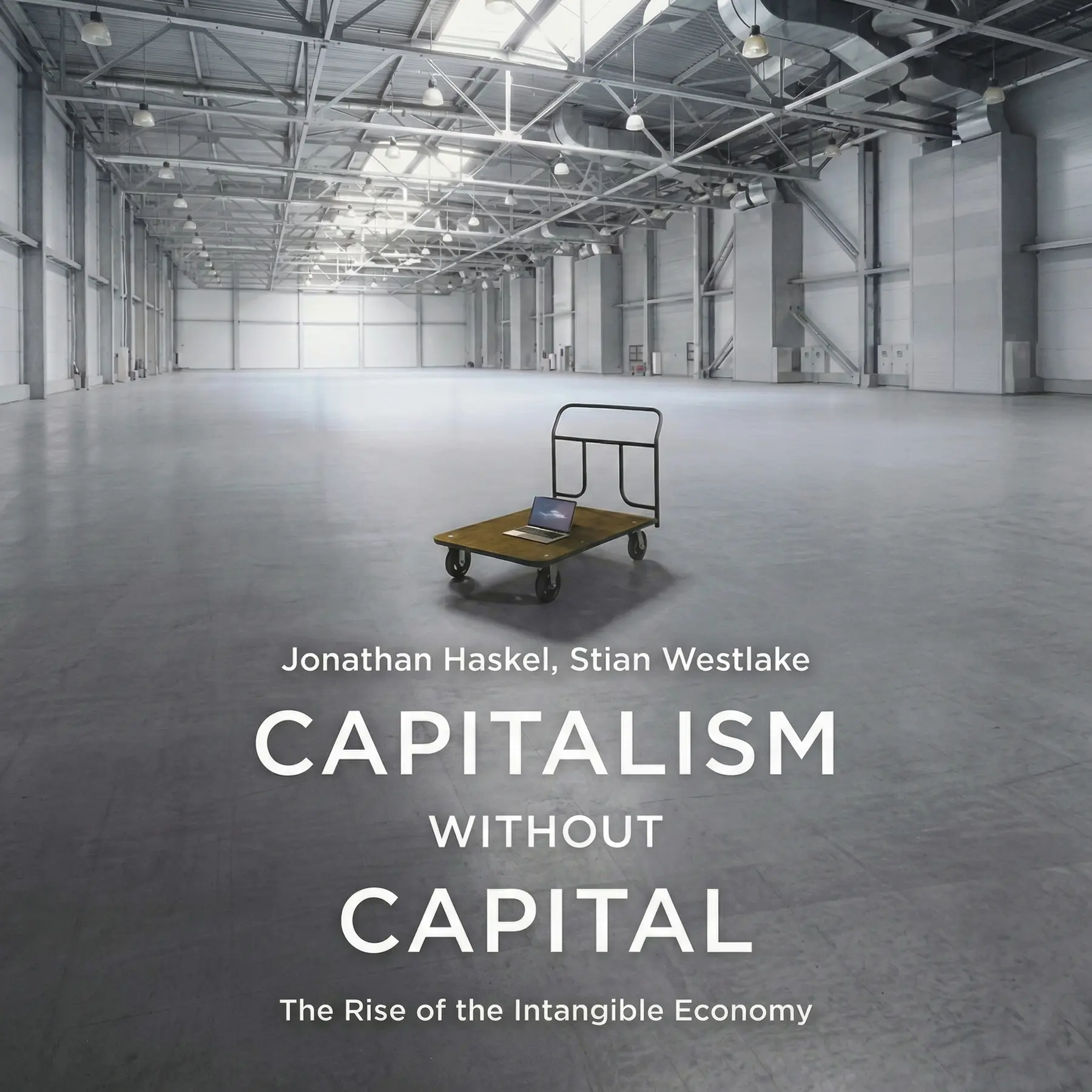
Capitalism Without Capital: The Rise of the Intangible Economy
Explains why software, brands, research and know-how now outweigh machines and buildings, and how their unusual traits decide which firms dominate, why banks hesitate, why inequality grows and what governments should fund.
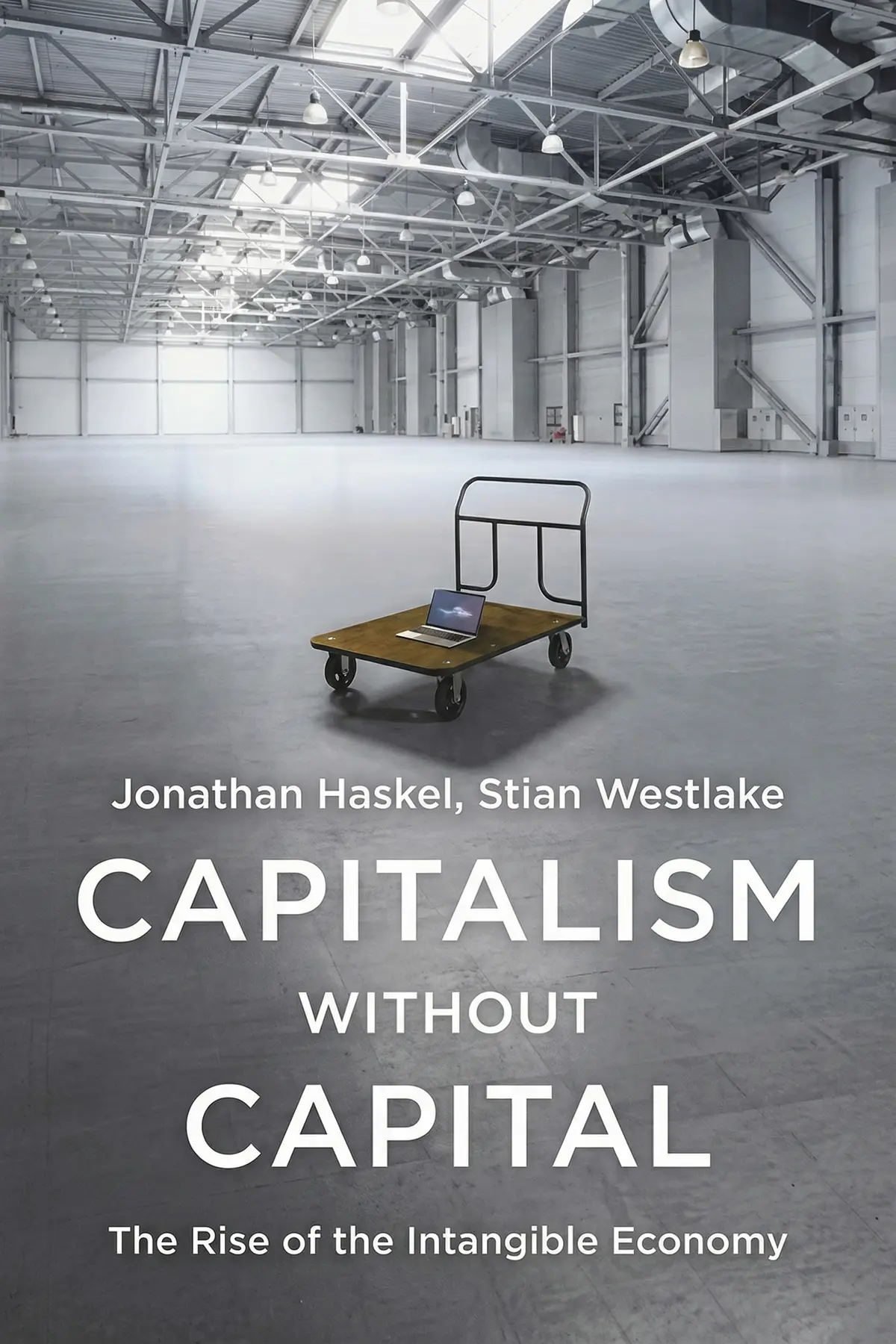
Table of Content
1. Introduction
1 min 13 sec
If you still judge a business by its buildings and machines, you are reading the economy with an eleventh-century ledger. Microsoft reached the top of the world’s company rankings by value in 2006, at $250 billion, yet its physical assets totaled only about $3 billion, roughly 1 percent of that figure. In Capitalism Without Capital, economist Jonathan Haskel and innovation policy expert Stian Westlake explain what fills that gap: software, brands, research and ways of organizing work, assets nobody can see or touch.
Their argument is that these intangible assets follow different rules from machines and buildings. They scale without limit, they are hard to sell when things go wrong, they leak to rivals and they combine into new ideas. Those traits explain why a few firms grow huge, why banks hesitate, why some cities boom while others stall, and why governments may need to invest more. Afterward, a company’s annual report, a city’s house prices and an argument about research budgets will all read differently.
2. See where a modern company's value hides
2 min 14 sec
A medieval king valued an English village by counting its pigs and cows. A walk through a supermarket that looks unchanged since the 1970s shows why that method now misses most of the wealth.
3. Expect scalable firms to grow fast and dominate
1 min 48 sec
A coffee machine can only pour so many cups before you need another. Some assets have no such ceiling, and that difference explains why a handful of companies end up owning entire markets.
4. Understand how lenders see businesses built on ideas
1 min 47 sec
A failed factory can sell its machines, even a used submarine. A failed coffee chain faces a far harder problem with its most valuable asset, and that difference could make the next crash worse.
5. Protect your ideas while borrowing from competitors
1 min 52 sec
Nobody steals a bus company’s buses at night. Yet rivals were copying the iPhone’s ideas soon after its release, and the same leak happens every time a skilled employee changes jobs.
6. Get new value by combining existing ideas
2 min 07 sec
A radar engineer discovered the microwave oven, yet households ignored it for years. What finally made it sell tells you where the best new ideas tend to come from.
7. See how idea economies widen pay and wealth gaps
1 min 57 sec
Between 1980 and 2015, house prices in one American city fell while another’s soared. The cause links paychecks, property and the kind of assets companies now invest in.
8. Policies that keep money flowing into research
2 min 17 sec
Forty years after electric power arrived, half of American factory capacity still ran without it. Three government choices, one backed by a striking productivity figure, could decide how quickly economies adjust this time.
9. Conclusion
1 min 15 sec
The title sounds like a paradox until you recall Microsoft in 2006: a $250 billion company resting on $3 billion of things anyone could touch. Haskel and Westlake show that this is the new normal, not a curiosity. The assets that matter most can serve a whole country at once, vanish in a crash, walk out with a departing employee and combine with other ideas into microwave ovens and ride services. Each trait moves something real: who dominates a market, who gets a loan, whose house soars in value, which economy grows.
The habits that follow are modest. Judge a company, an employer or your own work by its manual, brand, software and know-how before its equipment. Stay close to other people’s ideas, and build the mix of technical and social skill that intangible firms pay well for. And when someone proposes cutting research budgets, recall the three years it took for the payoff to show.
William’s surveyors counted pigs and cows because that was where the wealth lay. The wealth has moved, and the economies that learn to count it are the ones that will grow.
About this book
What is this book about?
Most economic thinking still treats wealth as physical things: factories, machines, buildings, stock. Jonathan Haskel and Stian Westlake show that this picture is out of date. By the mid-1990s in the United States, spending on intangible assets such as software, research, design, branding and organization had surpassed spending on physical assets, and much of the developed world has followed. The authors argue that intangibles behave differently. They scale without limit, so a few firms can grow huge and leave little for the runner-up. They are sunk costs, hard to sell when a business fails, which makes banks wary and crashes potentially harsher. They spill over to competitors, and they combine with other ideas to produce innovations like the household microwave oven. From these traits the book draws larger consequences: widening pay gaps, soaring house prices in innovative cities and the risk that economies invest too little in ideas. Readers get a clear framework for understanding modern companies and markets, along with the authors' case for more adult education, new ways to finance intangible businesses and greater public spending on research.
Book Information
Who it's for
Founders and investors
Founders and investors trying to value businesses built on software, brands and know-how.
Curious about uneven growth
Professionals wondering why a few firms and cities pull ahead while others stall.
Into policy and economics
Policy and economics readers who want a clear case for funding research and adult education.
About the Author
Jonathan Haskel
Jonathan Haskel is a British economist and professor of economics at Imperial Business School, part of Imperial College London. He sits on the board of the UK Statistics Authority, served on the Bank of England's Monetary Policy Committee and holds committee seats at the Financial Conduct Authority and the Payment System Regulator. Stian Westlake has been a policy adviser to the UK minister for science, research, innovation and universities. He spent eight years as Executive Director of Policy and Research at Nesta, the UK's national innovation foundation, running its think tank on innovation and technology policy, and later became a senior fellow there.
Ratings & Reviews
Ratings at a glance
What people think
Listeners find this book highly educational and well-crafted, noting that its impressive clarity makes the material easy to follow. They value the stimulating and relevant subject matter, with one listener observing that it offers deep insights into long-term economic shifts. The book also earns praise for its accessible style, and one listener points out its particular relevance to business and IPO valuations. Nevertheless, feedback regarding its overall value is varied, as several listeners feel that the cost approach to valuing intangible assets is inadequate.
Top reviews
Pop
Picked this up after seeing a recommendation for anyone interested in why the modern economy feels so vastly different from the one our parents lived in. Haskel and Westlake do a masterful job explaining the '4 S's'—Scalability, Sunkness, Spillovers, and Synergies—in a way that even a non-specialist can grasp. The realization that software and branding behave differently than factories is life-changing for your investment perspective. I particularly liked how they explained why traditional bank lending fails intangible-heavy firms. It’s a timely, clear-eyed look at the structural shifts occurring under our noses. While it reads a bit like a textbook in sections, the insights into why certain cities thrive while others decline are worth the price alone. If you're involved in business strategy or policy, this is essentially required reading for the 21st century.
Show moreJeeranan
Finally got around to reading this, and it’s arguably the most important business book I've encountered for understanding long-term economic shifts. The central thesis—that we are moving to a version of capitalism without the physical capital—is explained with such logic that it seems obvious in hindsight. I loved the comparison between the old Ford factory model and the new Microsoft software model. It explains the 'winner-take-all' dynamics of the modern economy better than anything else I've read. The authors have a gift for taking complex concepts like 'sunkness' and making them feel intuitive. This book is a must-read for anyone looking to understand IPO valuations or the future of urban planning. It's informative, well-structured, and provides a much-needed update to our mental models of how the world works. Five stars for the sheer clarity of the argument.
Show moreAria
As someone who struggled through intro economics years ago, I found this remarkably accessible despite the dense subject matter. The authors take the old 'Ec 10' supply and demand charts and explain exactly why they don't apply to a world dominated by data and R&D. It's fascinating to see how the lack of physical capital leads to such unique market behaviors. Personally, I found the chapter on inequality to be the most thought-provoking part of the entire book. They don't just blame 'neoliberalism' but look at how intangible assets naturally create talent clusters and widen the gap between leading firms and laggards. My only minor gripe is that the tone is a bit dry and academic at times. Still, the clarity with which they explain complex synergies is impressive. It’s an eye-opening read that makes sense of the current economic landscape.
Show moreRosa
This book provides a vital framework for understanding the transition from tangible assets like factories to intangible ones like R&D and branding. The writing is incredibly clear, making a potentially boring subject feel urgent and relevant. I was especially struck by the discussion on 'sunk costs' and how they make intangible investments riskier for traditional banks. It explains so much about why the venture capital model has become so dominant lately. While the authors avoid taking a political stance, their analysis of how these economic shifts fuel political fractures is brilliant. They manage to be informative without being condescending, which is a rare feat for economists. I would have liked more concrete policy solutions, but the broad ideas they offer are a great starting point for debate. Definitely worth your time if you want to understand the modern world.
Show moreIvan
The chapter on inequality really hit home for me, especially the discussion on 'inequality of esteem' and how geography impacts talent clusters. It’s not just about who has the money, but who has the 'openness' to thrive in a world that values ideas over iron. Haskel and Westlake write with great clarity, breaking down how the 'synergies' between different technologies—like the iPod example—actually function. It’s a very informative look at how our economic measurement tools, like GDP, are failing to capture the real value being created today. I appreciated that they didn't paint the move toward intangibles as inherently 'evil,' but rather as a neutral trend with complicated consequences. The book is well-structured and easy to follow, even if you aren't a math whiz. It’s a solid, thought-provoking read that will change how you look at the companies around you.
Show moreChee
Wow, I never realized how much of our global GDP calculation is essentially missing the point by ignoring things like market research and organizational culture. Haskel and Westlake argue convincingly that the rules of the game have changed, but our referees—the policymakers—are still using a 20th-century rulebook. The book is incredibly timely and offers valuable insights into why productivity has stalled in the West despite all our technological 'progress.' I found the sections on how firms use 'spillovers' from their competitors to be particularly enlightening for my own business strategy. It’s a quick read because the prose is so lean and functional. While it might be a bit basic for a PhD in Economics, it’s perfect for the curious layperson or business owner. It definitely helped me understand the logic behind the high valuations of 'asset-light' companies.
Show moreIngrid
Look, the transition to an intangible economy isn't just some tech-bro fantasy; it's a fundamental change in how capital behaves. This book does a great job of highlighting why we need to rethink everything from tax law to patent protections. I found the authors' tone to be refreshingly neutral, focusing on the 'how' rather than just the 'should.' The scalability of software and the synergies between data sets are the new engines of growth, and this book is the manual. I did find some of the charts to be a bit questionable in terms of correlation, but the overall logic is sound. It’s a timely piece of work that addresses the 'secular stagnation' we see in the markets today. If you want to know why the biggest companies in the world own so little 'stuff,' read this. It’s a very solid four-star read.
Show moreFilm
Ever wonder why the stock market values tech companies at billions when they barely own any physical property? This book attempts to answer that, though it's a bit of a mixed bag for me. On one hand, the definition of intangible capital is very well-handled and the framework for 'spillovers' is genuinely helpful for understanding competition. On the other hand, the authors rely heavily on the cost approach to valuing these assets, which many critics—myself included—find increasingly inadequate in a fast-moving market. To be fair, they admit their theories are somewhat speculative. I also felt the book became quite repetitive by the middle chapters, hammering home the same four points without enough new data. It’s a good introduction to the topic, but it might leave seasoned finance professionals wanting more depth regarding actual valuation metrics.
Show moreSamira
Gotta say, the first half of this book is excellent, but the second half loses steam. The authors are brilliant at defining what makes an intangible asset unique—scalability is a game-changer—but they struggle when it comes to the 'what now?' part of the equation. I found the suggestions for government policy to be a bit simplistic and idealistic. Also, for a book about 'capitalism,' there is a surprising lack of discussion regarding the darker sides of surveillance and data ownership. It felt like they were staying in a safe, academic lane. The truth is, the world they describe is much more chaotic than their neat frameworks suggest. However, the book is well-written and serves as a decent primer for anyone who wants to understand why physical capital isn't the king it used to be. It's a three-star 'good but not great' effort.
Show moreWitthaya
Not what I expected given the hype, as the authors seem to spend half the book repeating the same four concepts without offering enough hard policy solutions. Frankly, the '4 S's' framework feels like a consultant’s slideshow stretched out into a full-length volume. While the topic is certainly timely, the value for money here is questionable if you already read publications like The Economist regularly. I found the cost-based approach to valuing intangible assets to be particularly weak and outdated for today’s IPO environment. The book also has a bit of a textbook feel that makes it a slog to get through in the later chapters. It's not a 'bad' book, but it feels like an over-expanded essay that lacks the 'punch' needed to be truly revolutionary. I'd recommend just reading a detailed summary instead of the whole thing.
Show moreQuestions about this book
What is the main idea of Capitalism Without Capital?
Haskel and Westlake argue that developed economies now invest more in intangible assets, such as software, research, brands and organizational know-how, than in machines and buildings. In the United States the crossover came in the mid-1990s. Because intangibles behave differently from physical assets, their rise changes how companies grow, how they are financed, how inequality develops and what governments should do to keep investment flowing.
What makes intangible assets different from physical ones?
The authors describe four traits. Intangibles scale, so one Starbucks operating manual can guide more than 3,000 stores in China at once. They are sunk costs, hard to sell if a business fails. They spill over, as rivals copied the iPhone’s ideas. And they combine into synergies, as when Raytheon’s microwave know-how met Amana’s kitchen expertise and sales reached a million ovens a year by 1975.
How does the intangible economy increase inequality?
Intangible firms need people with both technical and social skills, and because their assets scale, they can pay those people more, which widens wage gaps. Wealth gaps grow through housing. Property prices rise fastest where intangible investment clusters: San Francisco prices rose almost 150 percent between 1980 and 2015, while Detroit, reliant on cars, saw prices fall in real terms.
What policies do Haskel and Westlake recommend?
They propose three changes. Governments should expand adult education so workers can retrain as skills shift. Finance needs new tools, such as the subsidized loans against intellectual property tried in Singapore and Malaysia. And governments should spend more on research and development, since research by one of the authors found that more UK funding for university research raised national productivity by around 20 percent, about three years later.
How can I apply the ideas in Capitalism Without Capital?
Value companies and employers by their software, brand, processes and know-how rather than their equipment. Expect markets where scale matters to crown a few winners. If you run an idea-based business, prepare for lenders asking what they could recover. Build the mix of technical and social skills intangible firms reward, and seek places and partnerships where other people’s ideas are close by.
Readers also enjoyed



Adults in The Room: My Battle With Europe’s Deep Establishment
Yanis Varoufakis


1929: Inside the Greatest Crash in Wall Street History--and How It
Andrew Ross Sorkin

23 Things They Don’t Tell You About Capitalism
Ha-Joon Chang
A Little History of Economics
Niall Kishtainy

AUDIO SUMMARY AVAILABLE
Listen to Capitalism Without Capital in 15 minutes
Get the key ideas from Capitalism Without Capital by Jonathan Haskel, plus 5,000+ more nonfiction titles.
- 5,000+ titles
- Listen as much as you want
- 7-day free trial
- Cancel anytime









