

14 min 52 sec
Available in: English
Brave New War: The Next Stage of Terrorism and the End of Globalization
By John Robb
Shows how small networked groups can now cripple states by striking the few points where power, oil and transport systems connect, and why decentralizing those systems protects society better than surveillance does.
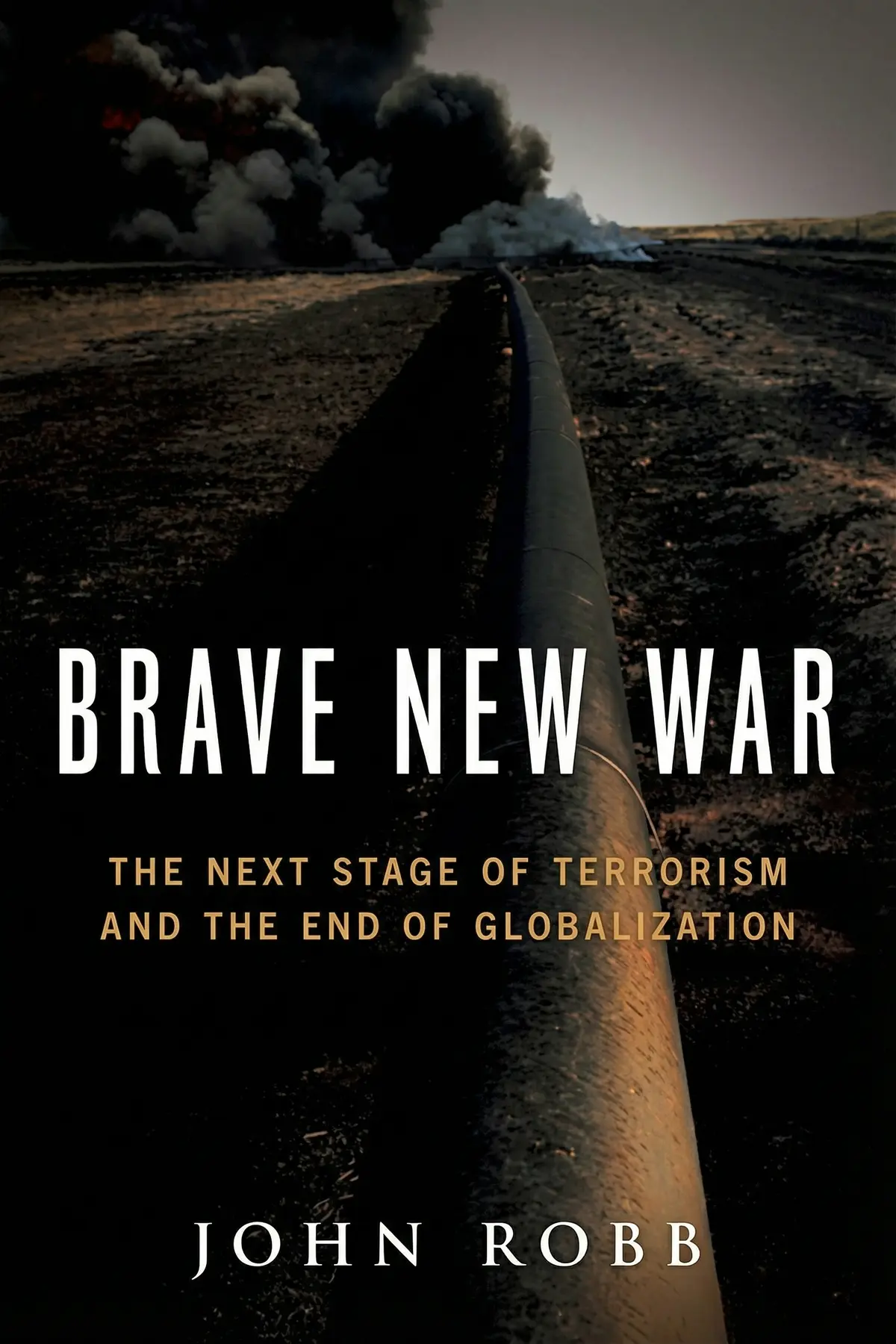
Table of Content
1. Introduction
59 sec
If you assume the government, the army and the police stand between you and serious harm, John Robb thinks you are trusting the wrong thing. In Brave New War, the former Air Force special operations pilot recounts how, in 2004, Iraqi insurgents spent about a thousand dollars to blow open an oil pipeline and cost their country more than $500 million. That ratio is the book in miniature.
Robb’s case is that small, loosely linked groups he calls global guerrillas can now bring down the systems modern life depends on. Big centralized states are too slow and too rigid to stop them. His remedy is to make those systems harder to topple by spreading them out.
Follow his argument and the news about attacks, black markets and surveillance starts to form one pattern. Along with it comes a clear sense of what would make a power grid, a company or a household harder to break.
2. See why the biggest army no longer wins
1 min 49 sec
For centuries, the country with the larger military usually won its wars. Something changed in the middle of the twentieth century, and big armies in three long conflicts found themselves worn down by far weaker opponents.
3. Understand what the internet takes from governments
1 min 43 sec
The modern state spent centuries crushing every rival for control of money, people and information. A technology most of us use daily is loosening that hold, and the clearest sign shows up in who now guards politicians.
4. Know who profits when a state breaks
1 min 36 sec
Drug smugglers, counterfeiters and insurgents seem to have nothing in common. Robb finds a shared source of trillions of dollars and a shared goal that differs sharply from what rebels wanted in the past.
5. Find the single point that topples a system
1 min 49 sec
A cheap act of sabotage in Iraq cost a quarter of a million times what it took to carry out. The reason lies in how modern networks lean on one another.
6. Killing the leader stops nothing in open-source war
2 min 23 sec
US forces celebrated the death of a top insurgent commander in 2006, yet the attacks went on. An idea borrowed from software and another from online bookselling explain why the usual way of winning stopped working.
7. Spot the security that costs freedom and fails
1 min 54 sec
After September 11, airports tightened their checks and agencies expanded their reach. Robb argues these steps aim at the wrong target, and that some of them weaken the very state they are meant to protect.
8. Build systems that can survive any attack
1 min 26 sec
No country can guard every pipeline and cable, and nobody knows where the next blow will fall. Robb proposes a design that holds up anyway, borrowed from the way the internet works.
9. Conclusion
1 min 13 sec
Robb’s book reads like a warning about terrorism, but its deeper subject is fragility. The modern state grew strong by centralizing, and the same tight wiring that made life efficient now lets a thousand-dollar attack cost half a billion. Small, shifting groups that profit from failure have learned to aim at that wiring, while centralized defenses, however large, keep preparing for the last war. The way out, as Robb sees it, is for defenders to become as fluid and self-reliant as their attackers.
His argument also reaches into ordinary life. Pay attention to which economy your money feeds. The black market is growing fast, and Robb notes that the 2004 attacks on Madrid’s transport network were paid for by selling ecstasy and hashish, so cheap counterfeit clothing or illegal drugs carry a hidden cost. And stop treating power, transport and communications as permanent. Plan for the days they fail, at home and at work, so that an outage becomes something you can manage.
A society that cannot be broken at one point is a society where many people can keep the lights on themselves.
About this book
What is this book about?
For four centuries, security meant a strong state with a large army. John Robb argues that this arrangement is breaking down. Nuclear weapons, global trade and the internet have eroded the advantage of big states. Meanwhile a booming black market funds loosely linked groups of terrorists, insurgents and criminals who would rather see governments fail than replace them. Robb is a former special operations pilot and technology entrepreneur, and he explains how these global guerrillas fight. They hit the single points where a society's networks connect, so that one cheap attack sets off a cascade of failures, as a sabotaged Iraqi pipeline did in 2004. They share and refine tactics the way programmers improve open-source software. They also split into dozens of small groups, so killing leaders or fighters barely slows them. Readers get a clear picture of why traditional security, from airport checks to mass surveillance, keeps falling behind. They also get Robb's alternative: power grids and other essential systems spread across many independent producers, so that no single strike can bring them down.
Book Information
Who it's for
Following terrorism and conflict
Readers who follow terrorism and conflict news and want one framework that connects attacks, insurgencies and black markets.
Managers and founders
Managers and founders responsible for infrastructure, supply chains or security who worry about single points of failure.
Politics and tech students
Students of politics and technology curious how the internet is reshaping state power.
About the Author
John Robb
John Robb trained in astronautical engineering at the US Air Force Academy and flew as an Air Force pilot, including in a tier one special operations unit focused on counter-terrorism. He later worked as an Internet analyst at Forrester Research. He co-founded Gomez, an online brokerage and banking firm later sold for 295 million US dollars, and ran UserLand Software as chief operating officer and then chief executive. He has advised US government bodies, among them the Joint Chiefs of Staff, testified before the House Armed Services Committee in 2009, and writes the Global Guerrillas Report on war, politics and technology.
Ratings & Reviews
Ratings at a glance

What people think
Listeners find the book highly engaging and accessible, with one remarking that it is a must-read for today's world. The writing style is straightforward and the narrative moves at a brisk pace. They value the subject matter, as one person describes it as the first real text on next generation warfare. Furthermore, the work earns praise for its depth, with one listener highlighting how it touches on the growing impact of technology.
Top reviews
Pia
Finally got around to reading Brave New War, and I’m struck by how Robb managed to turn complex military theory into such a fast-moving narrative. This feels like the first real text that accurately maps out next-generation warfare, specifically how small, networked groups use technology to paralyze massive nation-states. Frankly, the writing style is remarkably clear for a subject that usually gets bogged down in dense academic jargon. I found the sections on systems sabotage particularly unnerving because they highlight just how fragile our modern infrastructure really is in the face of decentralized threats. While some of the specific examples feel like artifacts of the mid-2000s, the underlying logic remains incredibly relevant to today’s geopolitical climate. It’s a must-read for anyone trying to understand why conventional militaries keep struggling against asymmetric enemies.
Show moreMai
This book should be required reading for anyone who thinks our current defense strategies are sufficient for the modern world. Robb captures the terrifying reality of how easily a few devoted individuals can carry out a catastrophic attack on our power grids. I’ve been looking for a text that explains the shift from traditional territory-based war to these decentralized insurgencies, and this is it. Not gonna lie, the realization of how fragile our global trade networks are made it hard to sleep after finishing the chapter on systems sabotage. Even if some of the geopolitical context has shifted since 2007, the logic of the 'swarm' is undeniable. It’s a brilliant, fast-paced wake-up call that everyone needs to hear, especially given how technology has only become more pervasive since it was written.
Show moreSaovapa
Robb provides a stark, necessary critique of the centralized military complex and its failure to adapt to the new reality of networked threats. The chapters on 'systemic sabotage' are the absolute highlight here, showing how small groups can disrupt massive oil facilities for a tiny fraction of the cost. Gotta say, his comparison between the Internet's structure and modern terrorist organizations is a very helpful way to visualize the current security landscape. While he is a bit light on the reality of state-on-state conventional war, his focus on the 'contest of wills' is spot on. The prose is clear and accessible, which is rare for a book that tackles such heavy topics like the collapse of national legitimacy. It’s an insightful read that definitely makes you look at the daily news through a much more cynical lens.
Show moreHassan
Wow, talk about a punchy wake-up call that hits even harder today than it probably did when it was first published. This is the first real text I’ve found that treats next-generation warfare as a technological and social shift rather than just a military one. Seriously, Robb’s writing is incredibly clear, and he manages to explain complex ideas like 'returns on investment' for sabotage in a way that anyone can grasp. I loved how the book challenges the idea that a centralized command is always superior to a decentralized network of motivated individuals. It’s a short, engaging read that refuses to pull its punches about the fragility of the modern nation-state and our globalized trade systems. If you want to understand why the world feels like it's fracturing into smaller units, you absolutely need this on your shelf. Simply brilliant.
Show moreJob
The core thesis here is fascinating, even if the text repeats its primary points a few too many times across the chapters. Truth is, Robb presents a compelling argument that we have entered a postmodern era where territory can't be held permanently by traditional means. To be fair, his insights into how Nigerian guerrillas or Baloch tribesmen achieve massive returns on investment through infrastructure attacks are genuinely eye-opening. The book is highly readable and moves at a clip that keeps you engaged, despite some of the analysis feeling a bit dated in the current decade. I appreciated the focus on 'swarm intelligence' and how it bypasses centralized command structures. It’s a solid addition to any security professional's shelf, providing a clear framework for understanding the growing impact of technology on global instability.
Show moreIsabelle
As someone who follows defense blogs and global security trends, I found Robb’s examination of Fourth Generation Warfare to be incredibly engaging and sharp. He does a superb job analyzing the flaws in conventional military thought, particularly regarding the failure of centralized hierarchies to deal with networked insurgencies. Personally, I liked how he connects the dots between social organization and technology to show why we are now in an era of permanent conflict. My only real gripe is that he pays mere lip service to the social contract, offering a vision of security that seems reserved only for those with deep pockets. Despite that, the book is a clear-eyed look at the future of conflict. The pacing is excellent, and it avoids the fluff that usually plagues this genre.
Show moreHarper
Picked this up after hearing it mentioned in a discussion about decentralized networks, and it's certainly a fast-moving, engaging piece of futurism. Robb sees a breakdown in global trade because of terrorist activities and argues that nation-states are losing their power to 'swarm intelligence' structures. To be fair, his analysis of why the Bush doctrine failed is quite self-evident now, but it was likely very provocative when first released. I found his look at how Nigerian guerrillas operate to be one of the more grounded parts of the book. While the writing is clear, the author sometimes makes light of the security reality of highly armed states threatening their neighbors via conventional means. Still, it’s a great primer on the growing impact of technology on warfare and a must-read for those interested in the future of the state.
Show moreSven
Seeing where the predictions landed years after publication made this a very informative, if somewhat lopsided, reading experience. Robb is at his best when describing the vulnerabilities of our centralized infrastructure, but he falls short when proposing a purely capitalist solution to security. In my experience, his vision of self-sufficient enclaves sounds less like a viable solution and more like a recipe for a global police state that abandons the poor. While his dunking on the Bush administration’s misunderstanding of terrorism is satisfying, some of his projections for 2016 simply didn't pan out. Real power hasn't dissolved quite as locally as he theorized, and national governments have proven surprisingly resilient. It’s an interesting look at the technology of war, but the conclusions feel a bit rushed and are largely unproven by subsequent global events.
Show moreCherry
Not what I expected from a book that is frequently cited as a 'must-read' in certain circles. While the analysis of military flaws is occasionally superb, the author’s misunderstanding of basic non-US concepts makes the whole work feel a bit provincial and dated. He portrays the 'swarm' as an unstoppable force, yet history has shown that states can be remarkably resilient when they commit resources to winning hearts and minds. In my view, the book feels more like a collection of blog posts than a cohesive argument, leading to a lot of jarring transitions and repetitive points. I also found it frustrating that he ignores the looming impact of peak oil on the very networks he describes. It's an interesting look at the technology of war, but the conclusions feel rushed and largely unproven by the events of the last decade.
Show morePaiboon
I felt this book kept spinning its wheels and really struggled to justify its existence as a full-length book rather than a short journal article. It's only about 180 pages, yet I still found myself bored because the same three or four concepts are recycled over and over again. To be blunt, the examples feel stuck in a specific moment of the Iraq war and ignore the real security gains made by states in the years since. I didn't even finish the last thirty pages because I just couldn't handle the repetitive phrasing and the lack of deep evidence. It’s a classic case of an interesting idea stretched way too thin to satisfy a publisher's requirements. Large mistakes regarding basic concepts outside the US make it hard to take the author's broader conclusions seriously.
Show moreQuestions about this book
What is the main idea of Brave New War by John Robb?
Robb argues that large states no longer dominate conflict. Nuclear weapons, trade and the internet have weakened them, while small networks of terrorists, insurgents and criminals, funded by a fast-growing black market, want states to fail. These groups cause huge damage cheaply by attacking key points in a society’s connected systems. Because centralized security keeps falling behind, Robb concludes that the best defense is to decentralize the systems society depends on.
What is a systempunkt in Brave New War?
A systempunkt is Robb’s name for the one point in an interconnected system whose destruction brings the whole system down. Hitting it sets off a cascade of failure that spreads to other critical points. His example is a 2004 attack in which Iraqi insurgents spent about a thousand dollars to breach a pipeline, stopping the country’s oil industry and costing more than $500 million in lost exports.
Who are global guerrillas according to John Robb?
Global guerrillas are Robb’s term for terrorists, insurgents and international gangs involved in drugs, human smuggling and counterfeit goods. Each has its own agenda, but they sometimes cooperate and share one aim: weakening the state. Unlike rebels of the past, most do not want to take over the government. A failing state supplies them with disillusioned recruits and weak laws that let crime thrive.
What solution does Brave New War propose?
Robb proposes decentralizing essential systems so that no single attack can set off a chain of failures. He favors platforms, systems where many people both use and contribute, like the internet. For electricity, that means letting users feed power into the grid from their own sources, most likely solar panels. With huge numbers of producers, knocking one out would barely matter, even if nobody predicted the target.
Why does Robb think surveillance and torture do not stop terrorism?
Robb argues that threats change faster than centralized agencies can adapt, so they keep preparing for the last attack. Measures like mass analysis of personal data by the NSA and reported enhanced interrogation and torture, in his view, do nothing to stop terrorists. What they do is damage the state’s legitimacy, especially for a country like the United States that sees itself as a moral leader.
Readers also enjoyed

A Warning
Miles Taylor



AI 2041: Ten Visions for Our Future
Kai-Fu Lee

Abolish Rent: How Tenants Can End the Housing Crisis
Tracy Rosenthal


Abortion: Our Bodies, Their Lies, and the Truths We Use to
Jessica Valenti


Adults in The Room: My Battle With Europe’s Deep Establishment
Yanis Varoufakis
AUDIO SUMMARY AVAILABLE
Listen to Brave New War in 15 minutes
Get the key ideas from Brave New War by John Robb, plus 5,000+ more nonfiction titles.
- 5,000+ titles
- Listen as much as you want
- 7-day free trial
- Cancel anytime









