
Brain Maker: The Power of Gut Microbes to Heal and Protect your
David Perlmutter
 English
Shows how screens, sugar, stress and short sleep tilt your brain toward impulse and loneliness, and how small, steady habits in daylight, food, rest, movement and meditation can rebuild calm, focus and connection.
1 min 06 sec
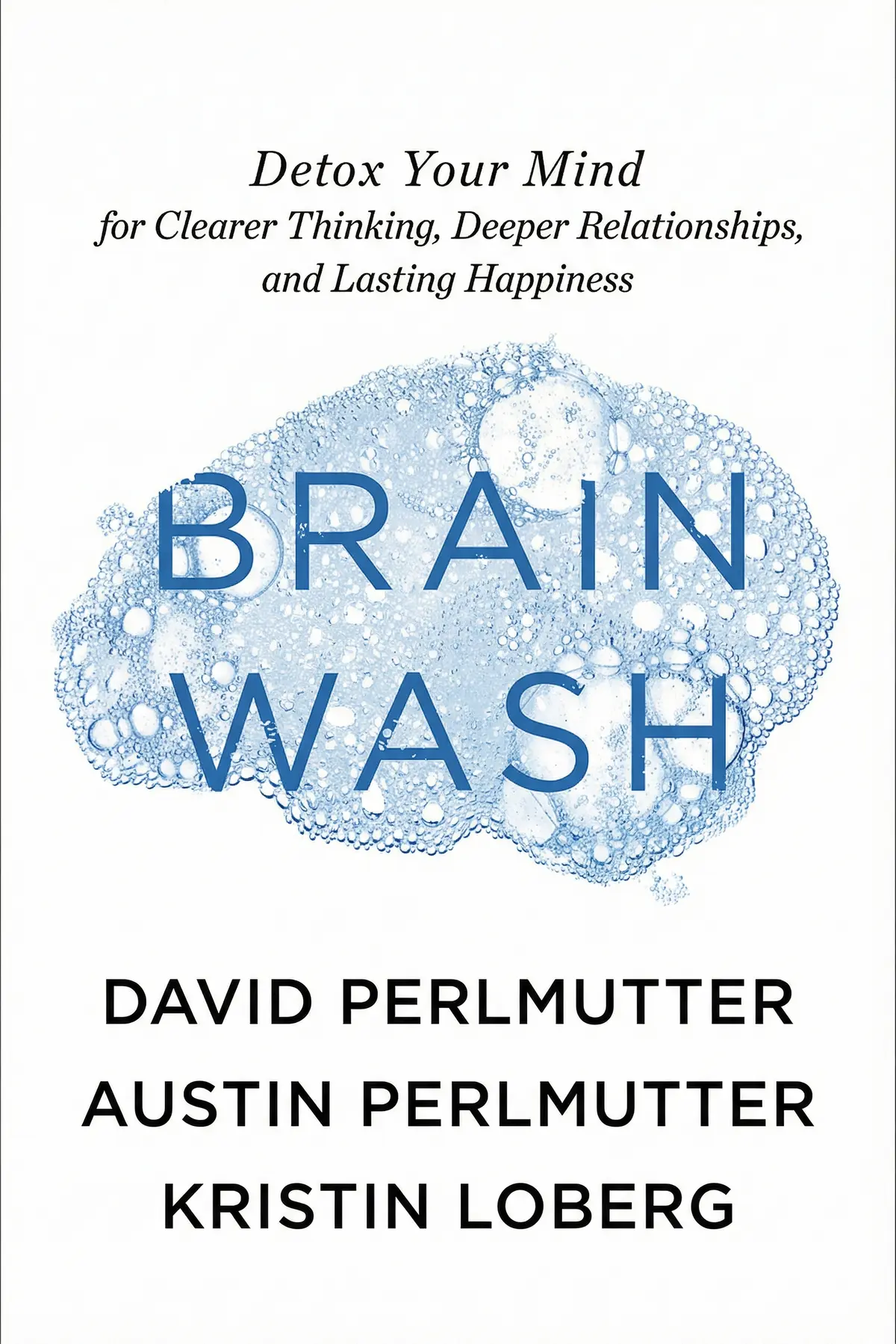
If your days are full of small pleasures and still end with you anxious, tired and oddly alone, the fault may lie less in your character than in your wiring. In Brain Wash, father-and-son doctors David and Austin Perlmutter, writing with Kristin Loberg, argue that modern conveniences hook the oldest parts of the brain, the ones built to chase sugar and social approval, while weakening the part that plans and reflects. They call the result disconnection syndrome: trading lasting happiness for instant gratification.
Their case is a hopeful one. The brain keeps rewiring itself, so the same everyday habits that knocked it off balance can restore it: fewer screens, more daylight, better food, real sleep, movement and a few minutes of stillness. Along the way you will meet a railroad worker with an iron rod through his skull, students who felt less lonely on ten minutes of social media a day, and a ten-day plan that turns each finding into one small change.
1 min 49 sec
Food, films and parcels arrive almost on request, so people should be happier than ever. American figures on prescriptions, suicide and sleep say the opposite, and the authors trace the gap to a very old part of you.
1 min 41 sec
A railroad accident in 1848 turned a friendly man cruel, and then something stranger happened. His story reveals a process running in your own head every day, and it can work for you or against you.
1 min 39 sec
Two chemicals take turns running an ordinary workday, from the first glance at a phone to the last episode at night. Together they build a loop that leaves you jumpy, restless and never quite satisfied.
1 min 52 sec
More accounts and more messages should mean more connection. A three-week experiment with students, and a sharp drop in empathy measured since 2000, suggest that constant contact may be doing the reverse.
2 min 03 sec
Hospital patients who could see a forest from their beds needed less pain medication. That finding, and a count of sugar in a million grocery products, point to two everyday changes with surprising reach.
1 min 47 sec
While you sleep, a little-known system goes to work on the waste your brain piles up during the day. Skip it, and the impulsive part of your mind starts making your choices the next morning.
2 min 05 sec
Hunter-gatherers in Tanzania walk miles a day, while most adults barely move. Studies of schoolchildren, 40,000 adults and meditators show what that difference does to focus and mood, and how small the fix can be.
1 min 12 sec
Brain Wash adds up to a plain argument: the brain was built for scarcity, and a world of endless supply keeps handing control to its oldest, most reactive part. The Perlmutters point to Phineas Gage’s gradual recovery as proof that the brain can change. A brain that can be bent toward impulse can be bent back, one repeated habit at a time.
Their ten-day program gives that a shape, one area per day: a digital detox that blocks time-wasting apps, writing down five things you are grateful for, time outside, a cleaner diet, better sleep, exercise, twelve minutes of breathing meditation and a dinner or call with people you love. The last two days are for reviewing what worked and committing to keep it.
The authors also warn against overhaul. Pushing for big change at once tends to end in burnout and relapse, so a few small changes that last beat a grand plan that gets dropped. If you pick one, start with the phone: keep it out of the bedroom tonight and out of your hand until after breakfast. The alarm brain will protest. The thinking brain grows stronger every time it wins.
Life has never been more convenient. Food, films and parcels arrive almost on request. Yet antidepressant prescriptions have soared, insomnia is widespread and most Americans report feeling lonely. Physicians David and Austin Perlmutter, father and son, writing with Kristin Loberg, argue that the two facts are connected. Our brains were shaped for scarcity and danger, and companies now profit by feeding their oldest cravings for sugar and social approval. The authors call the result disconnection syndrome: a habit of choosing instant gratification over long-term happiness. The constant swing between dopamine highs and cortisol stress strengthens the reactive amygdala and weakens the prefrontal cortex, the part that plans, reflects and feels for others. The good news is that the brain is plastic. Drawing on studies of social media limits, hospital patients with forest views, sugar in a million food products, sleep's cleaning system, exercise and meditation, the Perlmutters show how each everyday habit can push the brain back toward balance. They finish with a ten-day program, one focus per day, built for small changes that last.
Professionals who end busy, screen-filled days feeling drained, anxious or oddly lonely.
People fighting sugar cravings, late nights and endless scrolling who want to understand why willpower keeps failing.
Anyone wanting a short, step-by-step plan to reset mood and focus.
David Perlmutter, born in 1954, earned his M.D. at the University of Miami School of Medicine. He is a Fellow of the American College of Nutrition and has lectured at Harvard and Columbia, and in 2002 he received the Linus Pauling Award for his work on neurological disorders. His books Grain Brain and Brain Maker were New York Times bestsellers. His son and coauthor, Austin Perlmutter, also earned his medical degree at the University of Miami and trained in internal medicine at Oregon Health and Science University, with interests in burnout, depression and preventive care. Kristin Loberg is an American author who has written books with several leading physicians.

Listeners find the book well-crafted and easy to follow, with one listener noting that it contains extensively cited and quoted research. Furthermore, they appreciate its overall value and feel it is an excellent supplement to Perlmutter's collection of titles. Listeners also find the subject matter to be evocative and transformative, with one listener highlighting the book’s comprehensive chapter on meditation. They also prize the provided guidance, with one listener stating it is perfect for individuals looking to enhance their habits and daily lifestyle.
Finally got around to reading this, and the chapter on meditation alone makes the whole purchase worthwhile. Unlike many health books that just tell you to 'relax,' the Perlmutters dive deep into how mindfulness actually repairs the bridges between different parts of the brain. The writing is incredibly clear and accessible, which I appreciated since I usually struggle with dense medical jargon. I’ve started implementing the digital detox strategies, and the difference in my focus is already noticeable. I no longer reach for my phone the second I wake up, and that small change has radically shifted my morning mood. The book is heavily noted with research, which gives me a lot of confidence in the suggestions being made. If you feel like your brain has been hijacked by modern life, this is the manual you need to take back control. Truly life-changing stuff if you actually commit to the work.
Show moreThe depth of research cited in these pages is truly impressive for a mainstream wellness book. I'm the type of reader who checks the bibliography, and the Perlmutters have clearly done their homework here. What sets this apart is the synthesis of social factors with physical ones; they don't just blame your diet for your bad mood, but also your lack of community and connection to nature. The discussion on the 'amygdala hijack' and how our modern world keeps us in a state of constant low-level fear was eye-opening. I've been following the food protocol for a month now—not just the ten days—and my mental fog has lifted significantly. The recipes are easy to follow, even for a mediocre cook like myself, and they actually taste like real food. This is an essential guide for anyone looking to optimize their cognitive function and reclaim their attention span in an age of distraction.
Show moreWow, I didn't realize how much my smartphone was actually dictating my mood until I started implementing the digital detox suggested here. This book is a wake-up call for anyone who feels like they’re just going through the motions of life on autopilot. The Perlmutters provide a compelling argument for why we make such poor decisions when we're tired and overstimulated. I loved the comprehensive chapter on meditation and how it’s framed as a tool for brain repair rather than just something 'woo-woo.' The recipes are a great bonus, and I’ve actually enjoyed the transition to a more plant-forward way of eating. This is more than just a diet book; it’s a manual for reclaiming your humanity in a world that wants to turn you into a mindless consumer. I feel more present and focused than I have in years. Highly recommended for everyone!
Show moreAfter hearing about David Perlmutter's previous work on brain health, I was eager to see how he tackled our modern digital landscape. The concept of 'Disconnection Syndrome' is a fascinating framework for explaining why we feel so fragmented and impulsive lately. Frankly, the authors do a great job of connecting our biological hardware to our software-driven world, showing how constant notifications erode our prefrontal cortex function. I found the section on empathy particularly moving, as it’s something rarely discussed in typical 'biohacking' manuals. While some of the advice on nature and sleep feels like stuff we've all heard before, seeing it framed through the lens of neuroplasticity gives it fresh weight. I did find the 10-day plan a bit aggressive for a busy professional, but the core message is vital. It's a solid addition to any wellness library, even if you have to tweak the schedule to fit your actual life.
Show morePicked this up during a particularly stressful month when I felt like my brain was constant mush from scrolling through endless feeds. The authors have a way of making complex neurology feel relatable and urgent. I especially liked the focus on how our environment—from the blue light in our bedrooms to the processed oils in our snacks—is working against our mental clarity. It's a comprehensive look at lifestyle medicine that doesn't just focus on one thing like weight loss. Instead, it looks at the whole person. I did find some of the 'Disconnection Syndrome' talk a bit repetitive toward the middle, but the practical tips for reconnecting with nature were a great reminder to step outside. It’s a thought-provoking read that encouraged me to set some much-needed boundaries with my devices. Definitely worth your time if you're feeling burnt out.
Show moreAs someone who struggles with brain fog, I found the concept of 'Disconnection Syndrome' to be a perfect metaphor for my daily life. The authors explain how we get stuck in 'limbic' thinking—always reactive, always stressed—and offer a clear path back to the more rational parts of our brain. I appreciated the specific focus on gratitude and empathy exercises, as mental health is so often ignored in favor of just physical fitness. My only real complaint is that the book can be a bit 'preachy' regarding the organic lifestyle, which isn't always feasible. However, the advice on building a digital sunset and prioritizing deep sleep has been incredibly helpful for my productivity. It's a well-written, easy-to-read guide that provides a lot of value for the money. I've already recommended it to several coworkers who seem just as fried by their screens as I was.
Show moreIs it actually possible to rewire your entire lifestyle in less than two weeks? That is the question at the heart of the 10-day boot camp presented here, and personally, I’m skeptical. The book starts strong by diagnosing the 'disconnection' we all feel from our better selves due to tech addiction and poor diet. However, once it hits the implementation phase, the pace becomes almost laughable. They expect you to overhaul your digital habits, your kitchen, your sleep hygiene, and your exercise routine basically overnight. For most people, that's a recipe for burnout, not healing. To be fair, the recipes included are quite tasty and nutrient-dense, though some ingredients are definitely on the pricier side. It’s a decent collection of wellness tips that are scientifically supported, but don't expect a miracle transformation in ten days if you have a job and a family.
Show moreThe truth is, if you’ve been following the health and wellness space for any length of time, you won’t find much groundbreaking news here. We all know we should sleep eight hours, eat more plants, and put down the iPhone. That said, 'Brain Wash' does a nice job of synthesizing these various threads into a single, cohesive narrative about brain health. The formatting is clean, and the summaries at the end of the chapters are helpful for quick reference. My main gripe is the 10-day plan, which feels more like a marketing gimmick than a sustainable habit-building strategy. It takes much longer than ten days to break the dopamine loops created by modern tech. It’s a handy reminder of the basics, much like the advice a very tech-savvy grandmother might give you, but don't go in expecting a revolution in thought if you've already read 'Grain Brain' or similar titles.
Show moreLook, I appreciate the sentiment behind the 10-day boot camp, but the pacing feels completely disconnected from reality for most people. The authors suggest an hour of new activities daily on top of a total dietary overhaul, which is just a lot to ask. That being said, the science regarding how sugar and social media affect our decision-making is solid and worth reading. I found the sections on 'Big Ag' a bit biased and lacking the same rigorous citations as the neurological sections. It’s a bit of a mixed bag; the digital detox advice is 5-star material, but the dietary extremism and the unrealistic timeline drag it down to a 3 for me. It’s a good book to skim for the tips that work for you, but don't feel guilty if you can't follow their 'perfect' 10-day plan to the letter.
Show moreThis book started with such promise regarding digital habits, but it quickly devolved into elitist dietary advice that felt out of touch. While I agree that we spend too much time on social media, I was deeply frustrated by the sections on 'Big Ag' and organic produce. The authors make bold claims about GMOs and non-organic vegetables being essentially toxic without providing the same level of rigorous evidence they use for the sleep chapters. It reeks of privilege to tell people that conventional broccoli is somehow a step toward disease if it isn't labeled organic. Not everyone has the budget for the 'Brain Wash' grocery list, and the tone felt very dismissive of that reality. I’m also tired of the gluten-shaming that has become a staple of this author's brand despite mixed scientific consensus for non-Celiacs. Take the advice on social media and meditation, but maybe skip the food lectures if you're on a budget.
Show moreDavid and Austin Perlmutter argue that modern life exploits brain wiring built for scarcity. Sugary food, social media and constant stress strengthen the impulsive amygdala and weaken the reflective prefrontal cortex, producing what they call disconnection syndrome, a habit of trading long-term happiness for instant gratification. Because the brain is plastic, they say, everyday habits around screens, nature, food, sleep, exercise and meditation can rebalance it.
It is the authors’ name for a pattern of valuing quick rewards over lasting well-being. Companies profit by feeding our ancient cravings for energy-rich food and social approval, and our brains enjoy the short-term hit. Over time this leads to chronic illness, impulsive choices, weaker empathy and loneliness, even though people are more connected online than ever.
Each day targets one area: a digital detox, practicing gratitude by listing five things you are thankful for, time in nature, cleaning up your diet, improving sleep, exercise, twelve minutes of deep-breathing meditation and strengthening social ties. Day nine is for reviewing what worked, and day ten for committing to the new routines. The authors stress keeping changes small enough to sustain.
The Perlmutters advise against reaching for sleeping pills first, since they can cause grogginess and disrupt the body clock. Instead, limit screens before bed because their blue light can block melatonin. Their program adds removing devices from the bedroom, avoiding caffeine after 2 p.m. and setting an earlier bedtime you stick to. Sleep matters because it lets the glymphatic system clear waste from the brain.
It suits people who feel drained, anxious or disconnected despite comfortable lives, and who suspect their phones, diets or sleep habits play a part. Readers who want the brain science behind cravings and stress, plus a concrete ten-day plan to start changing them, will find both. Readers of David Perlmutter’s earlier bestsellers, Grain Brain and Brain Maker, will find him writing this one with his son, Austin.








AUDIO SUMMARY AVAILABLE
Get the key ideas from Brain Wash by David Perlmutter, plus 5,000+ more nonfiction titles.











