
14 min 03 sec
Available in: English
Born Liars: Why We Can’t Live Without Deceit
By Ian Leslie
Explains why humans start lying as babies, why most lies go unnoticed, and how deceit shapes our memories, our health and our shopping, so you can judge lies, including your own, more wisely.
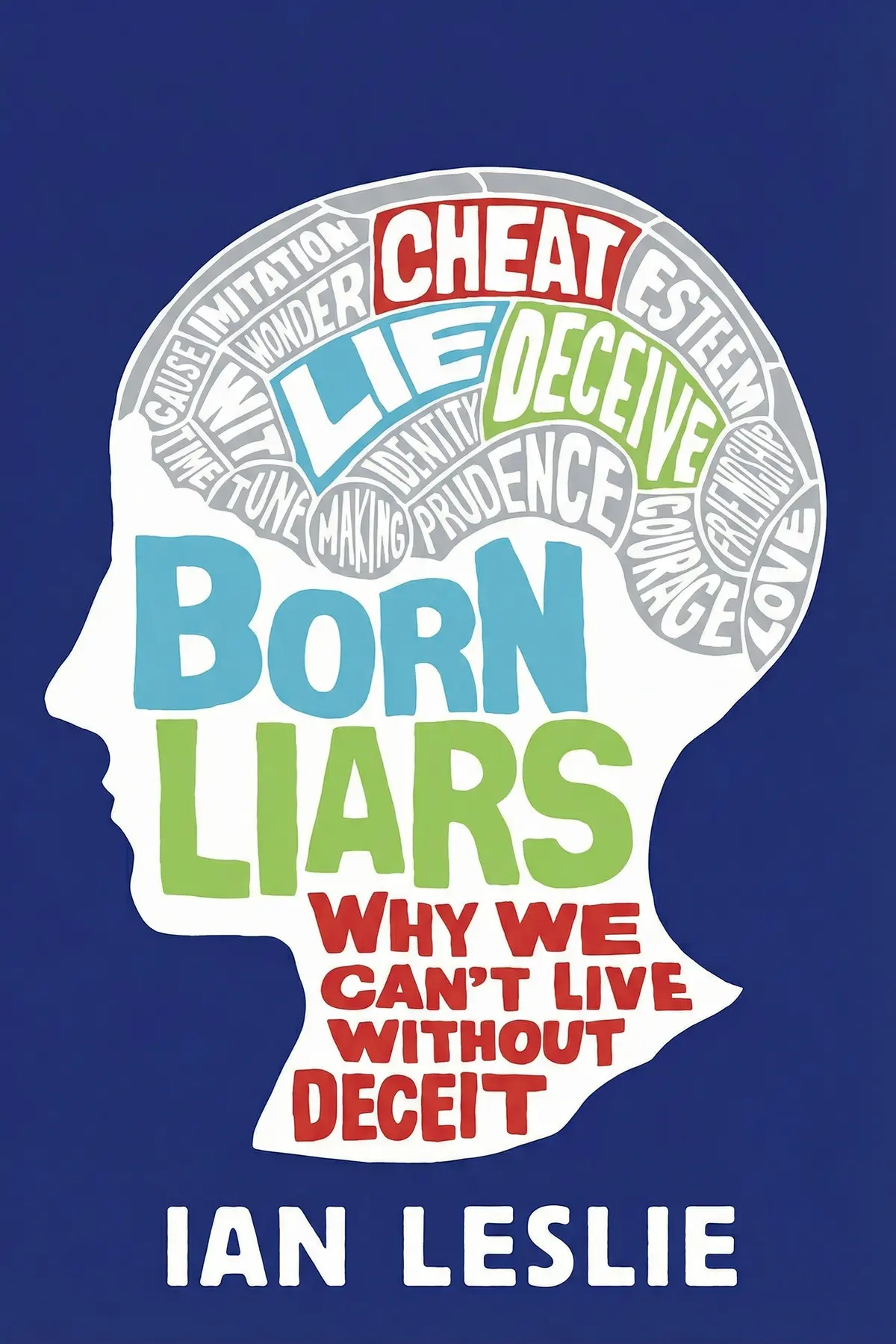
Table of Content
1. Introduction
56 sec
Most of us were raised to believe that honest people don’t lie, and most of us lie anyway, sometimes without noticing. In Born Liars, British writer Ian Leslie argues that this habit starts almost at birth: babies as young as nine months already fake a laugh to join in with others. Leslie, whose journalism has appeared in the New York Times and the Economist, treats lying as a basic human skill that lives in all of us.
His case is that the same social brain that helps us manage life with others also lets us mislead them and ourselves, and that this ability can heal, sell and protect, not only harm.
Follow his evidence, from scheming chimpanzees to a false confession and a cereal that was simply turned on its side. Along the way you will see where lies hide in your own day, why you rarely catch them, and why the most useful honesty begins with doubting your own memory.
2. See your small lies as part of being social
1 min 34 sec
Two young chimpanzees once put on a small act when an older ape wandered by. What they pulled off says a great deal about where human intelligence came from.
3. Read a child's first lie as a milestone
1 min 33 sec
Ask a three-year-old about the missing cookie and you will hear the truth. Ask a four-year-old and the story changes. Something important happens inside the child in that single year.
4. Learn why your polite fibs often go unnoticed
1 min 35 sec
Most of us trust our instincts about who is lying. A Princeton psychologist explains why that confidence is misplaced, and why the person telling the lie nearly always holds the stronger hand.
5. Stop trusting machines and memories to expose truth
1 min 42 sec
A lie detector can confirm a false confession as perfectly sincere. The reason has less to do with faulty equipment than with what happens every time you remember anything at all.
6. Catch the lies your own brain tells you
1 min 46 sec
Hills look steeper than they are, and almost everyone thinks they drive better than average. The brain bends reality for reasons that can protect us or, pushed too far, start wars.
7. Belief can ease pain and sweeten a cereal
1 min 55 sec
A nurse at a wartime field hospital had no painkillers left, so she tried something else. Decades later, an advertiser used the same principle on a breakfast cereal, and customers swore it tasted different.
8. See how culture draws the line on acceptable lies
1 min 43 sec
A child does a good deed, then denies it to her teacher. Children in one country called that wrong; children in another called it fine. The split reveals where our sense of honesty really comes from.
9. Conclusion
1 min 19 sec
What Leslie asks for is a change of attitude. Lying, in his telling, is no disease that infects only bad people. It is an old human trait that helped a social ape survive, that a four-year-old discovers without lessons, and that still does useful work, from a nurse’s salt water at Anzio to kind words about a friend’s vacation photos.
That view makes the world less tidy. The smile across the table may hide anything, the polygraph cannot rescue us, and the memory you feel surest about may have been rebuilt by someone else’s story, like the green shirt that became purple. The lies with the most reach are often the ones we tell ourselves.
Leslie’s own advice is small and practical. Be skeptical of what you think you know. When you catch yourself saying I know, try I think instead, and notice how the conversation opens up. Allow yourself kindness when a blunt truth would only wound. And when someone else’s honesty looks odd to you, ask which upbringing taught them their rules.
A species of born liars will never become perfectly honest. It can become honest about how little it can be sure of.
About this book
What is this book about?
Most of us are taught from childhood that lying is wrong, and most of us lie anyway: to spare a friend, to avoid trouble, or without realizing it at all. Ian Leslie sets out to explain why a habit we condemn is so hard to give up. His answer is that deceit is part of how a social species works. Leslie draws on primatologists who watched young chimpanzees fake boredom to hide food, psychologists who track the age when children learn to lie, and researchers who show how easily the liar wins in everyday life. He then turns inward, to memories rebuilt on the spot, false confessions a suspect can come to believe so fully that any lie detector would back them, and the self-deception that leads 88 percent of college students to place themselves in the top half of their group as drivers. The book also shows deception doing good, from a saltwater injection that calmed a wounded soldier to a cereal that people claimed tasted better once its squares were rotated to look like diamonds. Readers get a clearer view of where lies hide in their own day, why spotting them is so hard, and why doubting your own certainty may be the most practical kind of honesty.
Book Information
Who it's for
Professionals wary of instinct
Professionals who want to judge colleagues, clients and evidence without trusting their gut too much.
Parents puzzled by lying
Parents puzzled by a child's first convincing lie.
Cross-cultural managers and teams
Managers and teams working across cultures, where the rules about honesty and modesty differ.
About the Author
Ian Leslie
Ian Leslie is a British writer based in London whose articles have appeared in the New York Times, the Financial Times and the Economist. In Born Liars and Curious he examines one part of human psychology or behavior at a time, drawing on experts and real-life stories. His other books include Conflicted, published in the UK as How To Disagree, and John and Paul: A Love Story in Songs. He also writes and performs for the BBC Radio 4 comedy program Before They Were Famous.
Ratings & Reviews
Ratings at a glance

What people think
Listeners find that while perspectives on the author’s social and political views are mixed, many celebrate the volume as an intriguing and scholarly deep dive into why deception is evolutionarily necessary. They also value how the writing employs compelling stories to push back against the shame of dishonesty, presenting it as a nuanced and vital part of being human. Furthermore, listeners appreciate the look into cognitive shortcuts and the challenges of identifying falsehoods, with one listener noting that the book changed their perspective on how children develop. They also point out that the startling evidence provides a transformative look at how we perceive ourselves and the world around us.
Top reviews
Aroon
Ever wonder why we are the only species that lies with such sophistication? Leslie takes us on a journey from the deceptive behavior of great apes to the complex social structures of modern humans. He argues that lying isn’t just a moral failing, but a fundamental building block of our evolution as social beings. The stories about how children learn to deceive as part of their cognitive development were particularly eye-opening for me. It’s a fascinating, well-researched read that makes you question the very nature of honesty. Personally, I found the sections on self-deception a bit unsettling, but they were incredibly insightful for understanding my own biases.
Show moreDavid
This book completely dismantled my assumptions about truth-telling and what it means to be an authentic person. Leslie argues persuasively that becoming human was less about hunting and more about navigating the complex social web of deceit. The chapters on how we deceive ourselves to maintain a positive self-image were particularly startling and made me reconsider my own memory. Gotta say, it’s rare to find a psychology book that is this well-written and avoids the usual trap of over-relying on dubious statistics. Every page offers a new insight into the cognitive biases that shape our daily interactions and personal identities. It is a transformative read that will stick with me for a very long time.
Show moreMonthon
Reading this was a deeply uncomfortable, yet necessary, mirror to my own life and the lies I tell myself. Leslie does a fantastic job of showing how deceit is woven into the very fabric of our social contacts and personal growth. I was fascinated by the idea that our ability to imagine alternative realities is what actually makes us uniquely human. It’s a book that forces you to be skeptical of your own knowledge and the stories you tell yourself to get through the day. The writing is erudite and sharp, making complex ideas about evolutionary biology and neurology feel incredibly relevant. If you want to understand the secret engine of human society, you need to read this book.
Show moreMichael
As someone who works in communications, I found Leslie’s background in advertising shines through in the most engaging way possible. He doesn't just dump data on you; he weaves a narrative that challenges the stigma we usually attach to deceit. The book explores how 'social grease' allows our communities to function without constant friction and conflict. While the author occasionally leans into his own political leanings, the core message about our inherent nature is hard to ignore. It’s a compelling look at the masks we all wear every single day. If you enjoy popular psychology that actually respects the reader's intelligence, this is definitely for you.
Show moreLincoln
After hearing about this on BBC Radio 4, I knew I had to grab a copy to understand why we do what we do. Leslie’s exploration of how children develop the ability to lie is nothing short of brilliant. It turns out that a child who can successfully deceive is reaching a significant cognitive milestone rather than just being 'bad.' This shift in perspective changed how I look at my own kids and their creative storytelling. The book is full of these little 'aha!' moments that make you rethink your entire social world. It’s written with a light touch that makes even the complex evolutionary theories feel accessible and fun.
Show moreMeen
I picked this up thinking it would be another dry psychology text, but it’s actually a total page-turner. Leslie dives deep into why we are 'born liars' and why that might actually be a good thing for society. The book is packed with terrific stories that illustrate the evolutionary necessity of being able to read others and strategically withhold the truth. I especially enjoyed the part about how difficult it is for even the most trained professionals to spot a liar. It makes you realize how much of our world is built on a foundation of shared illusions. My only minor gripe is that it occasionally feels a bit too much like a collection of essays.
Show moreMax
Rarely do you find a non-fiction book that feels this much like a page-turner while still being deeply educational. Ian Leslie manages to wear his learning lightly, blending high-level psychological research with engaging anecdotes that keep you hooked. He challenges the reader to accept a margin of illusion in their lives, arguing that total honesty might actually be destructive. This perspective is a refreshing break from the moralizing tone usually found in books about ethics and behavior. The section on how our brains are wired to prioritize social cohesion over objective truth was mind-blowing. It’s a sophisticated look at the human condition that avoids all the usual clichés.
Show moreBrahim
While Leslie is undoubtedly a gifted writer, I found his tendency to frame lying as a social necessity a bit hard to swallow at times. He spends a lot of time discussing how we should distrust our own intuition in favor of social norms, which felt a bit like political posturing. The research on lie detection was genuinely interesting, especially the parts about how machines and experts often fail. However, the book feels a bit light on the darker side of institutional and governmental deception. It’s an erudite piece of work, but I would have preferred more depth on the consequences of systemic lies. Truth is, it’s worth a read for the anecdotes alone.
Show moreJoseph
The premise is absolutely gripping, but the execution starts to wobble in the final third of the book. I loved the early chapters on primates and the evolutionary building blocks of deceit, but the cultural analysis felt a bit rushed. Leslie relies heavily on academic material, which makes it feel very credible, yet I missed having more of his own personal thesis. In my experience, the insights into how we use narratives to construct our reality are still very valuable. It's a solid 3-star read for me because while the information is great, the flow felt a bit disjointed towards the end. It’s still a very informative look at the mechanics of the human mind.
Show moreSelin
Look, I struggled to finish this one because I found the author's conclusions about social reality deeply frustrating. He seems to suggest that there is no neutral truth and that we should just submit to the narratives of institutions. This felt less like a scientific investigation and more like an apology for the status quo and media manipulation. While the evolutionary psychology bits were okay, the moral bias of the author was too loud for me to enjoy the rest. I was looking for a more objective look at the psychology of lying, not a lecture on why I should distrust my own certainties. It’s definitely well-written, but the underlying message didn't sit right with me.
Show moreQuestions about this book
What is the main idea of Born Liars by Ian Leslie?
Leslie argues that lying is a natural human trait, not a flaw found only in bad people. It grew out of our social evolution, appears in infancy, mostly goes undetected, and even shapes our own memories and beliefs. Deception can also do good, as the placebo effect shows, and whether a lie is wrong depends largely on the values we were raised with.
At what age do children start lying, according to Born Liars?
Leslie describes babies of nine months faking laughter to join in with giggling babies. The bigger change comes around age four, when children develop theory of mind and realize others cannot see their thoughts. A three-year-old usually admits taking the last cookie, while a four-year-old is far more likely to deny it or blame someone else.
Why are lie detectors unreliable?
The polygraph measures signals like blood pressure and breathing, but an innocent, frightened suspect can react just as strongly as a guilty one. Leslie adds a deeper problem: memory is rebuilt each time we recall it, so pressured suspects can come to believe false confessions. A machine would then read them as truthful, as in the Norfolk Four case.
How can I apply the ideas in Born Liars?
Leslie’s main advice is to be skeptical of your own knowledge, for example by saying I think instead of I know, which keeps you open to discussion. The book also suggests holding gut judgments about others’ honesty loosely, checking whether you are dismissing facts that threaten your beliefs, and remembering that other cultures may draw the line on lying in different places.
Readers also enjoyed



A Liberated Mind: How to Pivot Toward What Matters
Steven C. Hayes


Acting with Power: Why We Are More Powerful Than We Believe
Deborah Gruenfeld


Age of Propaganda: The Everyday Use and Abuse of Persuasion
Anthony Pratkanis



AUDIO SUMMARY AVAILABLE
Listen to Born Liars in 15 minutes
Get the key ideas from Born Liars by Ian Leslie, plus 5,000+ more nonfiction titles.
- 5,000+ titles
- Listen as much as you want
- 7-day free trial
- Cancel anytime









