

15 min 09 sec
Available in: English
Blockchain Chicken Farm: And Other Stories of Tech in China's Countryside
By Xiaowei Wang
Shows how blockchain, drones, online classes and e-commerce are reshaping China's countryside, and how each technology brings rural communities new income and opportunity alongside new divides, pressures and surveillance.
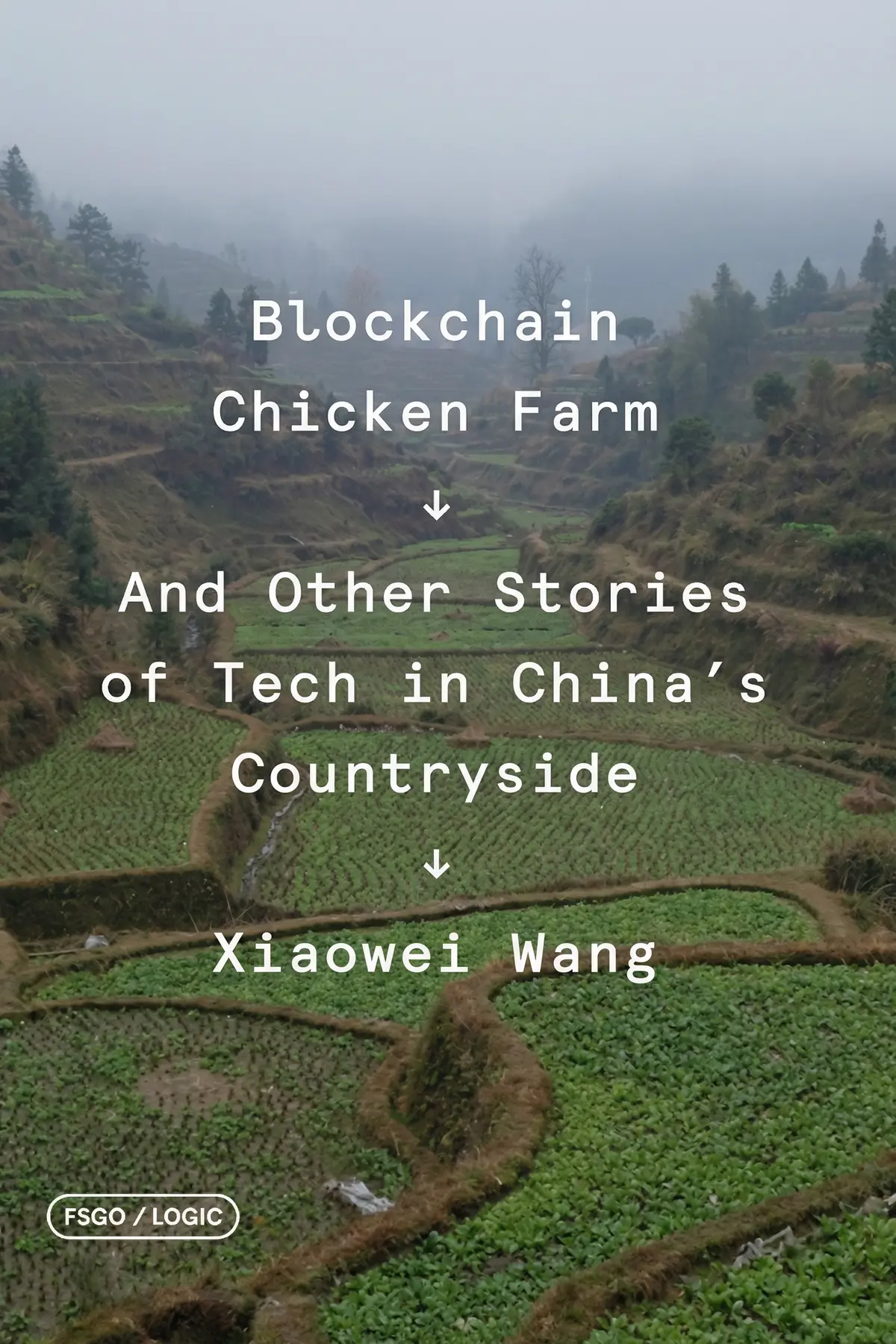
Table of Content
1. Introduction
55 sec
If you picture technological change happening in Silicon Valley or a Shanghai tower, Xiaowei Wang offers a different map. In Blockchain Chicken Farm, one stop is Sanqiao, a poor mountain village in Guizhou, where every free-range chicken is tracked from birth on a blockchain so a wealthy buyer on the coast can scan its life before eating it.
That farm carries the book’s argument. China’s digital future is being built in its countryside as much as in its megacities, and each new tool, from drones to online shops, brings real openings along with new divides and pressures.
Follow Wang from village to village and the flat headline image of China gains depth. You will be able to explain how farming regions became testing grounds for new technology, and to judge any promise of progress by asking who gains and who pays.
2. Read China's rise from the countryside up
1 min 45 sec
Each spring, more than 300 million people leave China’s cities at once. Where they go, the countryside, sits behind the country’s rise, a widespread famine and its plans for the future, a story no skyline tells.
3. Rebuild trust in food with a shared record
1 min 46 sec
A dairy scandal left children dead and buyers suspicious of everything on their plates. In a remote mountain village, one farm answers that distrust with a record each bird carries from hatching to the table.
4. Online learning can open doors geography closed
1 min 55 sec
A railway mechanic’s son with a vocational diploma now flies drones over farms. His rise is real, but so is the point where people like him stop climbing, and an elite school tried to move it.
5. Treat copying as a way to invent
1 min 53 sec
China’s fakes earned it a reputation for imitation. Inside one crowded electronics market, the same freedom to copy turns into something Silicon Valley rarely sees: devices built, changed and repaired by almost anyone.
6. See how mass surveillance misreads real people
2 min 07 sec
China is often imagined as a place where cameras see everything. A city database with only 60,000 names suggests otherwise, and the systems that do work raise a harder problem than accuracy.
7. Count the real costs of village e-commerce
1 min 50 sec
A village reached only by footpath for a thousand years now has a paved road, an internet cafe and a restaurant that takes phone payments. The money is real. So are the costs that never show up in the sales figures.
8. Hear what a smoking Peppa Pig reveals
1 min 49 sec
A friendly British cartoon pig became a cigarette-smoking nihilist on the Chinese internet. The joke carries a serious message about ambition, inequality and the young people a nation’s success story leaves out.
9. Conclusion
1 min 09 sec
Hold two images side by side. In one, a buyer in a coastal city scans a code and watches the life of a chicken raised in a poor mountain village. In the other, a cartoon pig in sunglasses lights a cigarette for young viewers who doubt the national dream was meant for them. Both come from the same countryside, and Wang’s book lives in the space between them. Technology really is reaching China’s villages, with paved roads, drone licenses, online shops and lessons streamed from elite schools. It also brings new divides, new stress and new ways of being watched.
What lasts is a better way to read any story about technology and progress. Look for where the tool actually touches the ground: a field, a market stall, a village database. Ask who holds the well-paid jobs and who flies the drones, who earns from the platform and who absorbs its costs. And listen to the jokes people pass around, because they often report what official figures leave out.
The future of a nation of megacities, Wang suggests, is still being written in its villages.
About this book
What is this book about?
Most stories about Chinese technology are set in gleaming megacities. Xiaowei Wang looks somewhere else: the farms and mountain villages of the countryside, where 40 percent of China's people still live, and the migrant neighborhoods of a city like Guiyang, where efforts to catalog residents for policing remain patchy. Wang visits a chicken farm in Guizhou that tracks every bird on a blockchain and follows a railway mechanic's son who became a licensed drone pilot. Other stops include an electronics market built on remixing other people's designs and remote villages being drawn into online trade through a national e-commerce push. Along the way Wang examines why China's surveillance systems are clumsier than their reputation, and why a cigarette-smoking Peppa Pig became a mascot for disillusioned young people. The result is a grounded picture of how city and countryside depend on each other. It also leaves a habit worth keeping: for every new tool, ask who gains, who is left at the bottom of the ladder and what costs never appear in the sales figures.
Book Information
Who it's for
Professionals working with China
Professionals who work with China and want to understand its countryside as well as its cities.
Founders and product builders
Founders and product people curious how blockchain, drones and e-commerce play out among small farmers and villages.
Wanting grounded human stories
Readers tired of both hype and fear about Chinese technology who want grounded, human stories.
About the Author
Xiaowei Wang
Xiaowei Wang works across art, film and writing, focusing on how technology and society shape each other. Wang is creative director at Logic magazine, and their writing has run in the New York Times and appeared with the BBC, CNN and VICE.
Ratings & Reviews
Ratings at a glance
What people think
Listeners find the work to be informative and skillfully composed, with one review noting its sharp attention to detail. They value the perspective offered, as one listener highlights its innovative look at Chinese culture.
Top reviews
Kanokporn
Xiaowei Wang offers a piercing look into the collision of high-tech logistics and rural life that feels light-years ahead of Western discourse. I was particularly struck by their exploration of 'metronormativity' and how we urbanites tend to project our own fantasies onto a countryside we barely understand. The chapters on Taobao villages and the sheer scale of the digital pearl trade provide a much-needed reality check for anyone still thinking of rural China as a primitive backwater. While some critics find the prose repetitive, I found the direct, declarative style refreshing and grounded in its observations. The inclusion of 'Sinofuturist' recipes adds a surreal, artistic layer that distinguishes this from a dry academic text. It’s a haunting, beautifully weird meditation on how technology actually functions on the ground, away from the sleek glass offices of Shenzhen or Silicon Valley. This is essential reading for anyone trying to grasp the global reach of racial capitalism.
Show moreLars
Wow, this was not at all what I anticipated when I saw a title about blockchain chickens. It is a brilliant, intersectional critique of how technology is reshaping the very fabric of our lives. Wang’s voice is empathetic and deeply human, especially when discussing the precarity of gig workers and the environmental cost of our 'shopping religion.' I felt a sense of daze and gratitude reading their observations of 'ghosts in the machine' and the hukou system. The philosophy of Shanzhai as a tool for community building rather than just 'counterfeiting' was a total lightbulb moment for me. It’s a book that asks what kind of world we actually want to build, rather than just optimizing for efficiency. The recipes are a quirky touch that makes the whole experience feel like a collaborative art piece. Highly recommended for those who like their tech analysis with a side of soul.
Show moreConnor
Finally got around to reading this and it’s easily one of the most provocative things I’ve read this year. The central argument—that AI is a quest for scale that ignores the stewardship of the land—is incredibly powerful. Wang highlights how the shift from growing wheat to chili peppers for American Halloween costumes is a form of ecological violence. I loved the 'buffet life' chapter and the way it connects global markets to the precarity of individual workers in China. The writing is visceral and haunting, especially the descriptions of the glistening skylines in Chongqing versus the neglected chickens in the hills. It’s a reminder that a computer can never enter into a commitment, and that our current tech path is fundamentally anti-human. If you want to understand the true cost of globalism, start here.
Show morePaiboon
Ever wonder where those weird 'oyster opening' livestreams on Facebook actually come from? Wang tracks the supply chain back to rural Zhejiang in a way that is both fascinating and deeply depressing. The book is less of a technical manual and more of a travelogue through the fringes of the global economy. I loved the section on 'Shanzhai' culture and how it challenges Western notions of intellectual property. However, the book does get bogged down in some pretty dense political theory that felt a bit shoehorned in. One minute you’re reading about pig farming, and the next you’re being lectured on the 'patriarchal authoritarianism' of the CCP. Still, the vivid descriptions of Taobao towns—where entire villages produce nothing but Halloween costumes—will stick with me for a long time. It’s a fresh, necessary perspective on Chinese culture that avoids the usual 'us vs. them' geopolitical tropes.
Show moreWararat
As someone who follows the intersection of AI and ethics, the chapter on predictive policing in Guiyang was absolutely chilling. Wang has a keen eye for the 'gulf between the database and the visceral,' showing how numbers can abstract away human suffering and fear. I appreciated the author’s transparency about their own positionality and the mandatory statement on the Uyghur crisis at the beginning. Some might call it virtue signaling, but in today’s climate, it feels responsible to acknowledge the state violence inherent in these technologies. The book isn't perfect; the transitions between anecdotes can feel a bit fragmentary and disjointed at times. You really have to be in the mood for a peripatetic meander rather than a coherent narrative arc. But the insights into how AI scales at the expense of local ecology are worth the price of admission alone.
Show moreWachira
Picked this up because I was obsessed with those YouTube videos of idealized rural Chinese life. This book is the perfect antidote to that fantasy, showing the gritty reality of fallow land and industrial waste that powers the e-commerce boom. The way Wang describes the 'race to the bottom' on pricing in Taobao towns is heart-wrenching. They show how Jack Ma’s 'miracle' often transfers all the risk onto the villagers while the platforms reap all the rewards. I did find the writing a bit repetitive in places, almost like a collection of separate articles that weren't quite edited into a single book. However, the information is so fresh and the perspective is so unique that I couldn't put it down. It’s a sobering look at how our desire for cheap junk on Etsy is literally changing the ecology of the Chinese countryside.
Show moreSakura
Beyond the catchy title, this is a deep meditation on the 'Sinofuturist' reality we are all living in. Wang does a fantastic job of dissolving the myth that the countryside is conservative or stagnant; if anything, it’s the testing ground for the most radical tech experiments. I enjoyed the blend of travelogue, recipes, and social critique, even if the transitions were sometimes a bit clunky. The book effectively challenges the idea that tech is 'lifting people out of poverty' without mentioning the massive ecological and social debt being accrued. While I disagreed with some of the author’s more ideological conclusions, I appreciated the intellectual honesty of the contradictions they explored. It’s not a perfect book, but it’s an important one that stays with you long after you finish it. A great read for anyone interested in the messy intersection of culture and code.
Show moreSaovapa
The title is a bit of a bait-and-switch, as the actual blockchain chicken farm only gets about ten pages of coverage. Most of the book is actually a series of essays on the social implications of tech, ranging from pearl parties to pig-farming AI. While the reporting on the ground is excellent, the author’s takes on political theory really slowed things down for me. For instance, claiming that Elinor Ostrom 'disproved' the tragedy of the commons is a massive oversimplification that ignores the nuances of her actual research. I also found the constant mentions of the author’s non-binary identity to be a bit distracting when I just wanted to learn about agriculture. There is some great prose hidden in here, and the facts about Taobao villages are genuinely eye-opening. I just wish it had more focus and less 'fully automated luxury space communism' posturing.
Show moreSaengdao
To be fair, I expected a rigorous analysis of decentralized ledgers in agriculture, but what I got was a meandering art project masquerading as journalism. The writing style is exhausting; page after page of simple subject-verb-object sentences makes the narrative feel like a primary school textbook. More importantly, the author seems to have a tenuous grasp on the very economic systems they criticize. They spend pages debating Hobbesian philosophy and 'disproving' the tragedy of the commons using Elinor Ostrom, but they provide almost zero technical data on how the actual blockchain integration works for the chickens. I was looking for a deep dive into tech, but instead, I was forced to sit through a 'critical theory striptease' that often ignored the actual voices of the peasants. It felt like the author was more interested in their own identity and performative virtue signaling than the actual farmers. If you want a book about blockchain, look elsewhere.
Show moreAkosua
Look, I really wanted to like this, but the author’s sanctimoniousness was a major hurdle. The book starts with a lecture on 'metronormativity' and then proceeds to do exactly what it critiques: talking over actual peasants with high-level academic mumbo-jumbo. I was hoping for a deep dive into the technical side of how China is using tech to solve food safety issues. Instead, I got a lot of 'vague platitudes' about doing 'the work' of care over efficiency. What does that even mean in a world of 8 billion people who need to eat? The author’s disdain for capitalism is palpable, yet they offer no realistic roadmap for how to feed people without the scale they so despise. It feels like a book written for a very specific type of intellectual rather than anyone actually interested in agricultural tech. A visceral disappointment.
Show moreQuestions about this book
What is Blockchain Chicken Farm about?
Xiaowei Wang explores how new technology is changing rural China, where 40 percent of the population still lives. The stories range from a Guizhou farm that tracks every chicken on a blockchain to drone pilots, Taobao Villages, an electronics market built on remixing and young people venting on streaming apps. Wang’s argument is that China’s future is shaped by city and countryside together, and that each tool brings gains along with new problems.
What is a blockchain chicken farm?
In Sanqiao, a poor village in Guizhou, a company called GoGoChicken raises free-range chickens that sell at premium prices to wealthy diners in coastal cities. Each bird is tracked from birth to the table, with its data stored on a blockchain, a shared record that is very hard to falsify. Buyers scan a code and see the chicken’s whole life on a website, a response to China’s serious food-safety problems.
What are Taobao Villages?
They are villages where more than 10 percent of households make goods to sell on Alibaba’s shopping site Taobao.com. Alibaba’s Rural Taobao plan, launched in 2013, opened service centers and taught villagers to sell online. Such villages numbered over 3,000 across 24 provinces as of 2018. Wang reports higher incomes, but also family stress and environmental damage from unregulated manufacturing.
What does shanzhai mean in Blockchain Chicken Farm?
Shanzhai is an insulting Chinese term for pirated goods. It literally means mountain stronghold, because some mountain villages built economies on imitation products. Wang argues it can also describe something positive: a culture where anyone can adapt and remix existing designs. At the Huaqiangbei electronics market, hundreds of small firms make products from 3D printers to modular phones that owners can repair themselves.
How can I apply the ideas in Blockchain Chicken Farm?
The book offers a lens more than a method. When you hear a story about technological progress, look at where it actually reaches people. Ask who holds the well-paid jobs, who carries the hidden costs, and whether anyone singled out by a data system can ever leave that record behind. The Peppa Pig memes also show that popular jokes can reveal discontent that official success stories miss.
Readers also enjoyed









AUDIO SUMMARY AVAILABLE
Listen to Blockchain Chicken Farm in 15 minutes
Get the key ideas from Blockchain Chicken Farm by Xiaowei Wang, plus 5,000+ more nonfiction titles.
- 5,000+ titles
- Listen as much as you want
- 7-day free trial
- Cancel anytime









