

13 min 40 sec
Available in: English
Better and Faster: The Proven Path to Unstoppable Ideas
Shows why successful companies fall into habits that ruin them, and how to train hunter instincts and apply six patterns of opportunity to spot and shape winning ideas before competitors do.
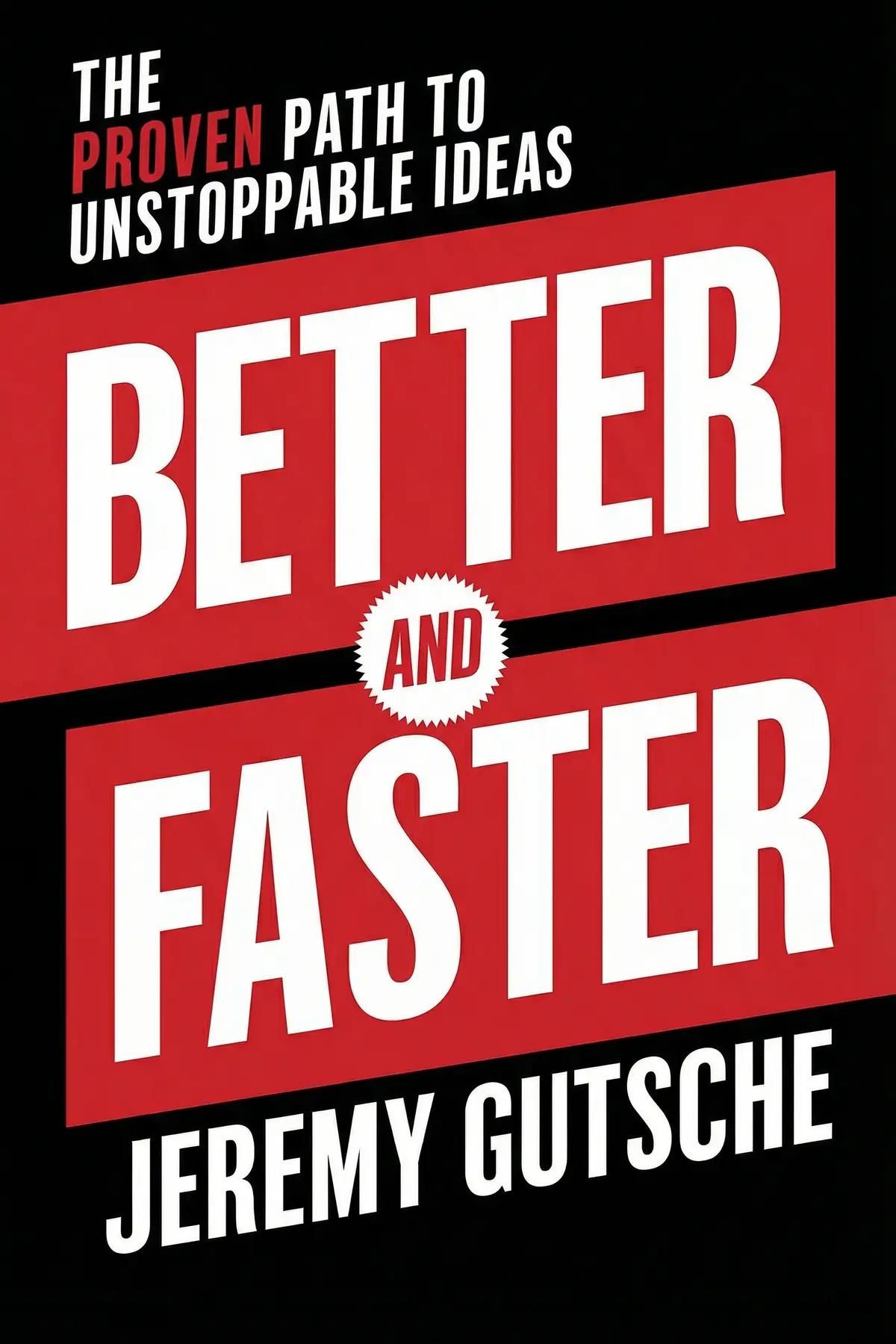
Table of Content
1. Introduction
1 min 04 sec
Teams rarely fail for lack of talent. More often they keep repeating what worked last time while the market moves somewhere else. In Better and Faster, Jeremy Gutsche, founder and CEO of Trend Hunter, traces that habit back thousands of years, to the moment people gave up hunting for farming and swapped risk for comfort and routine. In his view, many leaders still carry the farmer’s mindset: settled, cautious and slow to change. The ones who keep winning think like hunters, restless and ready to act.
Gutsche’s argument is that good ideas are less a matter of luck than of method. Escape the farmer’s habits, sharpen the hunter’s instincts, and six repeatable patterns will show you where the next opportunity is hiding. The cases are vivid: an energy drink that sells despite its taste, a car marketed on its own boxiness, a video chain that went from 9,000 stores to bankruptcy in about a year. Each one becomes a test you can run on your own product, team or career.
2. Spot the three habits that sink winning companies
2 min 00 sec
A typewriter giant, a video rental empire and a film legend were run by leaders who believed they were smart and tenacious enough to succeed. Each still collapsed, and each made a different version of the same mistake you may be making now.
3. Train the instincts that keep you hungry
1 min 52 sec
A bank grew while its rivals struggled, and a celebrated chef keeps throwing away dishes that already earned him top honors. Their habits look reckless from the outside, yet they are exactly what keeps a winner from going stale.
4. Combine popular trends or stand apart from them
1 min 46 sec
One app became a hit by mixing three things that already existed. One drink became a giant while selling a product many people dislike. Two opposite routes to standing out, and both can be copied.
5. Ride the momentum of nostalgia and spin
1 min 53 sec
Old things keep coming back, and a weakness can be renamed until people want it. A photo app and a famously square car show how to borrow energy that already exists instead of creating it from nothing.
6. Win a niche by stripping down or scaling up
1 min 56 sec
One camera won fans by doing almost nothing beyond the basics. One vacuum won by doing a single thing far better than anyone else. Both show how to stop trying to please everyone.
7. Choose a hunting ground and forecast what comes next
1 min 55 sec
Frameworks are easy to learn and hard to use. A designer’s double-purpose shop and a retailer that moves from sketch to store in two weeks show where to start, and how to see the next trend early.
8. Conclusion
1 min 14 sec
Gutsche’s farmer story is really a story about comfort. Smith Corona, Blockbuster and Kodak did not fail for lack of smart people. They failed because a good harvest convinced them the field would last forever. The hunter’s edge is different from genius. It is a habit of looking, again and again, at what customers might want next, joined to a set of lenses that turn that look into an idea. In a market Gutsche sees as more chaotic than ever, that habit decides who adapts and who is left behind.
The practice can start small. Choose one hunting ground this week and fill it with examples from inside and outside your industry. Run your current product or project through the six patterns, and pay attention to the one that gives you the strangest answer, because the strange answer is often where the opening is. When you notice something old coming back, treat it as a short window and move before it closes.
Red Bull sold a drink people found hard to love, and Volvo sold a car people found boxy. Both turned the weakness into the pitch. That is the hunter’s move: look hard at what you already have, and find the angle everyone else walked past.
About this book
What is this book about?
Smart, determined leaders run companies into the ground all the time. Jeremy Gutsche traces the cause to a mindset humanity adopted when it gave up hunting for farming: a preference for comfort, routine and safety. In business that mindset shows up as three traps, complacency, repetition and protectiveness, and Smith Corona, Blockbuster and Kodak each fell into one on the way to bankruptcy. Gutsche's answer is to think like a hunter. That means staying insatiable, staying curious and being willing to destroy what you built. He then turns those instincts into method with six patterns of opportunity: convergence, divergence, cyclicality, redirection, reduction and acceleration. Each comes with a case, from the running app Zombies, Run! and Red Bull's marketing to Instagram's vintage filters, Volvo's boxy cars, GoPro's two buttons and Dyson's 5,127 prototypes. Readers get a way to check their own work for farmer habits, a set of lenses for reframing any product or project, and a practical routine for picking a hunting ground and forecasting what customers will want next.
Book Information
Who it's for
Needing fresh ideas
Founders and product managers who need fresh ideas and fear their company is getting comfortable.
Marketers wanting products noticed
Marketers looking for ways to make an ordinary or flawed product stand out.
Professionals in fast-changing fields
Professionals in fast-changing industries who want a simple routine for spotting trends before competitors do.
About the Author
Jeremy Gutsche
Jeremy Gutsche is the founder and CEO of Trend Hunter. He developed a billion-dollar portfolio for Capital One Bank and has worked with brands including Coca-Cola, Sony and IBM, as well as with NASA. That experience helping large organizations find new opportunities is the ground Better and Faster draws on.
Ratings & Reviews
Ratings at a glance
What people think
Listeners find the book absorbing and simple to follow, filled with many fascinating tales and practical tips. They value its solid collection of creative concepts, with one listener highlighting how well it pairs with Jeremy's innovation keynote. The work earns praise for being accessible, as one listener pointed out it can be finished in a single session.
Top reviews
Varinee
Wow. Simply wow. While I have explored plenty of business literature in the past, Jeremy Gutsche’s approach to entrepreneurial thinking is on an entirely different level. He provides a brilliant roadmap for overcoming the psychological and cultural traps that cause even the smartest professionals to overlook massive opportunities. The way he contrasts the 'farmer' mentality with the 'hunter' mindset is particularly striking, emphasizing that a culture of rapid change requires us to be more predatory in how we seek out innovation. Truth is, the marketplace is more chaotic than ever, and these six patterns of opportunity offer a concrete way to find order in that chaos. I especially loved the section summaries and diagrams at the end—it makes the concepts so much easier to digest and apply immediately. If you want to thrive instead of just survive, you need to read this.
Show moreNadia
Do you ever feel like your next breakthrough is just out of reach? This book is for the entrepreneurs who have that constant itch for innovation but need a push to find the right path. Gutsche teaches his readers how to look at history, cycles, and social variables to work through ideas systematically. The heavy use of storytelling helped me see how these principles apply in the real world rather than just staying in the realm of theory. I love how the book is organized into distinct patterns, making it easy to flip back to specific sections when you need a spark of creativity. Not gonna lie, I’ve already started using his website as a resource for my own trend hunting. It’s an inspiring read that makes the daunting task of starting a new venture feel much more manageable.
Show moreAmelia
Gutsche’s writing style is incredibly punchy and engaging, making it one of those rare business books you can actually finish in one sitting without getting bored. I really enjoyed how he breaks down the psychological traps that lead to stagnation. The idea of 'divergence' and how brands like BeautifulPeople.com use rejection as a tool for success was a standout moment for me. It’s these kinds of 'out of the box' examples that make the book feel fresh despite a few older case studies. The structure is fantastic, moving from the broad hunter/farmer analogy into specific, actionable patterns. If you are planning to launch a new business or rethink your current strategy, this book provides a valuable lens to view the market. It’s inspiring, practical, and filled with reminders to stay hungry for what’s next.
Show moreJai
The six patterns of opportunity presented here are a genuine game-changer for anyone trying to navigate today's chaotic market. Gutsche has a knack for finding these enlightened business stories that actually stick with you long after you close the book. For instance, the anecdote about the chef who refuses to serve his 'signature' dish because it represents past success was a powerful reminder to stay insatiable and curious. Personally, I found the models for strategic thinking to be incredibly useful for my own startup planning. My only minor gripe is that a few of the examples felt slightly dated, as the speed of tech moves faster than publishing cycles can sometimes handle. Still, it is a fun, easy read that forces you to look at the market through a much more valuable lens. Highly recommended for those who feel like their next big idea is just out of grasp.
Show moreWorawit
Picked this up after hearing Jeremy’s keynote, and it’s the perfect companion piece to his live talks. The book is incredibly readable—I actually finished the whole thing in a single sitting on a Sunday afternoon. What I appreciated most were the actionable insights regarding trend spotting; it isn't just theory, but actual patterns you can look for in real-time. Gutsche unpacks how successful firms use refocusing and image shifts to stay relevant, which is helpful if you already have an established business. Some might say the writing is a bit too casual, but I found the punchy sentences and quick pacing refreshing. It’s a great reminder that the only certainty we have is change, and we might as well get better at hunting for the opportunities that change creates. Definitely worth a spot on your shelf.
Show moreIce
Finally got around to reading this, and the models for strategic thinking are actually quite insightful. Gutsche does a stellar job of illustrating how rapid change creates new problems that are essentially just hidden opportunities for those willing to look. I found the appendix case studies particularly helpful because they show the framework in action rather than just talking about it. The concept of being 'insatiable' and willing to destroy your own past successes to make room for the future is a tough pill to swallow but a necessary one. Franky, the marketplace is too turbulent to stay in 'farmer' mode for long. While I wish there were more diverse examples outside of the typical tech and fashion sectors, the core message remains powerful. It’s an enlightening read that will definitely change how you look at market possibilities.
Show moreChai
Rapid change is the only certainty, and Gutsche maps it out brilliantly. This is a good book to get you thinking about the mental blocks that hold us back from truly innovating. I loved the breakdown of how companies operated in the past versus how they must operate now to survive. The tone is encouraging and high-energy, which kept me engaged through some of the more analytical sections. One of the best parts is the way he compresses all the key concepts into diagrams at the end—it’s perfect for a quick refresher later on. To be honest, I think any aspiring entrepreneur would benefit from his perspective on trend cycles. It’s not just about being better; it’s about being faster at recognizing where the world is going before everyone else catches on.
Show moreRung
While the stories about various business ventures are undeniably hilarious and well-told, some of the core concepts felt a little thin to me. It is your typical business book: lots of anecdotes and a few really interesting nuggets buried within. To be fair, the 'Hunter vs. Farmer' analogy is a solid framework for understanding how companies stagnate when they get too comfortable. I did find the case study on the exclusivity of BeautifulPeople.com quite fascinating from a branding perspective. However, I noticed the vast majority of examples focused on massive corporations and global brands. I had really hoped for more small business applications that felt relevant to the 'little guy.' It's a decent book to get your brain moving, but don't expect a deep dive into data-driven strategy. It’s more about inspiration and reframing your perspective than a step-by-step manual.
Show moreKru
As someone who has been in marketing for a decade, I found the case studies enlightened but sometimes repetitive. The book covers a lot of ground regarding image issues and refocusing, which is useful, but I felt like I had heard some of these stories in other business books before. That being said, the 'six patterns' provide a decent vocabulary for discussing innovation within a team. I liked the focus on curiosity and the need to move away from the 'farmer' methodology of just protecting what you already have. It is an easy read, very conversational, but it occasionally prioritizes style over deep substance. If you are new to the world of trend hunting, this will be a 5-star read for you, but seasoned business owners might find some of it to be a review of things they already know.
Show moreFelix
Not what I expected from a book about cutting-edge innovation. Look, the writing is fine and the author is clearly charismatic, but I found the actual substance to be lacking in several areas. Most of the 'six patterns' felt like common sense repackaged with catchy titles. The focus on big-name brands makes the advice feel less applicable to someone trying to build something from scratch without a massive marketing budget. Also, mentioning exclusivity tactics from years ago felt a bit behind the curve for a book that claims to help you move 'faster.' There were some interesting nuggets here and there, but I spent most of the time waiting for a deep strategic takeaway that never quite arrived. If you want a light read with some cool stories, you might like it, but for serious business strategy, I’d look elsewhere.
Show moreQuestions about this book
What is the main idea of Better and Faster by Jeremy Gutsche?
Gutsche argues that success makes people think like farmers: complacent, repetitive and protective of what they have. Companies such as Smith Corona, Blockbuster and Kodak went bankrupt that way. The alternative is to think like a hunter, staying insatiable, curious and willing to destroy old work, and to use six patterns of opportunity to find new ideas before competitors see them.
What are the six patterns of opportunity in Better and Faster?
The six are convergence, which combines strong trends; divergence, which stands apart from the mainstream; cyclicality, which uses things that return, like nostalgia; redirection, which spins a negative into a positive; reduction, which strips a product to its simplest core; and acceleration, which pushes one key feature much further. Gutsche illustrates them with Zombies, Run!, Red Bull, Instagram, Volvo, GoPro and Dyson.
What are the farmer traps Gutsche describes?
There are three. Complacency is resting on past success, as Smith Corona did when it left a joint venture with Acer in 1990. Repetition is repeating an old formula, as Blockbuster did by sticking with stores and physical media while streaming grew. Protectiveness is guarding the status quo, as Kodak did with analog film until its 2012 bankruptcy.
How can I apply Better and Faster to my own work?
Check your current projects for the three farmer traps. Then pick a hunting ground, a cluster of similar products or ideas, and include examples from outside your industry. Run your central idea through all six patterns. When you see something old returning, Gutsche advises acting quickly, preparing for what follows and looking for the less obvious openings that large forces create.
Readers also enjoyed


Alibaba: The House That Jack Ma Built
Duncan Clark



7 Powers: The Foundations of Business Strategy
Hamilton Helmer

Bad Blood: Secrets and Lies in a Silicon Valley Startup
John Carreyrou
AUDIO SUMMARY AVAILABLE
Listen to Better and Faster in 15 minutes
Get the key ideas from Better and Faster by Jeremy Gutsche, plus 5,000+ more nonfiction titles.
- 5,000+ titles
- Listen as much as you want
- 7-day free trial
- Cancel anytime









