

13 min 42 sec
Available in: English
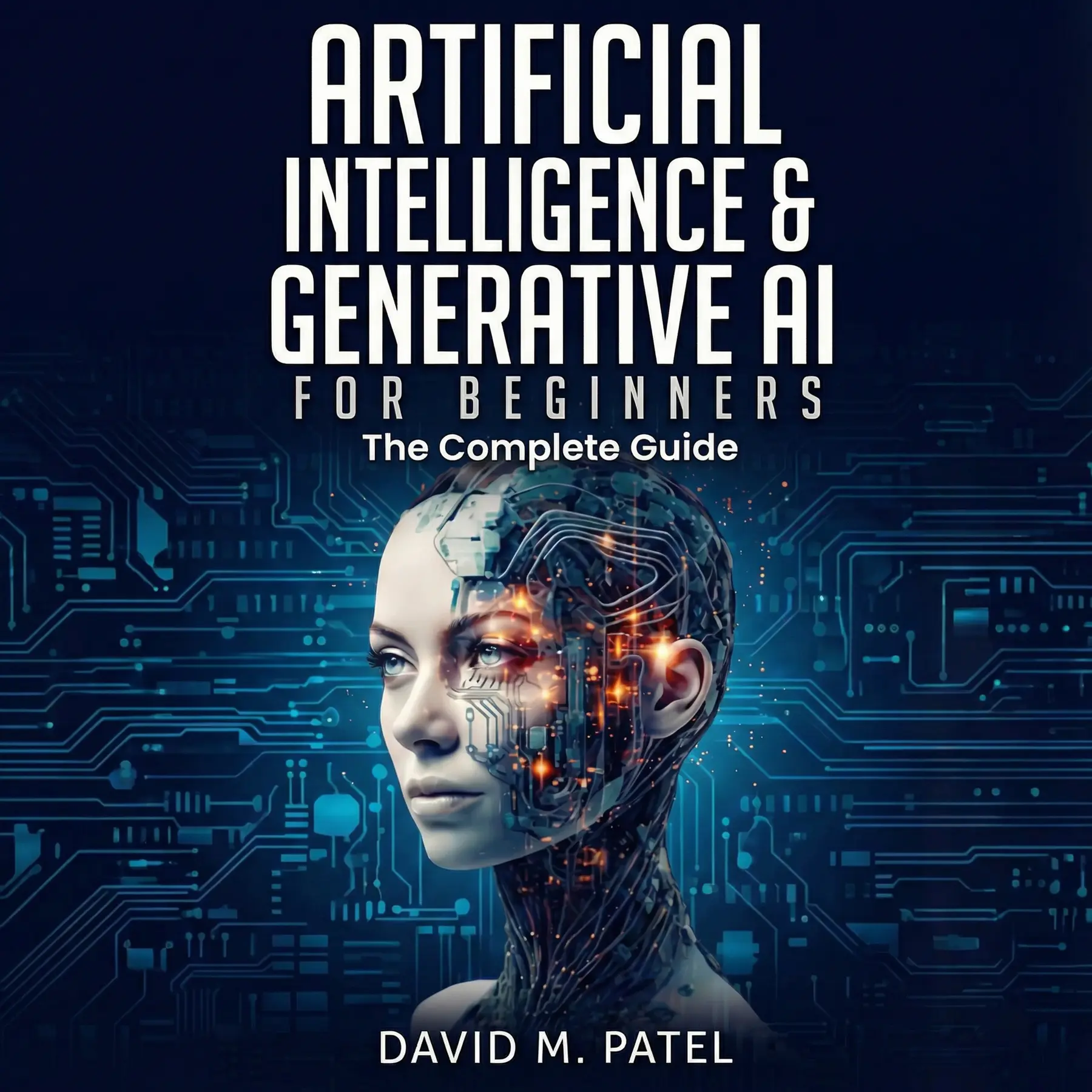
Artificial Intelligence & Generative AI for Beginners: The Complete Guide
A plain-language guide to how AI learns from data, how neural networks and generative models work, how to write prompts that return useful results, and which ethical risks to check as these tools spread.
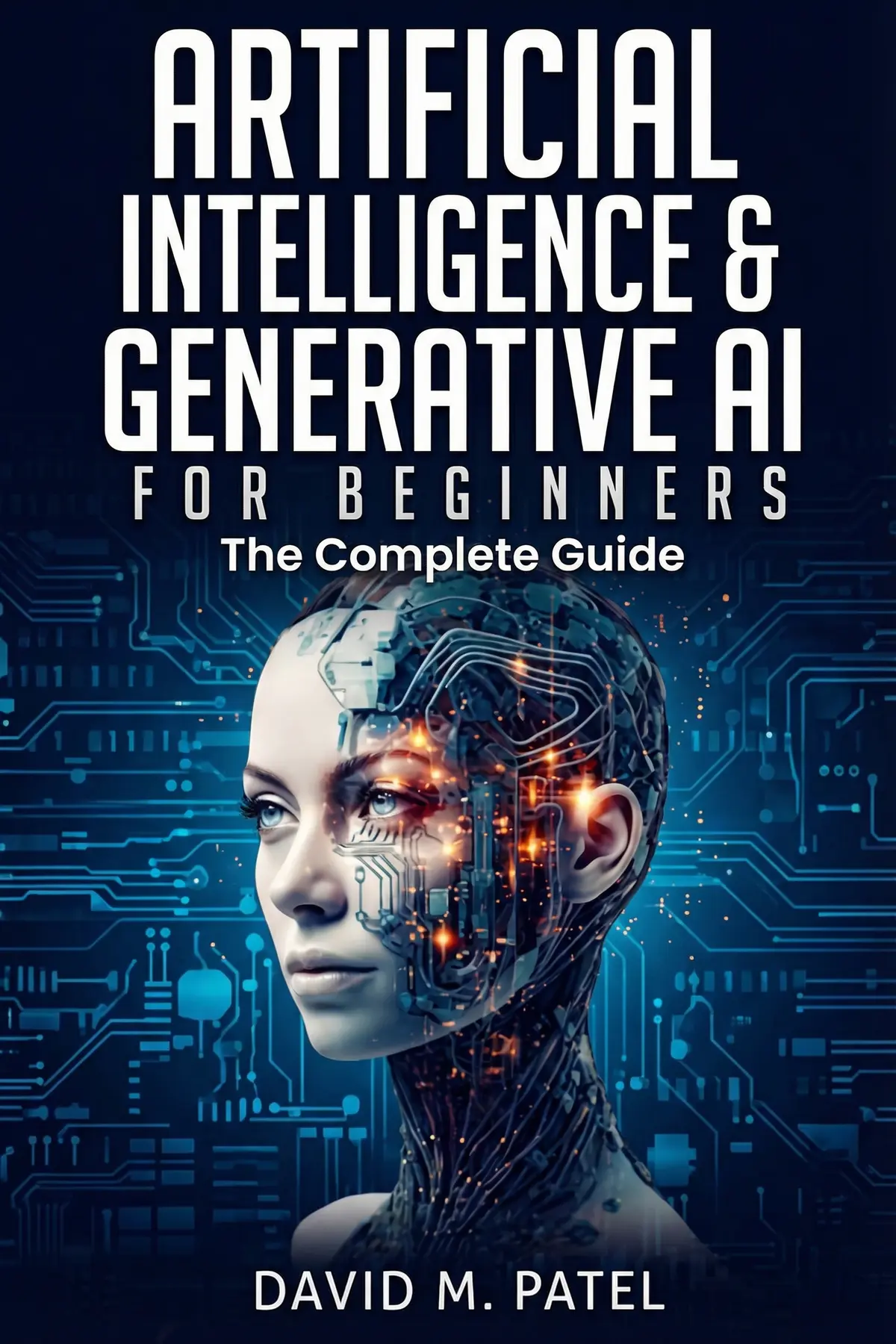
Table of Content
1. Introduction
1 min 03 sec
Most people now use AI every week without being able to say what it is, and that makes it hard to use well or to question. In Artificial Intelligence and Generative AI for Beginners, David M. Patel, who studied computer science at Cornell and worked at Google and Facebook, offers a plain starting point. An AI system is built to learn from data and then make decisions, and machine learning in particular does this from patterns rather than explicit instructions.
That single idea runs from the spam filter in your inbox to the chatbot that drafts your emails. Patel climbs from there: how machines learn, how layered networks borrow a rough version of the brain, how the same machinery began producing text and images, and how to talk to it so it helps. The top rung is judgment, knowing where these tools can do harm. By the end, you can tell a model that sorts from one that creates, write a prompt that returns something usable, and name the risks worth checking before AI touches your work.
2. Explain what AI is in plain words
1 min 57 sec
Siri, a self-driving car and a hospital diagnosis tool look like very different machines. Patel shows they share one simple design, and two questions you can ask of any product that claims to be intelligent.
3. Tell apart the three ways machines learn
1 min 55 sec
A spam filter, a Netflix suggestion and a Go-playing program all learn, but in strikingly different ways. Knowing which kind of learning sits behind a tool tells you what it can be trusted to do.
4. Learn how machines improve by fixing their errors
2 min 01 sec
A network that gets things wrong over and over can end up spotting tumors in medical scans. The trick lies in how it treats each error, and in how many layers it stacks.
5. Learn how AI that sorts differs from AI that creates
1 min 48 sec
Most of the AI covered early in the book labels things: spam or not, disease or not. Then the same pattern-finding machinery started writing poems and painting pictures, and that changed what the person using it has to do.
6. Get better answers by writing sharper prompts
1 min 50 sec
Two people can ask the same chatbot for help and get answers of very different quality. Patel traces the gap to a few habits of phrasing, and to a hidden limit on how much a model can read.
7. Weigh what AI promises against what it risks
1 min 59 sec
Patel sees AI designing medicines, buildings and video game worlds. He also flags deepfakes, biased outputs and copyright problems, and he argues the benefits depend on responsible development practices.
8. Conclusion
1 min 09 sec
Patel’s book adds up to a reassuring claim: the machines around us become far less mysterious once you see that they learn from examples. A spam filter, a Netflix suggestion, a tumor flagged in a scan and a paragraph written by GPT-4 all come from the same move, finding patterns in data and acting on them. What generative AI changed is direction. The patterns now flow outward as new text, images and sound, and the person asking has more say over what comes back.
That gives a beginner two kinds of footing. One is practical. Treat every prompt as a draft: say what you want, how long, in what tone, keep it short enough to fit the model’s window, and revise once you see the result. The other is critical. Before you trust a system with a real decision, ask what it learned from, whether that data was gathered fairly, and whether anyone can explain how it reached its answer.
Turing asked whether machines could think. For the rest of us, the more useful question is what they learned, and from whom.
About this book
What is this book about?
Artificial intelligence now sorts our email, recommends our shows and drafts our documents. Yet most people who use it could not say how it works, which makes it hard to use well or to know when to trust it. David M. Patel writes for complete beginners. He starts from the basic idea that AI systems learn from data and make decisions. Then he explains the three main kinds of machine learning, how neural networks improve by correcting their errors, and why deep learning handles images and speech. From there he shows how generative models such as GANs and transformers like GPT-4 moved from sorting information to producing new text, images and music. The practical core is prompt engineering. Clear, short, well-structured requests, a grasp of tokens and context windows, and steady revision lead to better results. Patel closes with where generative AI is heading in healthcare, entertainment, retail, architecture and cars, and with the ethical problems it raises, from privacy, consent and bias to deepfakes and copyright. Readers finish with a working vocabulary and a set of questions to ask of any AI tool.
Book Information
Who it's for
Using AI at work
Professionals who use ChatGPT or similar tools at work but cannot yet explain how they work.
Wanting AI explained plainly
Students and career switchers who want a plain vocabulary for machine learning, neural networks and generative AI.
Choosing AI tools
Team members asked to choose AI tools who need to understand privacy, bias and copyright risks.
About the Author
David M. Patel
David M. Patel writes about artificial intelligence, generative AI and ChatGPT for readers meeting these subjects for the first time, and he aims to make complex ideas clear and practical. He holds a master's degree in computer science from Cornell University and has worked at Google and Facebook. He also teaches and contributes to online courses and local education projects, and his website offers a free video course, Claude AI for Beginners, along with an AI newsletter.
Ratings & Reviews
Ratings at a glance
What people think
Listeners find this work a highly useful resource for newcomers, as the author distills intricate topics into straightforward, simplified explanations. They value the caliber of information, clarity, and readability, with one listener pointing out that it is understandable even for absolute novices. While the content is well-received, perspectives on accessibility vary; some feel it is overly elementary. Both the pacing and writing quality also draw mixed reactions.
Top reviews
Pannipa
David M. Patel has crafted an incredibly accessible entry point for anyone feeling overwhelmed by the current tech surge. Before reading this, I found the concept of neural networks completely intimidating, but the author breaks them down into digestible, human-centric metaphors. I especially appreciated the deep dive into how AI has moved from Alan Turing’s theoretical questions to the practical tools we use daily like Siri. The writing style is clear and moves at a steady clip, making it a great weekend read. It’s rare to find a book that covers both the history and the future—like prompt engineering and ethical deepfake concerns—without getting bogged down in dense jargon. If you want to understand the 'why' behind the AI revolution without needing a computer science degree, this is the guide to get.
Show moreAndrew
Ever wonder how we went from simple chatbots to AI that can generate original music and art? Patel’s book provides a comprehensive roadmap of that exact journey. I loved the focus on prompt engineering as a vital skill for the future; it turned the book from a passive history lesson into a practical manual. The chapters on reinforcement learning were a highlight for me, explaining how systems learn by interacting with their environments. It’s a very well-written piece of work that doesn’t shy away from the scary stuff either, like algorithmic bias and data privacy issues. I’ve recommended this to several colleagues who were looking for a clear, non-technical explanation of the AI landscape.
Show moreAiden
Picked this up because I felt left behind by all the talk about ChatGPT and generative tools. Patel is a master at taking complex, scary topics like 'Variational Autoencoders' and making them feel understandable. I particularly enjoyed the section on NLP and how machines are finally beginning to grasp human nuance. The book also takes a very responsible stance on ethics, which I think is important. It doesn't just celebrate the tech; it warns us about bias and the importance of human oversight. The structure is logical, the tone is encouraging, and the clarity is top-notch. I finally feel like I can participate in conversations about the future of AI with some actual confidence.
Show moreSupranee
In my experience, tech books are either too simple or far too dense, but this one hits the sweet spot. The way Patel explains the 'hidden layers' of deep learning by comparing them to the human brain’s neural networks was a lightbulb moment for me. I also found the practical tips on managing context windows in AI prompts to be immediately useful for my work. It’s a comprehensive, clear, and very readable guide. Despite what some other reviewers said about the formatting, I found the flow of information to be very logical. It’s a fantastic resource for anyone looking to leverage AI for positive change in their personal or professional life.
Show moreAnong
Finally got around to educating myself on the difference between supervised and unsupervised learning, and this book made it stick. The way Patel explains how data provides the 'experience' for AI while algorithms act as the guide is a brilliant way to frame it for beginners. I found the sections on Computer Vision and NLP particularly illuminating, as they explain the mechanics behind things we take for granted, like photo tagging. One minor gripe: the formatting is a bit hit-or-miss, as some section headers aren't bolded, making it easy to lose your place. Still, the information quality is high for a novice. It’s a solid 4-star read that demystifies a lot of the hype surrounding generative models like GPT and VAEs.
Show moreFatima
As someone who works in healthcare, I was specifically interested in how AI is reshaping my industry. Patel does a great job of highlighting real-world applications, from diagnostic assistance to drug discovery. The explanation of Convolutional Neural Networks for image recognition made sense to me in a way other articles haven't. My only complaint is the pacing; the book starts off strong but feels a little rushed toward the end when discussing the ethics of deepfakes. Look, it’s not a textbook, and it shouldn’t be treated as one. It’s a fast, informative overview for people who want to understand the jargon. Definitely worth the read for the prompt engineering tips alone.
Show moreNathan
To be fair, the first half of this guide is significantly stronger than the second half. The historical overview starting from the 1950s is well-paced and provides a necessary context for how we reached the current era of robotics and expert systems. However, once the author transitions into Generative AI, things become a bit messy. I noticed inconsistencies where 'Text-to-Text' was abbreviated as TTT in one section and T2T in the next, which is confusing for a 'beginner's guide.' It’s a bit of an obvious read if you’ve been following tech news at all lately. It works as a quick primer, but don't expect to walk away with a deep technical understanding of how these models are actually built.
Show moreBae
The journey through AI history was interesting, but the rest of the book felt like a bit of an obvious read. I appreciated the breakdown of the three main types of machine learning—supervised, unsupervised, and reinforcement—but I wish there was more 'meat' on the bones. The writing quality is okay, but it lacks a unique voice, making me wonder if generative AI was used to draft parts of it. For a total novice, this is an invaluable guide to the terminology. For anyone else, it might feel a bit like a collection of blog posts. It’s a decent introductory resource, but certainly not the 'complete' guide the title claims it to be.
Show moreEnd
Is it just me, or does this book feel like it was actually written by the very technology it’s trying to explain? I was suspicious the moment I saw weirdly specific chapter numbers like 2.3.1.2.1, which looks exactly like a nested LLM output. Truth is, the content is extremely thin and repeats itself constantly. In one paragraph, a case study refers to 'Gaming Company U,' but then switches to 'Gaming Company V' just two sentences later without any explanation. It’s frustrating because there is a decent outline of topics here, from CNNs to RNNs, but it never moves past a surface-level summary. It feels like a collection of ChatGPT responses that were barely edited before being sent to print. I’d suggest looking elsewhere if you want actual depth.
Show moreFord
Frankly, this was a disappointment. It reads more like a bloated PowerPoint presentation than a cohesive book. The author mixes high-level expert terminology with explanations that are so simplified they end up explaining nothing at all. I was looking for a real look at the mechanics of GANs and transformers, but I got a few paragraphs that felt like they were copied from a Wikipedia summary. Also, the lack of professional editing is glaring. When you see basic inconsistencies in company names and formatting errors throughout the text, it’s hard to trust the expertise of the author. It’s too general to be useful for anyone who has even a passing interest in technology.
Show moreQuestions about this book
What is the main idea of Artificial Intelligence & Generative AI for Beginners?
David M. Patel explains that AI systems learn from data and use it to make decisions, and that machine learning in particular works from patterns rather than explicit programming. He builds from that foundation through machine learning, neural networks and deep learning to generative AI, which produces new text, images and music. He then shows how to communicate with these tools through prompt engineering and closes with the ethical questions they raise, including privacy, consent, bias, deepfakes and copyright.
What are the three types of machine learning Patel describes?
Supervised learning trains on labeled examples, such as emails marked as spam or not, and then judges new cases. Unsupervised learning finds patterns without labels, as in grouping customers by behavior or Netflix suggesting shows from viewing history. Reinforcement learning learns by acting and receiving rewards or penalties, the way self-driving cars refine their driving and AlphaGo improved at Go by playing against itself.
What is the difference between discriminative and generative AI?
Discriminative models sort data into classes, for example deciding whether an email is spam or recognizing an object in a photo. Generative models learn the structure of large datasets well enough to create new content that resembles them, such as poems, images or music. Patel describes three generative families: GANs, where two networks compete, VAEs, which compress and rebuild data, and transformer models like GPT-4.
How does the book suggest writing better AI prompts?
Patel recommends short, clear and relevant prompts, with more specific detail for creative tasks like images. He explains tokens and the context window, the limit on how much text a model can consider at once, so overly long inputs can lose details. He suggests choosing the prompt type to match the goal, naming the tone, length or format you want, and revising prompts through repeated experiments.
What ethical concerns about AI does Patel raise?
He points to data privacy and consent, bias in AI-generated outputs, and the misuse of generated content such as deepfakes, which calls for transparent and accountable systems. He also flags copyright problems when models use existing creative work without proper credit, and the black box problem of not knowing how complex models reach decisions. He argues responsible development is the condition for AI’s benefits.
Readers also enjoyed







AUDIO SUMMARY AVAILABLE
Listen to Artificial Intelligence & Generative AI for Beginners in 15 minutes
Get the key ideas from Artificial Intelligence & Generative AI for Beginners by David M. Patel, plus 5,000+ more nonfiction titles.
- 5,000+ titles
- Listen as much as you want
- 7-day free trial
- Cancel anytime









