

14 min 30 sec
Available in: English
The Communication Code: Unlocking Every Relationship, One Conversation at a Time
Shows how to hear what people are really asking for in a conversation, whether celebration, care, clarity, collaboration or critique, and how to answer each request in a way that builds trust at work and at home.
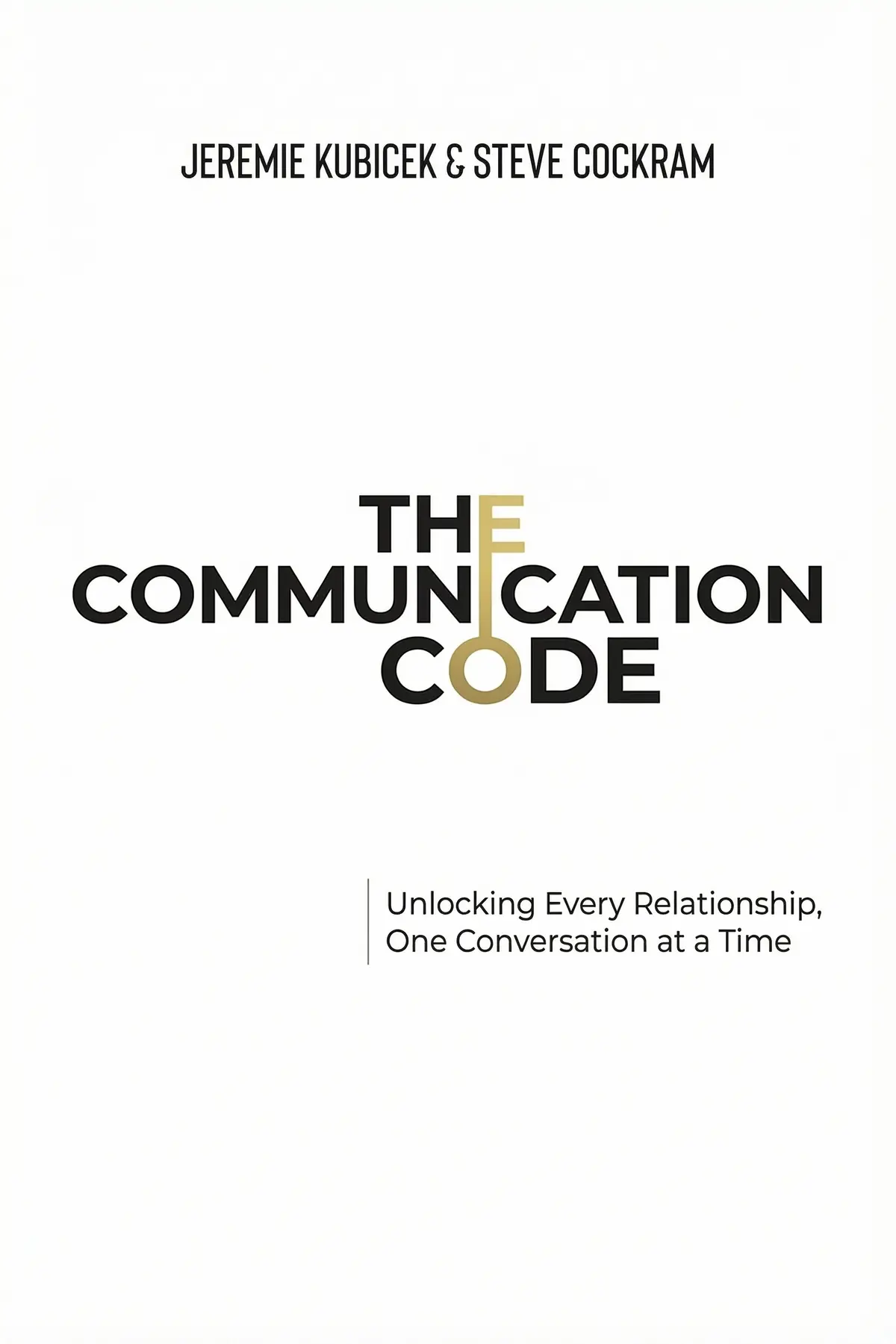
Table of Content
1. Introduction
1 min 04 sec
When a conversation leaves you tired and unheard, the cause is often simple: you answered a request the other person never made. A colleague who wanted to be listened to got a fix, or a partner who wanted a plan got sympathy. In The Communication Code, Jeremie Kubicek and Steve Cockram argue that nearly every exchange carries a hidden request, and that it usually falls into one of five kinds: celebration, care, clarity, collaboration or critique.
Their case is that you can learn to hear which one is in play, and that matching your reply to it makes talking at home and at work easier and far more productive. Before any of that works, two people need enough trust to say what they mean. The book starts there, with a husband learning to read his wife, then moves through each of the five requests. Along the way it offers a short set of habits for each one: questions to ask, words to use and mistakes to stop making.
2. Decode someone by first studying yourself
1 min 47 sec
A husband frustrated by his wife’s silence went to a coach expecting tips for reaching her. The first person he had to study was someone else entirely, and that changed how every argument ended.
3. Spot the trust and power gaps that silence people
1 min 45 sec
Some conversations are lost before the first word. Three underlying conditions shape whether people can speak to you openly, and one of them, uneven power, can quietly hold back the person with less of it.
4. Celebrate wins to keep good people engaged
1 min 42 sec
Many serious professionals see office celebrations as fluff. The authors argue the cost of skipping them builds slowly, and that the right way to mark a win depends on how each person thinks.
5. Know when someone wants comfort instead of answers
1 min 48 sec
Good advice can still be the wrong answer. Learn the phrases that signal a different need, and why the authors compare a lack of human connection to a daily smoking habit.
6. Make sure you were understood before moving on
1 min 48 sec
A treaty signed in 1840 still causes disputes because two peoples read it differently. The fixes that might have helped are small enough to use in tomorrow’s meeting.
7. Test whether your partnership is really working
1 min 50 sec
Apple’s founders split the work in a way neither could match alone. Four checks reveal whether your own partnerships are multiplying talent or slowly wearing down under strain.
8. Give feedback people can actually use
1 min 41 sec
Feedback can make people better or make them defensive, and the difference starts before you say a word. A simple sequence helps it land, whether you are giving it or hearing it.
9. Conclusion
1 min 05 sec
What Kubicek and Cockram describe is less a technique than a habit of attention. A frustrating conversation is usually two people talking past each other’s requests: one wants applause and gets analysis, another wants a listening ear and gets a plan, a third wants honest feedback and gets polite silence. Name the request, make sure trust and power allow an honest answer, and the right response is usually plain.
The practice can start small. In your next few conversations, ask yourself which of the five is being requested before you reply, and when you cannot tell, ask the other person. If someone says they need to vent, put your solutions away for now. Before you offer feedback, find out whether it is wanted, and lead with what already works. And with the person who matters most to you, begin where Mike did, by looking hard at your own habits before trying to decode anyone else’s.
Mike never learned a new language to reach Sarah. He learned to hear the one she was already speaking.
About this book
What is this book about?
Many conversations leave both people frustrated even when everyone means well. Talented teams lose time to simple misunderstandings, and couples who love each other argue more and connect less. Jeremie Kubicek and Steve Cockram trace much of this to one mistake: answering a request the other person never made. Their framework names five requests that sit underneath most exchanges. Some people want their success celebrated. Some want care and a listening ear. Some need clarity, some are asking to collaborate, and some want critique of their work. Each calls for a different response. Each also works only on a base of trust, shared expectations and an honest look at who holds power in the relationship. The book moves from a married couple learning to read each other, through the Treaty of Waitangi and the early partnership behind Apple, to step-by-step methods for clarifying, judging a collaboration and giving feedback that helps. Readers get a way to diagnose a conversation while it is happening and a concrete set of moves for each of the five requests.
Book Information
Who it's for
Managers of stalling teams
Managers whose talented teams keep stalling on misunderstandings and awkward feedback.
Families stuck arguing
Partners and parents who love each other but keep arguing past each other.
Problem solvers at work
Professionals who rush to fix problems when colleagues only want to be heard.
About the Author
Jeremie Kubicek
Jeremie Kubicek and Steve Cockram co-founded GiANT Worldwide. Kubicek wrote the bestselling Making Your Leadership Come Alive and speaks to organizations around the world on leadership, emotional intelligence and personal growth; his other books include 5 Gears and 5 Voices. Cockram has advised executive teams and organizations worldwide and is known for his work on how personalities develop, on applied leadership learning and on changing culture. He also teaches on apprenticeship and team building, and lives in London with his wife and three children.
Ratings & Reviews
Ratings at a glance

What people think
Listeners find this book life-changing for professional and personal connections, offering actionable methods for enhancing interaction skills that are simple to grasp and implement. They value its deep ideas and direct style, with one listener mentioning how it boosts relational intelligence. The work is praised for its high level of clarity and accessibility.
Top reviews
Andrei
After hearing so much about the 100X Leader series, I jumped into this one expecting standard corporate advice. What I found was something much more personal and applicable to my marriage and kids. The idea that we need to "decode" conversations based on whether someone needs care or critique is a total game-changer for my household. Most of the time, I try to solve problems when my wife just needs to vent or feel seen. By using the five code words, we've managed to avoid those stupid arguments that stem from unmet expectations. It’s a quick read, but the impact on our daily dialogue has been massive. I highly recommend it for anyone looking to build a deeper connection with their loved ones.
Show moreLeila
Honestly, the chapter on "Care" vs "Problem Solving" felt like it was written specifically for my life. I’ve always been the person who jumps straight to fixing things, and I never realized how much that can actually damage a relationship when the other person just needs to be seen. The authors describe how conversations are naturally "encrypted" with our own needs, and learning to ask for what you need—whether it’s celebration or clarity—is incredibly empowering. This isn't just a business book; it’s a manual for being a better human being. I’ve already bought three more copies for my friends and family.
Show moreAir
As someone who struggles with social anxiety, the "4 Stages" of communication mentioned here gave me a clear roadmap to follow. Moving from self-awareness to actually decoding what another person wants from me has lowered my stress levels significantly during meetings. The book is very readable and avoids the dry jargon that usually plagues these types of guides. I especially liked the focus on how criticism harms motivation when it's vague. Switching to constructive critiques has helped me become a more empathetic mentor. This is a must-read for anyone looking to boost their relational intelligence.
Show moreRotjanee
The framework presented in this book makes the messy reality of human interaction feel manageable and structured. I particularly appreciated the section on "Clarity" and the suggestion to use paraphrasing and analogies to ensure everyone is on the same page. In my experience, most project failures come down to these tiny misinterpretations that snowball over time. While some might find the "5 Cs" a bit gimmicky, they serve as an excellent mental checklist before you open your mouth. It isn't groundbreaking theory, but the practical tools for building relational trust are worth the price of admission alone. It's a solid addition to any professional development library.
Show moreHassan
Ever wonder why a simple conversation suddenly turns into a cold war? This book explains how our past interactions and "cumulative effects" dictate how we hear current messages. I love the concept of the five communication code words—especially the distinction between critique and criticism. Learning to deliver a critique from a place of humility rather than an attack has already improved my relationship with my direct reports. My only gripe is that it can be a bit repetitive at times, hitting the same points over and over. Still, it's a solid resource for any manager who wants to foster a culture of growth without crushing morale.
Show morePairot
Finally got around to finishing this, and I'm impressed by how the authors tackle the concept of relational trust. They don't just tell you to "be clear," they actually give you the probing questions and iteration steps to get there. I found the section on celebration particularly moving because we often skip the win to move on to the next task. Acknowledging milestones isn't just fluff; it's what feeds the team's need to feel valued. I'm knocking off one star because the layout is a bit cluttered and it feels a little too much like a textbook at times, but the core message is vital.
Show moreMint
To be fair, Kubicek and Cockram provide a very functional vocabulary for teams, but I found the content a bit surface-level. If you’ve read any major books on EQ or active listening, most of this will feel like a repackaged version of things you already know. The 4 stages of self-awareness to decoding are a nice progression, yet I wanted more depth on the psychological hurdles we face. The "Celebration" aspect felt a little forced to me, though I can see its value in a stale office environment. It’s a decent introductory guide, but maybe not for seasoned leaders who have already mastered the basics of empathy and feedback.
Show moreGai
Look, if you've been a fan of the GiANT worldwide ecosystem, you'll find this a comfortable addition to your library. It’s an easy read with a functional vocab cheat sheet that helps bridge the gap between intent and impact. However, I struggled with how formulaic the strategies felt in practice. Trying to actually say, "I need collaboration right now," can feel a bit robotic in real-life settings. It takes some finesse to make these codes feel natural rather than like a scripted exercise. Good for basics, but it requires a lot of personal adaptation to make it truly work in a non-corporate setting.
Show moreOlivia
Frankly, the concepts in this book are excellent, but the execution felt a little thin in places. The authors highlight that effective communication is complex because of our history with others, which is a brilliant point that I wish they had explored more deeply. Instead, the book stays focused on the five code words, which are helpful but feel a bit like a "quick fix" for much deeper issues. It’s a great starting point for teams that have zero communication strategy, but it might not satisfy those looking for a deep dive into organizational psychology. Practical? Yes. Revolutionary? Probably not.
Show morePor
Picked this up hoping for deep insights into complex communication dynamics, but it felt like a series of blog posts stretched into a book. It’s written in a very simplistic style that might appeal to some, but for me, it lacked the academic or psychological rigor I prefer. The authors act like "paraphrasing what you heard" is some brand-new secret code rather than Basic Communication 101. It’s not a bad book, just very elementary. If you are brand new to leadership or struggle with basic social cues, this is for you; otherwise, skip it. You won't find much here that isn't common sense.
Show moreQuestions about this book
What is The Communication Code about?
Jeremie Kubicek and Steve Cockram argue that most conversations carry a hidden request, and that frustration comes from answering the wrong one. They name five: celebration, care, clarity, collaboration and critique. Each needs a different response. All of them depend on trust between the two people, shared expectations about what the conversation is for, and awareness of power imbalances that can stop someone from speaking freely.
What are the five communication code words?
Celebration marks wins and gives a team identity and momentum. Care answers people who need a listener and compassion. Clarity removes confusion through questions, paraphrasing, examples and direct checks. Collaboration is an invitation to combine skills toward a shared goal. Critique is specific, work-focused feedback given with humility, which the authors set apart from criticism, which they describe as vague, personal and harmful to motivation.
How do you give good critique according to The Communication Code?
First make sure the person wants feedback. Then start with real strengths, give specific examples of what could improve and why, and speak from your own view with phrases like I feel or In my opinion. Ask for their self-assessment and goals before sharing yours, focus on next steps, and finish with encouragement and a commitment to keep talking.
How can you tell when someone needs care instead of advice?
The authors say the request is usually indirect. People say they just need to vent, or admit they know there is no solution but want someone to listen. That signals a need for compassion. Small acts answer it best: checking in, listening without judgment, taking a task off their plate, steady eye contact and leaning in while they talk.
Who should read The Communication Code?
It suits team leaders whose capable people still miscommunicate, professionals who give or receive feedback often, and couples or parents who feel they keep missing each other. The methods are short and practical: four stages for understanding one person, a check on trust and power, five ways to build clarity and a sequence for delivering critique.
Readers also enjoyed






AUDIO SUMMARY AVAILABLE
Listen to The Communication Code in 15 minutes
Get the key ideas from The Communication Code by Jeremie Kubicek, plus 5,000+ more nonfiction titles.
- 5,000+ titles
- Listen as much as you want
- 7-day free trial
- Cancel anytime









