
14 min 12 sec
Available in: English
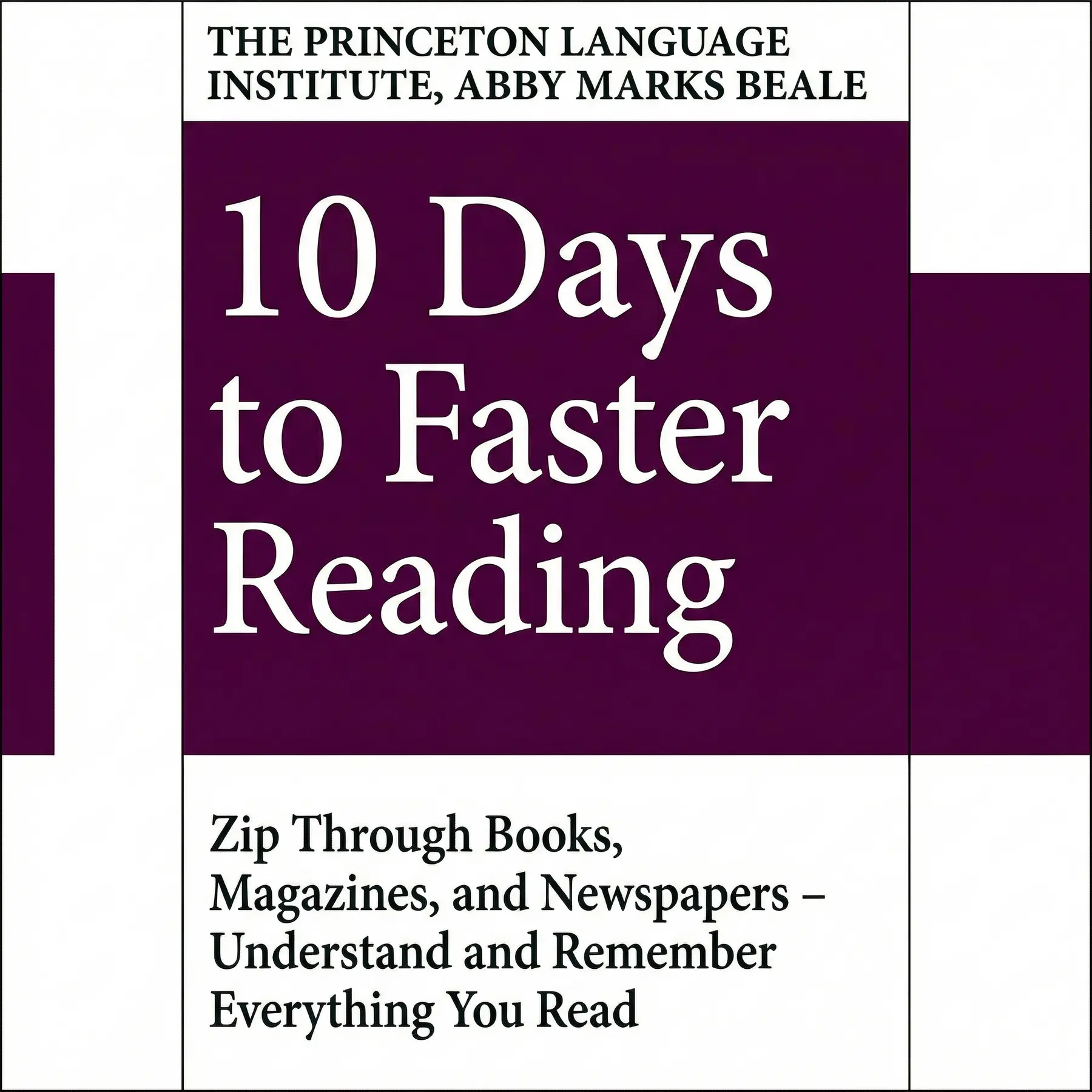
10 Days to Faster Reading: Zip Through Books, Magazines, and Newspapers – Understand and Remember Everything You Read
A practical plan for getting through more reading in less time. It shows you how to choose what to read, preview it for the main points and retrain your eyes so you still understand and keep what matters.
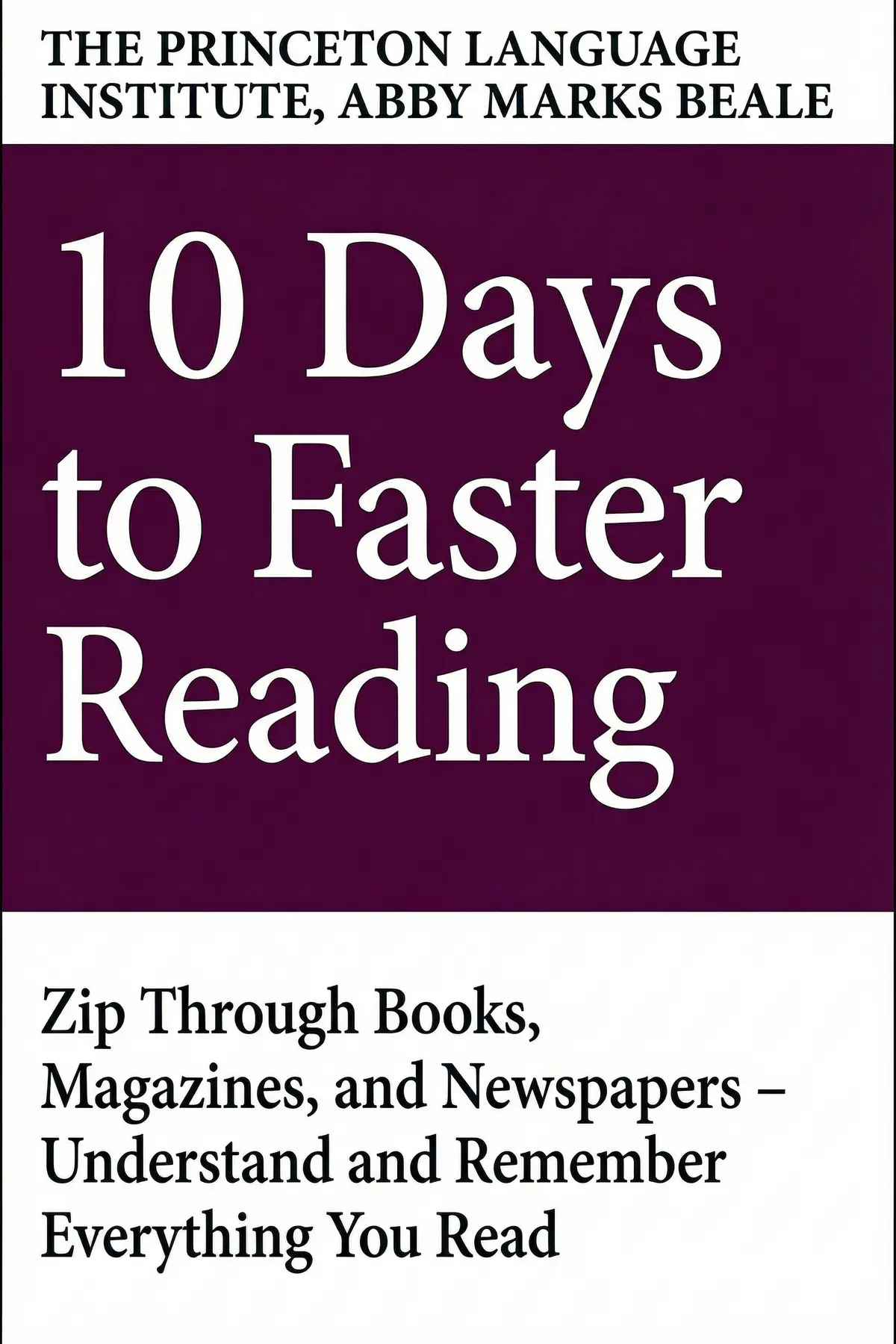
Table of Content
1. Introduction
59 sec
Most slow readers don’t really lack time. They are held back by habits picked up as children and never questioned. In 10 Days to Faster Reading, speed reading teacher Abby Marks Beale, working with the Princeton Language Institute, makes a striking claim: spend a few minutes previewing a text and you can pick up about 40 percent of its key information before properly reading it.
The book’s case is that reading speed is a set of habits, not a talent, and that most of us stopped training those habits in elementary school. Retrain them by choosing what to read, previewing it and moving your eyes in new ways. Then you can get through far more while still understanding and keeping what matters.
Ahead are the beliefs that turn reading into a burden and the three habits that quietly slow it down. After them comes a set of eye and hand techniques you can practice on tomorrow’s newspaper or the report already waiting on your desk.
2. Drop three beliefs that make reading a chore
1 min 53 sec
The pile of unread articles and books keeps growing, and most people blame the clock. Beale points instead to three common misconceptions about reading, one of them about whether reading at work counts as working at all.
3. Turn daydreams and rereading into progress
1 min 39 sec
You reach the bottom of a page and realize nothing went in. Beale names the two habits behind that moment and offers fixes so simple they fit inside a wallet.
4. Quiet the inner voice that slows you down
1 min 41 sec
Your brain can handle far more words per minute than you feed it, and the bottleneck is something most readers never notice. Beale’s fixes include one that sounds like a joke: humming.
5. Ask two questions before you read anything
1 min 38 sec
Old journals, daily homework checks, newsletters you never chose: much of what we read is unnecessary. Beale’s filter takes seconds to apply, and her rule for items that fail it is blunt.
6. A preview that hands you 40 percent
1 min 36 sec
Imagine knowing the main points of a long report before you have properly read it. Beale describes a three-move routine that does exactly this, and it also takes care of the urge to reread.
7. Train your eyes to take in whole phrases
2 min 02 sec
Your eyes jump across every line in small stops and starts. Remove just one of those stops and Beale says your speed can climb by more than ten percent. A license plate in traffic becomes a training tool.
8. A moving finger pulls your eyes forward
1 min 42 sec
Pointing at words feels like something only children do. Beale argues adults gave it up too soon, and she pairs it with a simple rule about breaks that protects every minute of practice.
9. Conclusion
1 min 02 sec
The promise of ten days can sound like a stunt, but the book’s logic is modest. Nobody is asking you to become a different kind of reader. You are asked to update a skill that stopped developing in elementary school, and to drop the school belief that good readers read everything and remember all of it.
What changes most is your relationship with the pile. It stops being a debt you owe and becomes a set of choices. Some items fail the two questions and leave. Some get a quick preview and give up their main points. A few earn a full read, done with a finger moving down the page and a card hiding the lines behind you.
Begin with tomorrow’s newspaper or the next report in your inbox. Ask why you are reading it and why you need it, and preview before you commit. Keep a short note to file instead of trying to memorize. When twenty minutes have passed, stop and rest your eyes.
Faster reading begins with deciding what you will not read.
About this book
What is this book about?
Most people who love to read, or need to for work, feel buried under a pile that grows every day. Abby Marks Beale and her co-authors at the Princeton Language Institute argue that lack of time is rarely what actually holds readers back. Most adults stopped training as readers in elementary school, and they still carry beliefs and habits from that age: reading every word, trying to remember everything, rereading lines and silently pronouncing each word. The book sets out a short program for replacing those habits. It begins with two questions that decide whether something deserves your time at all. Then comes a preview method that the authors say delivers about 40 percent of a text's key information. Last are eye and hand techniques for moving through the page faster: reading keywords and whole phrases, training peripheral vision, starting lines inside the margins and pacing with a finger. Readers get methods they can try the same day on a newspaper, a report or any nonfiction book. They also get a calmer way to handle reading, built on filing notes instead of memorizing and taking regular breaks.
Book Information
Who it's for
Professionals buried in reading
Professionals buried under reports, emails and industry news who never seem to catch up.
Students rereading and forgetting
Students who reread every line and still forget it days after the exam.
Bookworms falling behind
Book lovers whose to-read pile keeps growing faster than they can get through it.
About the Author
The Princeton Language Institute
Abby Marks Beale teaches speed reading, writes books, builds online courses and works with companies as a productivity expert. Her online course Rev It Up Reading grew out of more than 30 years of teaching thousands of people to read faster. Her other books include The Complete Idiot's Guide to Speed Reading and Success Skills: Strategies for Study and Lifelong Learning. She studied Spanish at Boston University and adult education at Southern Connecticut State University. The Princeton Language Institute is credited as her co-author.
Ratings & Reviews
Ratings at a glance
What people think
Listeners find this book effective for boosting reading pace and retention, with comprehension rates rising from 50 to 70%, and one listener noting no loss in comprehension. They also value the hands-on style, with one review emphasizing the chapter exercises, and find the techniques easy to grasp. The guide works quickly and follows through on its promises. However, the length receives mixed reviews, with one listener noting the chapters are short.
Top reviews
Chiw
I was skeptical, but this actually works. I went from a sluggish pace to finishing non-fiction books in nearly half the time. What really surprised me was that my comprehension actually improved—I’m retaining about 70% of what I read now compared to the 50% I was hitting before. The techniques for quietening that 'inner voice' (subvocalization) were the most helpful part for me. It’s well-organized and the chapters are short enough that you don't feel overwhelmed. If you're a student or someone who has to plow through a mountain of emails every morning, just buy it. It’s a solid investment in your own efficiency.
Show moreTalia
Five stars because it delivers exactly what the title says. It’s a 10-day program, and if you follow the schedule, you will see results. I felt like the writing style was very encouraging, even when the concepts (like using your peripheral vision to see blocks of text) were a bit tricky to master at first. The focus on comprehension is what sets this apart from other speed-reading 'hacks' I've seen online. It’s not just about moving your eyes faster; it’s about training your brain to absorb information more aggressively. Highly recommended for anyone overwhelmed by information overload.
Show moreBua
This book is a lifesaver for grad school! The chapter exercises are short and punchy, and they actually show you your progress in real-time. I went from being a 'word-by-word' reader to being able to scan whole paragraphs for the main idea without losing the plot. It’s very easy to understand, and Abby Marks Beale has a way of making the technical stuff feel accessible. I don't care how cheesy the car metaphor is—it works for the structure. If you feel like you're drowning in textbooks, this is the life raft you need. Fast, effective, and worth every penny.
Show moreNit
I honestly didn't think I'd get much out of this, but the exercises at the end of each chapter really kept me grounded. The whole 'racecar' metaphor is spread a bit thick—we get it, fast cars go zoom—but if you can look past the cheesy terminology like 'pit-stops' and 'engine overhauls,' there’s actual substance here. I personally found that using a pacer (like my finger or a pen) was a game-changer for my focus. My comprehension didn't just stay the same; it actually felt sharper because I wasn't letting my mind wander off every two sentences. It’s a slim book, which is ironic since it’s about reading faster, but it delivers on its promise if you actually do the work.
Show morePop
Practical and straight to the point. I loved that the book itself is printed in a larger font and is relatively short, making it easy to practice the techniques on the book itself. The previewing and scanning methods have saved me a ton of time at work. I used to feel guilty for skipping paragraphs, but this book gave me the 'permission' to only focus on the keywords and the meat of the content. It’s not perfect—some of the drills felt repetitive—but for the price of a lunch, I definitely got my money's worth in saved time.
Show moreKwame
A very solid manual for anyone looking to optimize their study habits. The Princeton Language Institute branding made me think it would be a dry, academic slog, but it’s actually quite casual and easy to digest. I particularly appreciated the section on 'previewing' text before diving in. It feels like a small thing, but it sets a mental framework that makes the actual reading much faster. I did find some of the 'props' a bit much—I’m not going to carry an index card around with me everywhere—but the core principles are sound. A good, practical tool for the modern age.
Show moreYuki
I applied the techniques from this book to the book itself, and it was a breeze to get through. It’s a very meta experience. While I don't think I'll ever be a 'super-speed' reader, I’ve definitely doubled my comfort level with skimming non-fiction. The advice to avoid subvocalizing is hard to follow, but even getting halfway there has helped me pick up the pace. My only gripe is that it feels very geared toward people who don't like reading. As someone who loves the prose in a good book, some of these methods felt a bit clinical. But for business or learning, it's excellent.
Show moreKavya
This book is a bit of a mixed bag for me. On one hand, the Princeton Language Institute clearly knows the mechanics of how we process text, and I did see a bump in my words-per-minute after practicing the peripheral vision drills. On the other hand, it feels very 'old school' with all the physical props like index cards and highlighters. I’m mostly reading on a Kindle these days, so those tips felt a little dated. Also, I’m not sure I agree that skimming is 'reading.' It felt more like a strategy to avoid reading, which might be fine for a boring business report but feels like a waste for a good novel. Still, it’s a quick 200-page read.
Show moreGiulia
I’ve been trying to get through my 'to-read' pile for years, so I picked this up hoping for a miracle. It’s okay, I guess. It basically teaches you that you don't have to read every single word, which felt like a 'duh' moment for me. The author relies way too heavily on car metaphors, which started to get on my nerves by chapter three. I found the 'pacer' technique with a pen incredibly distracting; it honestly made me feel like I was back in grade school. It’s probably great for people who really struggle with reading or hate it, but for a regular reader, it’s mostly just common sense packaged in a fancy way.
Show moreDylan
It is deeply ironic that a book about faster reading was one of the few books I’ve actually struggled to finish lately. I found the constant car analogies—road maps, stick-shifts, whatever—to be incredibly patronizing and tired. The 'tricks' are mostly things you’ve already heard: don't let your mind wander, look for keywords, use a finger to guide your eyes. It felt like a lot of fluff for very little payoff. I tried the pacer method and it just gave me a headache. Honestly, just google 'how to speed read' and save yourself the time and money. This was not for me.
Show moreQuestions about this book
What is the main idea of 10 Days to Faster Reading?
Abby Marks Beale and her co-authors at the Princeton Language Institute argue that slow reading comes from outdated elementary school habits, not from a lack of time or ability. They suggest dropping the belief that you must read and remember everything, choosing material with a clear purpose, previewing it, and retraining your eyes with keywords, thought groups and a pacing finger, so you read faster while still understanding.
What is subvocalization and how do you stop it?
Subvocalization means silently pronouncing words as you read. The book says the brain is able to handle as many as 400 words a minute, yet reading at the pace of speech holds most people to around 150. To reduce it, Beale suggests reading only the keywords, mumbling, humming or chewing gum while reading, or aiming your eyes at the white space just above each line.
How do you preview a book or article to read it faster?
Beale’s preview has three moves. Read the first few introductory paragraphs, then the titles, subtitles and subheadings, and finally the first sentence of each paragraph. She says this gives you about 40 percent of the key information, shows you which parts matter to you and reduces the need to reread later, because you already understand the structure.
How can I remember what I read without memorizing it?
The book says memorized material sits in short-term memory and fades within days. Instead, build a simple retrieval system: write down the key points on paper or electronically, or highlight and make margin notes, then file the material where you can find it. This removes the pressure to memorize while keeping the information available when you need it.
How long should I read before taking a break?
Beale cites research showing that people can concentrate effectively while reading for only about 20 minutes at a time. Her advice is to pause for five minutes after every 20 to 30 minutes of reading, giving your brain and eyes a chance to rest. This matters especially while practicing new techniques, since eye strain is common as your eyes adjust to a new rhythm.
Featured in
Readers also enjoyed

AUDIO SUMMARY AVAILABLE
Listen to 10 Days to Faster Reading in 15 minutes
Get the key ideas from 10 Days to Faster Reading by The Princeton Language Institute, plus 5,000+ more nonfiction titles.
- 5,000+ titles
- Listen as much as you want
- 7-day free trial
- Cancel anytime









