

13 min 51 sec
Available in: English
Younger Next Year: Live Strong, Fit, Sexy, and Smart – Until You’re 80 and Beyond
Shows why much of the decline we blame on age really comes from inactivity. Its seven rules on exercise, food, money, self-care and friendship are a plan for staying strong into your eighties.
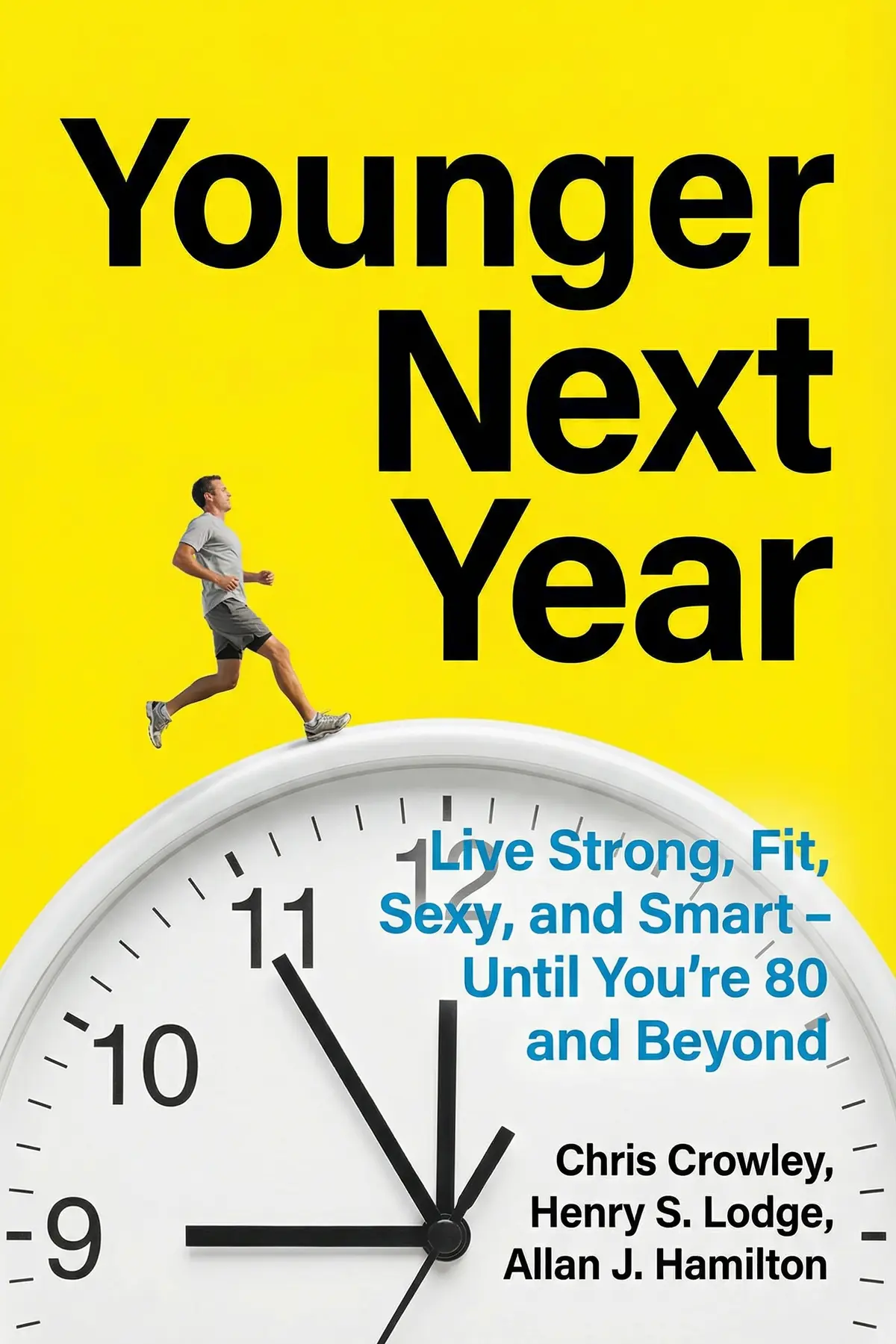
Table of Content
1. Introduction
59 sec
Most people expect their seventies to bring a wobbly, frail, softening body, and they treat that decline as normal. In Younger Next Year, former Wall Street litigator Chris Crowley and internist Henry S. Lodge argue that it is not. Lodge says the body is designed to age slowly, and that much of the fast decay we see comes from sitting still. Neurosurgeon Allan J. Hamilton later expanded the book with chapters on exercise and the brain.
The authors turn that claim into seven rules, and one case runs through all of them. How fast you age depends far more on daily choices than on birthdays: move almost every day, eat real food, live within your means, track yourself honestly and keep people close.
By the end you will know what a week of training looks like at sixty or seventy and which foods to drop first. You will also see why a notebook and a picnic belong in the same plan as a treadmill.
2. Slow down aging by moving six days a week
1 min 41 sec
The frail grandparent with a walking stick feels like a picture of nature taking its course. One doctor insists it is nothing of the kind, and his remedy asks for more than most people expect.
3. Build endurance in three gentle stages
1 min 48 sec
Starting cardio after years on the couch can feel like an all or nothing choice. The authors offer a ladder instead, with one simple test that tells you whether you are pushing too hard.
4. Lift weights to ease aching joints
1 min 41 sec
Plenty of people will walk a treadmill for an hour to avoid one set of dumbbells. The authors claim that skipping weights costs far more than it saves, and the evidence concerns pain as much as muscle.
5. Fill your plate with food that keeps you young
1 min 44 sec
The foods to cut are the ones on most dinner tables, and that can feel like losing everything. A Harvard nutrition pyramid shows how much is left once they are gone.
6. Keep an honest log that keeps you going
1 min 39 sec
Retirement removes the alarm clock, the commute and the deadlines, and with them much of the reason to try. A plain notebook can put that reason back, as long as you never lie to it.
7. Make your money last as long as you do
1 min 35 sec
Getting healthier creates a problem few fitness books mention: more years to pay for. The authors offer a deliberately pessimistic way to set a retirement budget, and a change of mindset to live within it.
8. Stay connected and add years to your life
1 min 33 sec
Turning down invitations feels like a harmless retirement habit. The studies the authors gather, from heart attack survivors to a grim finding from 1915, suggest it may be one of the riskiest choices of all.
9. Conclusion
1 min 11 sec
What Crowley and Lodge offer is a different picture of the later decades. The porch chair is not destiny. A body built to age slowly, they argue, falls apart early mainly when it is left idle, fed on starch, starved of purpose and cut off from people. Each of the seven rules removes one of those accelerants.
The starting point is the one the book insists on: begin. Book the gym or the class as you would a work shift, and walk for 20 or 30 minutes at a pace where you can still talk. Add two weight sessions with a trainer, with rest days between them. Open a notebook tonight and write down, honestly, what you ate and whether you moved. Then say yes to the next invitation.
The authors end with one more piece of practical caution. Doctors make mistakes too, and some prescriptions can dull your thinking or slow your reactions. Before taking a new medicine, check it with your pharmacist. Pharmacists usually know drugs better and have tools to spot harmful effects.
Seventy does not have to be the year you get wobblier. It can be the year you keep up with serious riders on a bike.
About this book
What is this book about?
Most people expect their later decades to bring a frail, wobbly, softening body, and they accept that as the normal price of getting older. Younger Next Year challenges that picture. Internist Henry S. Lodge argues that the body is built to age slowly, and that most of the rapid decay we see comes from sitting still and not caring. With former Wall Street litigator Chris Crowley, Lodge turns that idea into seven rules. Three cover exercise: work out six days a week, give four of them to aerobic training and two to strength training with weights. The others cover the rest of a long life. Eat from the bottom of a nutrition pyramid designed at Harvard. Spend less than you earn so the extra years are not full of money worries. Keep an honest daily log. And build friendships and community ties that, according to the studies the authors cite, help people survive illness. Readers get a concrete weekly plan, with heart-rate levels, rest days and starting doses. They also get a budgeting method for retirement and a clear reason to say yes to the next invitation.
Book Information
Who it's for
Afraid of growing frail
People in their fifties and sixties who fear a frail old age and want a concrete weekly plan.
Office workers near retirement
Desk workers nearing retirement who have not exercised in years and do not know where to start.
Retirees with fewer friends
Retirees whose days and friendships have quietly shrunk since they stopped working.
About the Author
Chris Crowley
Chris Crowley spent twenty-five years as a litigation partner at the Wall Street firm Davis Polk and Wardwell. He left the law early to live more than one life, and he has written a legal thriller and pieces for the New Yorker. Henry S. Lodge, known as Harry, was an internist who wrote about health until he died in 2017. Their book sold more than two million copies in twenty-three languages. For the 15th anniversary edition, Tucson neurosurgeon and University of Arizona professor Allan J. Hamilton added two chapters on exercise and brain health.
Ratings & Reviews
Ratings at a glance

What people think
Listeners find this book a straightforward and captivating listen, especially for those over 50, and they value the useful health guidance it offers. The material is strongly motivating and drives people to better their workout habits, with one listener remarking that it delivers methods for keeping fit and feeling young at any age. Listeners also speak highly of the writing quality and find the layout logical, while appreciating the core message of staying physically active throughout one’s life.
Top reviews
Sau
Finally got around to reading this after seeing it on my father's nightstand for years, and I regret waiting so long. The central metaphor of the 'cliff' versus the 'slow slide' into old age is incredibly powerful and shifted my entire perspective on aging. Instead of accepting a dwindling quality of life, Crowley and Lodge argue we can stay vibrant until the very end. The advice isn't revolutionary—it's essentially 'move more and eat less junk'—but the way they frame the biology makes it feel mandatory rather than optional. I particularly appreciated the emphasis on intense exercise six days a week, which sounds daunting until you read their reasoning. It's not just about vanity; it's about signaling to your cells that you aren't ready to decay yet. This book is a loud, necessary wake-up call for anyone over forty who has started to feel a bit 'creaky' and assumed it was just part of the process.
Show moreAmelia
This book is a game-changer for anyone who thinks their best years are behind them. I was drifting toward a sedentary lifestyle, watching the scale creep up and my social circle shrink, but the 'Harry’s Rules' section snapped me out of it. The discussion on the limbic system and the necessity of social connectivity was a revelation; it turns out that being part of a community is just as vital as hitting the gym. I’ve lost fifteen pounds since I started following the plan, and more importantly, I feel mentally sharper than I did a decade ago. Truth is, we all know we should exercise, but Lodge explains the 'why' in a way that makes you feel like you're fighting for your life every time you get on the treadmill. It’s a compelling, high-energy guide that treats aging as a challenge to be conquered rather than a sentence to be served. Essential reading for every baby boomer.
Show moreWissanu
The chapter on the limbic system and the 'biology of connection' makes this book worth its weight in gold. Most health books focus entirely on the physical, but Crowley and Lodge understand that humans are social animals who wither away in isolation. They argue that volunteering, deepening friendships, and staying involved in the world are biological imperatives for longevity. I’ve started volunteering at a local community garden as a result, and the mental health benefits have been just as significant as the physical ones. Look, the exercise routine they propose is grueling—six days a week is no joke—but the logic is sound. They don't promise an easy fix or a magic pill, just a rigorous path toward a functional, pain-free old age. It’s a refreshing change from the typical 'lose weight fast' nonsense that clutters the self-help shelves. This is about building a life worth living for the long haul.
Show moreGame
Wow, this really lit a fire under me. I first read this years ago and it completely transformed how I view my future. I went from being a 'weekend warrior' who was constantly injured to someone who treats exercise as a daily job, and the results have been life-altering. No more back pain, no more afternoon crashes, and I have more stamina now than I did in my forties. The authors are incredible cheerleaders who make you feel like you're part of a secret club of people who have found the fountain of youth. It’s not about avoiding death—we all know that’s coming—it’s about avoiding the 'dwindle.' They teach you how to live at 100% capacity until the very end. The writing is punchy, the evidence is sobering, and the plan is foolproof if you actually follow it. I’ve handed out dozens of copies to friends. This is the manual for aging that they should give everyone on their fiftieth birthday.
Show moreHarper
As a man approaching sixty, I found the core message here to be both terrifying and deeply motivating. The authors split the duties well: Dr. Lodge provides the heavy scientific lifting while Crowley adds a layer of relatable, if occasionally boisterous, humor. Some might find the writing a bit inflated or repetitive, as the same points about aerobic and strength training are hammered home repeatedly across 300-plus pages. However, that repetition might be exactly what a stubborn retiree needs to actually change their habits. I've started the recommended six-day-a-week routine, and while the 'blood, sweat, and tears' are real, the increase in my energy levels is undeniable. It is a bit annoying that there is a separate 'pink' version for women when the biological advice is 95% identical, but the content itself is solid gold. If you can move past the slightly dated tone, the roadmap to a healthier retirement is all right here.
Show moreNan
Picked this up on a whim after my doctor mentioned my rising blood pressure, and I’m glad I did. The structure is simple: four days of aerobic work and two days of heavy lifting. It sounds like a lot for someone my age, but the authors make a convincing case that our bodies are hardwired to either grow or decay based on the signals we send them. My only real gripe is the organization; the book jumps back and forth between the doctor’s clinical explanations and Crowley’s personal stories, which can be jarring. Also, some of the specific heart rate charts could have been clearer. Despite the padding, the emotional core of the book—the idea of staying 'young' by refusing to give up on physical vitality—is incredibly infectious. I’ve already bought a copy for my brother-in-law who thinks golf is enough exercise. Spoiler alert: it’s definitely not.
Show moreNathan
Not what I expected, but exactly what I needed. I thought this would be a dry medical text, but it’s actually quite entertaining and approachable. The authors don't pull any punches when it comes to 'lifestyle' diseases; they flatly state that most of the suffering we associate with old age is optional. That’s a bold claim, but they back it up with enough evolutionary biology to make you think twice about skipping your next workout. I do think the book is a bit overly focused on men, and the existence of a separate women's version feels like a bit of a cash grab. However, the universal truth of their 'Rules'—especially about eating less junk—is something everyone needs to hear. It’s a bit overwritten in places, and some of the jokes feel a little dated, but the enthusiasm is so genuine that you can’t help but feel inspired. I’m already planning my first 5k race in twenty years.
Show moreMontri
After hearing my doctor nag me about my sedentary habits for the tenth time, I finally picked this up. It’s a compelling read that manages to make the boring reality of 'diet and exercise' feel like an exciting new project. The focus on 'Harry’s Rules' provides a clear, no-nonsense framework that removes the guesswork from staying fit. I appreciated the honesty about the fact that sometimes bad luck like cancer happens regardless of your lifestyle, but that being fit gives you the best chance to fight back. The book is definitely aimed at the retirement crowd, but the advice would benefit anyone over thirty. It’s a bit wordy, and I could have done with fewer stories about Crowley’s skiing trips, but the underlying message is vital. It’s never too late to start signaling your body to grow instead of decay. If you want to avoid a future of metabolic disease and loss of mobility, start here.
Show moreWararat
Ever wonder if a book could have been a pamphlet? That’s how I felt about this one, despite agreeing with almost everything the authors had to say. The advice is pure common sense: work out a lot, stop eating processed garbage, and make some friends. Do we really need hundreds of pages to explain that? While the scientific evidence regarding cell regeneration is interesting, the narrative is weighed down by Chris Crowley’s endless anecdotes and 'guy-talk' jokes that often miss the mark. To be fair, the motivation factor is high, and the book successfully drives home the importance of strength training for older adults, which is often overlooked. But the constant repetition felt like they were trying to fill space. It's a decent motivational tool if you need a kick in the pants, but don't expect any 'secret' tricks to longevity. It’s just hard work and vegetables, wrapped in a lot of extra chatter.
Show moreMaria
To be fair, the science provided by the doctor is actually quite fascinating, but the other author is just too much. Chris Crowley tries to make every point through long-winded anecdotes and 'good old boy' jokes that really dragged the experience down for me. I found myself skipping large chunks of his chapters just to get back to the actual medical advice. The book is also incredibly repetitive; they say the same three things over and over again for 350 pages. I understand they want to drive the point home for people who are resistant to exercise, but it felt like a waste of my time. The core message—exercise six days a week and eat well—is something I could have found on a single blog post. It's too inflated, too gender-coded, and honestly, a bit out of date. If you want the science, just read the doctor's sections and ignore the rest.
Show moreQuestions about this book
What is the main idea of Younger Next Year?
Chris Crowley and Henry S. Lodge argue that the body is built to age slowly and that much of the decline we accept as normal comes from inactivity. They offer seven rules: exercise six days a week, four of them aerobic and two with weights, spend less than you earn, eat healthy food, care about your well-being and build relationships. Together, they say, these can keep you strong into your eighties.
How much exercise does Younger Next Year recommend?
Six days a week, treated like a job. Four days are aerobic, starting with 20 to 30 minutes at 60 to 65 percent of your maximum heart rate, slow enough to keep talking. Later you can add high-endurance work at 70 to 85 percent and, optionally, short anaerobic bursts. Two days are strength training with weights, never more than three, because strength cells need 48 hours to recover.
What foods does Younger Next Year say to avoid?
The authors follow a pyramid by Harvard’s Dr. Walter C. Willett. They advise cutting the foods found at its top, namely white rice, white bread, potatoes, pasta, sweets, butter and red meat. Starch, they say, is addictive and high in calories, while saturated fat raises the risk of Alzheimer’s disease, heart disease and stroke. Instead, eat whole grains at most meals and nine servings of fruit and vegetables a day.
How do I apply Younger Next Year if I have never exercised?
Start with the doctor’s approval, then book exercise like work shifts, ideally at a gym or a class. Walk or cycle 20 to 30 minutes at a conversational pace and build up gradually. Hire a trainer for your first weight sessions, using light weights and many repetitions. Keep a daily notebook of food and exercise, honestly recorded, so skipped days are visible.
Why does Younger Next Year include money and friendship?
Living longer only helps if those years are not spent anxious or alone. The authors suggest estimating retirement income, cutting it for inflation and then by another 5 percent, and living below that figure. On friendship, they cite studies showing that heart attack survivors with close friends fare better and that women with metastatic breast cancer in support groups live twice as long.
Readers also enjoyed


Ali: A Life
Jonathan Eig



An American Sickness: How Health Became Big Business and How You Can Take
Elisabeth Rosenthal



AUDIO SUMMARY AVAILABLE
Listen to Younger Next Year in 15 minutes
Get the key ideas from Younger Next Year by Chris Crowley, plus 5,000+ more nonfiction titles.
- 5,000+ titles
- Listen as much as you want
- 7-day free trial
- Cancel anytime









