

15 min 33 sec
Available in: English
WTF?: What's the Future and Why It's Up to Us
By Tim O’Reilly
Explains the two forces behind modern technology, open platforms and the algorithms that run them, why they misbehave in news, finance and work, and how people can steer them toward human goals.
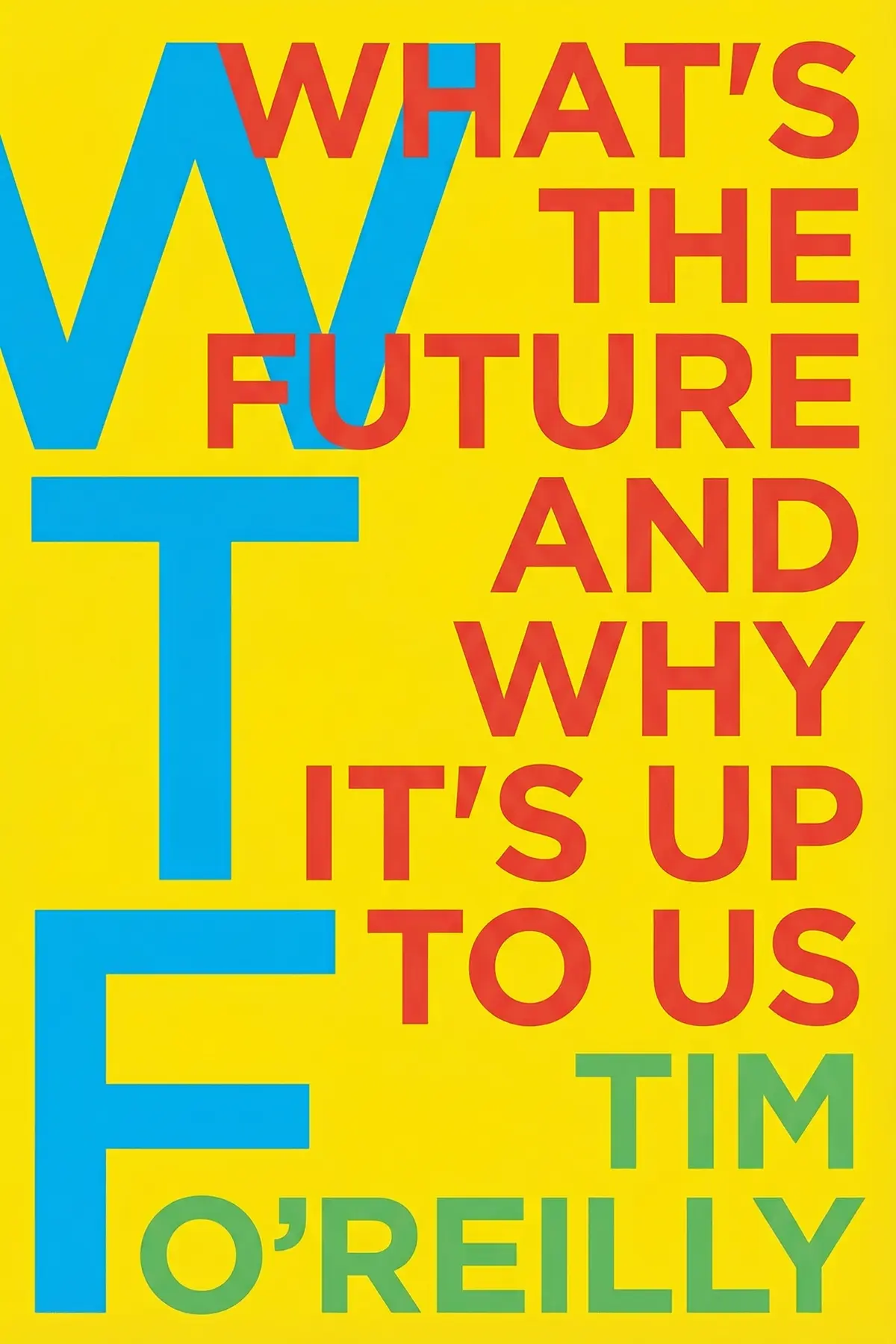
Table of Content
1. Introduction
1 min 00 sec
New technology tends to arrive as a mix of wonder and dread, and most of us stop at the reaction. In WTF?, Tim O’Reilly, whose company O’Reilly Media has taught a generation of start-up founders, argues that two forces sit underneath nearly every new gadget and service: open digital platforms and the algorithms that run them. Neither is good or bad by nature. An algorithm is closer to a genie, granting exactly the wish it was given, consequences included.
That idea is the thread through the whole book. The outcome depends on the goals people program into technology and on whether we work with it or fight it. O’Reilly moves from how platforms and algorithms work, to where they have already gone wrong, to what workers, regulators and builders can do about it. Expect a simple test for any system you build or buy: what wish was it given?
2. See the two engines behind every app you use
1 min 57 sec
The free, shared model that grew up around Linux ended up shaping how Uber and Amazon work. Understanding that strange lineage explains most of what the products on your phone do, and where they can go wrong.
3. Small teams and small government that deliver big
1 min 53 sec
Most governments work like a machine where you can press a button but never choose which buttons exist. An idea borrowed from Amazon and the App Store suggests a very different way to serve citizens.
4. Treat every algorithm like a wish-granting genie
1 min 50 sec
Search engines improve themselves through a digital version of natural selection, yet they still need someone standing over them. An old Arabian legend explains why obedient machines can cause so much trouble.
5. Understand how your news feed and the stock market misbehave
2 min 14 sec
Rogue machines are supposed to belong in science fiction films. O’Reilly finds two of them already at work, one deciding what you read and one deciding what your savings are worth.
6. What automation is really doing to your job
1 min 45 sec
Machines are taking some jobs, but the bigger shift may be harder to see. A new kind of work sits between a steady salary and freelancing, and it comes with freedom and a hidden cost.
7. Work alongside the machine instead of fearing it
1 min 53 sec
Two centuries ago, English weavers smashed the machines that threatened their craft, and they were right to be afraid. What happened next suggests a better response to today’s automation than resistance.
8. Build technology with goals bigger than profit
1 min 53 sec
A lawsuit over scanned library books showed how badly old rules fit new tools. O’Reilly’s answer reaches past regulation to a harder question about why anyone builds technology in the first place.
9. Conclusion
1 min 08 sec
WTF? begins with the gasp most of us feel at a new gadget and ends by turning that gasp into a responsibility. O’Reilly’s picture holds steady from start to finish. Platforms grow when people are free to share. Algorithms obey the wish they are given, whether that wish is traffic, clicks or short-term profit. The damage he describes, from filter bubbles to market crashes to insecure gig work, comes from the wishes, and wishes can be rewritten.
Standing in the way of change gets nowhere, he argues, any more than smashing looms did. When you set a target for a system or a team, read it the way a genie would and look for the harm it might grant by accident. When your feed agrees with you too neatly, go looking for the other side. And watch the edges of technology for patterns, the way open-source software became the template for platforms, because whoever sees the future early gets to give it decent goals.
The genie will keep granting wishes. The work is in choosing what to ask for.
About this book
What is this book about?
Every new gadget and service seems to arrive with equal parts amazement and alarm. Tim O'Reilly argues that two forces sit under almost all of it: digital platforms that grew out of open-source software, and the algorithms that run those platforms. Neither is good or bad on its own. An algorithm behaves like the genie of Arabian legend, granting exactly the wish it is given and ignoring the side effects. From that starting point O'Reilly works outward. He shows how the platform model shapes Amazon's two-pizza teams and could reshape government, how algorithms built to chase traffic and short-term profit produced filter bubbles, fake news and an unstable stock market, and how automation is both cutting jobs and creating insecure gig work like driving for Uber. His answer is neither panic nor blind optimism. Readers get a historical view of job loss from the Luddites onward, a case for augmenting workers with tools instead of replacing them, a call for rules that update as technology changes, and a challenge to build technology with goals bigger than money.
Book Information
Who it's for
Workers worried about automation
Professionals uneasy about automation who want a calm, historical view of what it means for their jobs.
Platform and product builders
Founders and product builders deciding what goals their platforms and algorithms should serve.
Civil servants and managers
Managers and public servants curious how small teams and platform thinking could change their organizations.
About the Author
Tim O’Reilly
Tim O'Reilly, born in Cork, Ireland, founded O'Reilly Media, which publishes books, runs conferences and offers online learning. He has often convened conversations across the industry. In 1993 he started the first commercial website on the internet to carry advertising, and in 1998 he organized the meeting that chose the name open source software. He later ran the Web 2.0 Summit in 2004 and the Gov 2.0 Summit in 2009, which focused on modernizing government technology.
Ratings & Reviews
Ratings at a glance
What people think
Listeners find the book to be insightful, with one listener mentioning it offers a personal perspective on tech industry developments, while another characterizes it as a guidebook for our collective future. Furthermore, the writing earns praise for being accessible, containing engaging stories, and maintaining an optimistic spirit. Conversely, the pacing draws a mixed response; one listener feels the style is too boastful, and another finds the content overly idealistic. Finally, the author receives varied critiques, though one listener values their skill in providing competent documentation.
Top reviews
Sudarat
Finally got around to reading this exploration of our digital trajectory, and I found it to be an incredibly necessary manual for the modern era. O’Reilly’s deep roots in the industry provide a perspective you just can’t get from younger analysts who didn't witness the birth of open source. The narrative flow throughout the book is remarkably accessible, blending personal anecdotes with high-level economic theory about how we prioritize shareholder value over societal health. I particularly appreciated the discussion on how algorithms are essentially the new laws of our land. While some might find the historical sections a bit dense, they provide the essential context needed to understand why the 'WTF?' moment is happening now. It’s a hopeful book that doesn’t shy away from the darker realities of our current tech-driven world. Truly, this is a must-read for anyone trying to navigate the next decade of innovation without losing their soul.
Show moreMuk
This isn't just another dry tech business book; it's a call to action for everyone to start working on things that actually matter. O’Reilly argues passionately that we shouldn't use technology to replace people, but rather to give them 'superpowers' to solve the world’s biggest problems. His optimism is infectious, even when he’s describing the potential pitfalls of automation and artificial intelligence. I particularly liked the examples of how user-driven innovation, like hashtags on Twitter, can eventually become core parts of the platform. It’s a book that makes you want to go out and build something meaningful instead of just another app for delivering laundry. The writing is clear and the stories are genuinely engaging, providing a front-row seat to the tech revolution. If you're feeling cynical about the future of the internet, this might be the antidote you need.
Show moreSarawut
What struck me most was the author’s unique perspective on how we've arrived at our current digital crossroads through decades of incremental shifts. This isn't just a memoir; it's an awareness manual that highlights how we've let the financial system stop serving the real economy. O’Reilly’s focus on sharing knowledge instead of hoarding it is a refreshing take in an age of walled gardens and proprietary data. The level of detail here is impressive, likely thanks to a very thorough research staff or a lifetime of meticulous note-taking. While it’s quite a long read at over 400 pages, the chapters are structured well enough that you can jump around to topics that interest you most. It serves as a vital reminder that technology is a tool we choose how to use, not an inevitable force of nature. This is essential reading.
Show moreDome
Wow, what a comprehensive look at how technology is rewriting the rules of our economy and our lives. O'Reilly provides a masterful synthesis of tech history, economic theory, and social commentary that feels both urgent and grounded in reality. The way he connects the dots between the early days of Unix and the current state of on-demand services like Airbnb is nothing short of brilliant. I found the sections on just-in-time learning and the changing nature of education to be particularly inspiring for the next generation. While the book is certainly a tome, the quality of the insights makes every page worth the effort. It challenges you to think about the fitness function of your own life and career in a way few other business books do. This is a rare 5-star book that I’ll be recommending for a long time.
Show moreYam
Ever wonder why certain tech companies feel so predatory despite their slick interfaces? O’Reilly dives deep into the 'fitness functions' of big tech, showing how the metrics we choose ultimately shape the world we live in. I was fascinated by the breakdown of how Google and Facebook optimize for engagement at the cost of truth. However, I did find his glowing descriptions of Jeff Bezos a bit hard to stomach at times, given what we know about warehouse conditions. To be fair, he balances this by critiquing the wider system of venture-backed capitalism that prioritizes quick exits over sustainable growth. The writing style is polished and professional, though it occasionally meanders when he talks about his own influence. Still, the core message about building software that augments humans instead of replacing them is powerful and timely.
Show moreRungrat
As someone who has followed O'Reilly Media for years, I found this to be a competent and thorough documentation of how Silicon Valley lost its way. The shift from 'don't be evil' to 'maximize shareholder value' is tracked with surgical precision throughout these pages. I loved the section on 'algorithmic governance' and the idea that we are essentially training our robot overlords with flawed data. One minor gripe is that the book is quite long and could have been tightened up by about fifty pages. Some of the 'chapter learning' sections felt a bit like blog posts stitched together rather than a cohesive narrative. Nevertheless, the insight into how we can fix our broken economic 'master algorithm' is worth the price of admission alone. It’s a dense read, but one that rewards the patient reader with a much clearer picture of where we are headed.
Show moreJack
Picked this up on a whim after seeing it mentioned in a podcast, and I have to say, it’s a great tour through the technological landscape. O’Reilly has an incredible knack for explaining complex concepts like TCP/IP or algorithmic bias without making the reader feel like an idiot. I particularly enjoyed the section where he takes a scalpel to the world of algorithms and how they drive our decision-making. My only real complaint is the occasional hero-worship of certain tech billionaires who haven't exactly been great for society. It feels like he’s trying to stay in the good graces of his Silicon Valley friends while still trying to play the role of the critical outsider. Despite that tension, the book is incredibly readable and provides a lot of food for thought regarding the future of work.
Show moreChan
Look, I know Tim O’Reilly can come across as a bit of a name-dropper, but the man has actually been in the room for most of these events. If you can get past the occasional ego-trip, there is a wealth of information here about the transition from the old web to the new algorithmic age. He makes a compelling case for why the current focus on 'relevance' in search and social media is insufficient for a healthy society. I was particularly interested in the discussion about how taxpayers funded the research that led to Google, yet the public sees very little of that return. It’s an insightful look at the hidden history of the tech we use every day. The tone is mostly hopeful, which is a nice change of pace from the doom-and-gloom that usually dominates tech journalism.
Show moreTod
To be fair, the first half of this tome is much stronger than the second, which tends to drift into some fairly utopian idealism. I enjoyed the history of the early internet and the explanation of how open source rebranded itself, but the prescriptions for fixing the economy felt a bit disconnected from political reality. He calls for better regulation and a shift in corporate values, which is great, but he doesn't fully grapple with how entrenched interests will fight those changes. The pacing can be a bit slow in the middle, and I found myself skimming some of the more repetitive parts about Uber and Lyft. That said, his points about the 'fitness function' of companies are absolutely brilliant and helped me see my own work in a new light. It's a solid 3-star read that offers value if you're willing to slog through the occasional thought leader fluff.
Show moreIngrid
The author uses the pronoun 'I' far too much for my taste, making it difficult to engage with the actual ideas being presented. It often felt more like a 400-page exercise in name-dropping and self-congratulation than a serious inquiry into the future of technology. Every major milestone in tech history seems to have been something Tim was personally involved in or predicted years in advance. This braggadocious tone is a huge distraction from the few interesting points he makes about algorithmic bias and regulation. Furthermore, the pacing is incredibly inconsistent; he spends way too long on the history of Unix before pivoting to a naive defense of 'disruptive' gig economy companies. Frankly, I expected a more objective analysis from such a respected figure in the industry, but this felt like a vanity project. Save your time and read a more balanced perspective on the digital economy.
Show moreQuestions about this book
What is the main idea of WTF? by Tim O'Reilly?
O’Reilly argues that two forces drive modern technology: digital platforms that grew from open-source software, and the algorithms that run them. Algorithms behave like genies, granting the exact wish they are given and ignoring side effects. Technology will keep changing how we live, so resisting it is pointless, but whether society suffers depends on the goals people set for it and how we choose to use it.
Why does O'Reilly compare algorithms to genies?
Like the djinns of Arabian legend, algorithms grant wishes literally and creatively, often with troublesome results. They pursue the goal they are programmed for without noticing collateral damage. Social media algorithms told to maximize traffic produce filter bubbles and spread fake news, and trading algorithms told to chase short-term profit make markets faster than humans can understand. None of this is malicious; the problem lies in the goals given.
What does WTF? say about technology and jobs?
O’Reilly accepts that automation destroys some jobs faster than new ones appear, which Keynes called technological unemployment. He also describes continuous partial employment, as with Uber drivers who choose their hours but get no guaranteed work or benefits. Pointing to the Luddite weavers, whose era eventually gave way to factory and office jobs, he argues for augmenting workers with tools and improving platforms instead of rejecting them.
How can I apply the ideas in WTF?
State the goals you give any system or team carefully, then watch for results you never asked for. Look for tools that strengthen the human side of your work instead of replacing it. When your feed feels one-sided, seek out opposing views. And watch the fringes of technology for patterns, as open-source software became the model for platforms, so you can help steer new trends toward ethical goals.
Who should read WTF? What's the Future and Why It's Up to Us?
It suits professionals worried about automation, founders and product builders deciding what their technology should do, and managers or public servants interested in platform thinking. The book covers Amazon’s two-pizza teams, a platform model for government, fake news after the 2016 US election, high-frequency trading and gig work, all tied to one argument about the goals we program into machines.
Readers also enjoyed








AUDIO SUMMARY AVAILABLE
Listen to WTF? in 15 minutes
Get the key ideas from WTF? by Tim O’Reilly, plus 5,000+ more nonfiction titles.
- 5,000+ titles
- Listen as much as you want
- 7-day free trial
- Cancel anytime









