

14 min 16 sec
Available in: English
Works Well With Others: An Outsider’s Guide to Shaking Hands, Shutting Up, Handling Jerks, and Other Crucial Skills in Business That No one Ever Teaches You
A funny, practical guide for anyone who feels like an outsider at work. It shows how small tactics in interviews, small talk, pitches, toasts and dress let you act confident while staying yourself.
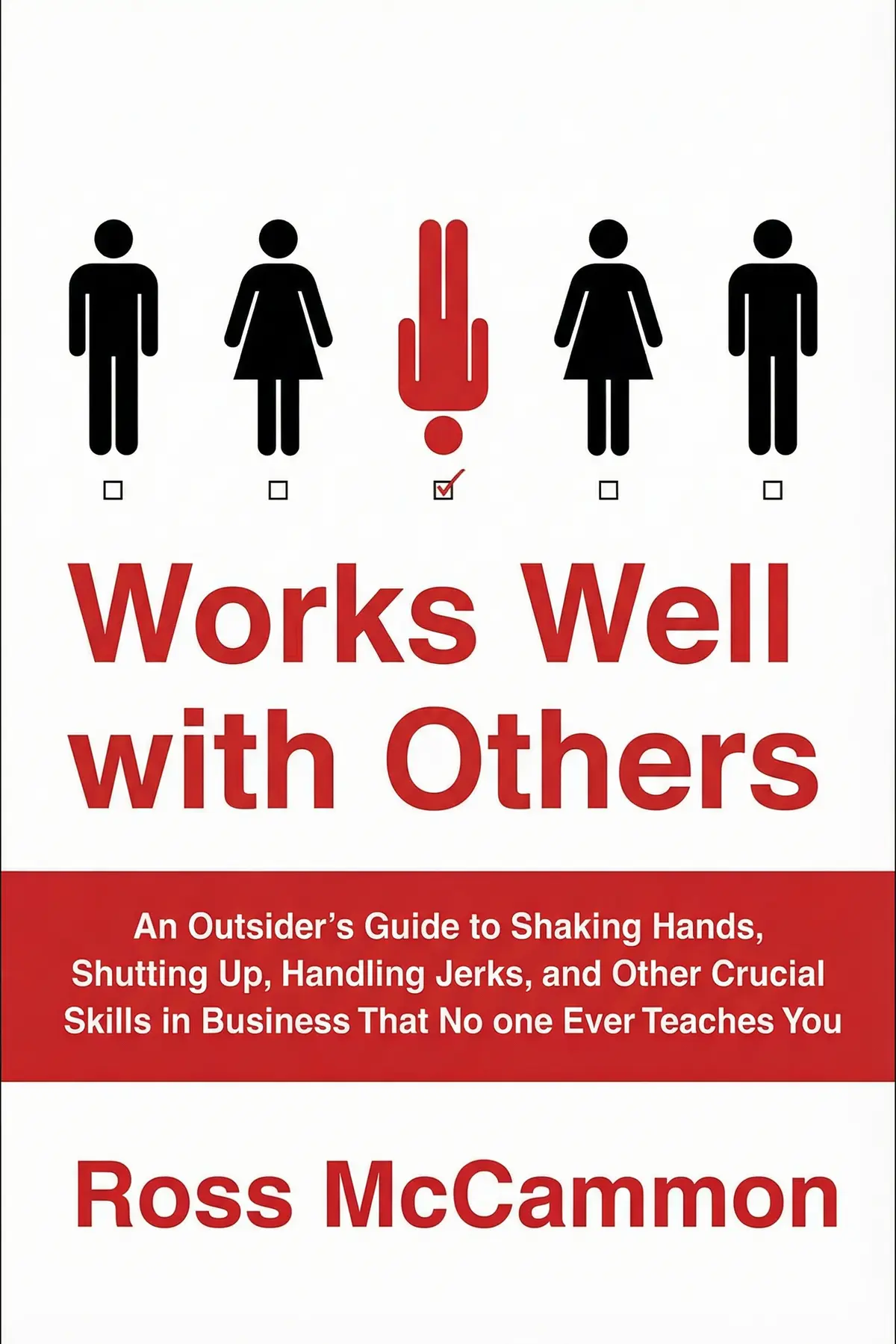
Table of Content
1. Introduction
57 sec
If you sit in meetings sure that everyone else got a rulebook you never received, Ross McCammon has reassuring news. They feel just as lost, and the calmest people in the room are often the most nervous. In Works Well With Others, the longtime Esquire editor turns his sudden leap from a suburban in-flight magazine to a New York dream job into a field guide for outsiders. It is part memoir, part manual, and funny on purpose.
His argument is that you do not have to cure your nerves to do well at work. What you need is a set of small, practiced moves, a modest dose of honest fakery, and the nerve to keep your own personality while you use them.
What follows is specific: a better reply than sorry when you slip up, a way through an elevator ride with a stranger, a two-question test for judging people, and a good reason to wear the bright tie.
2. Stop waiting to feel like you belong
1 min 57 sec
A magazine editor watching a parking lot in suburban Dallas got a call that changed everything, then spent months feeling like a fraud. What he discovered about the confident colleagues around him is the starting point for everything else.
3. Turn a nervous interview into a human conversation
1 min 57 sec
Candidates polish themselves into flawless answers, and the hiring manager across the table feels like he is chatting with a robot. The fix involves your eyes, your honesty and a stricter definition of on time.
4. Swap a few reflex phrases for stronger ones
1 min 49 sec
Two harmless-sounding words and one polite question can make colleagues take you less seriously every single day. Yet the same author also makes a cheerful case for swearing, and both ideas come from one belief about work.
5. Talk to anyone, from elevator strangers to Rihanna
1 min 37 sec
Thirty silent seconds in an elevator with a senior colleague can feel endless. McCammon, who has chatted with supermodels, offers a single question that works on celebrities and plumbers alike, plus lines for the moments nobody prepares you for.
6. Pitch and toast so the room is on your side
1 min 45 sec
Showing too much excitement about your idea can make people trust it less. McCammon’s answer is a three-beat rhythm for pitches, and a simple habit that saves a toast from the classic embarrassing slip.
7. Let your clothes lend you confidence
1 min 34 sec
A Columbia University experiment found that one simple garment changed how carefully people worked. McCammon uses it, along with a sixteenth-century Italian idea, to explain why style is less about rules than you think.
8. Handle jerks and early mistakes calmly
1 min 29 sec
A colleague clearly resents you, and you are itching to push back. McCammon has a one-line rule for that, a playful test involving beer and a puppy, and a surprising view on how many mistakes a new hire should make.
9. Conclusion
1 min 11 sec
McCammon’s story began at a second-floor window, watching a parking lot and counting the minutes until five. Nothing cured his nerves on the way from there to Esquire. He learned to work alongside them.
What the book adds up to is permission to be a little fake and fully genuine at once. You hold eye contact when your eyes want to drift. You keep your odd, singular personality in an interview instead of turning into a polite robot. Those demands stop feeling like a contradiction once you accept that the person across the table is nervous too.
That acceptance makes the small things easier to try. Arrive five minutes early and call it on time. Replace your next reflex apology with a plain statement of what went wrong and how you will stop it happening again. In the next elevator, ask someone about the part of their work nobody asks about, and actually listen to the answer.
None of this needs talent you lack. The people McCammon admired had simply decided to act as though they belonged, and anyone who has felt like an outsider can make that same decision tomorrow morning.
About this book
What is this book about?
Plenty of capable people walk into work sure that everyone else got a rulebook they never saw. Ross McCammon felt exactly that in 2005. A phone call took him from editing an airline magazine in the Dallas-Fort Worth suburbs to a dream job at Esquire in New York, and he spent a long stretch feeling anxious, awkward and unqualified. Works Well With Others is part memoir and part manual, and it is openly funny. McCammon's main discovery is that his admired new colleagues felt like impostors too. They were simply better at acting as though they belonged. So he skips the big strategy and sticks to tactics: holding eye contact, being early, dropping reflex apologies, surviving elevator small talk, pitching, giving toasts, dressing with confidence, and refusing to fight with jerks. What you get is a way to stop being thrown by your own sense of inadequacy. You also get small moves you can use the same day, including a two-question test for judging people. Running through all of it is McCammon's view that professional life asks you to be a little fake and fully genuine at the same time.
Book Information
Who it's for
Early-career employees
New hires and recent graduates who feel like impostors among confident colleagues.
Nervous job candidates
Job seekers who freeze in interviews or dread meeting recruiters.
Workers new to networking
Professionals without connections who want simple moves for small talk, pitches, toasts and difficult coworkers.
About the Author
Ross McCammon
Ross McCammon has been a senior editor at Esquire since 2005, covering pop culture, drinking, cars and etiquette. There he has edited the Dubious Achievement Awards and the yearly feature on America's best bars, writes the monthly column The Rules, and often contributes to the back-page humor section This Way Out. He is also the business etiquette columnist for Entrepreneur magazine, and his writing appears in a McSweeney's humor collection edited by Dave Eggers.
Ratings & Reviews
Ratings at a glance
What people think
Listeners find the book both functional and fun, with one review observing that it compresses a vast range of useful life skills. Furthermore, it is considered accessible and resonant; one listener emphasizes the personal anecdotes that maintain a lighthearted tone. They also value its suitability as a gift for new graduates, and one review suggests it is especially effective for interns starting their careers. However, views on its value for the price are varied.
Top reviews
Laddawan
Finally got around to reading this before my first internship, and it’s basically a cheat code for navigating office politics. I was worried this would be another dry, boring business book, but McCammon’s humor keeps the pages turning quickly. He’s not shy about sharing his own 'wince' memories, which made me feel much better about my own occasional awkwardness. The advice on how to handle crying at work or dealing with indiscreet questions at parties is incredibly practical stuff that they never teach you in college. Not gonna lie, I’ll be keeping this on my desk as a reference for a long time. It’s the perfect blend of entertainment and genuine workplace wisdom for anyone just starting out.
Show moreHarper
Truth is, I wasn't looking for a dry manual, and McCammon delivered exactly the kind of humorous insight I actually needed. The advice on how to handle someone crying at work was surprisingly profound and showed a level of empathy you don't often see in business books. I loved how he framed professional success as a series of small, manageable habits rather than some grand, unattainable mystery. Even the parts about how to properly shake hands or make eye contact felt relevant because he explains the psychology behind them. It’s a very light, easy read that still managed to leave me with several pages of notes. Highly recommended for anyone who wants to be better at their job without becoming a robot.
Show moreRapee
The chapter on 'sprezzatura' was a total game-changer for my morning routine, even if I don’t work in a fancy New York office. McCammon manages to condense a huge amount of helpful life skills into these short, snappy chapters that never feel like a slog. While some of the advice about drinking at lunch felt a bit outdated for my specific workplace, the core message about being curious and admitting ignorance is universal. I loved how he used his own embarrassing failures at Esquire to make the lessons feel more human and less like a lecture. It’s a very relatable read for anyone who feels like an imposter in a suit. If you’re looking for a gift for a recent graduate, this is a solid choice that they’ll actually enjoy reading.
Show moreDivya
As someone who has always struggled with small talk, I found the author's take on being 'meaningfully curious' to be surprisingly helpful. McCammon writes with a self-deprecating charm that makes even the most basic advice feel fresh and actionable. I particularly liked the section on 'sprezzatura' and the idea that your clothes should give you confidence without looking like you tried too hard. There’s a lot of focus on the social side of business, which is often ignored in more formal manuals. While a few of the anecdotes felt a bit self-indulgent, the overall tone is encouraging and relatable. It’s a great gift for anyone entering the workforce who needs a confidence boost.
Show moreOlivia
Picked this up for my daughter who was having some trouble navigating her first real job, and she actually finished it in two days. It covers everything from writing the perfect short email to how to act when you're the new person in the office. McCammon's writing is definitely informal—there’s plenty of swearing—but the underlying advice is about respect and being a decent human being. I liked the formulas for speeches and the tips on defusing 'wince' memories by focusing on peripheral details. Some of the stories about his time at Esquire are a bit wild, but they serve as good examples of what not to do. It’s a practical, modern guide that feels very relevant for today’s interns and entry-level employees.
Show moreSoontorn
Look, McCammon is clearly a talented writer with a sharp wit, but the actual utility of this book varies wildly depending on your career. I enjoyed the 50 Cent interview stories and the general vibe of the book, but I struggled with how much of it felt centered on a very specific New York City business culture. For those of us in 'fly-over country,' knowing which bar to pick for an after-dinner drink isn’t exactly a high-priority professional skill. I appreciated the sections on writing concise emails and handling meetings, though even those felt a bit basic at times. It’s an entertaining read that offers some perspective, but the value for money is a bit questionable if you’re already established in your field.
Show moreSatit
Ever wonder how people actually survive in those high-pressure magazine environments without losing their minds? This book gives you a peek behind the curtain at Esquire, and while the stories are often funny, the advice is a bit of a mixed bag. Some chapters are brilliant—like the 'enthuse, temper, enthuse' approach to pitching—while others just feel like common sense dressed up in fancy prose. I liked the short, snappy structure because it made the book easy to pick up and put down during my commute. However, I’m not sure I agree that profanity lends credibility to a speech, even if Joe Biden does it. It’s a fun read, but don’t expect it to change your life unless you’re a complete novice.
Show moreDome
I’ve been working in corporate environments for a decade, and while some of this felt redundant, the section on handling 'jerks and pricks' was spot on. The author has a very specific, breezy New York style that can be a bit much in large doses, but his honesty about his own mistakes is refreshing. I did find myself rolling my eyes at some of the more elitist tips, like the specific etiquette for ordering at fancy restaurants. To be fair, the book is meant to be funny, and it succeeds at being an entertaining memoir-meets-guide. If you can filter out the stuff that only applies to high-end media jobs, there are some solid career reminders here. It’s just not the definitive 'how-to' it claims to be.
Show moreLuke
Maybe I’m just not the target audience, but this felt like advice for a very specific type of Manhattan frat-bro. The author’s writing style is a bit too cheesy for my taste, and I found the constant defense of profanity and workplace drinking to be pretty unprofessional. To be fair, there are a few decent nuggets about making eye contact and the importance of a firm handshake, but you have to dig through a lot of fluff to find them. His anecdote about interviewing 50 Cent felt a bit tone-deaf and quite cringey. If you don’t work in a high-glamour media job, most of these 'essential' skills will seem either blatantly obvious or totally irrelevant to your daily life.
Show moreChanon
Not what I expected from a business etiquette guide at all, and frankly, I found most of it pretty useless. The author seems more concerned with proving how cool and edgy he is by defending swearing and drinking than actually providing professional guidance. It felt like reading a long-winded column for young, male jerks who think being successful means acting like you're in a sitcom. I was hoping for something that offered real depth, but instead, I got a list of obvious tips like 'smile' and 'make eye contact' mixed with inappropriate stories. Save your money and just look up a basic list of manners online; you’ll get more out of it without the unnecessary filler.
Show moreQuestions about this book
What is Works Well With Others by Ross McCammon about?
It is a funny, partly memoir guide to the unwritten social rules of work. McCammon draws on his jump from an airline magazine in suburban Dallas to Esquire in New York, and the impostor feelings that came with it. He argues that everyone is nervous, especially those who look calm, and offers small tactics for interviews, small talk, pitches, toasts, dress and difficult colleagues.
Who should read Works Well With Others?
McCammon wrote it for smart, ambitious people who lack connections or pedigree and feel like outsiders. It suits new hires, job seekers and anyone who finds interviews, elevator chats or office parties stressful. He calls it self-help for people who dislike self-help, because it sticks to concrete tactics rather than big life strategy.
What does McCammon say about impostor syndrome?
He cites psychologists Pauline Clance and Suzanne Imes, who named the impostor phenomenon in 1978. McCammon rejects fake it till you make it. He says to harness the feeling and accept your outsider status and your mistakes. He discovered his admired Esquire peers felt like impostors too; they were just better at acting as though they belonged.
What should you say instead of I'm sorry at work?
McCammon advises acknowledging what went wrong and committing to make sure it does not happen again, saving apologies for personal life. He argues apologies carry emotional weight that can make colleagues uncomfortable. He also suggests dropping Does this make sense?, avoiding the word grab when asking for someone’s time, and skipping email pleasantries about hoping someone had a great weekend.
What is the Two Beers and a Puppy test?
It is McCammon’s quick way to judge a person. You ask two questions: would you have two beers with them, and would you trust them with your puppy for a weekend? The first checks whether you enjoy their company, the second whether you trust them. He pairs it with a firm rule for colleagues who resent you: never fight.
Readers also enjoyed




60 Seconds & You’re Hired!
Robin Ryan




Be A Free Range Human: Escape the 9 to 5, Create a Life You Love,
Marianne Cantwell
AUDIO SUMMARY AVAILABLE
Listen to Works Well With Others in 15 minutes
Get the key ideas from Works Well With Others by Ross McCammon, plus 5,000+ more nonfiction titles.
- 5,000+ titles
- Listen as much as you want
- 7-day free trial
- Cancel anytime









