

A Bigger Prize: How We Can Do Better Than the Competition
Margaret Heffernan
 English
Shows why smart people, teams and companies ignore warnings that sit in plain view, from love and conformity to distant management, and how seeking out disagreement helps you see what others miss.
1 min 07 sec
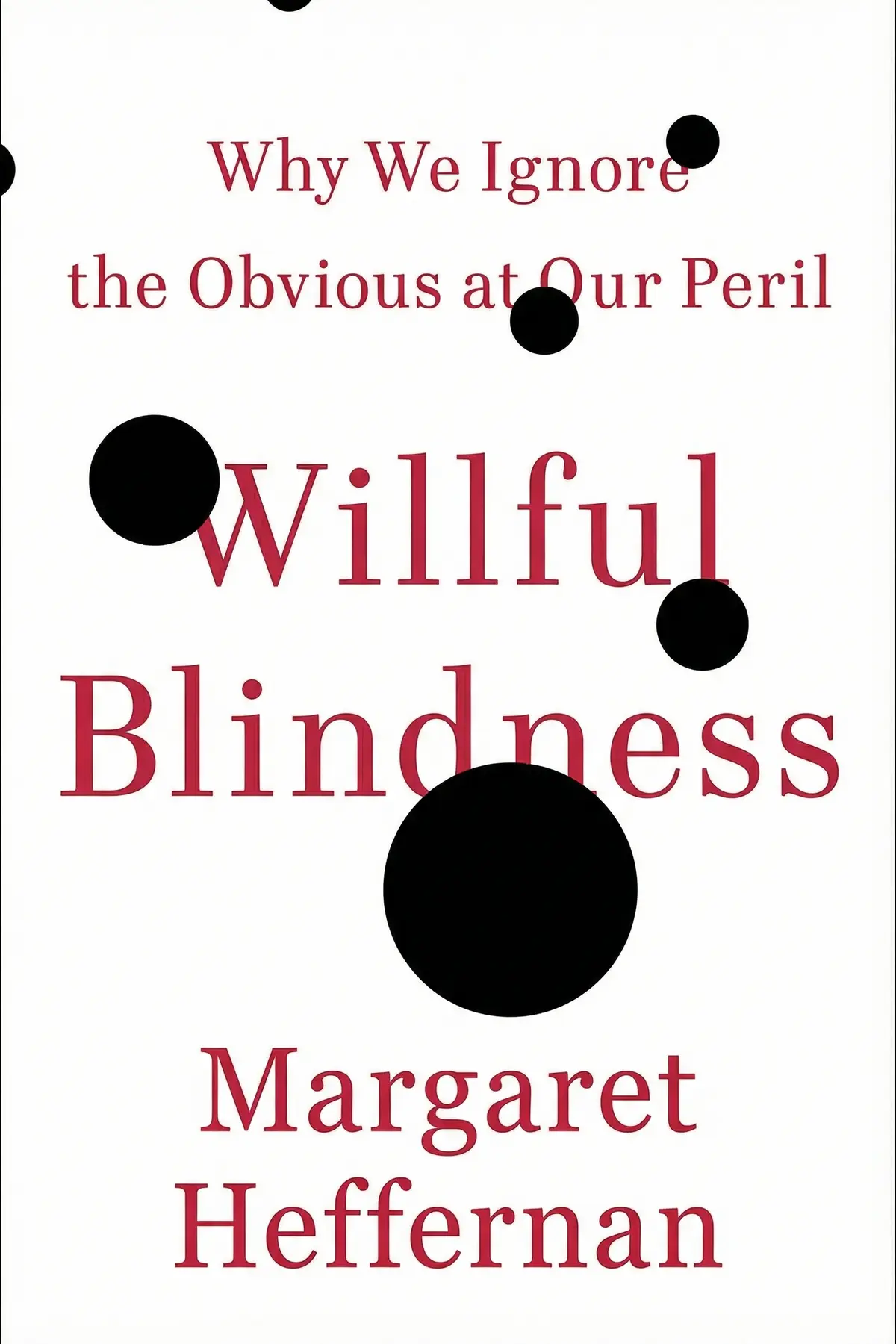
The warnings that matter most are rarely hidden. Usually they sit in plain view, and we decide, without quite admitting it, not to look. In Willful Blindness, former media and internet executive Margaret Heffernan borrows a legal idea to name that habit: you are responsible for what you could have known and chose to ignore. She traces it from the office kitchen nobody cleans to the 2007 housing crash, a sinking oil rig and a scandal over water bottles.
Her argument is that blindness comes from human comforts rather than missing information: loving people and ideas, fitting in, obeying orders and keeping hard realities at a distance. Each comfort makes a disaster easier to miss. Heffernan’s cure is unglamorous and practical. Seek out people who disagree with you, ask the question nobody else is asking, and treat easy agreement as a warning sign. By the end, the places where your team, family or company is looking away should be much easier to name.
2 min 01 sec
Almost nobody predicted the 2007 housing crash, even though the information was available to anyone. The reason lies in a habit most of us practice every week when we choose who to listen to.
2 min 01 sec
Mothers who miss what a partner is doing at home and doctors who rejected a researcher’s findings for years have something in common. Both were protecting a picture they could not afford to lose.
2 min 04 sec
One sleepless night affects your body much like being too drunk to drive, yet most people keep working anyway. Put them in a group and their reaction to danger slows even further.
2 min 05 sec
In a simple test about the length of lines, college students gave answers they almost certainly knew were wrong. The same pressure, joined to a vague order, helped produce one of the worst scandals of the Iraq war.
2 min 10 sec
An oil giant watched a drilling rig from thousands of miles away, and a bottle maker trusted a supplier it never questioned. Both learned, at great cost, what distance does to a company’s eyesight.
1 min 59 sec
A mythical woman whose warnings nobody believed and a modern whistleblower who leaked a video both pushed people to face what they preferred not to see. A business leader’s car ride offers a far gentler way to do the same.
1 min 27 sec
Heffernan accepts that choosing not to see is not always harmful. Her warning is about blindness as a default setting. The smuggler who never watched his bag, the doctors who dismissed Alice Stewart, the students who named the wrong line and BP watching a rig from London all ended up blind to something they could have seen. For the doctors, seeing clearly meant conflict with what they already believed; for the students it was the pull to conform, and for BP it was distance.
That is why the messy office kitchen is a fair place to start. Everyone can see the dirty dishes and the forgotten leftovers in the fridge, and somehow nobody sees them enough to act. Much larger disasters grow in that same gap between noticing and speaking.
The book supports a few modest habits. When everyone around you agrees, treat the comfort as information and go find the person who sees it differently. When a fact makes you defensive, look at it longer. When you notice smoke in a budget, a supplier contract or a project plan, speak before checking whether anyone else has reacted. And ask the question your organization has never asked.
Many of today’s problems, Heffernan argues, would be far easier to solve if people were willing to open their eyes. Usually the evidence is already in the room.
Most disasters are not secret. The warnings are there for anyone willing to look, yet families, teams, banks and global companies keep failing to see them. Margaret Heffernan borrows a term from law, willful blindness, to describe this habit of not knowing what we could and should know. Heffernan follows the habit through its many sources. Love softens our view of the people close to us. Fixed beliefs make us reject evidence, as doctors did when Alice Stewart linked x-rays in pregnancy to leukemia. Crowds slow our reaction to danger, obedience dulls our conscience and the pull to conform made students in Solomon Asch's experiment deny what their own eyes saw. Large organizations add distance and silos, which helped BP miss the risks on the Deepwater Horizon rig and left SIGG unaware of what its supplier put in its bottles. The book ends with a practical answer: fight the drift toward sameness. Through whistleblowers like Chelsea Manning and the daily habit of Indian business leader Ratan Tata, readers learn how to spot their own blind spots and invite the views that expose them.
Managers and team leads who worry their people stay silent about problems.
Founders and executives running distant teams, suppliers or partners they rarely see.
Professionals who suspect their own circle has started to think too much alike.
Margaret Heffernan was born in Texas, grew up in Holland and studied at Cambridge University. She made documentaries and dramas for BBC radio and television, ran a trade association for independent film and television producers, and later served as chief executive of three internet companies. Willful Blindness was a finalist for the Financial Times and Goldman Sachs business book prize. She is a professor of practice at the University of Bath's School of Management and joined the Thinkers50 Hall of Fame in 2021.
Margaret Heffernan
Listeners find this book profoundly insightful, with one individual highlighting its educational discussion regarding human behavior. Furthermore, they value its easy readability, as one listener noted that every chapter is filled with intriguing content. The work provides excellent examples and is written with significant depth, making it a highly engaging read. Additionally, listeners describe it as a sobering book that helps them become more aware, with one person mentioning that it serves as a quality introduction to various sources of bias.
Picked this up on a whim after seeing Heffernan's TED talk, and I wasn't prepared for how much it would shift my perspective. The book is incredibly informative on human behavior, specifically how our preference for the familiar often leads us into dangerous territory. I found the sections on 'resource depletion' and how exhaustion makes us less likely to doubt or question authority particularly eye-opening. While some of the psychology experiments like Milgram were familiar, the way she weaves them into modern corporate failures like BP makes the concepts feel urgent and fresh. It's a sobering read that forces you to examine your own daily habits of avoidance. Even though it's heavy stuff, the writing style is surprisingly readable and punchy. It definitely makes you want to be less blind to the world around you.
Show moreWow. This is a sobering look at the psychological mechanisms that allow us to ignore reality right in front of our faces. Heffernan explains how we edit our perceptions to justify the conclusions that serve us best, turning willful blindness into a daily survival mechanism. The chapter on 'Cassandras' was particularly haunting—it's true that we often punish those who tell us the truths we've worked so hard to hide. The book is full of fascinating content that makes you realize just how often we choose comfort over conflict. If you're a critical thinker looking to understand the cognitive dissonance that plagues modern society, you need to read this. It’s a compelling, page-turner of a book that stays with you long after the final page.
Show moreAs someone who works in corporate HR, the sections on power distance and 'vertical communication' hit uncomfortably close to home. Heffernan describes how the 'power aura' around leadership can effectively silence those below, making honest feedback nearly impossible. This book serves as a fantastic mirror for anyone in a management role who thinks their team is being completely transparent with them. While she does spend a lot of time on well-known cases like the Kitty Genovese murder, she manages to add a layer of behavioral research that makes it feel relevant again. Look, it’s not always a comfortable read, but it’s definitely an important one if you want to minimize the blind spots in your own organization and foster a culture that values truth over harmony.
Show morePersonally, I think this should be required reading for anyone in a leadership position. Heffernan manages to take complex psychological concepts and turn them into a page-turner that is both informative and deeply disturbing. The way she describes how we homogenize our environments to avoid conflict is a stinging indictment of how we live today. By surrounding ourselves with like-minded people, we are essentially building our own cages of ignorance. The science behind how we justify our own conclusions is solid, and the book offers plenty of shock and horror moments to keep you engaged. It’s one of those rare books that actually helps you become a little less blind to your own faults. Highly recommended for anyone eager to understand our primitive animal instincts and how to overcome them.
Show moreEver wonder why massive corporations or religious institutions can ignore the obvious rot within their own walls? Heffernan explores the concept of 'power distance' and how it creates a literal handicap for managers who become insulated from the truth. Truth is, we often choose to be blind because the cost of seeing is simply too high for our social lives or careers. I appreciated the breadth of examples, from the Catholic Church scandal to the Jonestown tragedy, showing that this isn't just a corporate issue. To be fair, the book leans heavily on anecdotes which might frustrate some academic readers, but for a general audience, it’s a great primer on sources of bias. My only real gripe is that the solutions offered in the final chapters felt a bit thin compared to the massive problems she describes.
Show moreAfter hearing so much about cognitive dissonance, I found Heffernan’s synthesis of real-world disasters surprisingly readable and well-structured. She does a great job explaining why we don't speak up when we know something is wrong, highlighting how our instinct to obey and conform overrides our moral compass. The discussion on 'resource depletion' was particularly relatable; we really do lose our ability to doubt when we are exhausted by modern life. I think the book provides a solid primer on the sources of bias, even if some of the examples felt a bit repetitive by the end. It's a thoughtful exploration of why we act like ostriches when facing inconvenient realities. Definitely worth a read for the perspective shift alone, especially if you enjoy behavioral science.
Show moreFinally got around to finishing this, and I'm left feeling both enlightened and a bit paranoid about my own decision-making process. The book is a deep dive into the 'drivers of willful blindness,' specifically how our love for big ideas and our dislike of change keep us trapped in failing systems. I especially liked the analysis of the 'group polarization effect'—it explains so much of what we see in politics and social media today. Gotta say, the tone is a bit heavy-handed at times, and the ending was a little bit of a letdown as she focuses more on the problem than the solution. Still, the depth of the research and the quality of the examples make it a compelling read for anyone interested in social psychology.
Show moreHeffernan dives deep into why we choose the comfort of the familiar over the hard truth of reality. This book is a fascinating look at the tangle of factors that lead to moral failures in both people and organizations. From the 'pekiwuh' concept in Javanese culture to the pedophilia scandal in the Catholic Church, the range of case studies is impressive. I found the writing to be very accessible, despite the heavy nature of the subject matter. It's a sobering reminder that we are all susceptible to self-deception if we aren't actively fighting against it. My only criticism is that it occasionally feels like she's preaching to the converted, but the insights into human behavior are too good to pass up for any curious reader.
Show moreThe first few chapters are absolutely gripping, but the momentum stalls significantly as the book progresses into areas where the author's expertise feels a bit stretched. I initially loved the psychological look at why we evade the truth, especially the discussion on groupthink and how like-minded people make each other more extreme. However, by the midpoint, it started to feel like a watered-down catchall for any mistake or disagreement. Frankly, the 'doom-mongering' became a bit tiresome without enough 'rocket-fuel' or actionable advice on how to actually fix these systemic issues. It's a decent summary of why the world is in a parlous state, but I was hoping for more depth in the later analysis of cognitive elaboration.
Show moreNot what I expected given the rave reviews. While the premise of the book—that humans see what they want to see—is obviously true, the execution feels like a collection of bland suppositions. Margaret Heffernan isn't a scientist, and it shows in the way she cobbles together research that doesn't always support her broad generalizations. It felt more like a hackneyed social commentary than a serious psychological study. There are much better-researched books on cognitive dissonance and groupthink out there that don't rely so heavily on cherry-picked anecdotes to prove a point. If you’ve read any basic psychology, most of this will feel like a retread of information you already know. Disappointing and ultimately a bit of a shallow dive into a complex topic.
Show moreHeffernan takes the term from law, where a person is held responsible for something they could and should have known but chose not to see. She argues the same habit runs through everyday life, families and companies. People look away from uncomfortable facts because facing them would bring conflict, and that choice has contributed to disasters from the 2007 housing crash to the Deepwater Horizon oil spill.
Heffernan identifies several sources. We surround ourselves with people who think like us. Love softens our view of partners, and fixed beliefs make us reject new evidence, a reflex psychologist Anthony Greenwald called the totalitarian ego. Groups slow our reaction to danger, obedience dulls conscience, and conformity led about a third of answers in Solomon Asch’s line experiment to follow a wrong majority. Large, distant or siloed organizations add their own blind spots.
Heffernan’s main advice is to resist the drift toward sameness. If you agree with almost everyone around you, seek out different views on purpose. She points to Ratan Tata, who sits beside his driver on the way to work and listens to his problems and ideas. The SIGG case adds another habit: ask suppliers and partners the questions you would rather not ask, because not asking is still a choice.
It suits managers, founders and executives responsible for teams, suppliers or operations they cannot watch directly, and anyone who has stayed silent in a meeting while sensing something was wrong. Its cases, from Abu Ghraib to BP and SIGG, show how ordinary people and respected companies miss obvious warnings, and its advice on seeking dissent applies in families as much as in boardrooms.




Joseph A. Maciariello




Deborah Gruenfeld

Richard Wiseman

Mike Michalowicz
AUDIO SUMMARY AVAILABLE
Get the key ideas from Willful Blindness by Margaret Heffernan, plus 5,000+ more nonfiction titles.









