

14 min 37 sec
Available in: English
Will It Fly?: How to Test Your Next Business Idea so You Don't Waste Your Time and Money
By Pat Flynn
A step-by-step way to test a business idea before you commit savings to it. It runs from checking that the idea fits your life, through customer research, to asking real buyers for pre-orders.
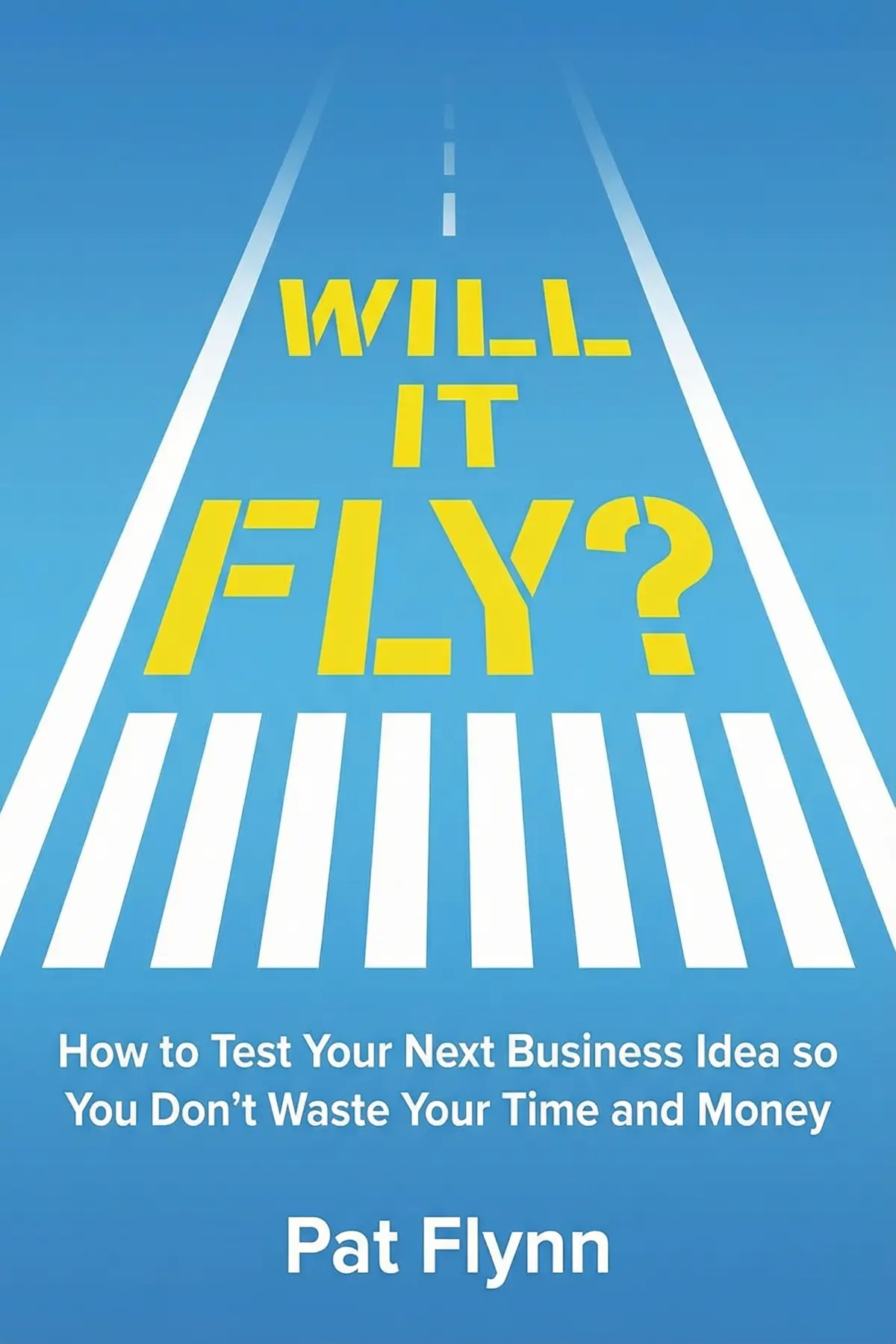
Table of Content
1. Introduction
58 sec
Most business ideas fail after the savings are spent, when it finally turns out that nobody wanted them. In Will It Fly?, entrepreneur and podcaster Pat Flynn argues that you can learn this much sooner by asking people to pay before the product exists. If about one in ten of the people you approach commits money, the idea is ready.
Flynn’s case is that an idea earns your time only after it passes a series of cheap tests, taken in order. First it has to fit the life you want. Then it gets reshaped by what real customers tell you in their own words. Finally it has to win pre-orders. Along the way come a food truck owner’s awkward question, a beginner’s first fly fishing trip and a simple spreadsheet with three tabs. What you get is a sequence you can run on your next idea before it costs you a website, a loan or a year of your life.
2. Picture the life your business has to pay for
1 min 25 sec
Most founders start with a logo or a search for funding. Flynn starts with a sheet of paper and your life five years from now, and that picture can kill a weak idea before it costs anything.
3. Find the edge hiding in your old jobs
1 min 37 sec
Every new business needs something rivals cannot easily copy. Often it is a strength you have stopped noticing, and the clues are in the jobs you liked and the ones that frustrated you.
4. Shrink a messy idea into one clear sentence
1 min 35 sec
An idea can feel complete in your head and still fall apart the moment you explain it. Flynn’s two-stage method turns a cloud of notes into something a stranger understands at once.
5. Real customers will reshape your idea early
1 min 39 sec
Flynn reached out to food truck owners, and the first thing they asked was whether he had a truck himself. How he answered it shows why the first real conversations should happen before anything is built.
6. Learn your customers' problems in their own words
1 min 32 sec
Two businesses can solve the same problem, and only one of them sounds like it understands the buyer. The difference begins with a few open questions and a habit of writing down exact phrases.
7. Turn customer stories into products people need
1 min 38 sec
A beginner’s account of his first fly fishing trip looks like a pleasant anecdote. Read closely, it points to where newcomers struggle and what someone could build for them.
8. Cheap tests that measure real interest
1 min 34 sec
Before asking anyone for money, you can find out whether strangers care at all. Flynn offers three low-cost ways to get real numbers, and one warning about what those numbers cannot tell you.
9. Know when an idea is ready to build
1 min 40 sec
Praise from friends and a pile of clicks both feel like proof. Flynn’s final test asks for something harder, and it comes with a simple number that tells you whether to go ahead.
10. Conclusion
59 sec
What Flynn offers, in the end, is a way to be wrong cheaply. Most failed businesses learn their lesson from a bank statement. His sequence moves that lesson much earlier: to a sheet of paper with four boxes, to a phone call where a food truck owner asks an awkward question, or to an email link that nobody clicks.
Before your next idea gets a name or a website, write your five-year picture and ask honestly whether the idea can pay for it. Talk to a handful of people who would use it, ask about the hardest part of what they do, and write down their exact words. When the idea fits into one sentence, send a pre-order offer to 50 of them and count the payments. Five means build. Fewer means go back and listen.
A business idea flies when strangers hand over money for it. Flynn’s point is that you can find out whether they will before you have spent much of your own.
About this book
What is this book about?
Most business ideas are tested by the market only after the money is spent, and many fail there because nobody wanted them. Pat Flynn argues that founders can find this out much earlier, and much more cheaply, if they run their idea through a series of small tests before building anything. His sequence starts with the founder. You picture your life five years from now so you know what the business has to pay for. You also look through your past jobs to find the advantage you bring. Then the idea gets mapped, written out and cut down to one clear sentence. After that, it goes out to real people. You build a market map, talk to likely customers about their problems and record the exact words and stories they use to describe them. The last stage is about money. Flynn shows how to measure interest with small ad tests, forum posts and shows of hands, and then how to ask for pre-orders. He borrows a benchmark from Everett Rogers: if about 10 percent of the people you approach pay in advance, the idea is ready to build.
Book Information
Who it's for
Would-be founders with ideas
Would-be founders with an idea who want proof before they spend their savings.
Planning their own business
Professionals planning a side business or a move into self-employment.
Creators and business owners
Online creators and small business owners who want to test a new product with real buyers first.
About the Author
Pat Flynn
Pat Flynn left a traditional office job to become an entrepreneur. He now advises people on building ethical online businesses through his website, SmartPassiveIncome.com, and hosts The Smart Passive Income Podcast. He also founded SPI, an online community for digital entrepreneurs, and advises a number of companies. The New York Times and Forbes have both written about him.
Ratings & Reviews
Ratings at a glance

What people think
Listeners find this title both educational and hands-on, giving high marks to the sequential instructions and activities designed to polish business concepts. Beyond that, the book is a helpful asset for founders, allowing them to expand on their ideas while avoiding the loss of capital and time. Listeners also appreciate how accessible the writing is, viewing it as a required resource for anyone with a business idea.
Top reviews
Kaen
Wow, Pat Flynn really nailed the practical side of entrepreneurship with this one. Unlike those gurus who sell you a dream wrapped in air, Pat gives you a concrete shovel to start digging into your own ideas. I particularly loved the five-year vision exercise because it forced me to consider if the business I wanted actually fit the life I desired. The book is packed with stories that make the technical validation steps feel much more approachable for a beginner like me. While some might find the tone a bit too 'blogger-esque,' the actual value lies in the structured framework he provides. If you’re tired of guessing whether your product will sell, this is the manual you need to stop wasting time.
Show moreNora
Picked this up after hearing about how transparent Pat is with his own business data, and he doesn't disappoint here. The most valuable part for me wasn't just the 'how-to' of validation, but the 'suitability' tests at the beginning. It’s easy to chase a profitable niche, but if it doesn't align with your personality traits, you'll burn out fast. He provides a fantastic roadmap for moving from a vague concept to a launched product without risking your entire life savings. I appreciated the inclusion of case studies at the end because they proved his methodology works across different industries. Not gonna lie, this should be required reading for anyone about to quit their day job for a 'brilliant' idea.
Show moreSarawut
This book is a total lifesaver for anyone who feels overwhelmed by the technicalities of starting an online business. Pat Flynn has this incredible ability to break down complex market research into manageable, bite-sized tasks that don't feel scary. I especially loved how he encourages you to find where your target audience hangs out and actually talk to them. It sounds simple, but so many people skip this step and wonder why their launch failed. Personally, I would have paid double just for the peace of mind this framework gave me. It’s not just about making money; it’s about making sure your business serves your life and your future goals.
Show moreHom
As someone who has been stuck in the 'ideation phase' for years, this was the kick in the pants I needed. Flynn takes a very down-to-earth approach to market research that doesn't require a massive budget or a business degree. I found the section on using Google AdSense keywords and scouring online forums to be particularly eye-opening for a solo founder. It’s not necessarily reinventing the wheel if you’ve read The Lean Startup, but it’s much more actionable for the 'average Joe' entrepreneur. To be fair, the writing style is very casual, which might put off some academic types. However, if you want a step-by-step guide to testing your solution against real-world problems, this is a solid investment of your time.
Show moreMats
Finally got around to reading this, and I have to say, the emphasis on 'one solution for one problem' is a game-changer. Most entrepreneurs try to build a Swiss Army knife when they should be building a single, sharp blade. Pat’s framework helps you strip away the fluff and focus on whether people will actually open their wallets for your idea. The exercises are practical, though I’ll admit that the deep-dive research into Google communities wasn’t exactly my cup of tea. It takes a lot of grunt work that isn't particularly 'fun,' but it's better than launching a product that nobody wants. This book effectively bridges the gap between having a dream and having a viable business plan.
Show moreZoe
Ever wonder why some businesses take off while others crash and burn immediately? Flynn argues it’s all about the validation process, and he provides a very thorough checklist to make sure you’re on the right track. I enjoyed the personal anecdotes throughout the book, as they humanize the struggle of starting something from scratch. My only real gripe is that some of the advice leans heavily on the 'rebrand' culture, which I find a bit economically thin. Still, the core principles of customer discovery and testing are sound and universally applicable. It’s a readable, inspiring guide that helped me refine my own project before I spent a dime on development.
Show moreMoo
Flynn’s methodology for testing a product before it's even built is both brilliant and terrifyingly simple. I used the techniques in Part 3 to vet a software idea I had, and the results saved me months of coding on a feature nobody wanted. While some critics complain about the 'passive income' tropes, Pat is very honest about the hard work required to get there. He doesn't promise magic; he promises a process that minimizes the risk of failure. The writing is energetic and encouraging, which helps when you're slogging through the less exciting parts of market research. It’s a solid, practical resource that I’ll likely revisit the next time a 'big idea' strikes me.
Show morePenelope
The chapter on the 'Airport Test' was definitely the highlight for me, but the rest of the book was a bit of a mixed bag. On one hand, the step-by-step instructions for testing your market are incredibly detailed and easy to follow. On the other hand, a lot of the 'lifestyle business' philosophy feels like a rehash of what other authors wrote years ago. Truth is, I was expecting more advanced tactics given Pat's reputation in the online marketing space. It’s a great entry-level resource for people who have zero experience with product management or customer development. If you’re already familiar with the basics of MVP development, you might find yourself nodding along more than learning anything truly groundbreaking.
Show moreZoey
After listening to the Smart Passive Income podcast for a while, I had very high expectations for this book. In my experience, Pat is at his best when he’s being hyper-transparent about his successes and failures, which he does here. However, the book suffers from some serious pacing issues and could have used a much more aggressive editor. There is a lot of 'tell' before the 'show,' and the repetition of key concepts became a bit grating by the halfway mark. That said, the free companion course is an excellent touch and adds a lot of tangible value to the purchase. It’s a decent starting point for beginners, but seasoned entrepreneurs might find it a bit too elementary.
Show moreLogan
Look, I really wanted to love this book since I’m a fan of Pat’s podcast, but it felt incredibly stretched out. The core message is solid—validate before you build—but he repeats the same three points in every single chapter with different analogies. There were sections where he’d quote an interview and then immediately summarize the quote in almost the same length, which felt like total filler. Frankly, this could have been a very effective, dense 30-page PDF or a long-form blog post instead of a 300-page book. It’s not that the advice is bad, but the signal-to-noise ratio is just too low for anyone who values their time. I found myself skimming through the intros and outros just to get to the actual meat of the exercises.
Show moreQuestions about this book
What is the main idea of Will It Fly? by Pat Flynn?
Flynn argues that a business idea should be tested cheaply before you put serious time and money into it. His sequence checks that the idea fits the life you want, uses your strengths, can be stated in one sentence and solves problems real customers describe in their own words. It ends with the hardest test: asking people to pay in advance through pre-orders.
How many pre-orders does Will It Fly? say you need?
Flynn uses a benchmark from the communications scholar Everett Rogers, who held that only 2.5 percent of people back a new idea right away and that a 10 percent positive response is a good sign of success. In practice, if you contact 50 people and five pay in advance, the idea is ready. If fewer do, gather more feedback and improve it.
What is the Customer P.L.A.N. in Will It Fly?
It is Flynn’s customer profile, kept as a spreadsheet tab with four columns: problems, language, anecdotes and needs. You find problems by asking open questions or running a survey. You record the exact words customers use, collect their stories, like a beginner’s first fly fishing trip, and turn what does not work in their lives into clear needs your product can meet.
How do you find your unfair advantage as an entrepreneur?
Flynn suggests reviewing your past jobs and volunteer roles, noting what you liked and disliked, and looking for patterns. His own time at an architecture firm showed him that influencing outcomes mattered greatly to him, which pointed toward running his own business. If you still struggle, email friends or colleagues and ask what they see as special or interesting in you.
Who should read Will It Fly?
It suits anyone with a business idea who fears wasting savings on something nobody wants: first-time founders, people planning a side business and online creators considering a new product. The method is low cost and practical, using paper exercises, a spreadsheet, customer conversations, small ad tests and pre-orders rather than large upfront investment.
Featured in
Readers also enjoyed


7 Powers: The Foundations of Business Strategy
Hamilton Helmer



Alibaba: The House That Jack Ma Built
Duncan Clark

Be A Free Range Human: Escape the 9 to 5, Create a Life You Love,
Marianne Cantwell
Be Obsessed or Be Average
Grant Cardone
Being Boss: Take Control of Your Work and Live Life on Your
Kathleen Shannon
AUDIO SUMMARY AVAILABLE
Listen to Will It Fly? in 15 minutes
Get the key ideas from Will It Fly? by Pat Flynn, plus 5,000+ more nonfiction titles.
- 5,000+ titles
- Listen as much as you want
- 7-day free trial
- Cancel anytime









