
16 min 37 sec
Available in: English
 ไทย
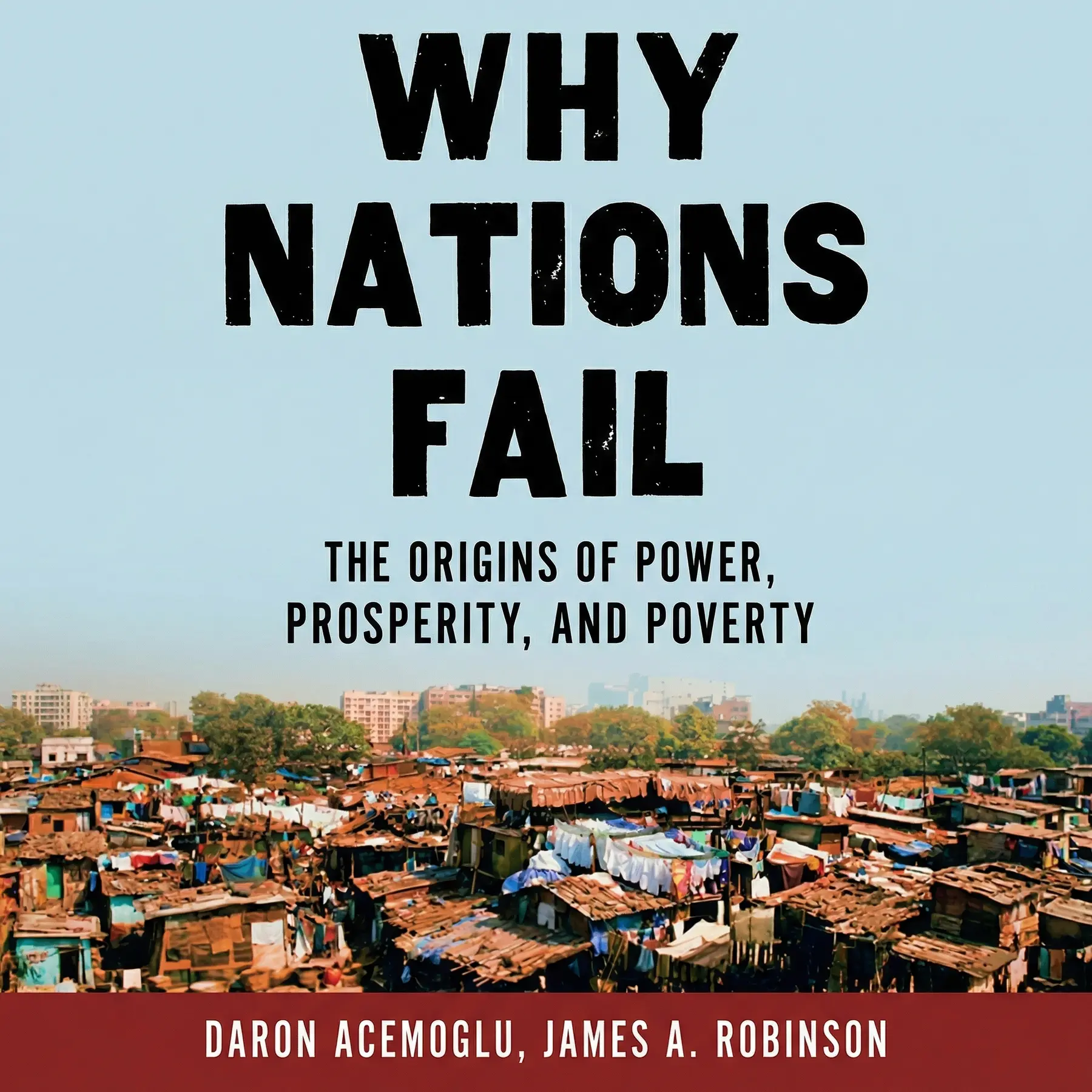
EnglishไทยWhy Nations Fail: The Origins of Power, Prosperity, and Poverty
Explains why some countries grow rich while others stay poor. It traces the difference to whether a nation's political and economic rules spread power widely or let a narrow elite extract wealth for itself.
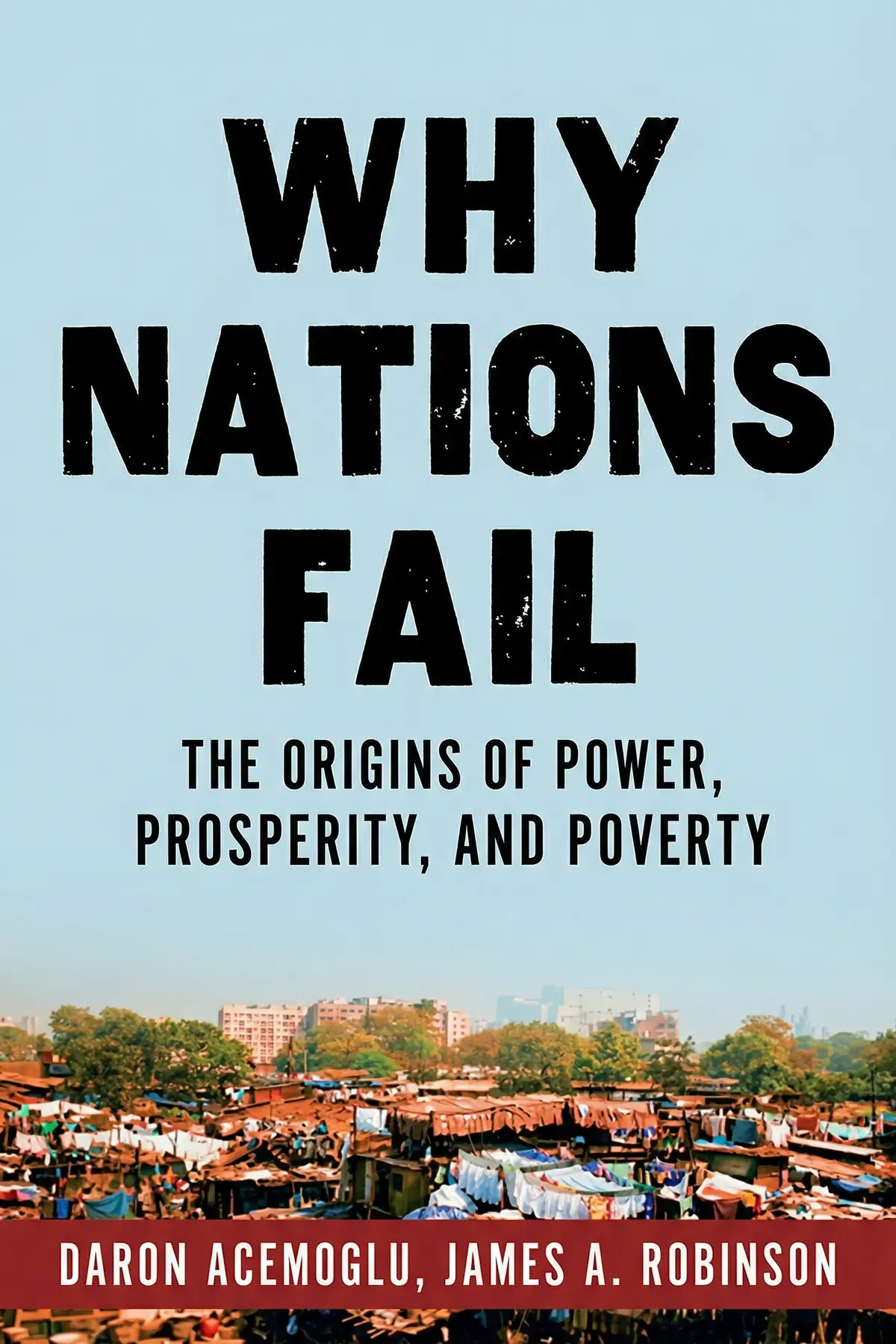
Table of Content
1. Introduction
1 min 07 sec
If you explain rich and poor countries by climate or national character, one border town should give you pause. In Nogales, Arizona, the average household earns three times as much as families across the line in Nogales, Sonora, and enjoys better schools, better healthcare and lower crime. In Why Nations Fail, economists Daron Acemoglu and James A. Robinson trace that gap to the rules each side lives under.
Their argument is easy to state. Countries prosper when political and economic institutions spread power and opportunity widely, and they stay poor when a narrow elite shapes those institutions to serve itself. Each kind tends to reinforce itself for centuries, so history’s turning points carry enormous weight. The story runs from the Black Death and the printing press to colonial Sierra Leone and the trade unions that helped end military rule in Brazil. What it leaves you with is one sharp question for any economic headline: who gets to write the rules, and who pays for them.
2. See past climate and culture to what decides wealth
1 min 42 sec
Two halves of one border town share the same weather, yet one earns three times more. Three famous explanations for national poverty fall apart when they meet this town and a divided peninsula.
3. Tell inclusive rules apart from extractive ones
1 min 46 sec
Two countries can both have markets, banks and governments and still end up worlds apart. A simple test of who owns, who borrows and who decides separates the nations that grow from the ones that drain.
4. Spot the turning points that split similar nations
1 min 42 sec
A plague that killed almost half of Europe freed peasants in the west and chained them tighter in the east. The difference came down to something that matters in every crisis since.
5. Shared power reinforces itself and keeps growing stronger
1 min 59 sec
England’s lead began centuries before its factories, with a revolution that limited a king. What followed was a loop in which every concession by the powerful made the next one more likely.
6. Learn what makes rulers block inventions that would enrich everyone
1 min 50 sec
Austria was still burning charcoal for iron long after the rest of the world switched to coal, and the Ottomans held back printing for centuries. Neither choice was a mistake from the rulers’ point of view.
7. Recognize the systems that outlive their founders
2 min 11 sec
A fee meant to protect Sierra Leone’s farmers grew until it took almost everything they earned. The case shows why unjust systems so often survive the revolutions meant to end them.
8. Know why a dictator's boom eventually stalls
1 min 31 sec
The Soviet economy expanded at a rate that impressed the world for thirty years, and the country launched the first person into orbit. Then a bonus scheme revealed the flaw that would eventually slow it down.
9. See how ordinary people break a poverty trap
1 min 40 sec
Extractive systems defend themselves for generations, yet some still fall. Brazil’s experience points to an unexpected group of reformers and to a different way of spending foreign aid.
10. Conclusion
1 min 09 sec
Why Nations Fail turns a sprawling question into one you can carry around. In Acemoglu and Robinson’s account, poverty is rarely an accident of climate or a flaw in a people. More often it is an arrangement that benefits someone, set up at a turning point and defended for generations, the way Sierra Leone’s chiefs still come from families the British chose. Prosperity is an arrangement too: power spread widely enough that no group can rig the economy for itself, with each round of sharing making the next more likely.
The book gives you a lens. When a country, a city or an industry pulls ahead or falls behind, look past the easy explanations to who can own property, borrow, vote and be heard, and who is blocking the new tools that would threaten them. When a crisis hits, notice which groups are organized enough to bargain, because they will help write the next set of rules.
The two halves of Nogales share the same weather. What divides their fortunes is a border and the rules on each side of it.
About this book
What is this book about?
On one side of the border between the United States and Mexico, a town's households earn three times as much as their neighbors on the other side. Daron Acemoglu and James A. Robinson use puzzles like this to test the classic explanations for global inequality, from climate and disease to culture and ignorance. They find each one wanting. Their answer is institutions. Where property is secure, credit is available and political power is shared among many groups under a strong rule of law, people invest and invent, and the system tends to reinforce itself. Where a small elite writes the rules to extract wealth from everyone else, growth stalls or never starts, and those rules often survive revolutions and independence. Turning points such as the Black Death push similar places down very different paths. The authors range from the Ottoman ban on printing and Austria's fear of railways to colonial Sierra Leone, the Soviet economy and the trade unions of Brazil. Readers gain a clear framework for judging why an economy rises or falls, and why lasting change usually comes from people who win a share of power.
Book Information
Who it's for
Students and professionals
Professionals and students who follow world news and want a clear reason some economies boom while others stall.
Weighing where growth lasts
Founders and investors weighing where property rights and politics make growth last.
Policy, aid, development workers
Policy, aid and development workers asking why money and expert advice so often fail to change poor countries.
About the Author
Daron Acemoglu
Daron Acemoglu, born in 1967, joined MIT in 1993, where he is Elizabeth and James Killian Professor of Economics and, since 2019, an Institute Professor. He studies political economy, development and labor economics, and won the John Bates Clark Medal in 2005. James A. Robinson, born in Chelmsford in 1960, is a professor at the University of Chicago's Harris School of Public Policy, taught at Harvard from 2004 to 2015 and researches long-run development in Latin America and Africa. In 2024 the two shared the Nobel Memorial Prize in Economic Sciences with Simon Johnson for work comparing prosperity across nations.
Ratings & Reviews
Ratings at a glance
What people think
Listeners find this work both thought-provoking and accessible, commending its thoroughly researched foundation in historical evidence. Furthermore, the prose is straightforward and thorough, with one listener mentioning that the text stays away from mathematical or technical explanations. Listeners also value the emphasis on economic and political frameworks, with one review emphasizing how inclusive systems lead to prosperity. The authors build a persuasive case using a variety of case studies, creating an essential resource for anyone curious about global history and economics.
Top reviews
Ana
Finally got around to reading this doorstopper and it didn't disappoint. The authors move away from simplistic geographic or cultural explanations, focusing instead on how political power is distributed. They use historical "critical junctures"—like the Black Death or the Atlantic trade—to show how small institutional differences can lead to massive divergence over centuries. I loved the Botswana example; it’s refreshing to see a success story that defies the typical "resource curse" narrative found in other economic texts. To be fair, the prose can feel a bit repetitive as they hammer home the "inclusive vs. extractive" point, but the depth of research is staggering. It makes complex global inequality feel understandable without relying on dense mathematical models or jargon. This is easily a must-read for any history buff.
Show moreSarocha
Wow, I didn't expect a book about macroeconomics to be this engrossing or easy to digest. Acemoglu and Robinson avoid the trap of technical jargon, opting instead for a narrative-driven approach that spans thousands of years of human history. The concept of "institutional drift" was a revelation for me, explaining how tiny differences in how a society responds to a crisis can lead to vastly different futures. Personally, I found the chapter on the Industrial Revolution particularly insightful because it highlights why some monarchs actively blocked new technologies like the steam engine to protect their own interests. It’s a sobering look at how human greed can literally hold back progress for centuries. If you enjoy authors like Jared Diamond or Steven Levitt, you’ll find this right up your alley, though it challenges many of their core assumptions.
Show moreLillian
Daron Acemoglu and James Robinson have crafted a masterpiece that feels both timely and timeless. They argue that the difference between the US and Mexico or the two Koreas isn't due to weather or work ethic, but the rules governing society. The way they trace the "iron law of oligarchy" through various revolutions is both chilling and illuminating. I loved how the book emphasizes that prosperity isn't guaranteed; it requires constant vigilance to keep institutions inclusive. Not gonna lie, I was worried it would be too academic, but it reads like a series of interconnected historical mysteries. It’s easily one of the most important books I’ve read in the last decade. It should be required reading for anyone interested in why the world is the way it is.
Show morePia
This book provides a masterclass in why some countries prosper while others remain trapped in poverty. Acemoglu and Robinson argue convincingly that inclusive institutions, which protect property rights and encourage "creative destruction," are the engine of sustainable growth. I was fascinated by the deep dive into the Glorious Revolution and how it set England on a different path than its European neighbors. Frankly, the writing is incredibly clear and accessible for such a heavy topic. My only gripe is that the authors tend to dismiss factors like climate and geography a bit too readily, which felt slightly one-dimensional at times. However, the sheer volume of historical evidence they provide—from the Maya to the Roman Empire—is hard to ignore. It’s a compelling, well-reasoned argument that changed how I look at global politics.
Show moreUbolwan
As someone who usually avoids non-fiction, I found "Why Nations Fail" surprisingly accessible and fast-paced. The authors do a great job of showing that the poverty of nations isn't an accident but a choice made by those in power. I particularly enjoyed the section on "creative destruction" and how new technologies often threaten the status quo of established elites. To be honest, I felt the book could have been about 100 pages shorter without losing its impact because the main thesis is stated early and repeated often. Still, the historical anecdotes about the Dutch East India Company and the massacre at the Banda Islands were eye-opening and deeply researched. It’s a dense read, but the lack of math makes it much more approachable for a general audience. A solid pick for anyone curious about the roots of inequality.
Show moreVera
The logic of inclusive vs extractive institutions is a powerful lens through which to view the world. I picked this up because I wanted to understand the disparity between North and South Korea, and the authors explain it perfectly through the incentives created by their respective regimes. Truth is, the book is incredibly ambitious, attempting to summarize the rise and fall of civilizations through a single political theory. While the prose is clear and the examples are vivid, the tone can be a bit repetitive toward the end. I also wish they had engaged more with the environmental costs of the "sustainable growth" they champion. Regardless, the historical breadth—from the Roman Empire's collapse to the modern growth of China—makes it an essential contribution to the field of political science.
Show moreDream
After hearing so much hype about this book in my economics class, I finally dove in. It’s essentially a long-form argument against the idea that geography or culture determines a nation's destiny. The authors' focus on how political centralization is necessary for inclusive economic growth was particularly interesting to me. Look, it’s a well-researched piece of scholarship that reads more like a history book than a dry economic treatise. I appreciated that they didn't rely on complex formulas to prove their points. My only criticism is that the "virtuous circle" concept feels a bit like wishful thinking at times, ignoring how even inclusive systems can be corrupted over time. It’s a thought-provoking read that will definitely spark debate, even if you don't agree with every conclusion.
Show moreDiego
This book’s focus on political and economic institutions offers a compelling alternative to the geographic theories of Jared Diamond. The authors show that when a small elite controls the resources, they have no incentive to innovate, leading to stagnation and eventual failure. I found the analysis of the Maya civilization’s collapse particularly interesting, even if it was a bit speculative. Gotta say, the writing is clear and detailed, avoiding the technical jargon that usually makes economic books such a chore to read. While it repeats itself quite a bit, the sheer variety of examples—from the Ottoman Empire to modern Sierra Leone—keeps you turning the pages. It’s a fascinating, well-supported argument that highlights why the struggle for pluralism is so vital for global prosperity.
Show moreGabriel
Ever wonder why some nations thrive despite having zero natural resources? This book attempts to answer that by looking at institutional frameworks rather than the usual suspects like location or religion. The core idea is solid: elites who extract wealth for themselves inevitably stifle innovation because they fear losing their grip on power. Not gonna lie, the first 200 pages were electric, especially the comparison between the colonization of North versus South America. But by the halfway point, the "extractive" and "inclusive" labels start feeling like a hammer looking for nails. Every single historical event is forced into this binary, which feels a bit reductive for a 500-page tome. It’s a brilliant magazine article expanded into a somewhat bloated book, though still worth the time for the unique case studies.
Show moreSook
Picked this up on a recommendation, but I have mixed feelings. On one hand, the historical data is fascinating and the writing style is very approachable for a layperson. On the other hand, the authors seem to ignore any facts that don't fit their specific "institutional" mold. For example, their dismissal of the role of tropical diseases in African development felt a bit too convenient for their theory. To be fair, the stories they tell are captivating—I particularly liked the bit about the Tudor and Stuart kings in England—but the repetition of the core thesis becomes exhausting after the fourth or fifth chapter. It’s a good book with a great premise, but it lacks the nuance I was hoping for in such a highly-regarded work of political science.
Show moreQuestions about this book
What is the main idea of Why Nations Fail?
Acemoglu and Robinson argue that nations grow rich or stay poor because of their institutions. Inclusive economic and political institutions, such as secure property, available credit and power shared among many groups, encourage people to work and invent. Extractive institutions let a small elite take wealth from everyone else. Both kinds tend to reinforce themselves, so turning points in history and organized citizens decide which path a country follows.
What is the difference between inclusive and extractive institutions?
Inclusive institutions draw many people into economic life and protect what they earn, as in South Korea and the United States with their property laws, banks and public schools. Extractive institutions move income from one group to another, as in colonial Latin America or North Korea under the Kim family. Politically, inclusion requires both pluralism, meaning shared power, and a central state strong enough to uphold the law.
Why do the authors reject geography and culture as explanations for poverty?
Their sharpest evidence is Korea, culturally uniform until it split into a communist North and a capitalist South that ended up far apart in wealth. The town of Nogales, divided between Arizona and Sonora, shows the same pattern under identical weather. The rise of Botswana, Malaysia and Singapore also challenges climate theories, and the failure of foreign aid and expert advice in Africa undercuts the idea that poverty comes from ignorance.
What is a critical juncture in Why Nations Fail?
A critical juncture is a shock big enough to upset the balance of power in a country or region. The Black Death is the authors’ main example. Labor shortages after the plague let organized peasants in Western Europe win lower taxes and more rights, while landowners in Eastern Europe tightened their grip. The authors call this splitting institutional drift, and each later juncture can widen the gap.
Can a country escape extractive institutions?
Yes, the authors argue, because history is not destiny. Western Europe and the American South both moved toward more inclusive institutions over time. Brazil is their clearest case: trade unions and other social movements built a coalition that drove out the military dictatorship in 1985, and the economy grew fast between 2000 and 2012. They suggest foreign aid should help excluded groups gain the means to challenge extractive rules.
Featured in

Readers also enjoyed

A Splendid Exchange: How Trade Shaped the World
William J. Bernstein

A Theory of Justice
John Rawls






A Warning
Miles Taylor

Adults in The Room: My Battle With Europe’s Deep Establishment
Yanis Varoufakis

AUDIO SUMMARY AVAILABLE
Listen to Why Nations Fail in 15 minutes
Get the key ideas from Why Nations Fail by Daron Acemoglu, plus 5,000+ more nonfiction titles.
- 5,000+ titles
- Listen as much as you want
- 7-day free trial
- Cancel anytime









