
14 min 55 sec
Available in: English
Whole: Rethinking the Science of Nutrition
Campbell argues that a whole-food, plant-based diet protects health better than supplements, nutrient labels or medical treatment. He also explains why a science and an industry focused on single nutrients keep hiding that simple fact.
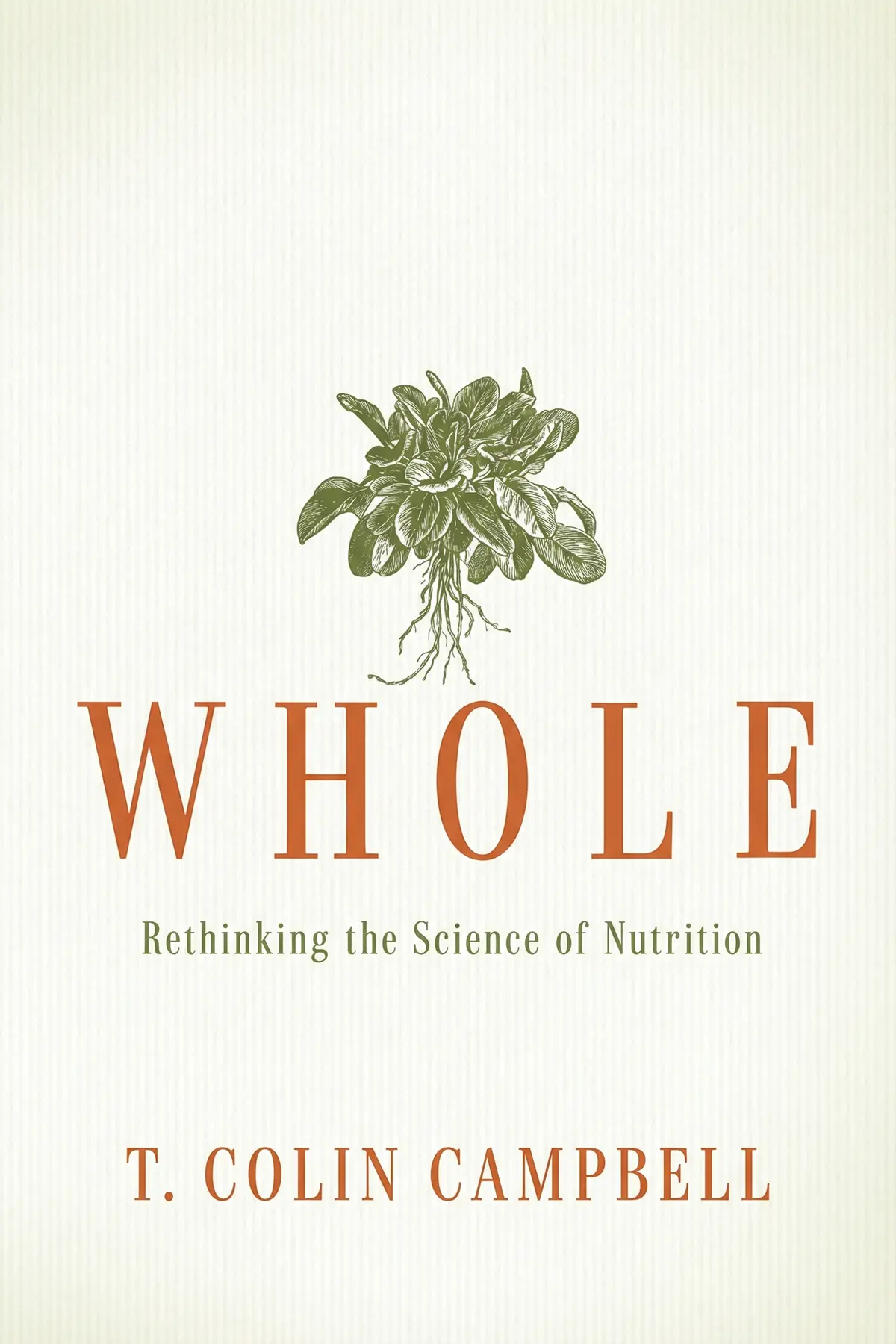
Table of Content
1. Introduction
1 min 00 sec
If eating well means reading labels, taking a daily multivitamin and trusting doctors to fix what goes wrong, T. Colin Campbell thinks you are looking in the wrong place. In Whole, the Cornell nutrition scientist argues that what you eat shapes your health more than your genes or your surroundings, and that a diet of whole plants can prevent, and even cure, the two biggest killers, heart disease and cancer.
His second claim explains why that message rarely reaches you. Modern science studies food one nutrient at a time, and the industries selling pills, procedures and packaged products gain little from showing the full picture. Health, in his view, comes from whole foods and whole systems, never from isolated parts.
The case runs through a study of rats, an apple that beat vitamin tablets and two peaches that differ forty times over. It ends with a simple way to judge the next health headline you read.
2. Make your plate your first line of defense
1 min 59 sec
The system most people trust to keep them well spends almost all its effort elsewhere, and it carries risks few people hear about. Campbell points to a cheaper, safer place to start.
3. Eat less animal protein to protect your cells
1 min 49 sec
A sliced apple turning brown on the counter reveals a process running inside you right now. A rat experiment from India suggests one everyday food choice can feed it or calm it.
4. Spot the blind spot in single-nutrient science
1 min 44 sec
Specialists can know every gear of a machine and still misunderstand what it does. Campbell explains the habit of mind behind that error and why it matters each time a study makes the news.
5. Stop counting micrograms and eat variety instead
1 min 44 sec
The panel of numbers on every package looks like the most scientific part of your groceries. Campbell argues it can steer you wrong, and two ordinary peaches show why.
6. Get more nutrition from an apple than a pill
1 min 45 sec
Half of one country swallows supplements regularly, spending billions a year. One laboratory comparison between a piece of fruit and vitamin tablets produced numbers that should make any buyer pause.
7. A plate that also cools the planet
1 min 52 sec
Climate change, animal suffering and world hunger look like three separate crises with three separate fixes. Campbell traces them back to one industry and one everyday decision that touches all of them.
8. Read health news with an eye on who profits
1 min 53 sec
Nutrition science keeps advancing, yet populations are not getting healthier. Campbell follows the money from election campaigns to charity research budgets to the morning headlines, and finds the same pattern at each step.
9. Conclusion
1 min 09 sec
Whole is finally an argument about where to look. Campbell’s case is that the body, its food and the systems that feed and treat it are each greater than their parts, and that a culture trained to see parts, a nutrient on a label, a disease to fight, a bill to pay, keeps missing what matters most. The rats in India, the apple and the two peaches all point the same way: a whole food does things its isolated pieces cannot.
Campbell does not expect change to come from governments or corporations, since few people can reach the levers of that power. In his telling it starts at the table. Shift a few meals each week toward beans, grains, fruit and vegetables eaten close to their natural form. Treat a supplement as the answer to a diagnosed shortage, not as daily insurance. Meet every miracle headline by asking who paid for it and what it leaves out.
None of this will remake the system overnight, he admits. But each plate is a small vote, and enough of them can move institutions that believe they are in charge.
About this book
What is this book about?
Many people treat health as something a hospital delivers and nutrition as a matter of label reading and vitamin pills. T. Colin Campbell, a nutritional biochemist at Cornell, argues that this view is costly for our bodies, for the planet and for politics. In his account, food shapes health more than genes or environment, and the right diet can help people avoid diabetes and can prevent, and even cure, heart disease and cancer. His deeper claim is about how we think. Modern science studies food one nutrient at a time, a habit he calls reductionism, and companies that profit from drugs, supplements and packaged products have little reason to show the larger picture. Against this he offers Wholism, which treats the body and its food as systems greater than their parts. Readers meet a striking rat study on animal protein, an apple that outperformed vitamin C tablets, and peaches that differ forty times over in one nutrient. They also get a clear picture of the diet Campbell recommends and a sharper eye for health headlines.
Book Information
Who it's for
Confused about healthy eating
People who take daily vitamins and read every label but still feel unsure what healthy eating means.
Hoping to prevent disease
Anyone facing heart disease, diabetes or cancer in the family who wants prevention, not just treatment.
Curious about food politics
Readers curious how diet connects to climate, animal welfare and corporate influence on health policy.
About the Author
T. Colin Campbell
T. Colin Campbell is professor emeritus of nutritional biochemistry at Cornell University and the author of more than 300 research papers. He was a lead scientist on the China Project, launched in 1983 by Cornell, Oxford and the Chinese Academy of Preventive Medicine to study how nutrition relates to diseases such as cancer and heart disease. With his son Thomas M. Campbell II he wrote The China Study, one of the best-selling nutrition books in America.
Ratings & Reviews
Ratings at a glance

What people think
Listeners find this nutrition book meticulously researched and straightforward to comprehend, offering transparent explanations of its subject matter. Beyond that, they regard it as a top-tier resource in the genre, delivering valuable perspectives on health and nutritional perks, specifically for avoiding or healing heart disease. The work also stresses the value of eating a whole food plant-based diet, with listeners praising it as a potent continuation of The China Study.
Top reviews
Noo
After hearing so much about the China Study, I finally dived into Campbell’s follow-up and found it truly eye-opening. It’s a powerful exploration of how we’ve been misled by nutritional science. Instead of focusing on isolated vitamins, Campbell explains why the synergy of whole vegetables is the key to preventing, and even reversing, heart disease. This isn't just a diet book; it is a fundamental shift in how we perceive the fuel we put in our bodies. The way he breaks down complex biological processes into understandable concepts is brilliant. I felt empowered reading about how much control we actually have over our own health outcomes through simple dietary choices. If you want to understand the 'why' behind the plant-based movement, this is essential. It is one of the best books I’ve read on the subject, providing a clear path to health benefits that actually last.
Show moreJan
Ever wonder why taking a multivitamin doesn't feel the same as eating a bowl of spinach? Campbell’s latest work answers that question with incredible precision. He explains the 'paradox of bioavailability' in a way that finally makes sense. The body doesn't just absorb everything we swallow; it takes what it needs based on an incredibly complex internal logic. This book is a masterclass in wholistic health. It challenges the capitalistic drive to sell us 'health in a pill' and points us back toward the garden. I found the sections on how the dairy and beef industries influence our national guidelines to be particularly shocking. It is a call to arms for anyone tired of being sick and tired. This is a life-changing benefit to anyone willing to listen. If you care about your long-term wellness, you need to read this.
Show moreAstrid
Wow, I wasn't expecting a nutrition book to get so philosophical about the nature of modern medicine. Campbell’s 'Whole' is a brilliant follow-up that tackles the systemic issues preventing us from being healthy. He argues that our genes aren't our destiny, which is a message of hope for anyone with a family history of cancer. The way he explains how nutrition can 'turn off' bad genes is revolutionary. It’s a dense book, packed with facts and strong opinions, but it’s written with a passion that is contagious. I appreciate that he doesn't sugarcoat the influence of corporate funding on our 'independent' research. This isn't just about weight loss; it's about survival in a system that profits from our illnesses. This is easily one of the most important books I've ever read regarding health and longevity.
Show moreFon
This book provides a fascinating, if sometimes dense, look at why our medical system is so obsessed with individual nutrients instead of looking at the big picture. Campbell’s argument against reductionism is compelling. He posits that studying a single chemical in a lab can’t compare to observing how thousands of nutrients interact within a whole food. While the scientific terminology can get a bit thick in the middle chapters, the core message remains accessible. My only real gripe is that the tone occasionally veers into a rant against the pharmaceutical industry, which might turn some readers off. However, the insights into how corporate interests influence government nutritional guidelines are too important to ignore. It makes you rethink every supplement you’ve ever taken. A solid read for anyone looking to go deeper than just surface-level diet advice.
Show moreTang
As someone who works in the medical field, I found parts of this book highly insulting yet undeniably necessary. Campbell’s critique of the 'pill for every ill' mentality is something many physicians struggle with daily. We see patients who want a quick fix instead of making the hard lifestyle changes required for true health. While I think he’s a bit too cynical about the motives of individual doctors, his critique of the broader 'sickness industry' is spot on. The way he describes the reductionist focus of research grants helps explain why we haven't made more progress in prevention. It’s not an easy read, and the tone is definitely sharp, but the underlying science regarding whole food nutrition is sound. It has certainly made me rethink how I discuss dietary intervention with my own patients. A provocative, challenging work that deserves a place on your shelf.
Show moreNim
What Campbell does best is challenge our fundamental assumptions about what constitutes 'scientific evidence' in the world of nutrition. He moves beyond the numbers to show how the whole system is rigged toward products rather than health. I loved the focus on empowerment. He makes it clear that we don't have to wait for a government report or a new drug to start healing. The chapters on the inner workings of health organizations were particularly enlightening, if a bit disheartening. It’s a much more technical read than Michael Pollan, but it provides the scientific backbone that some of those more 'fun' books lack. A few sections are a bit dry and technical, but the overall message is incredibly powerful. Highly recommended for those who want to understand the politics of what’s on their plate.
Show moreGai
The truth is that the way we fund research today is fundamentally broken, and Campbell exposes those cracks with the precision of someone who lived through it. This book isn't a diet plan; it’s a deep dive into why you can’t find a diet plan that actually works in a reductionist world. He makes a compelling case for why whole foods are superior to any supplement or extract. While I found the middle section regarding his personal career struggles a bit long-winded, the payoff is worth it. He provides a roadmap for rethinking our entire approach to wellness. It’s a bit of a call-to-arms for a grassroots movement. We can't wait for the top-down changes that may never come due to corporate interests. If you want to take control of your health, start here. It is thoroughly researched and very persuasive.
Show moreChamlong
Is it just me, or does Campbell seem increasingly frustrated with the scientific establishment? I appreciate his expertise, but the first half of this book felt like one long, emotionally-charged grievance against his colleagues. He spends a lot of time calling modern science 'reductionist' without offering as much new data as I expected after his first book. To be fair, the later chapters regarding the supplement industry and how health organizations operate are genuinely interesting and eye-opening. There is good information here if you are willing to sift through the bitterness. I still believe a plant-based diet is the way to go, but the delivery here was a bit painful to get through. It’s a decent follow-up, but definitely not as revolutionary or well-structured as The China Study. Read it for the industry insights, but be prepared for some repetitive philosophical arguments.
Show moreSupatra
To be fair, the nutritional core here is solid, yet the execution feels like a veteran scientist airing out decades of professional grievances. I’ve been following a plant-based diet for a year, so I’m already part of the choir he's preaching to. However, I found the philosophical deep-dives into the nature of science to be a bit of a slog. He spends so much time condemning others for being single-minded that he occasionally misses his own biases. The book is a bit of a mixed bag; the information on nutrient interaction is 5-star quality, but the repetitive prose drags it down to a 3. It’s a tough one to recommend to a casual reader. If you aren’t already invested in biology or chemistry, you might find yourself skimming large portions just to find the actionable advice. It’s informative but definitely lacks a certain spark.
Show moreBenjamin
Picked this up hoping for a practical guide to plant-based living, but instead I got a 300-page manifesto against the pharmaceutical industry. Look, I agree that our diet needs to change, but the constant attacks on Western medicine felt incredibly one-sided and biased. Campbell is clearly a brilliant scientist, yet he uses oversimplified metaphors that feel like he's talking down to the reader. The book is exceedingly redundant, repeating the same points about reductionism in almost every chapter. I wanted more case studies and less whining about why his research hasn't changed government policy yet. It’s a very dry, depressing read that lacks the 'how-to' many people are looking for. Honestly, you're better off just reading a summary online or sticking to his daughter’s cookbook for actual meal ideas.
Show moreQuestions about this book
What is the main idea of Whole by T. Colin Campbell?
Campbell argues that health depends far more on diet than on medical care, genes or environment, and that a whole-food, plant-based diet can prevent and sometimes reverse diseases such as heart disease and cancer. He adds that modern science misses this because it studies nutrients one at a time, a habit he calls reductionism, and that industries profiting from drugs and supplements reinforce that narrow view.
What diet does Whole recommend?
Campbell recommends fruit, vegetables, legumes, beans, nuts and whole grains, eaten close to their natural state with no added salt, oil or sugar. The diet excludes all animal products and processed foods. He describes its balance as roughly 80 percent carbohydrate, 10 percent fat and 10 percent protein, and encourages variety, including fruit and vegetables people usually overlook.
Does Whole say vitamin supplements work?
Campbell finds no definitive evidence that supplements give lasting health benefits for most people. He accepts that someone with a true iron or iodine deficiency may be helped, though a natural food source, like iodine from dried kelp, works better. He cites a study where two apple slices matched the antioxidant strength of 1,500 milligrams of vitamin C tablets while containing under six milligrams of the vitamin.
What is Wholism in nutrition?
Wholism is Campbell’s alternative to reductionism. Instead of assuming that understanding each part explains the whole, as you might with a clock, it treats complex systems like the human body as greater than the sum of their parts. Applied to food, it means judging a whole diet and whole foods rather than single nutrients on a label or in a pill.
How can I apply the ideas in Whole?
Start by replacing part of meals built on meat, cheese or eggs with beans, grains and vegetables. Stop chasing exact daily percentages on labels and add plants you rarely buy. Keep supplements for diagnosed deficiencies. When a headline promises a miracle food, ask who funded the study and whether it looked at one ingredient or a whole diet.
Readers also enjoyed








AUDIO SUMMARY AVAILABLE
Listen to Whole in 15 minutes
Get the key ideas from Whole by T. Colin Campbell, plus 5,000+ more nonfiction titles.
- 5,000+ titles
- Listen as much as you want
- 7-day free trial
- Cancel anytime









