
Feeling Good: The New Mood Therapy
David D. Burns
 English
Shows how to trace anxiety and panic to the beliefs, avoided fears and suppressed feelings behind them. It also gives drug-free CBT exercises for changing them, from rewriting rules to facing fears step by step.
1 min 09 sec
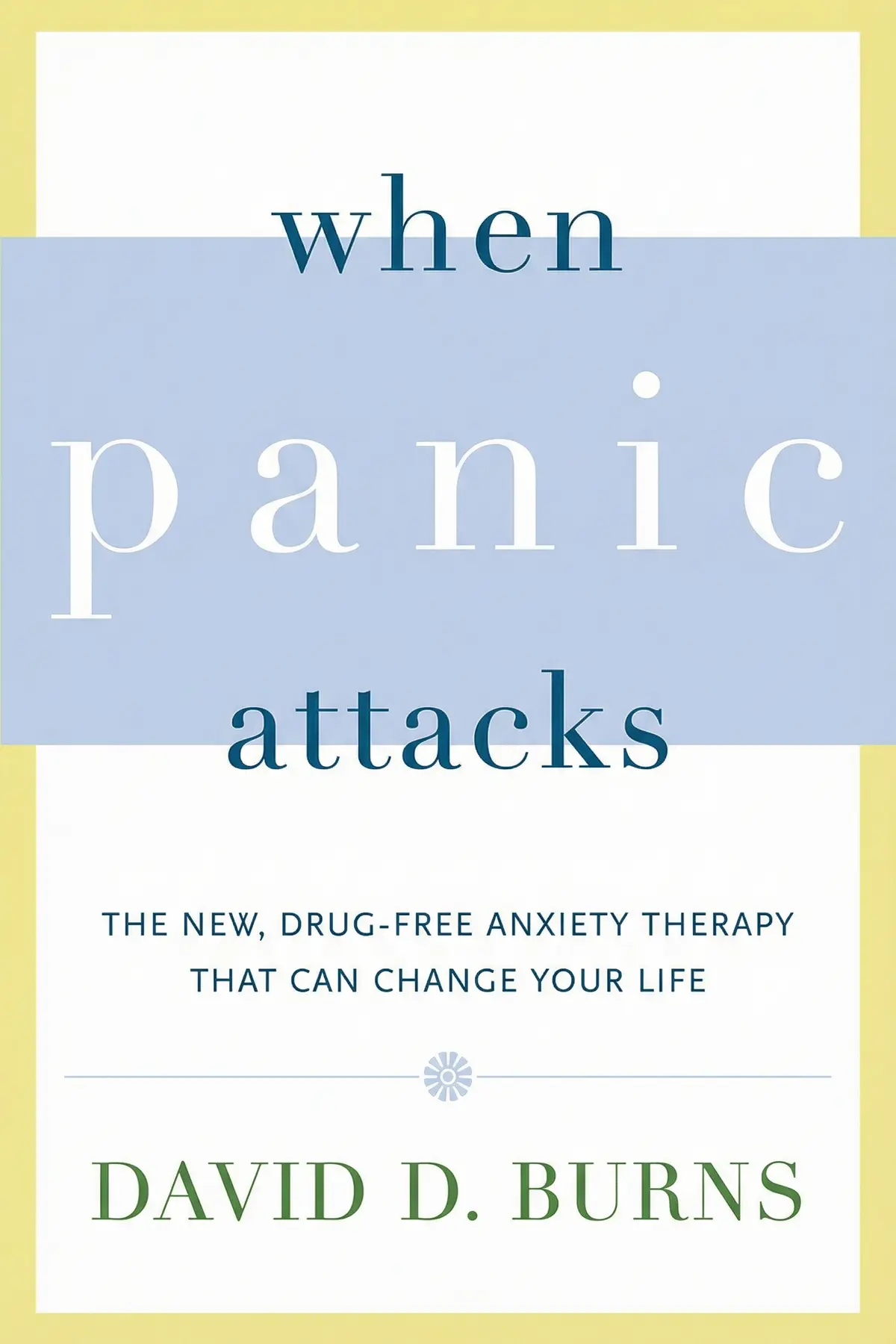
If anxiety has started running your days, with dread before ordinary events or sudden waves of panic, the usual advice is to find the right pill. In When Panic Attacks, psychiatrist David D. Burns argues for another route: the thoughts and habits that feed anxiety can be changed directly, without drugs. He points to a study in which a popular antidepressant, an herbal remedy and a placebo led to recovery rates with no meaningful difference between them.
Burns’s case is that anxiety rests on things you can work on: beliefs you rarely question, fears you keep avoiding and feelings you keep out of sight. Change those, and panic loses its grip. His tools come from cognitive behavioral therapy, and some are oddly playful, from inflating your worst fear until it turns comic to asking for something ridiculous in a busy drugstore on purpose. Listen through and you will have a way to trace a worry to its root, exercises for shrinking it, and a plan for facing the situations you have been steering around.
2 min 11 sec
Two conditions that often arrive together, a diagnosis built on fuzzy criteria, and a study where a sugar pill held its own. Burns questions the standard story about anxiety before offering his own.
1 min 51 sec
Two people can face the same exam and feel completely different about it. Burns traces the gap to something that stays hidden on good days and only shows itself when things go wrong.
1 min 39 sec
Knowing what drives your anxiety does not make it go away. Burns offers a small experiment you can run on your own mind, and a way to look straight at the outcome you dread most.
1 min 58 sec
A psychologist made a deliberately embarrassing request in a crowded drugstore. A martial arts student imagined being the worst in history. Both were using the same odd weapon against fear.
2 min 00 sec
Avoiding what scares you feels like safety, yet it may be what keeps the fear alive. Burns describes several ways to step into the feared situation, from a gentle ladder to the deep end.
1 min 46 sec
A young woman had panic attacks whenever her boss came near. Another worried nonstop for half a century. In both cases the anxiety was covering for an emotion neither wanted to admit.
1 min 11 sec
Burns’s book adds up to a hopeful claim: anxiety behaves like a set of habits of mind, and habits can be worked on. Every tool he offers does the same job from a different angle. It drags something hidden into daylight, whether a rule about your worth, a fear you keep circling or anger you have been too polite to admit, and then lets reality test it.
That changes what you can do the next time anxiety spikes. Jot the thought down, then keep asking yourself what follows if it turned out to be real, until you arrive at the belief beneath it. Pick one situation you avoid, break it into a ladder of smaller steps, and climb one rung this week, staying until the fear settles. And when worry seems to come from nowhere, check whether there is someone you are annoyed with and haven’t told.
None of this is instant. Burns is clear that real change takes steady practice, and he keeps medication available alongside therapy. Yet the people in his pages, Mandy at her Aikido test, Terri choosing clothing design, Marci finally speaking up, all made the same discovery. The thing they feared most was smaller than the fear.
Anxiety that never really leaves, and the panic attacks that can come with it, is often treated as a chemical problem with a chemical answer. Psychiatrist David D. Burns disagrees. He argues that the evidence for the serotonin imbalance theory is weak, that much of the benefit of antidepressants comes from the placebo effect, and that cognitive behavioral therapy beats medication in the short run and over the long term. His alternative is a set of practical, often surprising techniques. Readers learn to dig beneath an anxious thought to the self-defeating belief that feeds it, weigh that belief's costs and benefits, rewrite it and test it. Humor exercises turn fears absurd. Exposure methods, from gentle step-by-step ladders to flooding and memory rescripting, wear fear down by facing it. The Hidden Emotion Technique shows how panic can stand in for anger or frustration a person is too polite to admit. The result is a toolkit for working on anxiety at its roots, with real cases, including a woman freed of panic once she admitted she hated her job.
People with persistent anxiety or panic attacks who want tools beyond medication.
Perfectionists and people-pleasers whose worry spikes around exams, presentations or conflict.
Anyone avoiding a feared situation, from needles to heights to public speaking, who wants a step-by-step way back.
David D. Burns, born in 1942 in Minneapolis, earned his medical degree at Stanford and trained in psychiatry at the University of Pennsylvania School of Medicine. His best sellers, including Feeling Good, The Feeling Good Handbook and Feeling Great, helped bring cognitive behavioral therapy to a broad public in the 1980s. He founded TEAM-CBT, an approach to treating depression and anxiety, won the A. E. Bennett Award for brain chemistry research, and was named Teacher of the Year three times by Stanford residents.
David D. Burns

Listeners find this guide highly effective for addressing anxiety, particularly depression and panic attacks, and they appreciate the hands-on exercises and practical tips. The material is logically organized and easy to understand, with one listener mentioning that the exercises uncover fascinating insights into their thought patterns. They value the cognitive behavioral therapy approach and consider the book life-changing, with some even declaring it saved their lives.
After hearing so much about Dr. Burns' work from my own therapist, I finally dove into this massive volume. It is essentially a toolkit for your brain that actually gives you something to do besides just talking about your problems until you're blue in the face. The 'Recovery Circle' and the specific daily mood logs were incredibly eye-opening for me because they forced me to confront the logic of my panic rather than just drowning in it. Frankly, I think some people might be put off by his anti-medication stance, but for me, it was empowering to think I could manage my physiology without a pill. The book is dense and requires you to actually pick up a pen and do the work, which isn't easy when you're feeling low. However, if you are willing to push through the exercises, the shift in perspective is absolutely life-changing. It’s the first time I’ve felt like I have a map out of the woods.
Show moreWow, I didn't expect the 'exposure model' to be the thing that finally broke my cycle of avoidance. For years, I’ve been running away from anything that made my heart race, thinking I was protecting myself, but Burns shows how that actually feeds the monster. I started using his techniques to lean into the discomfort instead of fighting it, and the results were almost immediate. The metaphor of the roller coaster really stuck with me: if you stop resisting the ride and just sit in it, the fear eventually loses its power over you. Truth is, the writing is a bit old-fashioned and clinical, but the practical value of the EAR communication secrets alone makes it worth the price of admission. It helped me realize that a lot of my social anxiety was actually just me trying to be perfect in every conversation. I feel much lighter now that I've stopped trying to please everyone.
Show moreFinally got around to reading this after struggling with a specific phobia of elevators for nearly a decade. I’ve tried other books that just told me to breathe and 'think happy thoughts,' which never worked when the doors actually closed. Burns is different because he gives you aggressive, actionable strategies to confront the fear head-on. The cost-benefit analysis exercise helped me see exactly how much my anxiety was stealing from my life. Not gonna lie, the exposure exercises he suggests are terrifying at first, but they are the only things that have actually moved the needle for me. This isn't just a book you read; it's a book you do. If you're tired of the 'talk therapy' loop where you just analyze your childhood forever, this will be a breath of fresh air. It’s practical, science-driven, and most importantly, it actually provides a way to measure your progress as you go.
Show moreThe chapter on antidepressants was a real eye-opener for me and gave me the courage to try a different path. I’ve been on various SSRIs for years with limited success, and reading the research Burns presented about placebos was shocking. Personally, I found the 'Daily Mood Check' to be the most effective tool in the whole book because it forces you to quantify your feelings. Once you see the numbers on the page, the anxiety feels less like an overwhelming cloud and more like a specific problem to be solved. The book is definitely long-winded, and he repeats his four models of anxiety quite a bit, but that actually helped the information sink in for me. I’ve recommended this to three friends already because the tools are just so practical. It’s less about 'finding yourself' and more about fixing the broken logic that keeps you trapped in fear.
Show morePicked this up during a particularly rough patch with health anxiety and found the cognitive model section to be quite grounding. Burns explains that our fear doesn't come from the situation itself but from the stories we tell ourselves, which sounds simple but is hard to internalize. The 'Hidden Emotion' model was a revelation for me because I realized my panic attacks were often just suppressed anger I was too 'nice' to express. Look, the book is definitely too long and gets very repetitive around the middle sections with the case studies. It feels like it could have been 200 pages shorter if he didn't recount every single dialogue he's ever had with a patient. Still, the sheer number of techniques offered—40 in total—means you’re bound to find at least one or two that stick. It’s a solid resource for anyone who prefers a structured, DIY approach to mental health rather than just venting.
Show moreTo be fair, the book is quite a heavy lift at over 500 pages, and it reads a lot like a textbook. If you're currently in the middle of a massive panic episode, this might be too much information to process all at once. I had to take it in small chunks over several months to really digest the CBT concepts. The most helpful part for me was the section on self-defeating beliefs, specifically 'achievement addiction' and how it was fueling my daily stress. I appreciate that he cites actual studies regarding the effectiveness of antidepressants compared to placebos, even if his conclusions are a bit controversial in today’s medical world. While some of the patient stories felt a bit too 'neat' and perfectly resolved, the actual worksheets are the best I've ever seen in a self-help book. It’s a high-quality manual for anyone willing to put in the grueling effort required for recovery.
Show moreIn my experience, most self-help books are 90% fluff and 10% substance, but this one reverses that ratio. Dr. Burns provides a staggering amount of data and various techniques, which is great because anxiety isn't a one-size-fits-all problem. I particularly liked the 'Double Standard Technique' where you talk to yourself like you would a dear friend; it really highlighted how cruel my internal monologue had become. My only real gripe is that the author can be a bit dismissive of people with more complex diagnoses like BPD or bipolar disorder, acting as if everything can be solved with a thought log. For generalized anxiety and panic, though, it’s top-tier stuff. The writing style is accessible enough for a layperson while remaining grounded in clinical practice. It helped me stop viewing my panic as a 'sickness' and start seeing it as a series of manageable, albeit annoying, cognitive distortions.
Show moreAs someone who has struggled with 'nice person syndrome' my entire life, the Hidden Emotion model was a total game-changer. I always thought I was just an anxious person by nature, but it turns out I was just terrified of conflict. This book taught me how to identify the specific situations I was avoiding and how to express my feelings more directly using the EAR technique. The tone is a bit clinical, and the author's ego definitely peeks through in every single chapter, but the results are hard to argue with. I especially liked the sections on 'Self-Defeating Beliefs' because they got to the root of why I was so stressed in the first place. It’s not a magic cure, and you have to be prepared to do a lot of writing and self-reflection, but it’s a very solid roadmap. It’s much more useful than the vague advice you usually get in this genre.
Show moreIs it helpful? Yes. Is it repetitive? Absolutely. I felt like I was reading the same chapter over and over again with just different patient names swapped in. Dr. Burns is clearly a leader in the field of CBT, but he could really use a more aggressive editor to trim the fat from this 500-page beast. To be honest, I got stressed out just looking at the sheer volume of worksheets I was supposed to complete. Some of the techniques felt a bit childish, like the 'shades of grey' thinking, though I can see how they would work for someone who is really stuck in all-or-nothing patterns. It’s a good reference to have on the shelf, but I wouldn't call it a page-turner. If you have a specific phobia, go for it, but if you have generalized anxiety, you might find the 'quick fix' stories a bit frustrating and unrealistic.
Show moreLet’s be real: the author sounds incredibly full of himself throughout most of this book. I struggled to get past the tone, which feels like he’s constantly patting himself on the back for being a 'miracle worker' psychiatrist. Every patient example he provides seems to follow the same unbelievable script where they have a decades-old trauma that magically vanishes after one or two sessions of his specific exercises. It feels more like a long sales pitch for his own brilliance than an empathetic guide for people who are truly suffering. To be fair, there are a few decent worksheets in here, but his dismissive attitude toward biological causes and traditional medication is borderline dangerous for people with severe chemical imbalances. I found the 'miracle cure' narratives more stressful than helpful because they made me feel like a failure when his techniques didn't work for me in thirty minutes. Save your money and find a more humble resource.
Show moreBurns argues that anxiety and panic are driven by things a person can change: self-defeating beliefs, fears kept alive by avoidance, and emotions pushed out of awareness. Using cognitive behavioral therapy, he offers drug-free techniques to uncover and change each one. He also questions the serotonin imbalance theory and cites research in which CBT outperformed medication in the short run and over the long term.
They are lasting attitudes that make a person vulnerable to anxiety, such as perfectionism or the conviction that happiness depends on being loved. Burns splits them into individual beliefs about personal worth and interpersonal beliefs about relationships. To uncover one, take a distressing thought and keep asking yourself what follows if it turned out to be real. Then weigh its costs and benefits, rewrite it and test the new version.
Exposure means facing the feared situation until anxiety falls on its own. Burns describes gradual exposure, such as moving from imagining a blood test to having one, and flooding, such as standing atop a tall ladder. Response prevention resists compulsive rituals, while cognitive flooding and memory rescripting work on fears held in the mind. He suggests starting with a Fear Hierarchy ranked from mildest to worst.
It is Burns’s method for finding a suppressed feeling behind anxiety. He argues that very nice people who avoid conflict often bury anger or frustration, and the anxiety stands in for it. Terri’s panic attacks ended after she admitted she disliked her job, and Marci’s fifty years of worry eased once she voiced resentment toward her family. The step is to name the feeling and act on it.
No. Burns is skeptical of the chemical imbalance theory and cites a study where Zoloft, St. John’s wort and a placebo showed no significant difference in recovery. He warns against relying on benzodiazepines because they can be addictive and cause withdrawal. Yet he notes that combining CBT with medication may produce the best outcomes, so any change belongs in a conversation with a doctor.





Alcoholics Anonymous World Services

Steven C. Hayes


AUDIO SUMMARY AVAILABLE
Get the key ideas from When Panic Attacks by David D. Burns, plus 5,000+ more nonfiction titles.









