

15 min
Available in: English
What the Heck Is EOS?: A Complete Guide for Employees in Companies Running on EOS
Explains, for employees, how the Entrepreneurial Operating System works: its six components, tools such as Rocks, Scorecards and weekly Level 10 meetings, and the part each person plays in making it succeed.
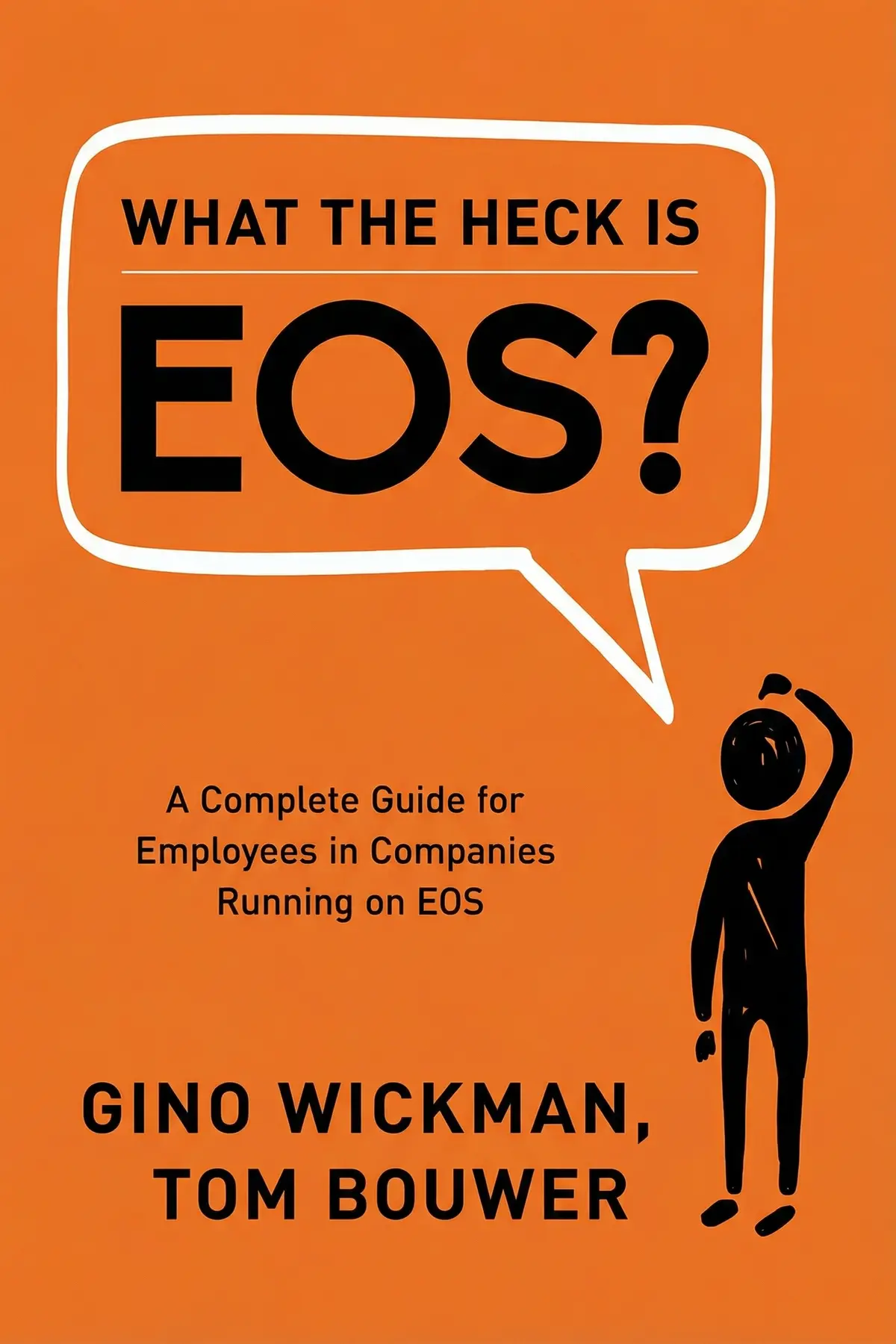
Table of Content
1. Introduction
1 min 02 sec
Most frustration at work comes from confusion rather than lack of effort: priorities that clash, meetings that drift, and nobody quite sure who owns what. In What the Heck Is EOS?, Gino Wickman and Tom Bouwer argue that average performers sharing one system will beat gifted people who each work their own way. Their system is EOS, the Entrepreneurial Operating System, built for entrepreneurial companies of roughly 10 to 250 people.
Written for employees rather than bosses, the book explains six components and the plain tools that make each one real. Its central claim is that those tools only work when every person owns a piece of them: a seat, a number, a few 90-day goals and an honest voice in a weekly meeting. By the end, every EOS term will make sense, your own job will have a clear place in the system, and you will know what to do on Monday to make it pay off.
2. Trade private work habits for one shared system
1 min 53 sec
An IT services company in Atlanta began losing clients, staff and money. Each project manager there had built a separate system for running jobs. The real problem was hiding in plain sight, and it may be slowing your workplace down too.
3. Put the whole company's direction on one page
1 min 59 sec
Managers at one telecom firm were asked a single simple question about their own company, and their answers exposed why their staff felt lost. A one-page document is meant to stop that from happening.
4. Know your seat and whether it fits you
1 min 42 sec
Missed deadlines and duplicated work often trace back to one small gap in how a company is drawn on paper. Fixing it reveals something harder: whether each person truly belongs in the role they hold.
5. Pick a few Rocks and leave the sand for later
1 min 54 sec
Ambitious plans tend to fade a few months in, no matter how motivated the team. A picture of a jar explains why, and a deliberately imperfect target keeps people from playing it safe.
6. Run a weekly meeting that actually solves problems
1 min 52 sec
Most meetings eat time and settle nothing, so most people dread them. One weekly format runs on a fixed clock and a fixed agenda, and it even asks the team to grade itself before leaving.
7. Give every person a number to own
1 min 50 sec
Telling people to work harder means little when nobody can see the score. A short weekly sheet changes that, but only if it tracks the right kind of number and puts the right name beside it.
8. Make the system work by owning your part
1 min 44 sec
A village story about two boys, a wise man and a hidden bird carries the book’s final message. A 20-question survey then shows how far most companies still have to go.
9. Conclusion
1 min 04 sec
What the Heck Is EOS? makes a modest-sounding claim with large effects: a company becomes calmer and faster when everyone uses the same plain tools, and those tools are only as good as the people who pick them up. The Atlanta firm never lacked talent. It lacked one shared way of working, and the price came in lost clients, staff and money.
The book also hands real power to the employee. No title is needed to make EOS work. What matters is knowing which seat belongs to you, and whether you understand the role, desire it and have the capacity to handle it. You need one number you watch every week, and one to three Rocks written clearly enough that day 90 settles the question. And you need to carry real issues into the weekly meeting instead of carrying them around in silence.
Start with whichever of those you cannot answer today. The wise man’s reply to the two boys fits here as well: what happens next is in your hands.
About this book
What is this book about?
When a company grows, confusion grows with it. Managers give conflicting instructions, every team invents its own way of working, meetings drift and nobody is sure who owns what. Gino Wickman and Tom Bouwer argue that the cure is one shared operating system, and that ordinary people following it will outperform talented people each going their own way. Their system is EOS, the Entrepreneurial Operating System, designed for entrepreneurial companies of roughly 10 to 250 people. Six parts hold it up: vision, people, data, issues, process and traction. Each comes with a practical tool, from the one-page Vision/Traction Organizer and the Accountability Chart to quarterly Rocks, weekly Scorecards, the People Analyzer and the 90-minute Level 10 meeting. What sets this book apart is its audience. It is written for employees rather than leaders, so it explains every term in plain language and shows where each person fits. Readers learn what their seat requires, how to choose and write their 90-day goals, which number they should own, how to take part in weekly meetings, and why the whole system stalls unless they commit to it themselves.
Book Information
Who it's for
Employees new to EOS
Employees whose company has just adopted EOS and who want the jargon explained in plain words.
New hires and teammates
New hires and team members unsure what Rocks, Scorecards or L10 meetings ask of them.
Team leads and owners
Team leads and owners who want one clear guide to hand their staff before rolling out EOS.
About the Author
Gino Wickman
Gino Wickman became an entrepreneur at 21 and at 25 took over his family's heavily indebted business, turned it around, ran it for seven years and sold it with his partners. He then created EOS and cofounded the coaching firm EOS Worldwide; his books include Traction. Tom Bouwer, president of The Bouwer Group, has started three companies in Turkey and led more than 1,000 full-day client sessions, from start-ups to Fortune 50 firms, drawing on over 30 years of global management and coaching experience.
Ratings & Reviews
Ratings at a glance
What people think
Listeners find this book offers an excellent introduction to EOS, breaking down fundamental ideas in an understandable way and acting as a useful tool for both long-term staff and fresh hires. Furthermore, the content is direct and accessible, and one listener pointed out how interesting the section on scorecards is. Listeners also value its clear organization and logical flow, with one individual praising the thorough explanation of company hierarchy and another specifically citing the useful recaps provided at the conclusion of every chapter.
Top reviews
Nadia
The chapter on company structure and the "Accountability Chart" alone made this worth the purchase for our small team. After hearing about the EOS framework from a colleague, I wanted something straightforward that my staff could digest without feeling overwhelmed by corporate jargon. This book delivers exactly that, laying out the organizational structure in a way that makes the "Right People in the Right Seats" concept feel attainable rather than just a buzzword. It’s organized beautifully, and the easy-to-read layout ensures that even the busiest employees can finish it during a lunch break. Personally, I found the lack of dense theory refreshing because it focuses on immediate implementation. This is the perfect resource for onboarding new hires into an EOS-driven culture.
Show moreWilliam
To be fair, I wasn't expecting much from a book with such a casual title, but it ended up being the most practical thing I've read all year. It strips away all the fluff you usually find in management books and gets right to the heart of how a business should actually function. The way it describes the "Visionary" vs. "Integrator" roles helped me finally understand why our leadership team was always clashing. It’s an engaging presentation of the scorecard and other tools that we could start using the very next day. I highly recommend it for any team member who feels lost in the day-to-day shuffle of their company. It gives you a vocabulary to discuss problems and a framework to solve them effectively.
Show moreSangduan
Finally got around to reading this intro guide after our leadership team decided to overhaul our operations. It provides a remarkably clear overview of the system, breaking down complex management ideas into bite-sized pieces that anyone can grasp in a single sitting. The section on scorecards was particularly eye-opening because it explains exactly how to track weekly metrics without getting bogged down in unnecessary data. Truth is, the simplicity is the book's greatest strength, though I can see why some might find it a bit too basic. The summaries at the end of each chapter are helpful for quick reference during meetings. While the constant testimonials from other companies felt a bit like a sales pitch, the core concepts are solid enough to stand on their own. It’s a great resource for getting the whole team on the same page quickly.
Show moreAmelia
Picked this up because my boss mandated it for the whole department, and I was pleasantly surprised by how quickly I got through it. The authors do a great job of explaining how the "scorecard" works to keep everyone accountable without making it feel like micromanagement. I've worked for several small businesses that were total chaos, and I can see how this structured approach would have saved them a lot of headaches. My only gripe is the constant "rah-rah" tone and the endless stream of customer testimonials that interrupt the flow of the instructional content. Still, it’s a very straightforward and easy read that gives you a clear roadmap for what to expect in an EOS company. The summaries are a nice touch for busy professionals who need a refresher.
Show moreSarawut
Ever wonder why business books are so thin on content but thick on pages? While that is somewhat the case here, the core concepts are actually quite brilliant, especially the way they approach trimming the fat from unproductive meetings and getting everyone aligned on the same vision. The writing style is very basic, and I found myself skimming through certain sections that felt like filler, but the layout of the company structure is helpful. Not gonna lie, I was hoping for more depth regarding implementation challenges, but it serves its purpose as an introductory guide for employees. It lacks the intellectual meat of some larger volumes, but for getting a whole staff to understand the basics of a scorecard, it hits the mark.
Show moreGift
Not what I expected, but in a functional way that actually helped our team get organized. I’ve been through plenty of corporate training sessions that were total wastes of time, but the EOS system feels grounded in reality. The book is written in a very accessible way, making the "Scorecard" and "Rocks" concepts easy to understand for everyone from the front desk to the executive suite. While I agree with other reviewers that it can feel a bit like a sales pitch at times, the actual tools provided are incredibly useful for maintaining a weekly rhythm. The layout is clean, and the summaries make it easy to go back and find specific details later. It’s a quick read that provides a solid foundation for any company looking to improve its internal operations.
Show moreAnucha
Gotta say, I was skeptical about another "operating system" for business, but the straightforward nature of this book won me over. It avoids the dense, academic language of most business texts, making the key concepts of EOS clear for every level of the organization. I particularly liked the detailed layout of the company structure and how it clarifies who is responsible for what. In my experience, most workplace issues stem from a lack of clear expectations, and this book addresses that head-on. There are some repetitive parts and a few too many quotes from other CEOs, but the overall value as a resource for new employees is undeniable. It makes the transition to a new way of working feel manageable and even exciting.
Show moreGun
As someone who just started at a firm using EOS, I found this to be an adequate, if uninspiring, introduction to the terminology we use daily. Frankly, it’s a bit patronizing at times, assuming the reader has never held a job or attended a meeting before. The concepts are definitely useful—especially the focus on Rocks and the Level 10 meeting format—but the delivery is incredibly dry and repetitive. I appreciate the clarity and the chapter-end summaries, but I wish there was more hard data to back up the claims made about the system's effectiveness. It works well as a glossary for the company culture, but don't expect a deep dive into business strategy. It’s more of a "how-to" for subordinates than a comprehensive guide for leaders.
Show moreJirapat
Reading this was an exercise in frustration because the actual content could easily have been condensed into a five-page PDF or a single well-structured email. To be fair, the underlying principles of the Entrepreneurial Operating System are quite logical, but the book is bloated with repetitive anecdotes and self-congratulatory quotes from satisfied clients. It honestly felt like I was reading a script for a multi-level marketing seminar rather than a serious business manual. The font size is massive and there is so much white space that it feels like they were desperately trying to reach a specific page count. If you already understand the basics of accountability and meeting structure, you won't find much new information here. I spent more time filtering through the "cheerleading" than I did learning actual management techniques.
Show moreRome
This book is essentially a glorified pamphlet that has been stretched out to justify a cover price. It’s hard to consider this a real book when the font is this large and the content is mostly just rehashed concepts from better business authors. Where is the evidence? The authors claim tens of thousands of companies use this, yet they provide zero data or empirical studies to prove it actually increases the bottom line. Look, if you need a guide on how to show up to a meeting on time and track a few numbers, maybe this helps. But for any seasoned professional, this is basic stuff you should have learned in your first year on the job. It’s a disrespect to the reader’s intelligence to charge money for what is essentially marketing material for their consulting services.
Show moreQuestions about this book
What is the main idea of What the Heck Is EOS?
Gino Wickman and Tom Bouwer argue that a company works best when everyone follows one shared operating system instead of inventing their own methods. The system EOS offers is built from six parts: vision, people, data, issues, process and traction. The book is written for employees, and its central point is that the tools only work when each person commits to them, from owning a weekly number to raising problems honestly in meetings.
What are Rocks in EOS?
Rocks are the three to seven most important priorities a team must finish in the next 90 days. Individual employees usually take one to three, linked to their manager’s or the company’s Rocks. They should be specific, measurable, attainable, realistic and timely. The goal is to complete at least 80 percent, because a 100 percent standard tempts people to pick easy goals rather than the most important ones.
What happens in an EOS Level 10 meeting?
The Level 10 meeting runs weekly for about 90 minutes at a fixed time with a fixed agenda. The team shares good news, reviews its weekly numbers, checks Rocks, hears customer and employee headlines, and reviews last week’s to-dos. The bulk of the meeting is spent on spotting, discussing and resolving the issues that matter most. It ends on time with a recap, messages to pass to other teams, and a rating of the meeting.
What is the GWC test and the People Analyzer?
The People Analyzer tests if a person is in the seat that suits them and is the right fit for it. It scores how steadily a person lives out the company’s core values, and it applies the GWC test: does the person understand the role, desire it, and possess the capacity for it? The result shows whether someone fits their current seat, would suit another role better, or might be happier at a different company.
How can an employee apply EOS in their daily work?
The authors suggest owning a few concrete things. Know the duties of your seat on the Accountability Chart and test yourself against them. Track the number you are responsible for each week. Write one to three clear Rocks each quarter and treat them as the core of your job. Bring real issues to the weekly Level 10 meeting and discuss them openly instead of waiting for someone else to raise them.
Readers also enjoyed





A Year with Peter Drucker: 52 Weeks of Coaching for Leadership Effectiveness
Joseph A. Maciariello



Acting with Power: Why We Are More Powerful Than We Believe
Deborah Gruenfeld

All In: How Great Leaders Build Unstoppable Teams
Mike Michalowicz

AUDIO SUMMARY AVAILABLE
Listen to What the Heck Is EOS? in 15 minutes
Get the key ideas from What the Heck Is EOS? by Gino Wickman, plus 5,000+ more nonfiction titles.
- 5,000+ titles
- Listen as much as you want
- 7-day free trial
- Cancel anytime









