How to Be a Great Boss
Gino Wickman
 English
Shows how a stalled, growing company can get out of firefighting by using one simple operating system: clear roles, values you can observe, a weekly scorecard and focused 90-day priorities.
1 min 05 sec
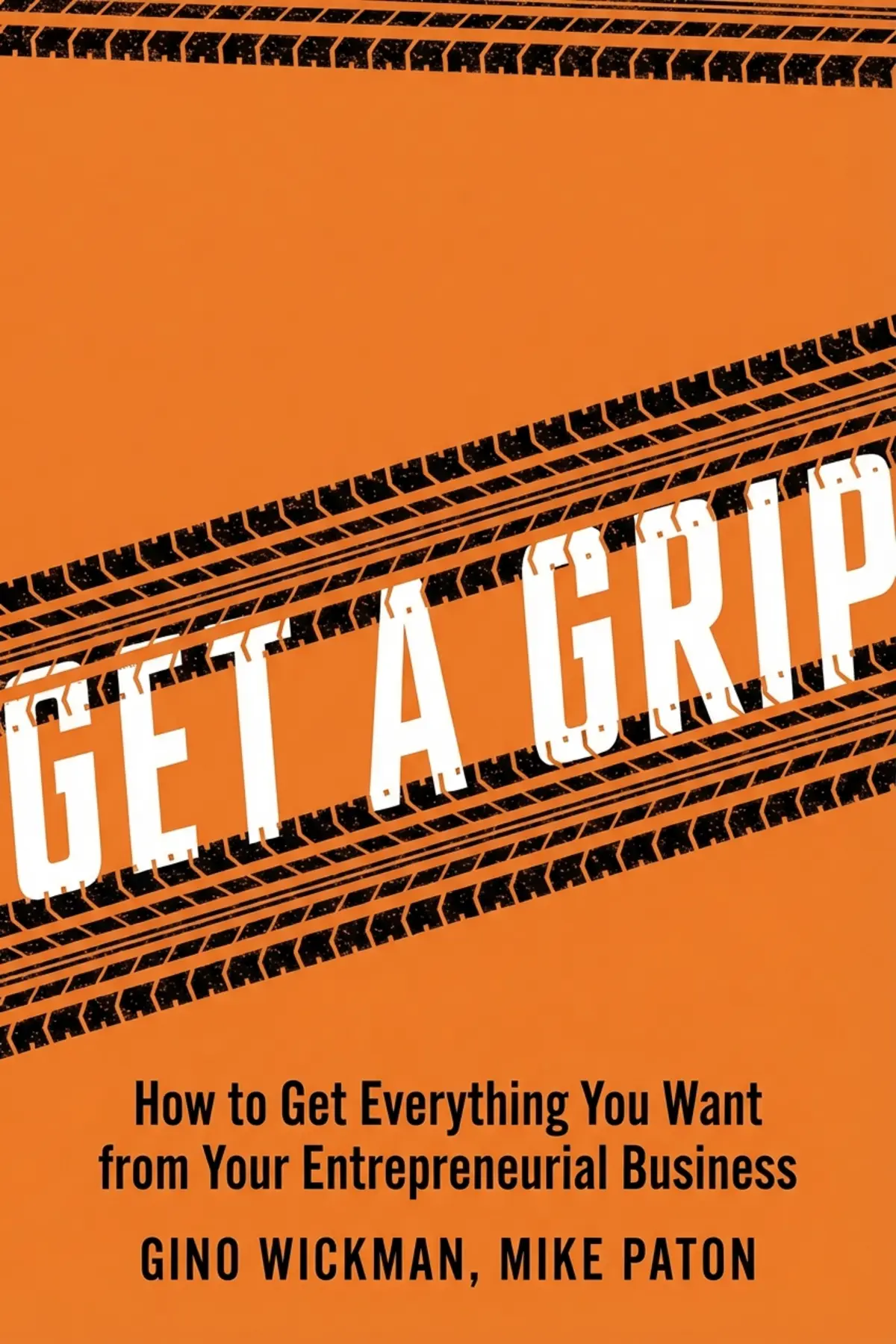
If you run a growing company, you may be working longer hours while the business slides backward. In Get A Grip, Gino Wickman and Mike Paton argue that this kind of stall points to a broken system, and that blaming people or pushing harder will not repair it.
They make the case through a fable. Swan Services is a fictional $7 million company. Right after their best year, its founders, Eileen and Vic, watch sales slip, clients leave and their own partnership crack. A consultant named Alan rebuilds the company on the Entrepreneurial Operating System, or EOS. Their argument is that a business which has outgrown its old way of running needs structure and discipline, applied week after week, until it can run without its founders holding it up.
Follow Swan’s year and you leave with a working kit: a meeting score worth taking seriously, a weekly scorecard, values you can hire against, a few 90-day priorities and a way for founders to step back.
1 min 55 sec
A company that grew for a decade can fall apart in a single year, right after its biggest success. The reason has little to do with talent, and a spreadsheet can make it worse.
2 min 17 sec
Swan’s leaders rated their own meetings 4 out of 10, yet kept holding them. The fix their consultant offered looks almost too plain to work, until you see what happens when its parts run together.
2 min 10 sec
When a whole team shares a responsibility, something strange happens to it. Swan’s sales group discovered the cost, and a simple drawing of seats changed how fast its leaders could decide.
2 min 04 sec
Most company values sound fine on a wall and change nothing. Swan found out why during an awkward rating session that put its own CFO below the bar, and the values that followed were very different.
2 min 02 sec
Coaching seemed to work on Swan’s difficult CFO, at least for a while. What happened under pressure is a pattern many managers know, and Swan’s answer starts long before anyone is hired.
1 min 46 sec
Some of Swan’s biggest clients were costing it money and morale. Ranking customers on two overlooked measures changed that, and the final test of the company’s recovery had nothing to do with revenue.
1 min 21 sec
Swan Services is invented, but the authors built its troubles from patterns every growing company meets: a ceiling nobody saw coming, meetings that go in circles, a talented person who poisons the team, founders who cannot step away. The book’s answer is unglamorous. Growth that lasts comes from a handful of habits repeated every week and every quarter, and the drama fades as those habits take hold.
What stands out is how much of the fix is about clarity. One name in each seat. Values you can watch in action. A customer described precisely. A few numbers checked weekly, and only a few Rocks at a time. Each one removes a question people used to fight about.
If your company feels stuck, the first moves come straight from Swan’s year. Ask your team to rate your meetings out of 10 and take the score seriously. Choose the 5 to 15 numbers you want on one page every week. Set only a few 90-day priorities and aim to finish most of them. And look hard at the one person or client you keep hoping will change.
Eileen’s measure of success was not a revenue line. It was leaving the office in time for a soccer game, knowing the company would still run without her.
Many owners hit the same wall. The company grew for years, and then sales slip, clients leave, meetings go in circles and the leaders start blaming each other. Gino Wickman and Mike Paton argue that this is a sign the business has outgrown the way it was run, and that the answer is a better system. They tell the story as a fable. Swan Services is a fictional $7 million company whose founders, Eileen and Vic, nearly lose both their business and their partnership right after their best year. A consultant named Alan introduces the Entrepreneurial Operating System, or EOS, which rests on Vision, People, Data, Issues, Process and Traction, six parts in all. Over the following year, Swan works through what EOS asks of it. The company sets one accountable owner for every function, writes core values based on behavior, narrows its target market, parts ways with a talented but toxic CFO, tracks a few numbers every week and commits to 90-day priorities called Rocks. Readers get a practical model of how a company moves from chaos to a business that does not depend on its founders every day.
Founders and owners whose company has stopped growing despite longer hours.
Leadership teams stuck in meetings that end without decisions and in finger-pointing.
Managers keeping a talented but difficult person and wondering whether they will ever change.
Gino Wickman took over his debt-laden family business at 25, turned it around, ran it for seven years and sold it with his partners. He then created the Entrepreneurial Operating System and cofounded the coaching company EOS Worldwide. He also wrote Traction. Mike Paton came from banking and helped run four growing small companies. He found EOS while leading a $7 million company in Minneapolis. He later succeeded Wickman as Visionary at EOS Worldwide, hosts The EOS Leader podcast and has led more than a thousand full-day EOS sessions for company leadership groups.

Listeners view this as essential reading for business leadership teams, effectively clarifying concepts and acting as a functional manual for applying the Entrepreneurial Operating System. They value the compelling storytelling method, with one listener remarking that the narrative successfully animates the system, and consider it a perfect partner to Traction. This title is highly regarded for its accessibility, real-world utility, and user-friendly nature.
This book is essentially the missing manual for business owners who felt 'Traction' was a bit too dry or academic. By following the fictional journey of Swan Services, Wickman and Paton breathe life into the EOS framework in a way that feels incredibly grounded. I have consumed dozens of management books over the years. However, seeing the messy, human side of Eileen and Vic trying to fix their company made the concepts click for me. It isn't just theory. It is a play-by-play of the friction, the tears, and the hard decisions like letting go of a toxic high-performer. While the dialogue can feel a bit staged at times, the practical application of 'Rocks' and 'Scorecards' is crystal clear. If you are tired of theoretical fluff and want to see how a real turnaround happens, this is your blueprint.
Show moreAs someone who struggled to visualize how 'Rocks' and 'L10 meetings' actually function in a messy office environment, this was a godsend. Most business books tell you what to do, but this one actually shows you how it looks when things go wrong during the implementation. Seeing Alan guide the team through their first quarterly session helped me anticipate the pushback I might get from my own staff. To be fair, the characters are a bit stereotypical of the management world. Yet, their struggles with growth ceilings felt 100% authentic to my own experience. It’s a transformative look into how a company can regain focus by simply simplifying their core processes. I’d recommend this as the second read in your EOS journey after you’ve tackled the foundational theory in Traction. It’s practical, engaging, and ultimately very motivating for any tired entrepreneur who feels stuck.
Show moreThe chapter on cleaning up the leadership team hit way too close to home for my comfort level. I’ve been in Vic’s shoes, watching a once-thriving company slowly unravel while the founders clash over every single tiny detail. This book provides a clear path out of that chaos by emphasizing the need for 'right people in the right seats.' Using the People Analyzer tool on fictional characters made it much easier for me to objectively look at my own organization. Frankly, the narrative format is much more digestible than a standard business text, and it helped me remember the core values we’ve let slide. It’s about moving from a founder-dependent model to a scalable enterprise that can function without constant firefighting. Even if you aren't fully committed to the EOS system yet, the lessons on delegation and prediction are worth the price of admission. It’s an essential read.
Show morePicked this up during a period of absolute chaos in my own startup when everything felt like it was unraveling at the seams. What I loved most was how clearly Wickman links healthy systems to healthy people, proving that structure is actually the key to freedom. The transformation of Swan Services from a bureaucratic mess into a streamlined machine was both inspiring and deeply relatable for me. I especially appreciated the lessons on narrowing the target market; chasing every client is a recipe for disaster that we’ve tasted too many times. Implementing the 'Level 10 Meeting' structure has already saved us hours of pointless circular discussion every single week. This book proves that success comes from discipline and shared accountability rather than just working seventy-hour weeks. It’s a must-read for any entrepreneur who wants to reclaim their personal life while still growing their company.
Show moreGotta say, I was skeptical about a 'business novel' at first, but the narrative of Swan Services makes the theory stick better than any textbook. The way Alan, the consultant, interacts with the team provides a great template for how to handle internal resistance during a major transition. It was fascinating to see how the company’s new discipline extended beyond the leadership team to their actual client relationships and profitability. They didn't just fix their internal meetings; they fundamentally changed how they viewed their entire market and core focus. While the writing is definitely elementary at times, the clarity it provides for implementing the six components of EOS is unmatched. This book brings the system to life through a relatable story that makes you want to go out and fix your business immediately. It’s a brilliant companion to Traction and a very practical guide for any management staff.
Show moreEver wonder why your leadership team feels like it’s rowing in opposite directions despite everyone working their tails off? Get A Grip provides a front-row seat to that exact frustration and then meticulously shows you how to solve it. Using the narrative of a struggling company, the authors demonstrate the sheer power of the Entrepreneurial Operating System in real-time. Personally, I found the breakdown of the 'Visionary' vs. 'Integrator' roles to be the most enlightening part of the entire experience. It helped me realize that my own business wasn't failing due to a lack of talent, but rather a lack of structured accountability. The story format makes it a very quick read. Some might find the ending a little too perfect for a real-world scenario, but it is still a fantastic companion for anyone already familiar with the Traction library.
Show moreFinally got around to reading this after my business partner wouldn't stop raving about the EOS framework for months. I’m glad I did because the storytelling approach really itched my brain in the right way by putting the tools into perspective. The way they portrayed the conflict between Eileen and the rest of the leadership team felt like a mirror to our own boardroom battles. Not gonna lie, the part where they finally addressed the cultural misfits on the team was the most satisfying chapter of the book. It highlights the painful truth that you can't grow if you're holding onto the wrong people, no matter how skilled they might be. My only gripe is that it feels a bit like a long advertisement for the EOS coaching system. Regardless of that, the takeaways on accountability and 'Same Page Meetings' are immediately actionable for any small business owner.
Show moreWow, the storytelling approach really makes the complex organizational principles of the Entrepreneurial Operating System feel attainable for a mid-sized firm. Instead of just listing the six components, the authors walk you through the 'Identify, Discuss, Solve' method in a way that actually makes sense. I appreciated how the book didn't shy away from the awkwardness of the first few EOS meetings where everyone is still figuring out the rhythm. In my experience, most companies fail because they lack this kind of rigorous structure, not because they lack a good product. The focus on data-driven scorecards instead of emotional hunches is a lesson every founder needs to hear repeatedly. While some of the dialogue is a bit clunky, the underlying message about discipline over charisma is incredibly powerful. It’s a great guide for anyone who feels like their business has plateaued.
Show moreLook, the business parable format is definitely an acquired taste that might irritate some seasoned executives who prefer data over drama. While I think this is a wonderful success story for the EOS model, I could not easily piece everything together without having read Traction first. The book serves as a canned explanation of how a rollout works, but it lacks some of the deep theory behind why certain steps are necessary. That being said, it does a great job of showing the 'rhythm' of the system, specifically the 90-day world and the importance of quarterly Rocks. I found the sections on documenting core processes to be a bit brief compared to other parts of the narrative. It’s a solid 3-star read for the practical examples, but don't expect it to replace the more technical manuals. Good for an introduction, but maybe not the only book you should rely on.
Show moreNot what I expected, to be frank, as the writing style felt incredibly elementary and a bit patronizing at points. The book utilizes a Socratic method to tell the story of a nondescript company, but it comes off feeling like a dry After School Special for managers. While I understand the goal is to make EOS accessible, the 'See Jane Run' prose made it difficult for me to take the strategic advice seriously. Everything is presented in a way that feels laughably contrived, especially the way they handle the departure of the CFO, Carol. Truth is, I would have much preferred a straightforward manual over this saccharine business fable. If you are a fan of 'The Goal' or other business novels, you might enjoy this, but for me, the cheese factor was simply too high to overcome. It felt more like a marketing brochure than a serious guide.
Show moreIt is a business fable about Swan Services, a fictional $7 million company that hits a wall right after its best year. Sales slip, clients leave and the founders turn on each other. A consultant introduces the Entrepreneurial Operating System, and over about a year the company rebuilds its structure, values, focus and meeting habits until it beats its revenue goals and no longer depends on its founders day to day.
The book describes Vision, People, Data, Issues, Process and Traction. Vision aligns everyone on shared goals. People means the right people in the right seats. Data is a weekly scorecard of 5 to 15 numbers. Issues uses Identify, Discuss, Solve. Process documents a few core processes at a high level. Traction sets 90-day priorities called Rocks and a fixed weekly meeting. The authors say the benefit comes when all six work together.
Rocks are a company’s priorities for the next 90 days. The authors argue that people lose focus about every quarter, so quarterly meetings create a 90-day world that pulls leaders out of firefighting. In the story, Swan learns that completing 80 percent of its Rocks takes hard focus, and that a few well-chosen goals work better than a long, ambitious wish list.
The authors argue that people who do not fit the culture rarely change and only hide it for a while. Swan used a three-strike rule, recorded specific incidents, held direct conversations and set clear expectations, while the partners met regularly to stay aligned. To prevent the problem, Swan used a Core Values speech in interviews to discourage poor fits and relied on referrals from trusted staff.
It suits owners and leadership teams of growing companies that have stalled, especially those with unproductive meetings, unclear roles or partners in conflict. Because it is told as a story, it also works for team members who want to understand how EOS feels in practice before adopting it, from writing behavioral core values to ranking clients by profitability and ease.



Margaret Heffernan





Joseph A. Maciariello


AUDIO SUMMARY AVAILABLE
Get the key ideas from Get A Grip by Gino Wickman, plus 5,000+ more nonfiction titles.