

13 min 23 sec
Available in: English
 ไทย
EnglishไทยTraction: Get a Grip on Your Business
By Gino Wickman
Traction shows business owners and leadership teams how to stop firefighting by getting six parts of a company clear and shared: vision, people, data, issues, processes and 90-day goals that each have one owner.
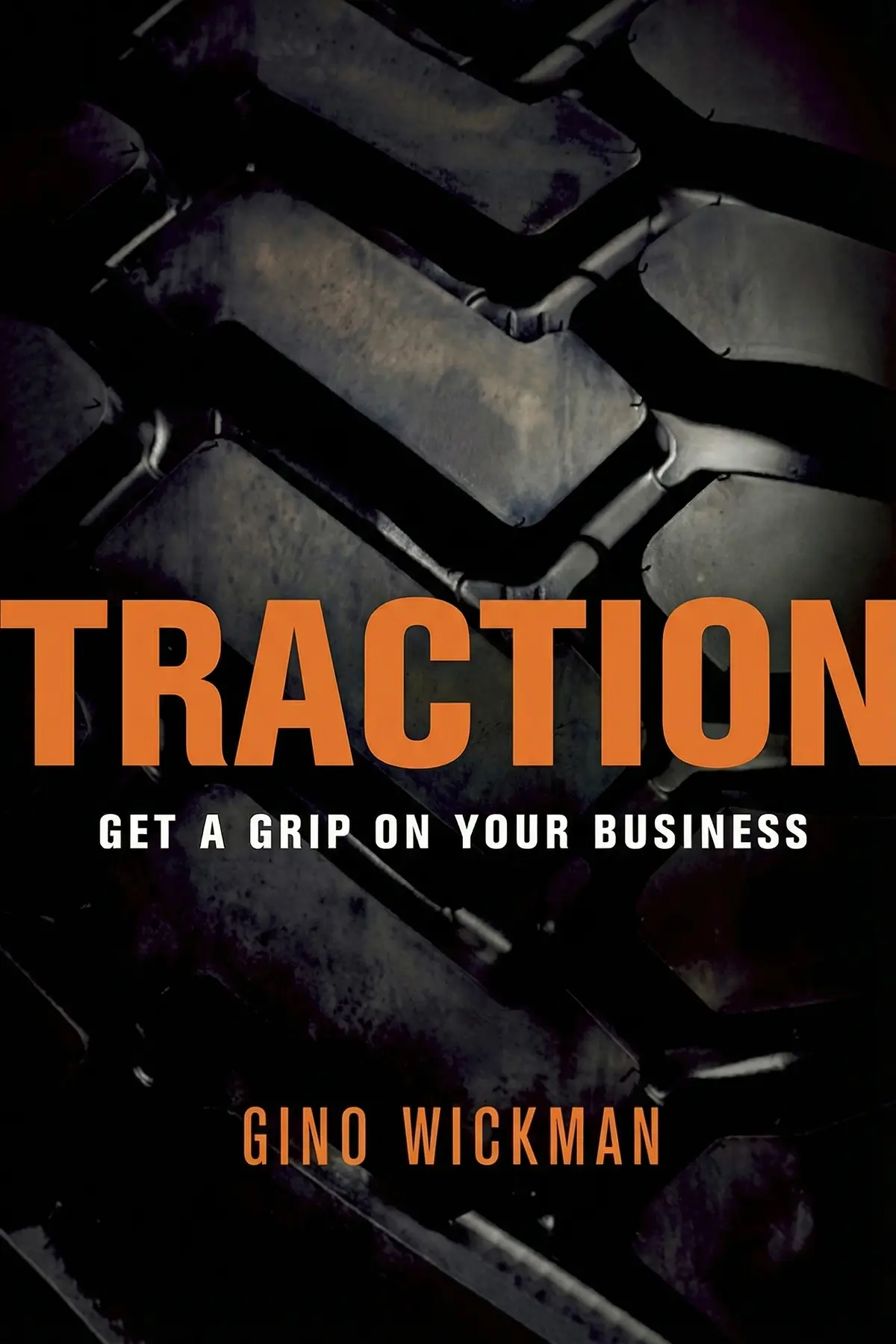
Table of Content
1. Introduction
1 min 06 sec
If your company feels busier every year yet harder to steer, the problem may be fewer moving parts than you think. In Traction, Gino Wickman, the entrepreneur who turned around his own debt-laden family business, argues that a company can get back on track by focusing on six elements: vision, people, data, issues, processes and quarterly goals, or rocks.
He bundles them into what he calls the Entrepreneurial Operating System, or EOS, which works like a short business plan built from answers to a handful of hard questions. The throughline is simple. A business gets a grip on its market when its leaders make each of those six parts clear, simple and shared, and then keep checking them every week and every quarter.
Wickman’s tools are plain on purpose: a grid for judging staff against your values, a weekly scorecard, a three-step routine for problems and 90-day goals with a single owner each. Every one of them can be tried at your next leadership meeting.
2. Give your company one direction everyone shares
1 min 52 sec
A printer service company drifted into computer networking and ran into trouble. What turned things around was its leaders reminding themselves of the company’s core focus, and the choice that focus led them to make.
3. Turn a ten-year dream into ninety-day steps
1 min 51 sec
Big ambitions usually die somewhere between the strategy offsite and next Monday. Wickman’s fix is a planning ladder with four rungs, plus a hard choice about which customers you will stop trying to please.
4. Put the right person in the right seat
1 min 55 sec
A brilliant engineer is next in line for an executive role, and he understands it and could do it well. Wickman explains why promoting him would still be a mistake, and how to see it coming.
5. Catch problems weekly before they grow expensive
1 min 54 sec
Most leaders learn about trouble when it is already costly. A short weekly sheet of numbers and a three-step meeting habit are meant to change that, provided one condition about your staff is met.
6. Strip the waste out of how work gets done
1 min 56 sec
Somewhere in most companies, people are carefully doing work that nobody needs. Wickman shows how writing a process down, step by step, exposes it, and why the final check leads back to your values.
7. Make every goal belong to exactly one person
1 min 45 sec
A leadership team can easily produce twenty goals for the coming quarter. Wickman explains what happens to most of them, and why sharing responsibility for a goal is the surest way to see it fail.
8. Conclusion
1 min 04 sec
Traction offers a set of habits that make a company easier to see. Values and focus say who you are. A ten-year target shrinks into ninety-day rocks. Two simple charts show whether people fit their roles. A scorecard and a short problem-solving routine reveal what is going wrong while it is still small, and written processes show where effort is wasted. Each tool turns a vague feeling into something a leadership team can point at and agree on, and that shared clarity is what Wickman means by traction.
You do not need all six parts at once to feel the difference. Write down your core values and check your team against them on a simple grid. Choose a handful of weekly numbers and give each one an owner. When the next quarter begins, cut your list of goals to around seven and make sure every one belongs to a single person.
ImageOne did not grow by adding a new division. It grew by remembering what it was for and letting go of what did not fit. Most companies have their own computer division somewhere, waiting to be named and dropped.
About this book
What is this book about?
Many companies feel busy and stuck at once. Staff argue, rules pile up, and leaders spend their weeks reacting to problems rather than steering. Gino Wickman, who took over his family's debt-laden business at 25 and turned it around, argues that most of this trouble traces back to six areas a leadership team can actually manage. He bundles them into the Entrepreneurial Operating System, or EOS. It starts with a vision built from core values and a core focus, then turns that vision into a 10-year target, a three-year picture, a one-year plan and 90-day milestones he calls rocks. After that it moves on to selecting suitable people and placing each one in a fitting role, following a weekly scorecard, tackling problems through a simple routine of identifying, discussing and solving, writing down and pruning core processes, and assigning one owner to each quarterly goal. Readers get a set of plain tools they can bring to their next leadership meeting: the People Analyzer, the Get Want Capacity test, the scorecard, IDS and the rock sheet. Each one turns a vague worry into something a team can see, discuss and agree on.
Book Information
Who it's for
Company owners feeling stuck
Owners of small and mid-sized companies who feel busy, stuck and short of a clear plan.
Leadership teams losing focus
Leadership teams whose goals drift and whose meetings end without decisions.
Managers deciding on roles
Managers deciding whom to hire, promote or move into a different role.
About the Author
Gino Wickman
Gino Wickman has been an entrepreneur since he was 21. At 25 he took over his family's business, which was deeply in debt, turned it around, led it for seven years and then sold it with his partners. He went on to help owners and leaders get better results from their companies, creating the Entrepreneurial Operating System and cofounding the coaching company EOS Worldwide. His other books include Get A Grip, How to Be a Great Boss and What the Heck Is EOS?
Ratings & Reviews
Ratings at a glance

What people think
Listeners find this business volume to be an exceptional resource that offers actionable tactics and a structured method for managing a company. The material is accessible and clear, with one listener pointing out its ability to make intricate ideas straightforward. Listeners value how well it produces tangible outcomes; one mentions significant improvements in meeting efficiency, while another emphasizes its capacity to create transparency across the entire firm.
Top reviews
Jeeranan
Stop trying to reinvent the wheel every Monday morning and just read this book. Wickman provides what he calls the Entrepreneurial Operating System, and for my small agency, it was the structural skeleton we were missing. The concept of 'Rocks'—those 90-day priorities that actually move the needle—completely shifted how our leadership team views productivity. To be fair, some of the terminology feels a bit forced, like they are trying to trademark common sense, but the results are hard to argue with. We implemented the Level 10 meeting format last month and our efficiency has already skyrocketed because we finally stopped talking in circles. It is a dense read if you are looking for a narrative, but as a manual for growth, it is unparalleled.
Show moreNarumon
Ever wonder why your team is constantly spinning their wheels despite everyone working eighty hours a week? Traction answers that question by forcing you to look at the six key components of your business with brutal honesty. We started using the Scorecard to track our weekly measurables, and it’s like someone finally turned the lights on in a dark room. No more managing by 'gut feeling' or reacting to the loudest problem of the day. The book is remarkably easy to digest, breaking down complex management theories into actionable steps that any entrepreneur can follow. It isn't just theory; it is a practical roadmap that provides the tools needed to actually execute a long-term vision without losing your mind in the process.
Show moreSam
Wow, I didn't expect a business book to actually provide a step-by-step roadmap that stays grounded in reality. Most of these titles are full of fluff and high-level philosophy, but Wickman gets into the weeds of how to actually run a weekly meeting. We adopted the 'Everyone has a Number' philosophy, and the level of accountability in our office has transformed overnight. People actually want to hit their targets when they are clearly defined and visible to the whole team. It’s a functional, cohesive system that builds on the work of Jim Collins and Stephen Covey but makes it more accessible for the average small business owner. If you feel like your business is running you instead of you running it, buy this immediately.
Show moreGame
The beauty of Wickman’s system lies in how he simplifies the chaotic reality of entrepreneurship into six manageable key components. I’ve read dozens of management books, but this is the first one that felt like it gave me a literal 'operating system' I could install. The 'Three Uniques' exercise in the marketing section was particularly eye-opening for our sales team, helping us differentiate ourselves in a crowded market. Look, it’s not going to solve every human problem in your office, but it provides the structure to identify and solve those issues promptly. This book isn't just about reading; it's about doing, and the results for our bottom line have been nothing short of significant since we started the implementation.
Show moreSupachai
The clarity this brought to our leadership team was undeniable, even if the prose feels a bit like a long-form sales pitch for his consulting firm. We spent years stumbling over the definitions of goals versus objectives, yet the V/TO (Vision/Traction Organizer) gave us a shared vocabulary that stuck. I particularly appreciated the distinction between the 'Visionary' and the 'Integrator,' which helped us realize we had the right people but they were definitely sitting in the wrong seats. Truth is, you have to be willing to look past the slightly pedantic tone to find the gold within the framework. It is a systematic approach that demands total buy-in to work, but once you have it, the chaos of the day-to-day starts to subside into something manageable.
Show morePim
After hearing about EOS from every other business owner in my networking group, I finally dove in to see what the fuss was about. The book is effectively a workbook for the 'Entrepreneurial Operating System,' and its strength lies in its simplicity and repeatability. I've been using the 'People Analyzer' to evaluate our staff, and it helped us make some tough but necessary decisions about culture fit. My only gripe is that the book is quite repetitive, hammering the same points home over and over again to the point of exhaustion. However, for a business that lacks a pulse or a clear direction, this provides a much-needed heartbeat. It simplifies the messy reality of running a company into a series of checklists that actually work.
Show moreAstrid
Picked this up on a whim and ended up highlighting half the pages regarding the Accountability Chart and the GWC (Get it, Want it, Capacity). We realized our biggest bottleneck wasn't our product, but the fact that our roles were incredibly muddled. To be fair, the author's tone can be a bit self-promotional at times, frequently referencing his own success and his specific client list. That aside, the actual 'Traction' components are solid gold for anyone struggling with organizational drag. It provides a shared language that eliminates the 'he-said, she-said' nonsense that kills productivity in small teams. It’s not a literary masterpiece by any means, but as a functional tool for your business kit, it is absolutely essential.
Show moreCharlotte
As someone working in a non-profit environment, I found that the core principles of this book translate surprisingly well to mission-driven work. We often struggle with decisiveness, and Wickman’s warning against governing by consensus really challenged our leadership style in a healthy way. I do wish there was a version tailored specifically for ministries, as the corporate jargon can be a bit jarring when you're trying to apply it to a volunteer-heavy organization. Still, the V/TO and the concept of 10-year targets have given our board a level of focus we haven't had in a decade. Got to say, the emphasis on documenting core processes is a total game-changer for onboarding new staff and ensuring quality remains consistent across the board.
Show moreSamira
While I appreciate the 'Level 10' meeting structure, the book often treats an organization like a linear machine that can be perfectly controlled. In my experience, a business is more like a complex adaptive system—a garden that needs nurturing—rather than a collection of cogs you can just tighten. Wickman borrows heavily from the Rockefeller Habits and Patrick Lencioni, which isn't necessarily a bad thing, but it feels less revolutionary if you've already read the classics. The 'Accountability Chart' is a useful tool for defining roles, yet I found the writing style a bit dry and repetitive at points. It is a decent primer for someone who has never managed a team before, but seasoned leaders might find it a bit reductive.
Show moreWei
Frankly, this felt like an over-branded version of better business books disguised in shiny new terminology to sell consulting packages. Everything in here has a special, trademarked name for things that have existed for decades, which makes the reading experience feel quite gimmicky. 'Rocks' are just quarterly goals, and 'IDS' is just a basic problem-solving framework, yet Wickman presents them as if he discovered fire. Without an expensive outside facilitator to manage the human elements, I suspect most leadership teams will just end up creating dangerous rabbit trails. I'd suggest reading 'Rework' or 'Brave New Work' instead if you want a perspective that feels like it belongs in the twenty-first century. It was far too rigid for our creative culture.
Show moreQuestions about this book
What is the main idea of Traction by Gino Wickman?
Together these form the Entrepreneurial Operating System, or EOS. Each component comes with a simple tool, from core values and a core focus to weekly scorecards and 90-day goals called rocks, so a leadership team can see problems clearly and agree on what to do.
What are rocks in the EOS system?
Rocks are specific, reachable and measurable goals a company commits to for the next 90 days. Each quarter, the leadership team lists everything it wants to do, usually 10 to 20 items, and cuts it to about seven. Every rock gets one owner, because shared goals leave nobody feeling responsible. Leaders also set personal rocks, and departments and employees choose one to three rocks that support the company’s.
What is the People Analyzer and the GWC test?
The People Analyzer is a grid with core values across the top and employees down the side, marked plus, plus-minus or minus for how often each person lives each value. GWC asks whether someone gets the role, wants it and has the capacity to do it. Wickman’s example is a talented engineer who should not be promoted to executive because he dreads meetings and so does not want the job.
How do you solve problems with IDS?
IDS stands for identify, discuss and solve. The team first lists everything that is not working, which requires staff to feel safe raising concerns. For each issue, it identifies the real cause, since a visible problem may be a symptom of something deeper, lets everyone share views and possible fixes, and then decides. The decision is often a concrete task given to one person, which should make the issue go away.
Who should read Traction?
It suits business owners and leadership teams who feel their company is busy but stuck, with unclear goals, bickering staff or too much bureaucracy. It also helps managers who make hiring and promotion decisions, and anyone who runs regular leadership meetings. Its tools are simple enough to try right away, such as a weekly scorecard of 5 to 15 numbers or calling out tangent alert when a meeting drifts.

Readers also enjoyed


A Bigger Prize: How We Can Do Better Than the Competition
Margaret Heffernan





A Year with Peter Drucker: 52 Weeks of Coaching for Leadership Effectiveness
Joseph A. Maciariello



Acting with Power: Why We Are More Powerful Than We Believe
Deborah Gruenfeld
AUDIO SUMMARY AVAILABLE
Listen to Traction in 15 minutes
Get the key ideas from Traction by Gino Wickman, plus 5,000+ more nonfiction titles.
- 5,000+ titles
- Listen as much as you want
- 7-day free trial
- Cancel anytime









