

A Splendid Exchange: How Trade Shaped the World
William J. Bernstein
 English
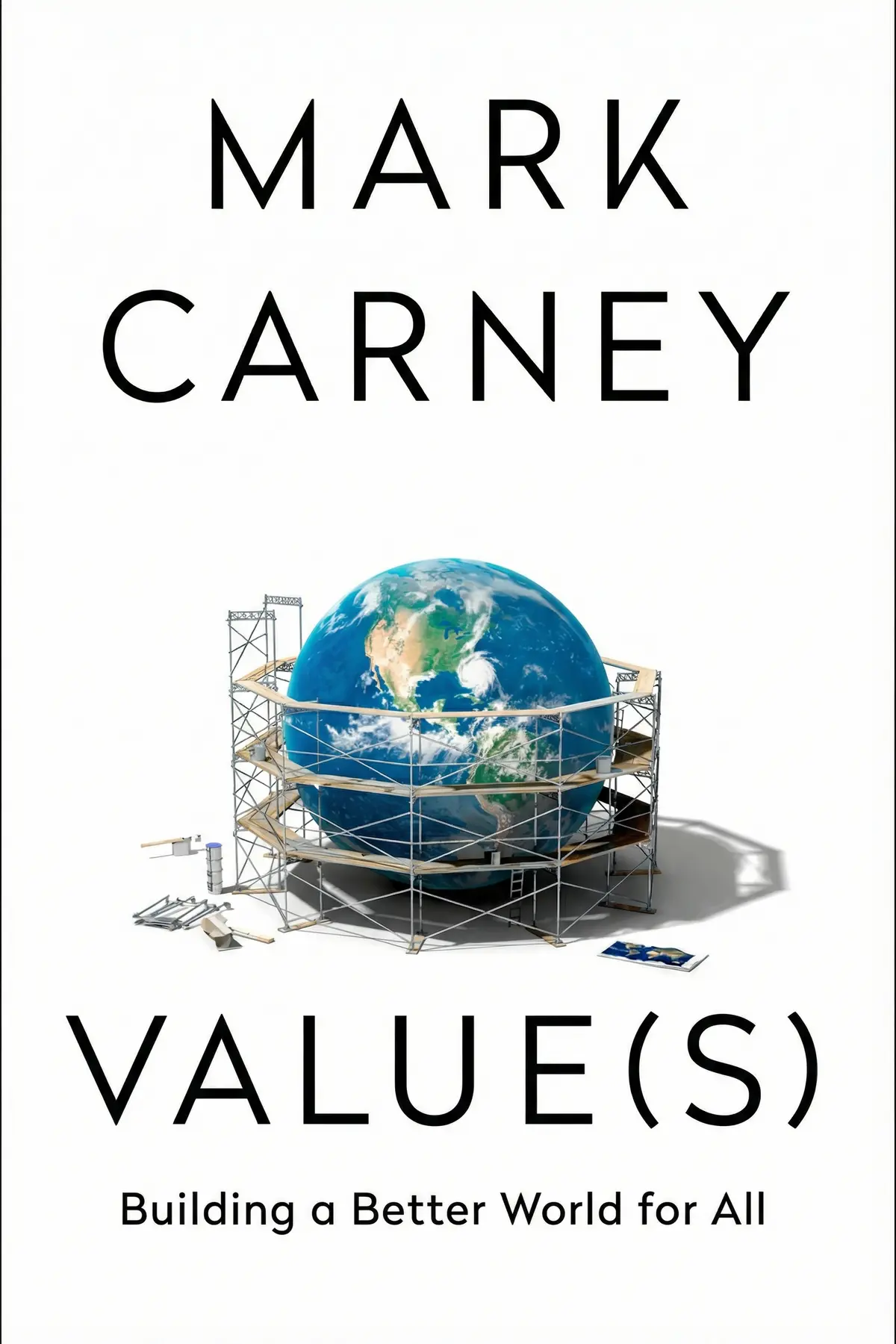
Mark Carney shows why market prices undervalue nurses, nature and the future, how the climate crisis exposes that flaw, and which five leadership qualities can put shared values back at the center of decisions.
57 sec
Most of us assume a price tells us roughly what something is worth. In Value(s), Mark Carney, who ran both the Bank of Canada and the Bank of England, argues that this assumption has turned our sense of worth upside down. Nurses and care workers were applauded nightly during the pandemic, yet their pay never improved. A rainforest that steadies the climate counts for nothing in a company’s accounts until the trees have been felled and sold.
Carney’s throughline is that when market price becomes our only measure of value, society starves the things that keep it alive, and the repair has to come from leaders guided by values. He traces the confusion from Aristotle to modern economics, tests it against the climate crisis, and ends with five qualities of leadership anyone can practice. What you gain is a sharper eye: the habit of asking whether any job, product or plan creates value or only extracts it.
1 min 31 sec
A city can cheer its nurses every evening and still decide they are not worth a raise. Carney traces that contradiction to an old puzzle about water and diamonds that economics never really solved.
1 min 39 sec
A teacher and a predatory lender can both show healthy numbers at the end of the year. Only one of them leaves anyone better off, and most of our measures cannot see the difference.
1 min 34 sec
The man now treated as capitalism’s patron saint spent most of his career warning about markets without morals. He was not alone, and the thinkers before and after him left a question worth asking about your own money.
1 min 43 sec
Economic theory assumes fair competition, rational buyers and complete markets. Carney walks through what happens when none of those hold, and why the numbers governments steer by can miss the work that matters most.
1 min 41 sec
A hurricane’s damage fits neatly on a spreadsheet. A dying coral reef or a scattered community does not, and Carney argues that the losses we cannot price are the ones that decide the outcome.
1 min 36 sec
One natural gas company’s own climate models turned out to be accurate, even as it publicly funded climate denial. Carney’s explanation is more unsettling than simple villainy, and it applies to many organizations you know.
1 min 41 sec
Carney’s answer to a broken measure of worth is not a cleverer market. It begins with two qualities that decide which way a company, charity or government points before any plan is written.
1 min 47 sec
Two leaders in a pandemic and John F. Kennedy facing the risk of nuclear war show what steadies a leader under pressure. The last quality on Carney’s list may not be the obvious one for a leader, but he calls it essential.
1 min 08 sec
Value(s) is finally an argument about measurement. Carney spent his career inside institutions that set the price of money, and he concludes that a price tag is a narrow instrument. It reads exchange value well. It struggles with use, barely registers intrinsic worth and goes blank on anything beyond the next decade. A society that steers by that instrument alone will clap for its nurses, log its rainforests and treat the sky as a free dump, all while believing it is being rational.
His fix starts with the people who make the choices. The next time a salary, a valuation or a growth figure lands in front of you, ask what it leaves out, and whether the thing behind it creates value or only takes it. When a decision stretches years ahead, give the unpriced losses a line of their own. If you lead others, write down the purpose you serve, test hard decisions against it and admit your mistakes out loud.
Water will probably always cost less than diamonds. Carney’s warning is that we have started reading that price as a verdict on which one we can live without.
Nurses were applauded every night during the pandemic and then went back to the same pay. A rainforest that helps steady the climate has no value in the accounts until the trees are felled. Mark Carney, who led two central banks, argues that these are symptoms of one mistake: we have come to treat market price as if it were the same thing as worth. Carney follows that mistake from Aristotle, Davanzati, Adam Smith and Marx to the modern subjective theory of value. He shows where it breaks down: in concentrated markets, in human bubbles and panics, and in GDP figures that leave out parents and carers. His main case study is climate change. Short time horizons and an unpriced atmosphere make wrecking the planet look rational to the companies that profit from it. His remedy is leadership guided by values. It rests on five qualities: purpose, perspective, clarity, competence and humility. Most come with an example, from organizations and their stated purposes to leaders handling real crises. Readers come away with a way to question any price, salary or growth figure, and a model for leading by more than the numbers.
Professionals who sense their pay, targets or company numbers miss what their work is really worth.
Managers and team leads who want a values-based model for hard decisions and crises.
Readers curious how economics, climate change and leadership connect, told by a former central banker.
Mark Carney grew up in Edmonton, Alberta, studied economics at Harvard and Oxford, and spent 13 years at Goldman Sachs. He was governor of the Bank of Canada from 2008 to 2013 and then governor of the Bank of England until 2020, the first non-British person in that role. He also chaired the Financial Stability Board and served as United Nations Special Envoy on Climate Action and Finance. In 2025 he became Canada's 24th prime minister.
Listeners find the writing both engaging and educational, and one person notes that it is a must-read for decision makers. The book is also commended for its brilliance, with one listener emphasizing its insightful view of risk evaluation. Furthermore, listeners value the work's significance, with one characterizing it as a moral diary of a central banker, and they feel it is worth every penny.
Mark Carney’s 'Value(s)' feels less like a standard economics textbook and more like a moral diary of a man who held the keys to the kingdom. It offers an insightful view of risk evaluation that goes beyond the usual GDP metrics. Truth is, we've drifted into a 'market society' where everything has a price tag but nothing has intrinsic value. Carney's breakdown of the 2008 crash and the climate crisis is essential reading for anyone in a decision-making role. While his writing style leans into the academic at times, the way he connects the Statistical Value of Life to real-world policy is fascinating. It’s worth every penny if you want to understand how global financial architecture needs to shift. He manages to be both a technocrat and a philosopher, which is a rare feat in today’s world.
Show moreWow, this book really hit home for me in a way I didn't expect from a central banker. It’s refreshing to see someone of Carney’s stature admit that the three lies of markets—that this time is different, that markets are always right, and that markets are moral—have caused so much damage. He writes with a sense of urgency about the climate and the post-COVID world that feels authentic. I loved the anecdote about Greta Thunberg visiting the gold vaults; it perfectly captured the disconnect between old-world finance and new-world reality. Personally, I think this should be required reading for anyone who thinks capitalism is working perfectly as it is. It’s a bold vision for a fairer system that doesn't just prioritize the elite. It’s long, but every chapter adds a new layer to his argument for a more human-centric economy.
Show morePicked this up after hearing Carney speak at a conference and I was pleasantly surprised by the depth of his risk assessment. This is a must-read for decision makers who want to move past short-termism. The way he analyzes the 'tragedy of the horizon' regarding climate change is genuinely brilliant. Carney provides an incredibly intelligent framework for how we should value things like reefs and social capital that don't fit neatly onto a balance sheet. Look, it’s a heavy tome—nearly a doorstop—and some sections on COVID-19 felt a bit dated already. But the core message about restoring moral sentiments to our markets is powerful. He uses his experience at Goldman Sachs and the BoE to lend real credibility to his calls for reform. Definitely worth the effort for the patient reader.
Show moreAs someone who works in finance, I found this to be one of the most readable and informative books on the intersection of morality and money. Carney argues that we need to stop letting the market define our values and start letting our values define the market. His five lessons from the 2008 financial crisis are particularly sharp. They provide a clear roadmap for future stability. I particularly liked the focus on ESG and how bureaucratic processes can actually lead to meaningful change if guided by the right ethics. Some critics say he's just auditioning for a political role. Even if he is, the ideas here are solid. The sentence structures vary from snappy insights to long, complex policy explanations, which keeps the reader engaged. It’s an intelligent look at how we quantify the world.
Show moreAfter hearing several interviews with Mark Carney, I wanted to see if his writing was as sharp as his public speaking. The result is a highly intelligent, albeit dense, exploration of why our systems fail. He doesn't just criticize; he offers a way forward through what he calls 'stakeholder capitalism.' The sections where he reflects on his time at the Bank of Canada and the BoE are the highlights, providing a 'seat at the table' feel. To be fair, it’s a bit self-aggrandizing at points, and he quotes his own briefing notes liberally. However, his view of risk evaluation in the face of environmental collapse is some of the best thinking I’ve seen on the subject. It's a chunky book, but a rewarding one for those interested in the 'why' behind global policy.
Show moreDirect and ambitious, 'Value(s)' is a manifesto for the next decade of global governance. Carney addresses the COVID wreckage with a level of clarity that is often missing from political discourse. He uses the Statistical Value of Life to explain why certain trade-offs were made, which I found to be a very insightful view of risk evaluation. While the book is definitely a doorstop, it’s worth every penny for the insights into how central banks are trying to 'green' the financial system. It’s not perfect—some of the Goldman Sachs references feel a bit like he’s dusting off old reports—but it’s an essential read for anyone interested in the future of our social contract. It challenged my thinking on what 'value' actually means in a world facing extinction.
Show moreFinally got around to finishing this massive book, and I have mixed feelings about the whole experience. On one hand, Carney is obviously brilliant and offers an insider’s perspective on the financial crisis that few others can provide. On the other hand, the prose is incredibly dry and reads like a series of government white papers stitched together. He has a weirdly intense hatred for cryptocurrency, which he dismisses with a level of contempt that seems misplaced for a book about future-proofing our economy. I appreciated the chapters on humility and the fallacy of meritocracy, yet I kept zoning out during the long-winded sections on climate-resilient infrastructure. It's a three-star read because the good parts are great, but you have to dig through a lot of bureaucratic fluff to find them. It's informative, just not very engaging.
Show moreThe chapter on leadership felt like a generic HR training manual, which was a huge disappointment. Carney is smart. However, this book needs a serious editor because it is far too long and gets repetitive after the first two hundred pages. He lists 'values' so many times it starts to feel like a corporate mission statement rather than a philosophy. Not gonna lie, I skipped the gold standard bits. It’s a 3-star book because there’s wisdom in here to justify the price, but it’s a struggle to get through the officialese. If you like lists and bureaucratic frameworks, you'll love it. For the rest of us, it’s a bit of a slog that lacks a clear, singular point.
Show moreEver wonder what goes on in the head of the man responsible for the UK's money? This book gives you the answer, and it’s surprisingly bureaucratic. Carney spends a lot of time on the mechanics of central banking, which is great for nerds like me but might bore the average reader to tears. He makes a compelling case that we’ve moved from a market economy to a market society, but his solutions often feel like more 'modeling' and 'scenarios' rather than concrete action. Frankly, the writing style is a bit stilted, and he uses the word 'must' far too often without explaining the actual 'how.' It's a decent overview of where we are, but it lacks the punch of a truly revolutionary text. It's a solid 3 stars for effort and scope.
Show moreNot what I expected from a former Governor of the Bank of England. To be fair, I went in with high hopes given the author’s prestige. However, the book is a slog of regurgitated briefing notes and endless, repetitive lists that could have been summarized in a pamphlet. He spends way too much time showing off with irrelevant histories, like a random dive into the Magna Carta, just to prove his intellectual credentials. The word 'dynamism' appears so often it lost all meaning by page 100. It reads like a platform for a future political career in Canada rather than a cohesive economic theory. I found it rambling and, frankly, a bit of a bore compared to more focused works on stakeholder capitalism. Save yourself the headache and read a summary instead.
Show moreCarney argues that modern society confuses market price with real worth. That confusion leads us to underpay care workers, ignore the value of nature and discount the future, while rewarding speculation and extraction. He uses the climate crisis as his main case study and proposes values-led leadership, built on purpose, perspective, clarity, competence and humility, as the way to put shared values back into decisions.
Values are moral principles that guide behavior, such as integrity, courtesy and respect for human dignity. Value is the worth we assign to an object or to someone’s work, and it always depends on context, as Richard III showed when he offered his kingdom for a horse. Carney’s point is that a healthy economy needs values to shape how value is measured.
Climate change shows the failure of price-based value on the largest scale. The atmosphere carries no price, so each company finds emitting cheaper than cutting, and together those choices lead toward collapse. Corporate discount rates of 8 to 12 percent make anything beyond a decade look nearly worthless. Losses such as dying coral reefs and broken communities barely appear in market prices.
Ask whether your role, product or deal creates value or simply moves it from someone else. Before trusting a figure such as a salary, valuation or growth number, ask what it leaves out. For long-term decisions, list the unpriced losses alongside the priced ones. If you lead people, state your purpose in a sentence, test decisions against it and admit mistakes openly.
Carney names purpose, perspective, clarity, competence and humility. Purpose anchors every decision and builds trust. Perspective weighs how shared problems hit people in different situations. Clarity, shown by Jacinda Ardern and Angela Merkel during COVID-19, means plain, honest messages. Competence, as in Kennedy’s handling of the Cuban Missile Crisis, means getting more right than wrong. Humility means admitting uncertainty and changing course.
William J. Bernstein

John Rawls





Miles Taylor

Yanis Varoufakis

AUDIO SUMMARY AVAILABLE
Get the key ideas from Value(s) by Mark Carney, plus 5,000+ more nonfiction titles.









