

15 min 20 sec
Available in: English
Valley of Genius: The Uncensored History of Silicon Valley (As Told by the Hackers, Founders, and Freaks Who Made It Boom)
By Adam Fisher
A history of Silicon Valley told through its people. It shows how ideas passed from Atari and Xerox to Apple, eBay, Google and Facebook, and what their wins and failures teach about timing, trust and users.
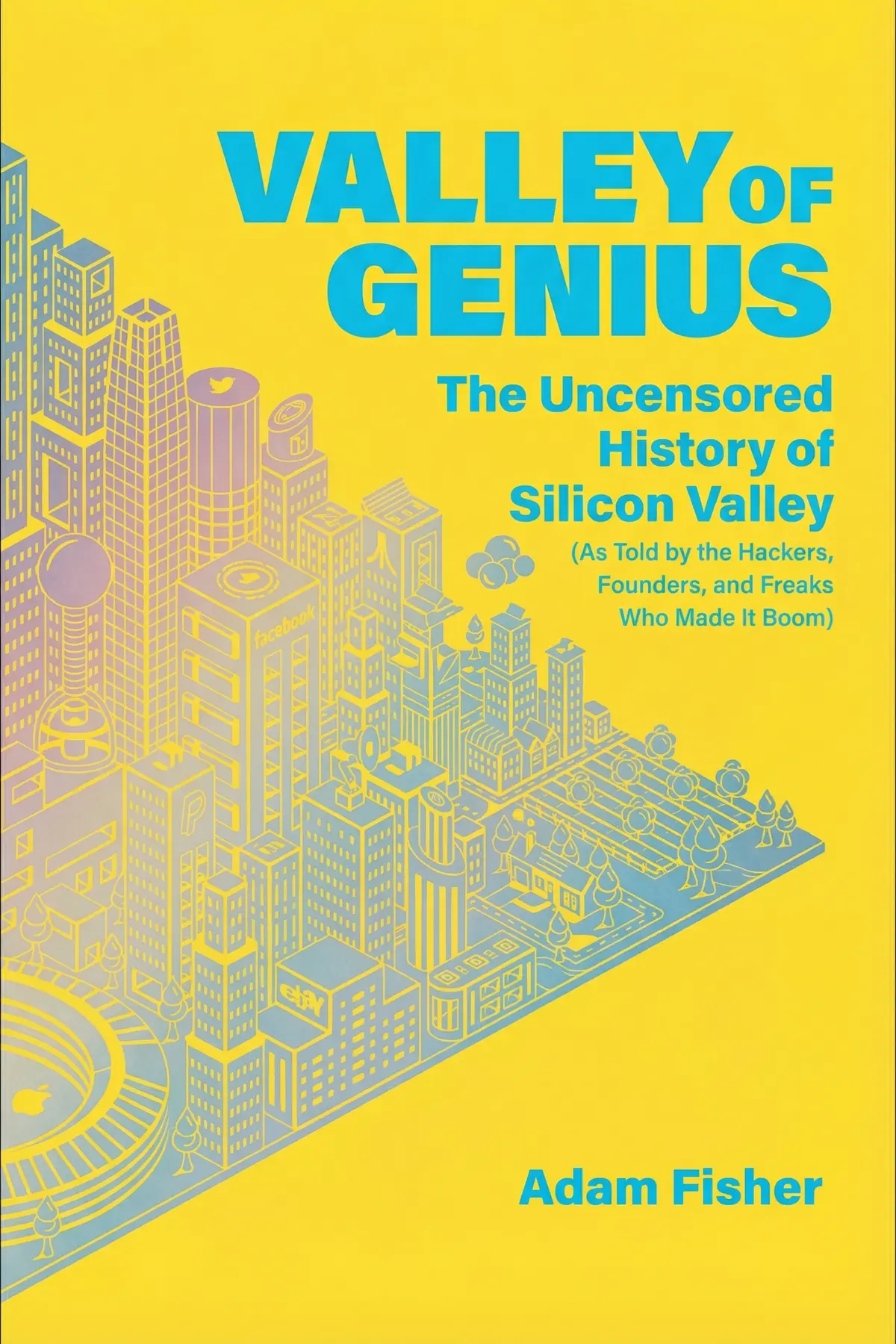
Table of Content
1. Introduction
1 min 01 sec
Silicon Valley is usually told as a story of money, but the fortunes were never the most interesting part. In Valley of Genius, technology writer Adam Fisher, who grew up there, tells it as a history of people and ideas, and the ideas kept escaping the companies that had them. Xerox built something close to the modern personal computer in the early 1970s, then lost interest. Apple took the idea. A failed startup sketched the smartphone ten years early, and its engineers went on to build the real ones.
One thread runs through every story here. A breakthrough tends to reward whoever ships it and whoever watches what people actually do, while the Valley’s wild culture builds companies fast and breaks them just as fast. Follow that thread from a jammed Pong machine to Facebook’s News Feed and any tech company’s rise or fall becomes easier to read. Along the way come lessons on timing, trust and users.
2. What Atari's boom and crash teach about culture
1 min 39 sec
A broken arcade machine in a bar turned out to have the best problem a founder could hope for. What came next shows how the culture that wins the first round can lose the second.
3. Inventing first is not enough to win
1 min 33 sec
A photocopier company built windows, icons, a mouse and color screens years before most people owned a computer. So why does almost nobody give it credit for the personal computer?
4. Turn a borrowed idea into an unforgettable launch
1 min 45 sec
A night shift at Atari, a tour of Xerox’s lab and a computer that introduced itself on stage. Together they show where Apple’s real advantage came from.
5. Tell a bad idea from an early one
1 min 35 sec
A small company designed apps, emojis and a handheld communicator a decade before the iPhone, then vanished. Its story tests how to tell a flawed idea from one that simply arrived too soon.
6. Build trust between strangers with public ratings
1 min 44 sec
In 1995, sending money to a stranger online was an act of faith. One programmer’s weekend project bet that people were mostly honest, then built the tool that made trusting them easier.
7. Read a rival's refusal as a market signal
1 min 40 sec
Two students who wanted to finish their doctorates offered their invention to an established company and were refused. The reason for the refusal is the most useful part of the story.
8. Grow faster by opening a closed system
1 min 42 sec
Apple’s music player was fashionable but sold poorly, and its first iPhone shut out other developers. Both times the fix went against Jobs’s own instincts.
9. Trust behavior over loud complaints
1 min 37 sec
Students marched against a Facebook feature they said they hated. Inside the company the data told a very different story, and that gap raises questions the Valley still faces.
10. Conclusion
1 min 04 sec
Fisher’s history adds up to a relay of ideas. The graphical interface passed from Xerox to Apple. The smartphone passed from General Magic’s failed communicator to the iPhone and Android. eBay’s ratings and Google’s link counting began as weekend code and a detour from a doctorate. What kept ideas moving was a small patch of suburbs and cities with dense talent, access to investment and an unusual tolerance for failure and for odd personalities. That same looseness sank Atari and let Facebook push new code live overnight.
When a good idea is stuck, ask who wants it badly enough to ship it. When a buyer refuses something plainly better, look at their incentives before you doubt your work. When users protest a change, check what they actually do. And when growth stalls behind a closed door, try opening it, as Apple did twice.
In the Valley, the first sign of a breakthrough was never a business plan. It was a coin box too full to take another quarter.
About this book
What is this book about?
Silicon Valley is often described in terms of funding rounds and fortunes. Adam Fisher tells a different story, one about people and ideas. His builders were young, obsessive and sometimes outrageous, and they kept turning wild concepts into products in workplaces where all-nighters were normal and drugs were common. The book follows the region's breakthroughs from Atari's first Pong machine, its coin box stuffed with quarters, to the Alto at Xerox PARC, a computer with windows, icons and a mouse that its own company shelved. It shows how Steve Jobs turned a tour of PARC into the Macintosh and how General Magic designed a smartphone a decade too early. Pierre Omidyar's weekend project gave the web its feedback system. Google's founders started a company only after an established search firm turned them down. Opening closed systems revived Apple, and Facebook learned to trust what users did over what they said. Readers come away with a clear picture of how technology history really moved. They also get lessons that apply far from the Valley: an idea needs an owner who will ship it, timing can sink a great product, and behavior is a better guide than complaints.
Book Information
Who it's for
Product builders and founders
Founders and product people who want the real stories behind the companies they compete with or copy.
Students and tech professionals
Tech workers and students curious how the personal computer, the smartphone and social media came about.
Managers preserving creative culture
Managers trying to keep a creative culture alive as their organization grows.
About the Author
Adam Fisher
Adam Fisher grew up in Silicon Valley playing Atari games, writing programs and reading science fiction, and he still lives in the Bay Area. He writes about technology, where it came from and where it is heading. His work has appeared in Wired, MIT Technology Review and The New York Times's Sunday magazine. This is his first book.
Ratings & Reviews
Ratings at a glance
What people think
Listeners consider the book a captivating work that offers remarkable insights into Silicon Valley’s history. They value the narrative style, with one listener highlighting how the interviews are woven together into a conversation, and the writing's quality, with one noting it is written using transcribed interviews. The arrangement of the book draws varied responses, as some applaud the ingenious structure while others find the format a bit unusual.
Top reviews
Kanchana
The narrative structure here is something else entirely, trading traditional prose for a curated collage of voices that feels like a front-row seat to history. Fisher doesn't just tell you what happened at Xerox PARC or the Homebrew Computer Club; he lets the icons and the outcasts argue it out right on the page. By weaving thousands of hours of interviews into a singular timeline, the book manages to capture the frantic, drug-fueled, and often ego-driven energy of the early computing days. I particularly enjoyed the segments on General Magic and Netscape, which often get overlooked in favor of the usual Apple and Google mythology. It is a massive undertaking that pays off by creating a multi-dimensional portrait of innovation. This is less of a business manual and more of a visceral piece of art that documents how a few rebels actually changed the world.
Show moreFord
Wow, what a wild ride through the ego-driven, visionary, and often chaotic birth of the digital world. This book captures the erratic pulse of Silicon Valley by letting the participants speak for themselves, creating a sense of immediacy that standard histories can't match. From the garage days of Jobs and Wozniak to the utopian dreams of Burning Man, Fisher connects the dots between counterculture and corporate dominance in a way that feels organic. The chapter on Napster was particularly illuminating, offering a cradle-to-grave look at a company that usually only gets a footnote. It’s a thick read, but the short, punchy quotes keep the momentum moving at a breakneck pace. This is the definitive record of the personalities who decided what the future was going to look like before the rest of us even knew it was coming.
Show morePing
As someone who lived through the dot-com boom and bust, reading this was like a visceral trip down memory lane that hit all the right notes. The way Fisher splices these interviews together makes it feel like you're sitting at a dinner party with the brightest and most arrogant minds of the last fifty years. It’s messy and loud and brilliant, exactly like the industry it describes. I especially appreciated the inclusion of figures like Mike Slade and the detailed look at General Magic—stories that usually get buried under the weight of the Apple/Google dominance. The book doesn't just give you the facts; it gives you the flavor of the era, the smell of the soldering iron, and the frantic energy of a startup. This is the 'Please Kill Me' of Silicon Valley, and I couldn't put it down.
Show moreTippawan
This book captures the frantic, erratic pulse of the Valley better than any other tech history I have ever encountered. Fisher's curation is masterful, allowing the narrative to emerge from the cacophony of voices without the need for a heavy-handed narrator. The stories are legendary, the personalities are larger than life, and the sheer audacity of these 'geniuses' is on full display throughout every chapter. It’s a brilliant piece of journalism that manages to be both a celebration and a cautionary tale about the power of technology. Whether it's the section on the first conferencing software or the detailed account of Steve Jobs' return to Apple, the book feels alive. It’s a massive, beautiful, and occasionally frustrating document of the people who shaped our modern reality. If you have any interest in tech culture, this is an absolute must-read.
Show moreAir
Fisher has managed to curate a vivid, messy tapestry of the tech world that feels more authentic than any polished biography. Truth is, the oral history format is a double-edged sword that provides incredible intimacy while occasionally giving the reader a bit of chronological whiplash. You get the raw, unfiltered perspectives of the legends—and the people who hated them—which adds a layer of grit often missing from these stories. My only real gripe is the glaring absence of the 'PayPal Mafia' and companies like Sun Microsystems, which felt like a strange hole in an otherwise comprehensive timeline. Still, the sections on the 'Mother of All Demos' and the early Atari days are worth the price of admission alone. It’s a fascinating, albeit slightly exhausting, look at the personalities that built the digital age we now inhabit.
Show moreZanya
Ever wonder what it was actually like in the trenches during the rise of the personal computer? This book skips the dry analysis and goes straight for the jugular with first-hand accounts of the feuds, the failures, and the occasional strokes of brilliance. I loved how it didn't just focus on the suits, giving plenty of room to the engineers and the dreamers who were dropping acid and building the future simultaneously. While the lack of a traditional narrator might be jarring for some, I found the spliced-together conversations to be a refreshing way to digest such a massive amount of information. It reads like a high-speed documentary where everyone is trying to get the last word. If you’re a fan of 'Please Kill Me,' you will definitely appreciate the vibe Fisher is going for here.
Show moreSangduan
Finally got around to this one and the oral history format is a stroke of genius for a subject as fragmented as Northern California's tech scene. Fisher doesn't try to smooth over the contradictions; he lets the conflicting accounts stand side-by-side, which feels like a much more honest way to document history. The transition from the idealistic, acid-dropping hippies of the 60s to the ruthless capitalists of the 90s is captured with startling clarity through these snippets. Personally, I found the deep dive into Xerox PARC and the development of the GUI to be the most rewarding part of the whole book. It’s a bit of a commitment due to its length and the sheer number of names to keep track of, but it’s an essential read for anyone who wants to understand the culture behind the code.
Show moreUdom
Picked this up on a whim and was surprised by how much the 'spliced interview' style actually works once you get into the rhythm of it. It’s less a textbook and more of a grand, sprawling conversation that spans decades of innovation and ego. While it’s definitely more focused on software and internet culture than the 'silicon' hardware of the early days, the insights into the minds of the founders are gold. You see the connections between the Whole Earth Catalog and the eventual rise of social media in a way that feels inevitable. My only criticism is that it can feel a bit repetitive when multiple people are describing the same party or feud. However, as a primary source for the legends of the Valley, it’s an incredibly valuable and entertaining resource.
Show moreOrathai
To be fair, I went into this expecting a deep dive into the engineering breakthroughs of the Valley, but it felt much more like a collection of gossip and personality clashes. The format is undeniably unique, but the constant jumping between speakers made it difficult for me to stay grounded in the actual technological evolution. It often feels like a hagiography that leans too heavily on the 'rebel genius' trope while ignoring the systemic issues or the people displaced by these tech giants. I found the section on Wired magazine a bit self-indulgent and unnecessary compared to the meatier chapters on Apple and NeXT. It’s a decent enough index for tech history, but I think I would have preferred a more cohesive narrative that offered some critical distance. Interesting as a social document, but less so as a historical analysis.
Show moreJonathan
Look, I wanted to love this, but it felt like a total hagiography that spent way too much time celebrating a hyper-masculine culture of 'disruption.' It’s a revolving door of men talking about how they fought, took drugs, and got rich, with almost zero attention paid to the people their innovations actually affected. The oral history style is an interesting gimmick, but without a narrator to provide context or push back on some of the more outrageous claims, it just feels like an echo chamber. I found myself bored by the endless feuds and the obsession with who gets the credit for what. If you want a story about coke-fueled egos and tech-bros patting each other on the back, this is for you. Otherwise, stick to Isaacson or someone who actually analyzes the impact of these companies.
Show moreQuestions about this book
What is Valley of Genius by Adam Fisher about?
It is a history of Silicon Valley told through its people and ideas instead of its finances. Fisher follows the region from Atari’s Pong to Xerox PARC’s Alto, the Macintosh, General Magic, eBay, Google, the iPod and iPhone, and Facebook. A recurring pattern runs through it: ideas often leave the companies that first imagine them and succeed with whoever ships them at the right time.
Did Xerox really build the first personal computer?
Fisher argues that Xerox came closest first. In the early 1970s its PARC lab built the Alto, which had overlapping windows, icons, fonts, menus, a bitmap display and a mouse. A later machine, the Bravo, showed 256 colors. Xerox’s leaders saw little market for it and stuck to printing. After touring PARC in December 1979, Steve Jobs brought its graphical interface to Apple.
What lessons does Valley of Genius offer founders and managers?
Several. An invention needs an owner who wants it in the market, as Xerox shows. Timing matters, since General Magic built a smartphone before the technology could carry it. Public ratings, like eBay’s feedback forum, let strangers trust each other. Opening a closed system can drive growth, as Apple found with iTunes and the app store. And Facebook’s News Feed shows that behavior can reveal more than complaints.
Why did Google's founders start a company instead of licensing their search engine?
Larry Page and Sergey Brin wanted to finish their doctorates, so they tried to license their technology first. At Excite, their search for the word internet gave useful results while Excite’s own engine returned mostly random pages. The chief executive, George Bell, still refused, since he preferred that people remain on his site instead of finding things quickly. When nobody would license it, they founded Google.
Who should read Valley of Genius?
It suits founders, product people and tech workers who want to know how today’s technology really came together, told through the stories of the people who built it. Managers will find warnings about culture, such as Atari’s collapse after its sale to Warner. Students and curious readers get a lively, connected history running from arcade games to social networks.
Readers also enjoyed

Alibaba: The House That Jack Ma Built
Duncan Clark




21 Lessons for the 21st Century
Yuval Noah Harari




AI 2041: Ten Visions for Our Future
Kai-Fu Lee
AUDIO SUMMARY AVAILABLE
Listen to Valley of Genius in 15 minutes
Get the key ideas from Valley of Genius by Adam Fisher, plus 5,000+ more nonfiction titles.
- 5,000+ titles
- Listen as much as you want
- 7-day free trial
- Cancel anytime









