

Acting with Power: Why We Are More Powerful Than We Believe
Deborah Gruenfeld
 English
Shows leaders why strategies that once worked can stall them, and how a repeating three-phase cycle of unlearning, relearning and breakthrough helps them test fresh approaches with their teams, customers and products.
1 min 07 sec
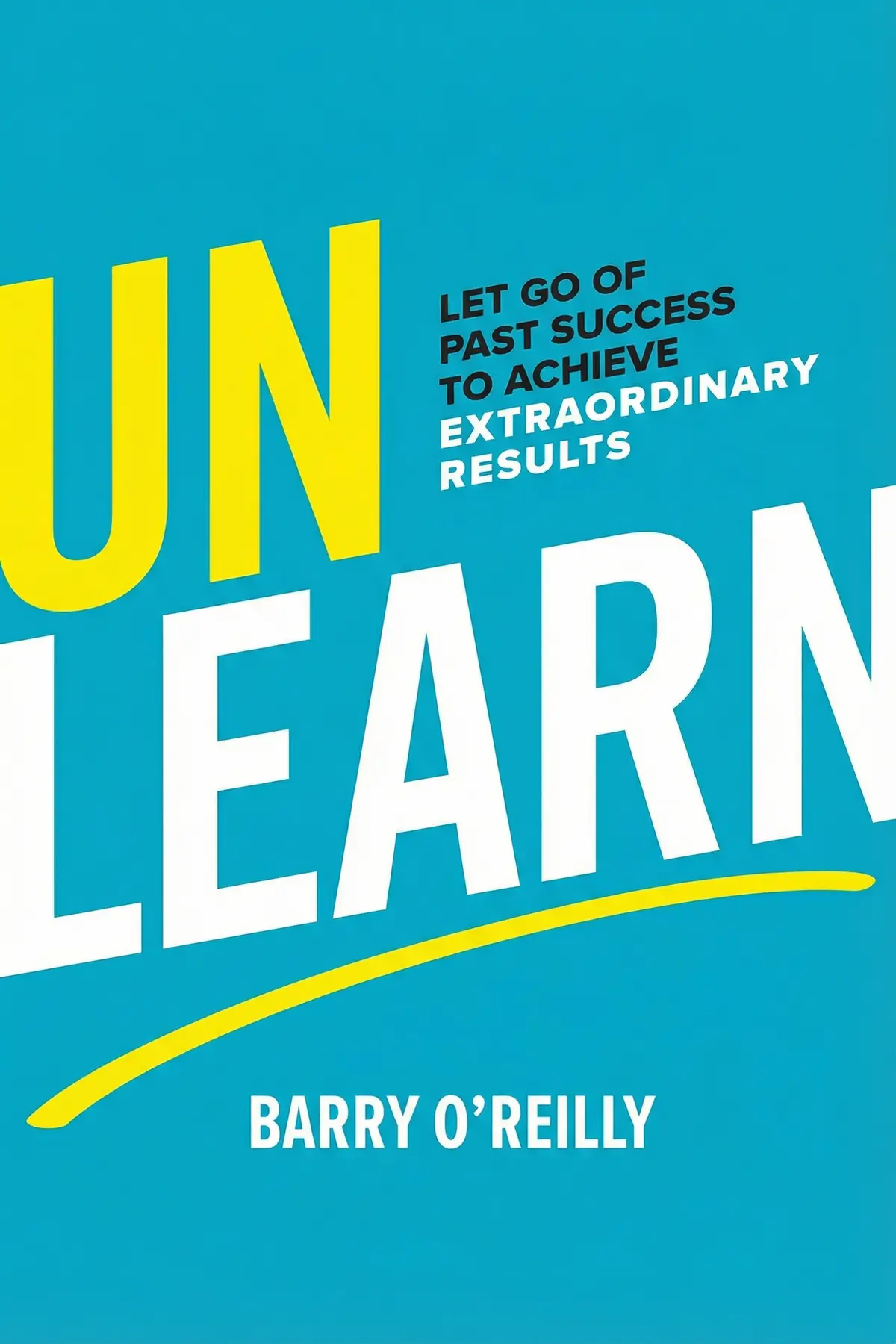
Strategies that once made you look brilliant can become the very thing holding you back, and the fix is to let go of them on purpose. In Unlearn, Barry O’Reilly, who advises senior leaders and executive teams, argues that knowledge now expires quickly, so past wins are a poor guide to the next decision. That is why so many successful people stall: they keep repeating moves built for a world that has moved on.
His remedy is a repeating cycle with three phases. First you drop the old approach and picture the outcome you want. Then you relearn through small, measurable experiments. Finally you study each result and let it shape the next step. The same cycle, he shows, can change how you manage people, listen to customers and build products.
Along the way come a tennis champion who rebuilt her game, an Intel chief who asked what his own replacement would do, and a 30-person team that succeeded where a costly government project collapsed. Each one leaves a habit you can try at work this week.
1 min 33 sec
After returning from injury, the world’s top-ranked player struggled with inconsistent play and then fell at the French Open to Virginie Razzano, who was ranked 111th. Her slide, and how she reversed it, shows what goes wrong when a proven method quietly stops fitting the situation.
1 min 26 sec
Intel’s core business was dying, and its chief executive found the way out by imagining someone else in his chair. His question exposes the two inner habits that keep experienced leaders defending yesterday’s answers.
1 min 34 sec
Leadership retreats send people home full of ideas, and within weeks almost nothing has changed. O’Reilly explains why inspiration fades so fast, and what the first phase of his cycle asks you to do instead.
1 min 25 sec
An app promises to turn people who never exercise into marathon runners in half a year, and its first session sounds almost too easy. That modest opening holds the logic of the second phase.
1 min 28 sec
A Renaissance genius and a tennis coach share a habit most busy leaders skip once a task is done. It decides whether an experiment becomes progress or just another forgotten attempt.
1 min 32 sec
Executives from retail and finance told a Netflix engineer they simply lacked his company’s talent. His blunt reply put the blame somewhere they had not thought to look.
1 min 23 sec
One new chief executive spent hours a day on the phone with his support line, and another fixed a complaint within a week. Both had found a shortcut most leaders never take.
1 min 34 sec
A government health project burned through billions before it was scrapped. A team of just 30 people then built infrastructure linking over 23,000 healthcare systems on a limited budget, by changing when users got their first look.
1 min 00 sec
What O’Reilly offers is a way to treat your own expertise as provisional. The strategies that made you successful were answers to older questions, and holding on to them out of habit or pride is how good leaders stall. Williams came back by rebuilding her footwork, then her preparation, one change at a time. Grove saved Intel by looking at it like a stranger.
The book’s closing advice is practical and a little uncomfortable. Pick a goal you want to reach and have a colleague score your ability to achieve it on a scale of 1 to 10. Then ask which of your behaviors help and which get in the way. Pick one small change from what you hear and make it straight away.
From there the cycle carries itself: a measurable goal, a step small enough to try today, an honest look at the result. Let your team run the same loop, and let customers into it early.
Expertise that keeps getting tested stays useful. Expertise that is only defended slowly expires.
Many leaders reach a point where the methods that built their reputation stop producing results. They push harder on the old playbook, confidence drops across the team, and performance slides further. Barry O’Reilly argues that the cause is rarely a lack of talent. Knowledge now expires fast, and the habits behind yesterday's wins are often the very thing in the way. His answer is the Cycle of Unlearning, a system with three phases. Leaders first let go of an outdated approach and picture the outcome they want. They then relearn by turning that goal into a measurable statement and taking the smallest possible step toward it. Finally they study each result and let it guide the next move, before the cycle starts again. O’Reilly applies the cycle to three areas: management, customers and product development. Stories from Serena Williams, Intel's Andy Grove, Netflix, T-Mobile, Tesla and a 30-person team inside the British health system show what it looks like in practice. Readers get a repeatable way to question their own expertise and to build teams that keep experimenting.
Experienced managers whose proven methods have stopped delivering and who want a way to rethink them.
Team leads who want staff to experiment and decide instead of waiting for orders.
Founders and product owners who want customer feedback before launch, not after.
Barry O’Reilly, born in Ireland, works with senior leaders and executive teams on how their organizations make decisions and perform. He co-founded the venture studio Nobody Studios, founded ExecCamp, an experience designed for executives, and teaches as faculty at Singularity University. He has contributed to The Economist. His book Lean Enterprise was named a must-read for business leaders by Harvard Business Review.

Listeners find the book accessible and highly useful, featuring many stories they can relate to throughout. Furthermore, they appreciate how it instructs people to let go of poor habits, with one listener describing it as a valuable tool for driving a learning mindset in organizations. They also value the straightforward methodology, as one listener points out the distinct framework while another remarks on how it encourages people to choose courage over comfort.
After hearing Barry O'Reilly speak at a conference a few years back, I knew I had to pick this up. The core premise is that our past successes often become the very things that block our future growth. Truth is, we get so attached to the methods that worked once that we stop questioning them. I loved the Serena Williams case study because it shows that even the world's best athletes have to strip back their mechanics to reach the next level. The writing is incredibly accessible, avoiding the dense jargon you usually find in business manuals. While some might find the repetition a bit much, I think it serves to drive home the necessity of the 'Cycle of Unlearning.' It’s a great tool for anyone trying to cultivate a more adaptive mindset in a fast-paced environment. Choose courage over comfort—that's the real takeaway here.
Show moreFinally got around to finishing 'Unlearn' and the most striking takeaway for me was the concept of generative culture. Barry references Ron Westrum’s models of organization, and it really clicked why some of my previous projects failed despite having great talent. If you don't have high cooperation and a performance-oriented mindset, you're just spinning your wheels. The book is incredibly practical and offers a clear framework for breaking bad habits that we don't even realize we have. I found the stories about NASA and Serena Williams to be great anchors for the theory. It’s the kind of book that makes you want to immediately change how you run your Monday morning meetings. If you’re trying to drive a learning mindset in a rigid organization, this is a fantastic resource. Highly recommended for leaders at all levels.
Show moreThe chapter on the Roman Empire really stuck with me because it reframed the idea of success as a potential trap. We often think that because the Romans were masters of the world, they were rigid, but O'Reilly points out they actually abandoned their own practices the moment they found better ones. That’s a powerful lesson for modern leadership. This book provides a very simple framework for identifying where you’re stuck and how to break through those mental plateaus. I appreciated the emphasis on 'safe-to-fail' environments, as most companies punish mistakes so heavily that unlearning becomes impossible. The stories are relatable and help ground the more abstract ideas of 'generative culture.' It isn't a long read, but it's a practical one that I've already started recommending to my team to help them let go of outdated workflows.
Show morePicked this up during a particularly stagnant period at my startup, and the timing couldn't have been better. We were stuck in a bureaucratic loop, and Barry’s breakdown of psychological safety really hit home. I’ve seen him talk about these concepts before, but seeing them laid out as a repeatable system was helpful. Look, it’s not reinventing the wheel, but it does provide a clear mirror to show you why you’re failing. The mention of Google’s five vital qualities for teams was a great touch, reminding us that dependability and impact start with feeling secure enough to admit we don't have all the answers. My only gripe is that it can feel a bit repetitive in the middle sections. Regardless, it’s a solid add-on for anyone trying to foster a genuine learning mindset in their organization.
Show moreEver wonder why those strategies that worked like magic five years ago are suddenly falling flat today? That's the central question Barry O’Reilly tackles, and he does it with a lot of heart and practicality. He suggests that the biggest obstacle to innovation isn't a lack of new ideas, but an inability to let go of old ones. This isn't just about corporate strategy; it feels deeply personal. I loved the distinction between an attachment to the past and a fear of the future—very Marie Kondo-esque. The 'Cycle of Unlearning' provides a relatable path for leaders who are brave enough to step out of their comfort zones. It’s a highly practical guide that values action over just 'thinking differently.' While a few sections felt a bit bloated, the overall message is vital for anyone operating in a disruptive market.
Show moreAs someone who has been in change management for over a decade, I found the emphasis on individual disruption quite refreshing. We always talk about 'disrupting industries,' but Barry reminds us that it’s actually the individuals who get disrupted first. The book is a simple approach to a very complex problem: how do we stay relevant when the world moves faster than our habits? I appreciated the focus on 'starting small' while thinking big, which prevents taking those unrecoverable risks that terrify most executives. Some of the points felt a little redundant by the end, but the core message about choosing courage over comfort is something every leader needs to hear periodically. It’s a solid 4-star read that provides plenty of relatable stories to use in my own workshops.
Show moreWow, this book really challenges the ego-driven idea that we always need more information to succeed. In a world drowning in data, Barry argues that the real competitive advantage is knowing what to discard. It’s a short, punchy read that focuses on the behaviors that limit our success rather than just the skills we lack. I liked the focus on reflection and scaling results, as those are usually the first things to go when a team gets busy. The writing is casual and the framework is easy to follow. Not gonna lie, I was skeptical about the title at first, but the 'Cycle of Unlearning' actually makes a lot of sense once you see it applied to these high-stakes case studies. It’s a great add-on for anyone looking to build a more resilient, adaptive team.
Show moreIs it just me, or does the word 'unlearn' feel like a fancy way of saying 'change your mind'? I went into this expecting some deep, neurological deep-dive into habit formation, but it’s more of a high-level business strategy book. Barry is clearly knowledgeable, and his work on Lean Enterprise was foundational, yet this felt like it was stretched a bit thin. Much of the advice revolves around the idea that we need to test and iterate, which isn’t exactly a revolutionary concept if you’ve spent any time in the Agile world. Frankly, the book could have been half its length without losing any of the core impact. It’s a decent read for a beginner who needs a push to try new things, but for veterans, it might feel like a collection of existing concepts packaged in a new wrapper. Not a bad book, just not the 'raw meat' I was hoping for.
Show moreTo be fair, Barry has a very approachable writing style that makes the concepts easy to digest in one sitting. I finished the book in about two evenings. It’s a good read if you’re looking for some quick inspiration or a way to kickstart a conversation about change in your office. However, if you are looking for a deep, academic study on organizational behavior, you might find this a bit shallow. It leans heavily on anecdotes and high-level summaries of other books like B.J. Fogg’s work. The 'unlearn, relearn, breakthrough' system is a nice mnemonic, but it doesn't offer much in the way of granular, step-by-step implementation. Personally, I think it works best as a motivational piece rather than a rigorous manual. It’s 3.5 stars for me, rounded down because I expected a bit more 'meat' given the author’s reputation.
Show moreNot what I expected from the author of Lean Enterprise, unfortunately. I’ve followed Barry’s work for a while and found his previous insights revolutionary, but this book felt more like a long-form essay that was forced into a 200-page format. To me, unlearning should mean actively purging knowledge, but the book mostly describes just... learning new ways of doing things? It feels like a triumph of form over content. I struggled to find any truly original ideas here that haven't been covered better in other Lean or Agile literature. The case studies like NASA and IAG are interesting enough, but they don't quite save the book from feeling redundant. I stopped about halfway through because I felt I had already gotten the gist. It might work for someone brand new to business theory, but for me, it was a bit of a letdown.
Show moreO’Reilly argues that knowledge now expires quickly, so the strategies behind past success can hold leaders back. He offers the Cycle of Unlearning: let go of an outdated approach and picture the ideal outcome, relearn through small measurable steps, then study each result in a breakthrough phase that guides the next move. The cycle repeats, and he applies it to management, customers and product development.
The first is unlearning: name a goal, take ownership, picture the best outcome and choose courage over comfort. The second is relearning: write a measurable unlearn statement, brainstorm without censoring, then take the smallest possible step and reflect. The third is breakthrough: question what the result taught you, spot helpful behaviors and use that knowledge to start the cycle again.
Start with the book’s closing exercise. Have a colleague score, on a scale of 1 to 10, your ability to reach a goal, ask which of your behaviors help or hurt, and then make one small change immediately. With a team, set one measurable goal, pick the tiniest action toward it, and review the result. Hand over decisions with clear goals, and put early versions of products in front of real users.
It suits leaders whose results have stalled despite past success, managers trying to move from giving orders to supporting decisions, and people building products who want customer input before launch. Its examples range from Serena Williams and Intel’s Andy Grove to Netflix, T-Mobile, Tesla and a small team that built infrastructure linking more than 23,000 healthcare systems in the United Kingdom.
Deborah Gruenfeld

Mike Michalowicz



Hamilton Helmer

Margaret Heffernan



AUDIO SUMMARY AVAILABLE
Get the key ideas from Unlearn by Barry O’Reilly, plus 5,000+ more nonfiction titles.









