

12 min 03 sec
Available in: English
Unbroken: The Trauma Response Is Never Wrong And Other Things You Need to Know to Take Back Your Life
Explains why trauma reactions are the nervous system's sensible response to overwhelming events. Offers three simple writing and imagining exercises for changing the painful stories that keep survivors caught in shame and repeating patterns.
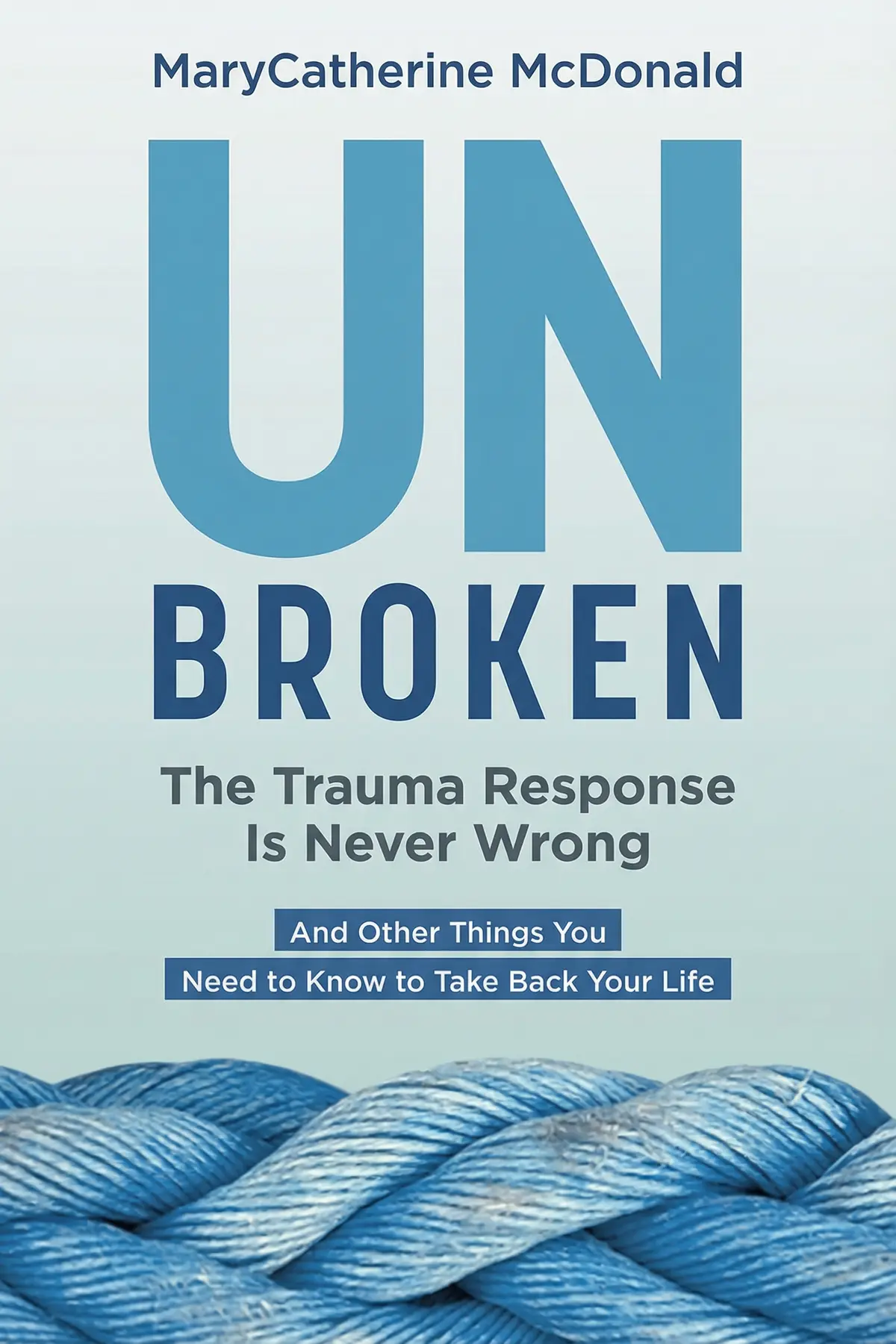
Table of Content
1. Introduction
1 min 13 sec
If your own reactions sometimes frighten or embarrass you, Marycatherine McDonald starts with a reassuring claim. She means the racing heart over nothing, the reckless weekend and the fear that will not leave. Trauma, she argues, is defined less by the event than by how your body and mind responded to it. In Unbroken, McDonald, who has researched and lectured on trauma for more than a decade, treats that response as a physical process run by the nervous system. The subtitle of her book says it plainly: the trauma response is never wrong.
From there she follows three people she spoke with. One is a combat veteran. One is a woman caught in a storm of loss. The third is a woman facing cancer and her childhood at the same time. Together their stories prove one point: your reactions made sense, and healing comes from changing the story they are stuck in. Along the way McDonald offers three exercises small enough to try tonight. You write four versions of a painful event, spend a few minutes in a deliberately impossible daydream and list one hundred things you are.
2. See your reactions as your body protecting you
1 min 36 sec
The jumpiness, numbness or dread that lingers after a hard event can feel like proof of weakness. McDonald points to what the brain’s emergency systems are doing, and to why the old definitions of trauma left so many people out.
3. Spot the moral injury behind self-destruction
1 min 36 sec
A combat veteran kept denying that he was struggling, even as he became involved in a fight club. His story exposes a wound that goes deeper than fear, and it shows the turn that started to change it.
4. Write four versions of the story that haunts you
1 min 25 sec
Most of us tell one version of our worst moments, over and over. A simple writing exercise tests whether that version deserves our trust, and McDonald is frank about what it cannot do right away.
5. Break the reckless loops that loss can create
1 min 40 sec
After a friend died suddenly, a woman began living as if sand were pouring out of an hourglass. Her reckless choices looked senseless from the outside, yet McDonald sees a clear logic underneath.
6. Practice absurd hope a few minutes each day
1 min 34 sec
Picturing a future you know will never happen sounds like a waste of time. McDonald argues that a few minutes of it each day can shift energy and perspective for people stuck in painful cycles.
7. Find the hidden strength in your own past
1 min 35 sec
A woman facing the end of her life chose to talk about her childhood instead of her cancer. A memory of hiding in a closet, and a famous boxing match, changed how she saw herself.
8. Conclusion
1 min 24 sec
McDonald’s book adds up to a change of verdict. The old view put trauma survivors on trial for their own reactions. She argues that those reactions were the body protecting itself, and that they were never wrong. What can change is the story. Malcolm moved from a fight club to jiujitsu. Max found words for a life draining away like sand in an hourglass. Lily, near the end of her life, discovered that the child hiding in a closet had been fighting back all along.
None of this requires erasing the past. Healing, as McDonald describes it, means learning to live alongside what happened and redefining yourself as you go. There is no final point where the work is done.
The practical starting points are modest. The next time one of your reactions embarrasses you, ask what your nervous system was guarding against before you judge it. Pick the event you keep circling back to and write it down four different ways, and expect the old version to return under stress. On a dark day, spend a few minutes inside a future you will never live. If someone else’s labels still define you, start a list of what you actually are.
The response that kept you going made sense, and the story you built around it is still yours to rewrite.
About this book
What is this book about?
Many people who have lived through something overwhelming carry a second burden. They believe their reactions, whether fear, recklessness or numbness, prove they are weak or broken. Marycatherine McDonald, a trauma researcher with a doctorate from Boston University, argues the opposite. In her view, trauma is defined by how the body and mind respond to an event. That response is a physical process run by the nervous system, and it is never wrong. McDonald builds her case around people she spoke with. Malcolm, a combat veteran, shows how trauma can wound a person's moral sense. Max was overwhelmed by a friend's sudden death, and her story shows how unprocessed loss produces reckless, repeating patterns. Lily, who was dying of cancer, came to see her childhood in a new way. Each story comes with a practice. Readers write four versions of a painful event, spend a few minutes a day imagining impossible futures and list 100 things they are. The book offers a kinder explanation of one's own reactions and simple tools for changing the stories people get caught in.
Book Information
Who it's for
Carrying shame after hardship
People who feel ashamed of how they reacted to a sudden loss, combat or a hard childhood.
Trying to understand self-destruction
Veterans, partners and families trying to understand reckless or self-destructive behavior after trauma.
Wanting simple self-guided exercises
Readers who want simple writing and imagining exercises they can start on their own.
About the Author
Marycatherine McDonald
Marycatherine McDonald has spent more than ten years researching, publishing and lecturing on trauma, covering its psychology, its neuroscience and the experience of living through it. She earned a master's degree at The New School and a doctorate at Boston University. Her other books include Merleau-Ponty and a Phenomenology of PTSD and American and NATO Veteran Reintegration. She works to reduce the stigma around mental health and to give people science-based tools for leading their own healing.
Ratings & Reviews
Ratings at a glance
What people think
Listeners find the work to be articulate and approachable, offering clear-cut explanations alongside actionable strategies throughout the text. They appreciate the high standard of content, especially the way it structures core concepts and viewpoints, regarding it as an excellent framework for understanding trauma. Listeners prize its success in helping people rediscover their identity and reshape their lives, while also delivering functional methods for navigating and overcoming traumatic events.
Top reviews
Wacharapol
After navigating years of traditional therapy, I found Dr. McDonald’s perspective on the inherent "rightness" of trauma responses to be a total paradigm shift. Most books treat our reactions as glitches to be fixed, but she argues that these responses are actually our bodies working exactly as they should to keep us safe. The way she blends hard neuroscience with such a compassionate, human tone makes the information stick without feeling like a dense textbook. I especially appreciated the tools for rewiring the brain toward safety. Truth is, I cried through the first few chapters because it was the first time I didn't feel broken for having a nervous system that reacts to the world. It’s accessible, it’s grounded, and it’s deeply needed for anyone struggling with the weight of their own history.
Show moreDavid
Picked this up on a whim after a friend recommended it, and I am genuinely impressed by how much ground it covers in such a short span. The central thesis—that your trauma response is never wrong—is such a powerful way to reclaim your sense of self. I’ve spent so much time feeling ashamed of my triggers, but seeing them framed as signs of strength and resilience changed my entire outlook. The writing is punchy and direct, avoiding the sensationalism that sometimes plagues the self-help genre. McDonald uses composite client stories effectively, though some content warnings would have been nice for the more intense sections. If you're looking for a way to start unbreaking your heart, this is a fantastic roadmap to follow.
Show moreDream
Wow, this was exactly what I needed to hear right now. Dr. McDonald manages to bridge the gap between clinical research and personal survival in a way that feels both authoritative and deeply kind. The chapter on "tiny little joys" was a standout for me—reminding us that joy and trauma can coexist without one canceling out the other. I've read plenty of psychology books, but few address the physical sensations of the trauma response with this much clarity. The focus on rewiring our brains for safety through connection is a message that resonates truthfully in our current world. It's a quick read but one that I know I'll be returning to whenever I feel myself getting stuck in old patterns.
Show moreYuwadee
As someone who has spent a lifetime feeling like my body was an enemy, reading this felt like receiving a formal apology. McDonald flips the script on trauma, showing us that our survival instincts are a testament to our amazing resilience rather than a sign of weakness. The book is short and accessible, making it perfect for someone who might be currently in the thick of it and lacks the cognitive energy for a 400-page academic tome. I found the sections on the "relational home" especially moving—it really highlights how we need each other to heal. This is a must-read for survivors and those who love them. It provides a much-needed path forward toward growth.
Show moreGioia
Finally got around to finishing this, and I can honestly say it's one of the most empowering books on mental health I've encountered. The way it dismantles the shame associated with trauma is nothing short of revolutionary. We live in a culture that tells us to "just get over it," but McDonald shows why that’s not only impossible but also biologically incorrect. The tools for coping and the strategies for reclaiming your sense of self are grounded in real-world application, not just theory. It’s a well-written, compassionate guide that helps you realize you aren't broken—you're actually functioning exactly as a survivor should. I’ll be buying copies of this for several people in my life.
Show moreKwame
Having lived through several traumatic events, I'm usually wary of the resilience narrative because it can feel like a way to gloss over the pain. However, McDonald approaches the topic with such nuance that it never feels performative. She validates the struggle while simultaneously providing a map for the journey ahead. The book is incredibly readable, which is a blessing when your nervous system is shot and you can’t focus on heavy text. It’s full of useful information that feels relevant to the world we live in today. This isn't just about surviving; it's about understanding why we survived and how we can find safety and connection again. It truly is an essential guide.
Show moreAna
This book is an excellent primer for anyone who finds titles like The Body Keeps the Score too overwhelming to finish. McDonald has a knack for taking complex psychological concepts and distilling them into something you can actually use in your daily life. I loved the emphasis on removing shame, as that’s often the biggest barrier to any real healing. However, I do wish there had been more distinction between PTSD and complex PTSD, as the nuances there are pretty important for long-term recovery. Still, the practical exercises and the focus on finding a "relational home" for our pain are incredibly valuable. It’s a solid resource that feels very modern and relevant to how we understand mental health today.
Show moreKasemsan
The chapter on neuroscience was surprisingly easy to digest, which is a testament to McDonald's skill as a teacher. She doesn't hide behind jargon, instead opting for clear metaphors that help you understand what's actually happening in your amygdala and prefrontal cortex during a flashback. Not gonna lie, I was skeptical about another "healing" book, but the practical tools included are actually things you can do in five minutes. My only real gripe is that I wanted more of the author's own story woven throughout, as those moments felt the most authentic and raw. It’s a great perspective on trauma that emphasizes function over failure, and I’d recommend it to anyone who feels like they’re overreacting to life.
Show morePacharapol
McDonald’s writing style is refreshingly honest and lacks the fluff you often find in the wellness space. She treats the reader like an equal, sharing both science and stories to illustrate how we can begin to heal the wounds that have marked us. I found the challenges and lists particularly helpful for identifying my own patterns that I couldn't quite name before. Look, it’s not a magic cure, and healing takes a lot of work beyond these pages, but as a guide, it’s incredibly effective. I do think the book could have benefited from a bit more focus on the differences between various types of trauma, but as an overall framework for understanding the body's response, it's top-tier.
Show moreOrawan
Ever wonder why some trauma books feel like they’re talking down to you? Luckily, this one doesn't, though it didn't quite hit the mark for me in terms of depth. While I appreciate the author's credentials and her shame-free approach, I felt the book stayed a bit too much on the surface level. To be fair, it's marketed as an introduction, but I was hoping for more rigorous exercises rather than just general principles. I also noticed some phrasing regarding suicide that felt a bit dismissive, even if unintentional, which pulled me out of the experience. It’s a decent starting point for a beginner, but if you’ve already done a lot of work in this area, you might find yourself wanting more substance than what’s provided here.
Show moreQuestions about this book
What is the main idea of Unbroken by Marycatherine McDonald?
McDonald argues that trauma is defined by how the body and mind respond to an event, and that this response is a physical process run by the nervous system. When something overwhelms us, the brain’s emergency systems can stay switched on long after the danger has passed. Because the reaction is biological, she says, it is never a sign of weakness. Healing comes from changing the stories we tell about what happened.
What is moral injury in Unbroken?
Moral injury is trauma that damages a person’s sense of right and wrong. McDonald describes three parts to it: self-blame, a loss of trust and a crisis about the meaning of life. Her example is Malcolm, a combat veteran who at first denied struggling but took part in a fight club. Moving from that violence to jiujitsu, from self-destruction to self-care, marked his first step toward a new story.
What is the four versions of your story exercise?
It comes from narrative therapy, which holds that people understand their lives as stories. You choose one event you are struggling with and write four different accounts of what happened and why. Seeing several versions shows that the one you carry may be harmful and limiting. McDonald warns that the old version can return during stress or uncertainty. The goal is to stop it from steering your actions and feelings.
What is absurd hope and how do you practice it?
Absurd hope is a daily practice for people stuck in repeating patterns after trauma. For a few minutes each day, you imagine in detail a future you know will never happen, such as being a ballerina in Paris or owning a tiny flower shop in Savannah, Georgia. McDonald says the benefit comes from the change in the brain while imagining. People may notice more energy and a brighter outlook.
Who should read Unbroken?
It suits anyone who feels ashamed of their reactions to a painful event, or who is trying to understand a loved one’s reckless behavior after loss or combat. The stories of Malcolm, Max and Lily show trauma in very different lives. The exercises, writing four versions of an event, practicing absurd hope and listing 100 things you are, are simple enough to start without special preparation.
Readers also enjoyed


ADHD an A-Z: Figuring It Out Step by Step
Leanne Maskell






Alcoholics Anonymous
Alcoholics Anonymous World Services

A Liberated Mind: How to Pivot Toward What Matters
Steven C. Hayes
AUDIO SUMMARY AVAILABLE
Listen to Unbroken in 15 minutes
Get the key ideas from Unbroken by Marycatherine McDonald, plus 5,000+ more nonfiction titles.
- 5,000+ titles
- Listen as much as you want
- 7-day free trial
- Cancel anytime









