

A Promised Land
Barack Obama
 English
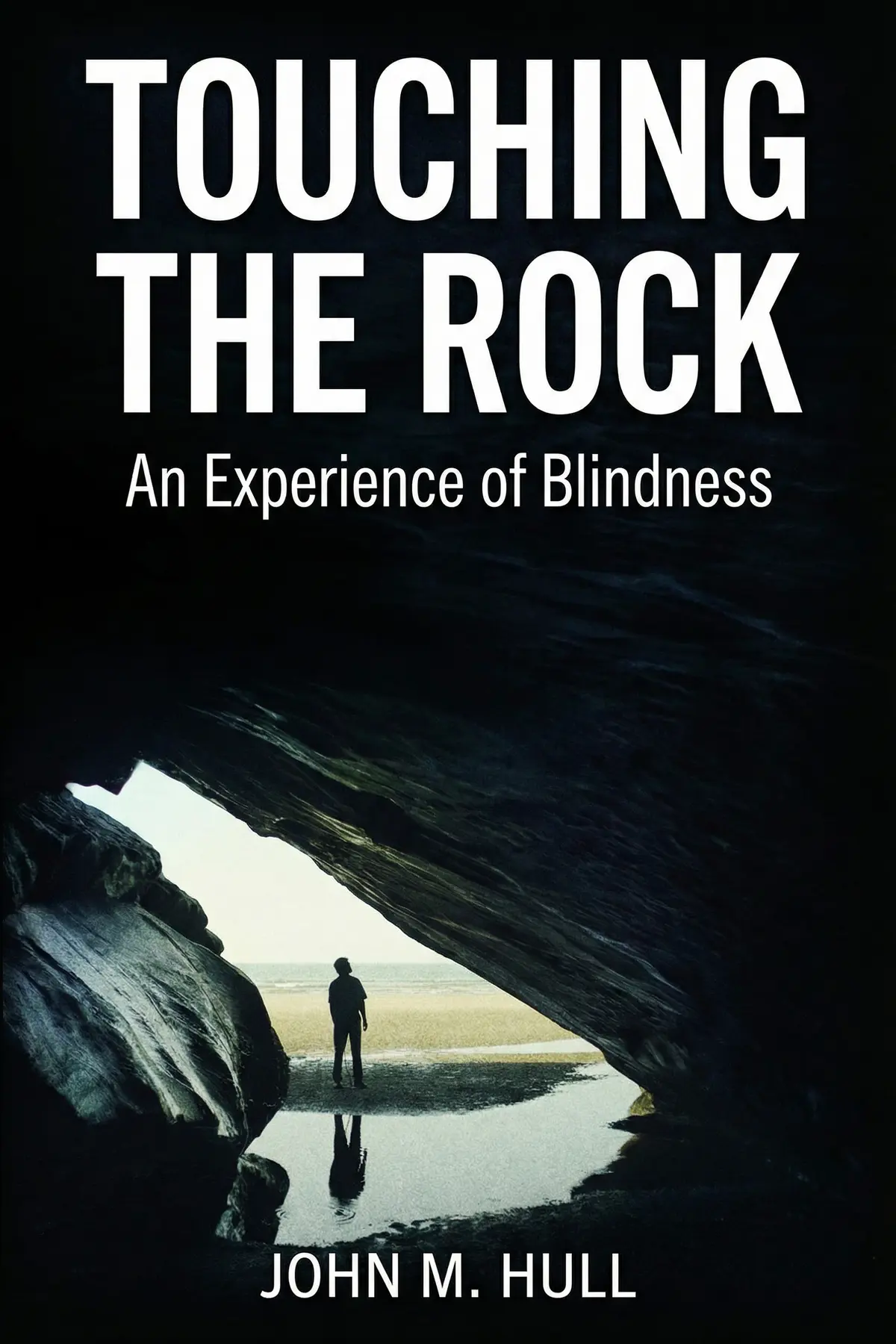
A theologian who went blind at 45 records what disappeared and what replaced it: fading faces, a world drawn by sound, appetite cut loose from images, and a life held together by meaning.
1 min 04 sec
Most of us assume that losing our sight would leave only an empty space. In Touching the Rock, the theologian John M. Hull describes something stranger: after going blind at 45, he found the faces of his own wife and children fading faster than those of relatives far away.
Hull, an Australian-born religious educator in Birmingham, England, had lost the sight of his left eye as a teenager, after a cataract operation led to a detached retina. More than twenty years later, a black disk spread across his right eye until nothing was left. From 1983 to 1986 he spoke his experience into cassette tapes.
Those tapes show a man learning that blindness is a different way of perceiving, with its own losses and discoveries, and that a life can stay meaningful even when it does not feel happy. Ordinary things look different after hearing him: a voice, rain on a path, a helping elbow, the reason a plate of food makes you hungry.
1 min 38 sec
A man who had seen for 45 years expected to remember his family’s faces longest. The opposite happened, and what filled the gap turned out to judge people about as well as his colleagues’ eyes did.
1 min 38 sec
A train ride and a rainy evening became, for one blind man, detailed maps of space. Yet the same sense that built his world could also erase it in an instant, in a way sight never does.
1 min 39 sec
A blind man found he could learn the paths of an entire abbey by himself. The hard part was the days before that, when well-meaning people kept guiding him, and one guest tried to steer him into a chair.
1 min 42 sec
Smell should be enough to make a meal appealing. For a man who lost his sight, it was not, and the reason says something about how desire works in everyone who can see.
1 min 38 sec
A vivid nightmare about his wife and daughter showed a blind father what he feared most. Then his young son learned the truth Hull had been hiding, and the reaction was not what he expected.
1 min 31 sec
At parties and conferences, a blind man kept getting stuck with one person all evening. The simple question he invented let him meet a dozen people quickly, though one attempt at giving directions ended in real embarrassment.
1 min 45 sec
A painful trip home left a blind man in one of his darkest periods. Two years later he was asking whether his blindness might be a gift, and his answer did not depend on feeling happy.
1 min 10 sec
Hull’s tapes amount to a report from a place most sighted people only dread. He never pretended the loss was small. Faces faded, appetite dulled, parties turned into traps and a family visit ended in depression. Yet the same darkness gave him rain that traced the shape of his garden, voices that told him who people were, and a son who loved him exactly as before. What he gained was a second way of perceiving, and a sharp view of how much everyone else leans on their eyes.
The book asks sighted readers to pay attention. Listen to a voice before you judge the face. Offer an elbow and let the other person decide how to take it. When desire flares, ask what you just looked at. And when a hard change refuses to feel good, look for the work, faith and people that still make it matter.
Hull came to call his blindness a gift he never chose. What he leaves his readers is the reminder that every sense is a way of knowing the world, and sight is just one of them.
John Hull had already lost one eye as a teenager. More than twenty years later his other eye failed, and at 45 he was registered blind. Between 1983 and 1986 he spoke his experience into cassette tapes, and Touching the Rock is the record of those years. Hull does not tell a story of triumph over disability. He describes, in close detail, what blindness actually does. The faces of his wife and children faded before those of distant relatives. Rain revealed the shape of his garden. Help from kind strangers often took away his independence, and food lost its pull once he could no longer see it. He writes about nightmares, about raising young children who did not yet understand, and about the awkward work of making friends among sighted people. Readers get a window into perception itself. Each loss Hull describes shows how much sighted people rely on their eyes without noticing. His account ends with a hard-won conclusion: a life can matter deeply even when it does not feel happy.
Readers facing a sudden loss of health or ability who want an honest account of adjusting.
Families, friends and colleagues of blind people who want to help without taking over.
Curious minds drawn to how perception, desire and faith shape everyday experience.
John M. Hull (1935 to 2015) was born in Australia and taught religious education at the University of Birmingham, where he later became an emeritus professor. He edited the British Journal of Religious Education for 25 years and co-founded the International Seminar on Religious Education and Values, serving as its general secretary for 32 years. Losing his sight in mid-career led him to write about disability from both personal and theological angles. In 2012 the Royal National Institute of Blind People gave him a Lifetime Achievement Award for his writing on blindness.
Listeners find the book both profound and accessible, with one review noting its thorough exploration of the many dimensions of loss of sight. The prose is highly regarded, as one listener characterizes the account as a beautifully written journey into blindness. On the topic of social interactions, listeners offer a range of differing opinions.
The chapter on the sound of rain really changed my perspective on how we inhabit space. Hull describes the acoustic world not just as a backup to sight, but as a rich, three-dimensional landscape where every drop defines a boundary. To be fair, the prose is remarkably lucid, turning what could have been a depressing diary into a philosophical exploration of 'deep blindness.' I was particularly moved by his descriptions of his children; the way he has to learn their faces through touch and voice is heartbreaking yet beautiful. Personally, I think the fragmented nature of the essays works in the book's favor. It mirrors the way he has to piece his world together from disparate sensory inputs. This isn't just a book about losing something; it's about the courageous, exhausting work of gaining a whole new way of being. Truly a haunting and brilliant journey.
Show moreAfter hearing that David Bowie considered this one of his favorite books, I knew I had to experience it for myself. It is a marvelous, moving account that transcends the typical 'triumph over adversity' trope. Hull isn't interested in being an inspiration; he’s interested in being a witness to his own disappearing world. The way he describes the 'grey, overcast days' as good days because the temperature is mild is a small but powerful example of how his values shifted. It’s a very intimate look at a man trying to maintain his dignity as a father and a scholar while his primary sense fails him. Not gonna lie, the parts about his children asking how he 'knows' things without seeing them brought me to tears. It’s a short read but the impact stays with you for a long time.
Show moreFinally got around to reading this, and I'm struck by how much we take for granted in our visual-centric world. Hull's description of 'deep blindness' as a state where even the memory of light begins to fade is terrifying and beautiful all at once. The way he handles the topic with such tenderness and sensitivity is admirable. I particularly enjoyed the essay on how time ceases to be a factor because a blind person simply cannot rush through tasks in the same way. It requires a level of courage—both physical and emotional—that I never truly considered before. It’s a beautifully written journey into a world most of us will never know. Even if you aren't religious, the way he clings to his humanity and his role as a father is incredibly moving. This is a must-read for anyone interested in the human condition.
Show moreWow. What a powerful, albeit fragmented, look at the transition from vision to darkness. The title 'Touching the Rock' perfectly encapsulates the grit and reality of Hull's experience. He doesn't sugarcoat the experience with 'inspirational' fluff; instead, he gives us the immediate, often painful reality of no longer being able to see his partner's face or read a physical book. The social interaction aspect—how he feels himself becoming a 'passive' object in the eyes of the sighted—was eye-opening. While some might find the dream sequences a bit much, I thought they added a surreal, psychological depth to his mourning process. It’s an honest, heartfelt, and ultimately marvelous collection of essays. It makes you realize that our similarities with the blind are far greater than our differences, even if the world we inhabit looks completely different.
Show morePicked this up because I wanted to understand the psychological shift of losing one's sight later in life, and Hull delivers a very comprehensive look at that transition. He doesn't shy away from the 'shitty hand' he was dealt, but he processes it with a heavy dose of academic and theological rigor. Look, some readers might find the dream analysis and the religious questioning a bit tedious, but for me, it grounded the experience in a very human search for meaning. I found the sections on social interaction particularly insightful—how a blind person has to consciously mimic facial expressions like smiling because they no longer have the visual trigger to do so spontaneously. It makes you realize how much of our humanity is tied to visual feedback loops. A solid 4 stars for such a thoughtful, easy-to-read, yet profound memoir.
Show moreThis book provides an insightful look at the many facets of blindness that the average person never considers. Hull captures the 'strangeness' of his new reality with a style that is both sensitive and intellectually sharp. I was fascinated by his observation that hearing is passive while sight is active—you can’t just 'shut your ears' the way you close your eyes. The truth is, it made me feel quite guilty about how much I take for granted, like being able to simply cast my eyes over the pages of a physical book. While the religious aspects didn't resonate with me as an atheist, I respected his dedication to finding a spiritual framework for his condition. It’s a beautifully written journey, though the lack of a cohesive structure makes it feel more like a collection of meditations than a standard biography.
Show moreAs someone who appreciates a well-written memoir, I found Hull’s prose to be remarkably lucid even when discussing the most abstract sensations of loss. The book isn't a traditional narrative; it’s a series of fragments that build a map of a world made of sound and touch. I loved the nuances he found in a rainstorm, where the world is suddenly 'filled in' by the sound of water hitting different surfaces. It’s a fascinating look at the alienation of disability. However, I’ll agree with other reviewers that the religious referencing felt a bit much toward the end. If you can get past the heavy theology, you’re left with a very honest, heartfelt exploration of what it means to be 'a whole man' when you’ve lost the sense that most people use to define reality. A very rewarding, if occasionally slow, read.
Show moreEver wonder what happens to your dreams when the world goes dark? John Hull spends a massive amount of time on this, and frankly, it got a little repetitive for me. While the first half of the book is a fascinating account of the transition from sight to blindness, the latter half gets bogged down in dream interpretation and some pretty heavy-handed religious reflections. I appreciate his honesty, but I struggled with his passivity in social situations. There’s a lot of what some might call internalized ableism here; he often apologizes for his blindness as if it’s a burden to the sighted people around him. It’s a touching account, no doubt, but I wish it had focused more on his daily adaptations and less on his subconscious. Still, his writing on the 'loss of the horizon' was incredibly evocative and worth the read.
Show moreNot what I expected, specifically regarding the heavy theological overtones that permeate the second half of the journal. I was expecting a more clinical or perhaps more adventurous account of blindness, but Hull is a religious man, and his faith is the lens through which he views his struggle. Some of his insights are profound—like the conscious effort required to smile—but others felt buried under layers of dream analysis that went nowhere. Personally, I found the pace to be a bit sluggish because of the repetitive themes. He mentions the same struggles with his children and his career multiple times without much evolution in the narrative. It’s a sad and touching account, and the writing is certainly high-quality, but it felt more like a private catharsis than a book written for a general audience. An okay read, but be prepared for the religious weight.
Show moreTo be fair, I found the author's constant apologies for the 'inconvenience' of his existence quite frustrating to sit through. As a reader looking for an empowering perspective on disability, this wasn't it. Hull seems to submit so readily to the passivity that sighted people expect of the blind, and his internalized ableism is honestly astounding at times. He treats microaggressions against his dignity as acceptable, which made it very hard for me to stay sympathetic toward his journey. Also, the obsession with analyzing every single dream he had felt like filler. I was hoping for more practical observations on navigating the world, but instead, I got a lot of questionable theology and self-pity. While his prose is decent, the tone was just too disheartening and submissive for my taste. I wouldn't recommend this to anyone newly blind.
Show moreIt is Hull’s account of going blind at 45, recorded on cassette tapes from 1983 to 1986. He describes how faces faded from memory, how sound and the whole body took over from sight, and how blindness affected eating, sex, parenting and friendships. Over time he came to see blindness as a different and even precious way of perceiving, and decided that meaning mattered more than happiness.
Hull noticed that the new memories he formed with his wife and children after going blind seemed to cover his old visual images of them. He could recall them only through particular photographs, which made him wonder whether his wife would always look young to him and his daughter would stay seven. Relatives in Australia he had not seen for years stayed clearer, because no new unseen memories replaced them.
Hull found he moved most freely alone, using his cane, his feet and echolocation, and that constant guidance kept him from learning a place himself. Being led meant holding an elbow, keeping his cane close and talking, which drowned out useful echoes. He valued helpers with the empathy to see how they could make things easier while leaving him his agency, not people who took control, like the woman who tried to push him into a chair.
To avoid being stuck with one person all evening, Hull would end a conversation by asking his partner whether they saw anyone they knew, then ask to be introduced. This saved the other person from searching for someone Hull already knew and kept him meeting new people. He found he could speak with a dozen people in fifteen minutes this way. The approach works for anyone at a crowded event.
Hull struggled with grief and depression, including a hard visit to Australia in 1984. He never claimed blindness made him happy. Instead he concluded that meaning was more important than happiness, and found it in his teaching at the University of Birmingham, his religious communities and his family. He also started thinking of himself as a whole-body-seer, who takes in life more directly than the eyes allow.
Barack Obama


Masaji Ishikawa

Ben Macintyre


James Shapiro


Ben Macintyre

AUDIO SUMMARY AVAILABLE
Get the key ideas from Touching the Rock by John M. Hull, plus 5,000+ more nonfiction titles.









