

14 min 50 sec
Available in: English
Tools and Weapons: The Promise and the Peril of the Digital Age
Shows what happens when data, cyberweapons, disinformation and AI escape anyone's control, and why Microsoft's president argues that tech firms and governments must build the rules together.
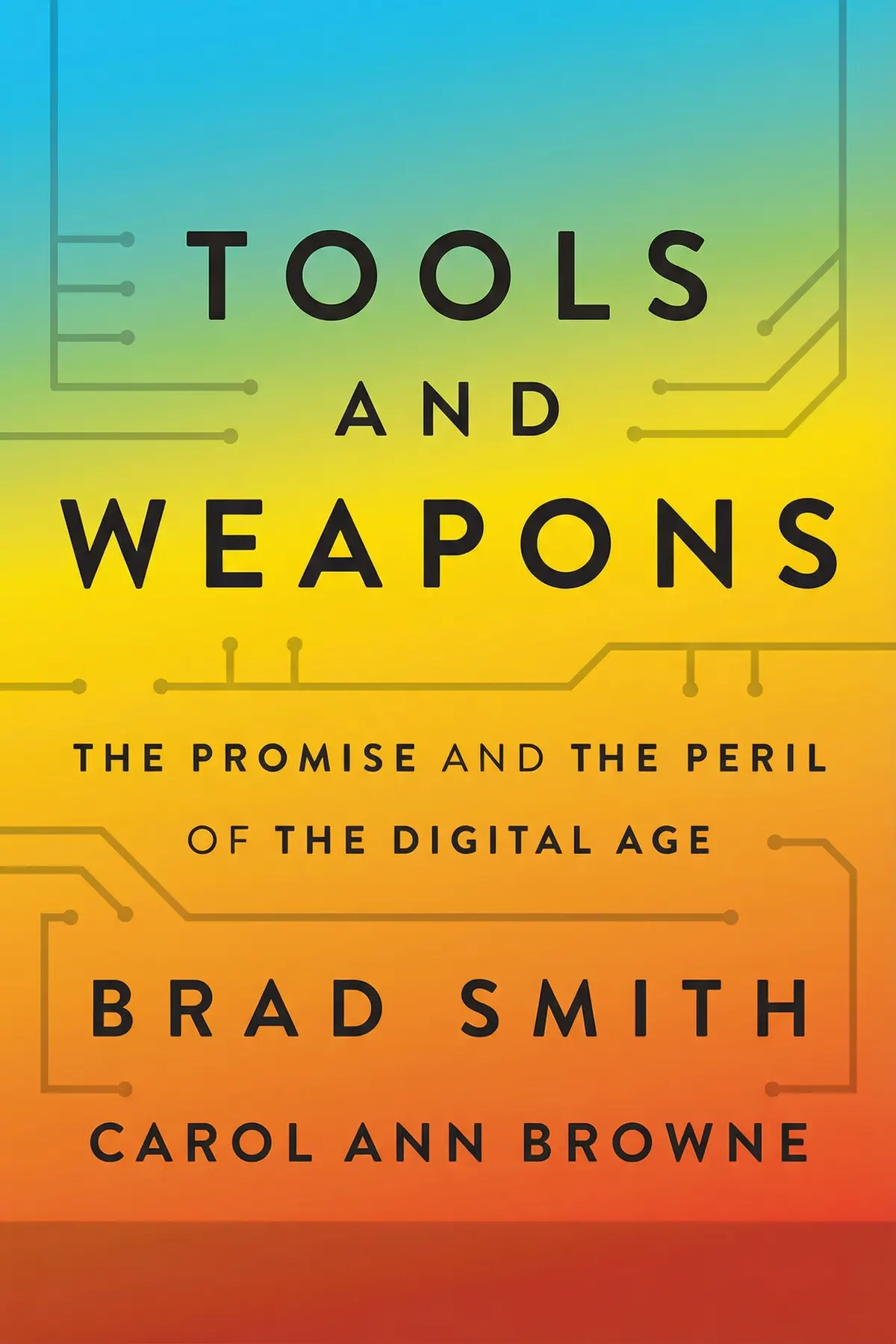
Table of Content
1. Introduction
58 sec
Technology news can feel like a run of alarms: hospitals hacked, elections manipulated, software that misjudges people, and nobody clearly in charge. In Tools and Weapons, Microsoft president Brad Smith and his colleague Carol Ann Browne start from a simple picture: a broom can sweep a floor or hit someone over the head, and digital technology works the same way.
Their argument is that the digital age tips toward promise or peril depending on two things. Tech companies must accept responsibility beyond profit, and governments must learn enough to regulate, and the two must work together. Writing from inside one of the largest tech firms, they bring cases few outsiders saw, from an urgent FBI request after a terror attack to a heart operation cancelled by hackers. Their stories make the headlines easier to read: who holds your data, who can reach it, and what to check before believing a story.
2. Know where your data really lives
1 min 33 sec
Your photos and emails feel like they live nowhere in particular. A small town east of Seattle tells a different story, one involving buildings big enough to hold airliners and a hidden twin for every one of them.
3. Understand the long history of privacy fights
1 min 35 sec
A leaked trove of intelligence files shocked Microsoft in 2013. The authors trace the same quarrel back more than two centuries, to a rebellious lawmaker, broken doors and a court verdict nobody expected.
4. Security and privacy can both be protected
1 min 31 sec
After a terror attack in Paris, Microsoft handed over account details in under an hour. Later it took the US government to court. Both choices make sense once you see the line the company drew.
5. Read a country's past before storing its data
1 min 34 sec
A former prisoner in Berlin changed how one of the world’s biggest tech firms decides where to keep information. His story explains why two democracies can disagree so sharply about privacy.
6. Cyberattacks can hurt people far from any screen
1 min 31 sec
A man waiting for heart surgery was sent home because of code launched thousands of miles away. Where that code was first built is the detail that worried Microsoft most.
7. Spot the outsider stirring an online fight
1 min 43 sec
Two crowds shouted at each other in Houston without knowing who had brought them there. A French diplomat played the same game in 1793, and George Washington’s response still carries a lesson.
8. Build diverse teams to catch bias in AI
1 min 41 sec
The most pressing danger in artificial intelligence today has nothing to do with a robot uprising. Two researchers testing faces from two continents found a problem that starts with the people who build the systems.
9. Steer technology toward good with shared rules
1 min 42 sec
AI is reassembling scattered medieval manuscripts and helping rangers protect wild animals. Getting more of that, the authors argue, depends on two groups that rarely understand each other learning to cooperate.
10. Conclusion
1 min 02 sec
Smith and Browne write from the engine room, and what they saw there is that every digital gain casts a shadow. Buildings that keep your memories safe also tempt spy agencies. Code written for national defense ended up cancelling a man’s heart surgery. Software meant to be neutral was found biased against Black people. Their remedy never changes: companies that accept they answer to the public, and officials who learn enough to write sensible rules, working at the same table.
You do not have to run a tech firm to act on it. Ask where your data is stored and who could be forced to open it. When a headline makes you angry, look for the same report from several respected outlets before passing it on. If you build or buy systems, check who is missing from the data and from the team.
John Wilkes won because he refused to accept that soldiers could break any door without a reason. The digital age needs that same stubbornness, from citizens as much as from courts.
About this book
What is this book about?
Every week brings another alarming technology story: a hospital frozen by hackers, a fake news campaign, software that misjudges people by the color of their skin. It is hard to tell who is responsible, or whether anyone is in charge at all. Brad Smith, president of Microsoft, and his colleague Carol Ann Browne write from inside one of the world's largest technology companies. Their cases include an email about Edward Snowden's leaks, an FBI request hours after the Charlie Hebdo attack, the WannaCry ransomware that cancelled surgeries in London, and Russian operatives who staged rival rallies in Houston. They set these beside older stories, such as an eighteenth-century British lawmaker who won a landmark privacy case and a French envoy who split George Washington's cabinet. The argument is that any technology can be used to help or to harm, much like a broom. Readers come to understand where their data physically lives, how privacy, security and culture pull against each other, why AI bias starts with data and teams, and what both companies and governments must do so that technology serves people rather than threatening them.
Book Information
Who it's for
Professionals using the cloud
Professionals who rely on cloud services every day and want to know who can reach their data.
Building or buying software
Managers and founders building or buying software, AI systems or data storage.
Worried about digital threats
Readers worried about hacking, election meddling and biased algorithms who want a view from inside big tech.
About the Author
Brad Smith
Brad Smith is president of Microsoft. Carol Ann Browne joined Microsoft in 2010 after working at Sun Microsystems and Burson-Marsteller, and brings a background in writing, video, multimedia and social media. She grew up in El Paso, Texas, and graduated from Arizona State University and its Walter Cronkite School of Journalism and Mass Communications. The two have worked together on writing, video and other projects in the United States and abroad, including the Today in Technology blog series.
Ratings & Reviews
Ratings at a glance
What people think
Listeners find the work highly educational, highlighting the impressive mountain of research it contains. They also note the writing is thought-provoking and quite accessible. Nevertheless, opinions regarding the book's value for money are split among listeners.
Top reviews
Game
The chapter on rural broadband alone was worth the cover price, as it highlights a digital crisis often ignored by the urban tech elite. Brad Smith writes with a surprising amount of clarity, breaking down how Microsoft navigated the fallout from the Snowden leaks without getting bogged down in impenetrable legalese. While some might argue the book leans too heavily into corporate defense, the historical parallels he draws are genuinely enlightening for any modern reader. To be fair, you have to read between the lines occasionally to spot the marketing spin, but the wealth of data presented here is undeniable. It feels like a masterclass in how a modern tech giant perceives its global responsibilities in an age of constant surveillance and rapid change. I highly recommend this to anyone who wants to see the 'cockpit' view of global policy.
Show moreIngrid
Wow, what a fascinating dive into the hidden machinery of the digital age and the massive responsibility held by tech leaders today. Brad Smith doesn't just talk about code; he talks about the soul of technology and whether it will ultimately serve as a tool or a weapon. I was particularly impressed by the sections on Chinese and American tensions, which are handled with a surprising amount of nuance and historical context. The book is incredibly readable and moves at a fast pace, never getting stuck in the weeds of technical jargon. I appreciate the transparency regarding past mistakes, even if the current solutions are presented through a slightly rosy lens. This is essential reading for anyone trying to make sense of our hyper-connected world and the giants that run it.
Show morePong
Picked this up because I wanted to understand the intersection of policy and innovation, and it definitely delivered on the research front. The authors clearly spent an enormous amount of time aggregating data on cyberwarfare and the moral dilemmas surrounding artificial intelligence. Frankly, the writing style is more engaging than your typical dry business memoir, which makes it an easy weekend read for anyone interested in current events. I did find the constant 'Microsoft is the hero' narrative a bit exhausting after the first few chapters, but the insights are still valuable for my career. It serves as a solid survey of the tech landscape from the late 2010s without being too technical. If you can ignore the occasional corporate cheerleading, there's a lot to learn here about our future.
Show moreTantipat
After hearing about the tension between government surveillance and user privacy on the news, I was curious about Smith's internal take. This book dives deep into those waters, offering a unique perspective on how massive corporations handle requests for private data from intelligence agencies. The narrative about the international warrant case was particularly gripping and shed light on a side of the legal battle I hadn't fully considered before. Gotta say, the way they link lessons from the industrial revolution to current AI ethics is a provocative touch that kept me turning pages. It’s not perfect, as some sections feel a bit like a PR scrub for the executive team, but the overall breadth of topics is impressive. It’s a necessary read for anyone worried about the future of democracy.
Show moreChai
Ever wonder how a company like Microsoft decides which side to take when two governments go to war in cyberspace? This book attempts to answer that by laying out a mountain of research on modern conflict and the erosion of digital borders. The prose is clean and persuasive, though you can definitely feel the influence of a high-level lawyer in every carefully constructed sentence. I found the discussion on the 'Digital Geneva Convention' to be one of the most provocative ideas in the whole text. It’s a bit pricey for what essentially feels like an extended corporate white paper, but the information is current and relevant. Most of the takes are safe, yet they provide a clear roadmap of where Big Tech thinks it is heading.
Show moreDiego
Finally got around to reading this after hearing it was better than Satya Nadella’s book, and I have to agree that it’s far more engaging. While Hit Refresh felt like a standard corporate rah-rah session, Tools and Weapons actually grapples with difficult societal questions like inequality and cybercrime. It’s not quite on the level of a narrative masterpiece like Shoe Dog, but it holds its own as a serious policy discussion. Not gonna lie, the pro-Microsoft bias is palpable and you have to filter through some of the self-congratulation to get to the meat. However, the sheer volume of research and the clarity of the arguments make it worth the time. It’s a solid 4-star read for tech enthusiasts and policy wonks alike.
Show moreMoo
Truth is, I expected this to be a dry legal tome, but it’s actually a very fluid and provocative look at our digital future. The way Smith and Browne connect the history of the telegraph to current internet regulation shows a deep understanding of technological evolution. I was especially captivated by the stories regarding the battle over facial recognition software and the ethical guardrails that need to be in place. It’s a well-researched book that provides a helpful framework for thinking about the power of the tech industry. Some of the chapters felt a bit like surface-level news summaries, yet they provide a necessary foundation for the broader arguments. It’s a readable, informative, and mostly balanced look at some very complex issues we face today.
Show moreHang
Brad Smith provides a unique perspective from the pinnacle of the tech industry, and while it’s clearly a curated view, it’s still highly valuable. The book covers everything from the moral conundrums of AI to the challenges of bringing broadband to rural communities in America. I found the writing style to be accessible and engaging, making complex geopolitical issues feel manageable for the average reader. Frankly, the mixed reactions on value for money are understandable if you already follow tech policy closely, but for most, this is a great primer. It’s a polished piece of work that highlights the dual nature of our most powerful inventions. I walked away with a much better understanding of the current tech-government landscape and the stakes involved.
Show moreThitima
As someone who works in the software industry, I found most of the information here to be a bit superficial and lacking in granular detail. Smith is a talented writer and clearly knows his stuff, but he often stops just short of giving the kind of deep, specific insights I was craving. The structure is repetitive: present a global crisis, explain the history, and then show how Microsoft is saving the day. Personally, I would have preferred more about the internal disagreements at the company rather than the polished, final stance. To be fair, it’s a great introductory text for someone who doesn't follow tech news daily and wants a mountain of research in one place. It just felt a bit like a very long, high-budget think piece.
Show moreConnor
Not what I expected at all, as I was hoping for deep technical insights instead of a glorified press release for Redmond. The 'infomercial' quality that other readers mentioned is unfortunately very real and set my teeth on edge by the halfway point. Every problem the world faces seems to have a convenient solution that involves a Microsoft product or a policy they just happen to support. It’s a very safe, curated version of history that avoids any real risk or admission of significant failure. Look, the prose is fine and the research is there, but I didn't learn anything that I couldn't have found in a Sunday newspaper. It is basically expensive propaganda in book form. Save your money and just read a few HBR articles instead.
Show moreQuestions about this book
What is the main idea of Tools and Weapons?
Brad Smith and Carol Ann Browne argue that digital technology, like a broom, can help or harm depending on who uses it. Drawing on cases from inside Microsoft, from the Snowden leaks to the WannaCry attack, they conclude that tech companies must accept moral responsibility beyond profit and governments must understand and regulate technology. Only by working together, they say, can the two make sure technology serves people.
What does Tools and Weapons say about privacy and government surveillance?
The authors trace privacy fights back to John Wilkes, an eighteenth-century British lawmaker whose court victory required stronger grounds for searches. They see Snowden’s 2013 revelations as the same old conflict. Microsoft gave the FBI data within 45 minutes after the Charlie Hebdo attack, yet later sued the US government over gagging orders, which led the Justice Department to agree to limits.
What examples of AI bias appear in Tools and Weapons?
The authors cite a ProPublica article, Machine Bias, reporting that software used to predict future criminals was biased against Black people. They also describe research by Joy Buolamwini and Timnit Gebru showing facial recognition was less accurate for Black politicians in Africa than white politicians in Europe. The causes, they explain, are unrepresentative data and teams that do not reflect the world.
How can I apply the ideas in Tools and Weapons?
When you come across an inflammatory headline online, check whether several well-regarded outlets carry the same story, and be wary of being fooled if it appears in only one place. Ask where your data is stored and under which country’s laws. If you build or buy AI systems, check who is missing from the training data and from the team designing it.
Readers also enjoyed

Abortion: Our Bodies, Their Lies, and the Truths We Use to
Jessica Valenti


Adults in The Room: My Battle With Europe’s Deep Establishment
Yanis Varoufakis



Age of Anger: A History of the Present
Pankaj Mishra


A Different Kind of Power: A Memoir
Jacinda Ardern
AUDIO SUMMARY AVAILABLE
Listen to Tools and Weapons in 15 minutes
Get the key ideas from Tools and Weapons by Brad Smith, plus 5,000+ more nonfiction titles.
- 5,000+ titles
- Listen as much as you want
- 7-day free trial
- Cancel anytime









