

15 min 50 sec
Available in: English
Thirteen Days: A Memoir Of The Cuban Missile Crisis
Robert F. Kennedy's insider account of the Cuban Missile Crisis shows how time to think, open argument and close attention to an opponent's pride kept two superpowers out of nuclear war in October 1962.
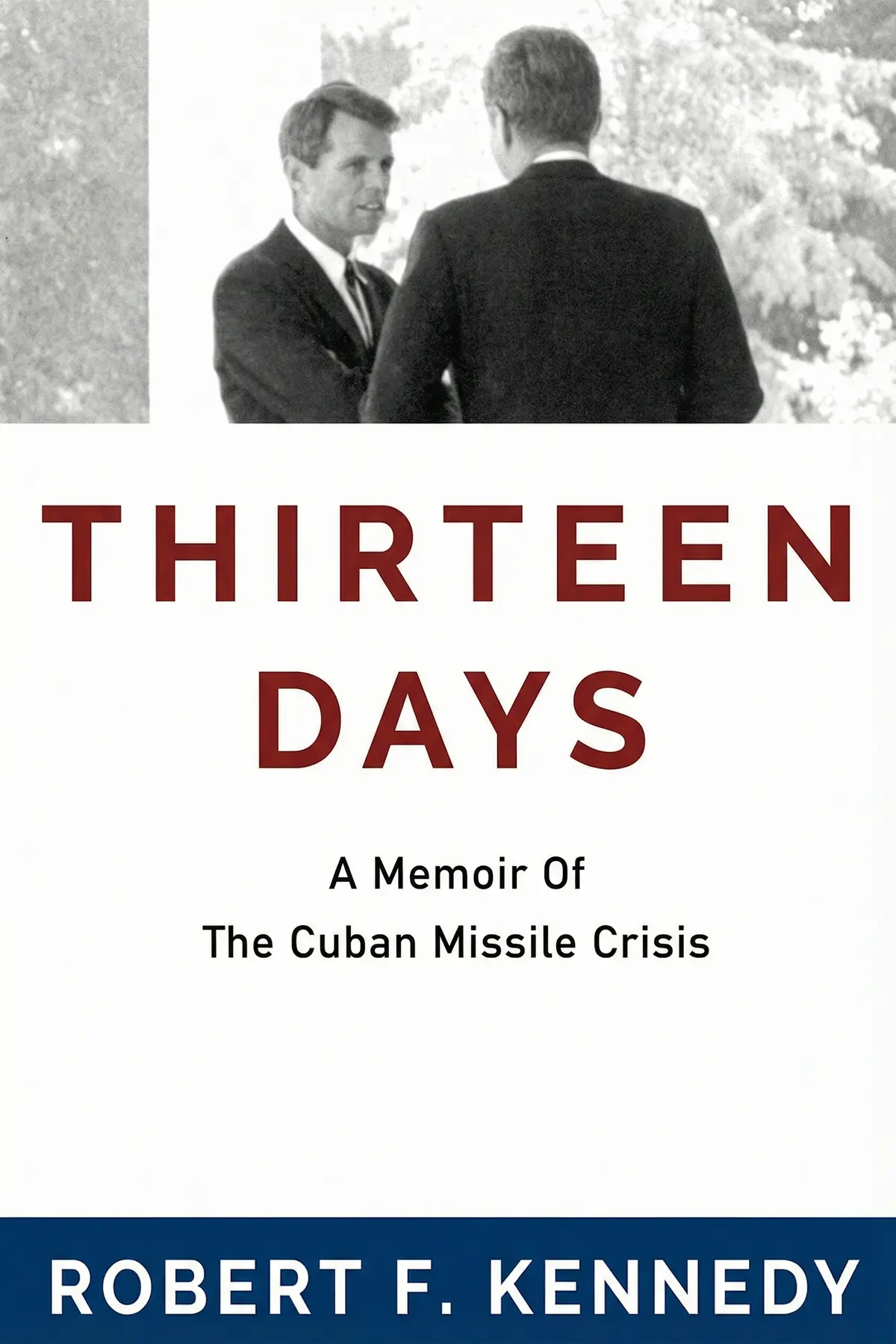
Table of Content
1. Introduction
1 min 05 sec
Most of us face moments when angry, confident voices demand a fast, hard answer and a wrong move cannot be taken back. In Thirteen Days, Robert F. Kennedy, attorney general and one of his brother’s closest advisers, tells how the White House resisted exactly that pressure in October 1962. His story opens with a lesson about trust: Moscow had promised in private and in public to keep offensive missiles out of Cuba, and one spy plane proved the promise false.
What saved the following two weeks, in Kennedy’s telling, was a way of deciding. The president’s circle took time to think, let many voices argue in the open, chose pressure it could adjust, and kept picturing the crisis through Khrushchev’s eyes. Those habits turned a standoff that threatened tens of millions of lives into a deal both sides could accept. They also form a method for any high-stakes choice, from a tense negotiation to a team split down the middle.
2. Test a rival's promises against hard evidence
1 min 56 sec
The Soviet ambassador, the Soviet government and Khrushchev himself all gave the same reassurance, and American intelligence believed them four times over. Then a single flight over the Caribbean brought back pictures that changed everything.
3. Get honest advice by leaving the room
1 min 52 sec
The most powerful man in the room can be the biggest obstacle to a good decision. John Kennedy found an odd way around that problem, and it produced arguments so bitter they kept exhausted men up at night.
4. Spot how confident voices can steer you toward disaster
2 min 01 sec
Every senior officer in the American military agreed on what to do, and one general promised the Soviets would not even react. The president had a history book on his mind that made him doubt them all.
5. Choose pressure you can raise step by step
1 min 50 sec
An attack hands the next move to your opponent. Robert McNamara proposed something that kept control in American hands, and a final military report made the case for it more convincingly than any adviser could.
6. Make a firm stand visible, then wait
1 min 48 sec
Khrushchev’s first reply called the blockade banditry, and Soviet ships kept sailing toward the line with a submarine among them. Then, one morning at 10:25, a message reached the White House.
7. Answer the offer you can live with
2 min 11 sec
Two letters from Khrushchev arrived a day apart, and they asked for different things. The reply the Kennedys sent is famous, and it is also the part of this memoir that one historian disputes most sharply.
8. Give your rival a way to save face
1 min 44 sec
After the most dangerous standoff of the age ended in Washington’s favor, the president forbade his own people from saying so. Robert Kennedy considered the reasoning behind that order the deepest lesson of the whole crisis.
9. Conclusion
1 min 23 sec
Thirteen Days is a short book, about 185 pages, first published in 1968, the year its author was shot during his own presidential campaign. One reviewer compares its style to a legal memo, and its heroes are not the people who acted boldly. The bravest choices in it are acts of restraint: a president leaving the room so others will speak, a committee refusing to stage its own Pearl Harbor, a quarantine instead of bombs, a reply to the gentler of two letters, and a victory nobody was allowed to celebrate.
That is what the memoir adds up to. In Robert Kennedy’s account, peace in October 1962 came from people who distrusted easy certainty, including their own.
The habits travel well beyond the Cold War. When a decision cannot be undone, buy time before you commit. Invite the people who disagree with you, and make it safe for them to say so when you are not there. Before any hard move, imagine how it looks from the other side of the table, then leave your rival a way to step back with dignity.
At 10:25 one October morning, a few ships stopped in the water. Everything worth learning from the crisis lies in why they had the room to.
About this book
What is this book about?
In October 1962, an American spy plane photographed Soviet missile sites in Cuba, weeks after Moscow had promised there would be none. For the next thirteen days, President John F. Kennedy and a small circle of advisers argued over how to respond, while the Joint Chiefs pressed for an immediate attack. Robert F. Kennedy, then attorney general and his brother's closest confidant, tells the story from inside the room. He follows the discovery, the fierce debates of the committee known as ExComm, the choice of a naval quarantine over air strikes, the standoff at sea, and the confusing pair of letters from Khrushchev that led to a deal. Along the way he draws out the lessons he took from it: allow time for private deliberation, test every view through debate, and never push an adversary into a corner where escalation is the only way to save face. The result is a short, tense account of decision-making under the highest pressure imaginable. It also offers a method readers can use for their own high-stakes choices, whether they lead a team, run a company or face a hard negotiation.
Book Information
Who it's for
Managers and team leads
Managers and team leads who must make high-stakes calls while strong voices push for speed.
Hoping to pressure rivals
Founders and negotiators who want to pressure a rival without backing them into a corner.
History buffs
History readers who want an insider's view of the Cuban Missile Crisis, with its disputed points included.
About the Author
Robert F. Kennedy
Robert F. Kennedy (1925 to 1968) studied at Harvard and earned his law degree at the University of Virginia. He managed his brother John F. Kennedy's 1952 Senate campaign and challenged Teamsters president Jimmy Hoffa as chief counsel of a Senate committee. At 35 he became US attorney general and one of the president's closest advisers, serving from 1961 to 1964, then became a senator for New York. He was shot during his 1968 presidential campaign and died on June 6, 1968.
Ratings & Reviews
Ratings at a glance

What people think
Listeners consider this memoir an absorbing and accessible chronicle of the Cuban Missile Crisis, highlighting its lucid language and polished storytelling. This work provides intriguing perspectives on this pivotal moment in history, as one listener points out that it functions as a paradigm for crisis management. Listeners value the historical substance, with one characterizing it as a powerful short success story.
Top reviews
Ellie
Picked this up on a whim after a history podcast mentioned it, and I couldn't put it down. Even though everyone knows how the Cuban Missile Crisis ends, the tension RFK builds is palpable. He provides a masterclass in crisis management, showing how JFK deliberately encouraged dissent within the ExComm to avoid the groupthink that led to the Bay of Pigs. It is fascinating to see how they balanced military pressure with the need to give Khrushchev a 'face-saving' way out. The book is barely 100 pages, but every sentence carries weight. Some might find the lack of citations annoying, but this is a memoir, not a textbook. If only current world leaders had this much restraint and intellectual rigor. It's a quick, thrilling read that stays with you long after the final page.
Show moreChaiwat
The tension in this memoir is absolutely incredible. Robert Kennedy, serving as both Attorney General and the President's most trusted confidant, gives us a seat at the table for the most dangerous thirteen days in human history. I was particularly struck by the description of the 'staccato exchange' of fragmented sentences between the brothers. They had a shorthand that transcended normal speech. It shows how vital trust is during a crisis. The book details the U-2 pilot being shot down and how JFK refused to be provoked into an immediate, emotional response. That kind of calm is rare. It’s a short, punchy book that reads like a high-stakes thriller. Even if you aren't a history person, the lessons on leadership and decision-making are universal. This belongs on every bookshelf.
Show moreJob
After hearing about this book for years, I finally got around to reading it, and I’m so glad I did. The edition I read included an afterword by Richard Neustadt and Graham Allison, which provided excellent context on 'The Nuclear Paradox.' RFK’s narrative itself is a masterpiece of pacing. He captures the back-and-forth of the Khrushchev letters perfectly—the first one being emotional and seeking peace, the second being cold and demanding. It was Bobby’s idea to ignore the second letter and respond to the first, a move that essentially saved the world. That kind of tactical brilliance is what makes this book a classic. It isn't just a history; it’s a study in how to think under pressure. It’s powerful, short, and carries a massive emotional impact. Five stars without hesitation.
Show moreSupatra
Ever wonder how close we actually came to the end of the world? This book answers that with chilling clarity. Robert Kennedy takes you behind the closed doors of the White House as they debated whether to launch air strikes or a quarantine. Personally, I found the discussion about the missiles in Turkey most interesting. It reveals the complex horse-trading that happened to avoid a nuclear winter. The writing style is surprisingly accessible, lacking the dry jargon you usually find in political memoirs. My only real complaint is that it feels a bit too brief. I wanted more detail on the back-channel communications. However, the inclusion of the actual letters between JFK and Khrushchev at the end is a fantastic touch that adds a layer of raw authenticity to the narrative.
Show moreKatya
As a child of the sixties, I have vivid memories of duck-and-cover drills under my school desk. Reading this was like reliving that fear, but from the perspective of the people at the controls. Robert Kennedy does a beautiful job explaining the heavy moral burden his brother carried. He mentions JFK was deeply influenced by 'The Guns of August,' fearing a repeat of the accidental escalation that started WWI. That detail alone makes the book worth reading. It highlights how important it is for leaders to be well-read and reflective. While some historians claim Bobby polished his own image here, the emotional core of the story feels very real. It’s a powerful success story about how diplomacy can triumph over the 'gung ho' instincts of the military brass. Highly recommended for any history buff.
Show moreNina
Look, if you want a deep dive into every single minute of the missile crisis, look elsewhere. But if you want a gripping, first-person account that captures the 'vibe' of the White House under siege, this is the one. Gotta say, I was surprised by how much Robert Kennedy focused on the moral side of the conflict. He didn't want the U.S. to be seen as a 'Tojo' launching a Pearl Harbor-style attack on a small neighbor. That ethical framework is often missing from modern political discourse. The book is clear, concise, and incredibly gripping. It’s amazing to think that 80 million Americans could have died if the 'surgical air strike' crowd had won the day. It’s a sobering reminder of the fragility of peace. A very worthwhile read for a weekend afternoon.
Show moreKomsan
Robert Kennedy offers an insider's view that is both fascinating and terrifying. The way he describes the exhaustion of the ExComm members—sleeping on couches and eating cold sandwiches while debating the fate of the planet—really humanizes the history. He explains the naval quarantine in a way that makes you realize how much of a gamble it actually was. It wasn't just a simple blockade; it was a delicate dance with Soviet submarines. I did find the sections on the Joint Chiefs of Staff a bit one-sided, as he clearly had a distaste for their 'military-first' mindset. However, his writing is so engaging that you almost don't notice the lack of objectivity. It’s an easy-to-read account of a very complex situation. For a book written in the 60s, it still feels remarkably modern.
Show moreDylan
Wow, for a book that is over fifty years old, this still packs a massive punch. In my experience, most political memoirs are boring and self-congratulatory, and while this definitely has some of the latter, it’s far from boring. Robert Kennedy makes you feel the weight of the nuclear threat. He talks about the 'miscalculation and misunderstanding' that leads to war, which feels incredibly relevant in today’s political climate. The book does a great job explaining why they chose the blockade over the air strike, focusing on the long-term consequences rather than the immediate win. My only gripe is that it skips over some of the internal bickering that we now know happened. But for a hundred-page snapshot of history, you really can’t beat the perspective offered here.
Show moreSoontorn
It is a bit of a shock to go back and read this after finishing Sheldon Stern’s recent analysis of the ExComm tapes. For decades, RFK’s account was the gold standard for what happened during those terrifying weeks in 1962. We see Bobby as the cool-headed dove, but the recordings tell a more complicated, hawkish story. Truth is, while the writing is tight and the drama is undeniable, the historical accuracy is now under heavy fire. Robert presents himself as the indispensable advisor, but he often masks how aggressively he pushed for military action. Still, as a piece of political memoir and a look into the Kennedy family psyche, it is indispensable. Just don't take every word as absolute gospel. It serves better as a primary source of how the Kennedys wanted to be remembered rather than a raw historical record.
Show moreNam
To be fair, this is a very well-written book, but I struggled with the obvious bias throughout. Bobby Kennedy clearly had some axes to grind, particularly with Dean Rusk. He portrays Rusk as almost irrelevant or indecisive, which historical tapes have since proven to be quite unfair. Frankly, the way Bobby positions himself as the 'dove' who saved the day feels a bit like historical revisionism when you compare it to the actual meeting transcripts. He was much more hawkish than he lets on here. That said, the book is a paradigm for how to structure a narrative. It moves fast and hits all the high notes of the crisis. If you read it alongside a more objective history of the era, you get a great sense of the atmosphere in the room, even if the specific details are skewed.
Show moreQuestions about this book
What is Thirteen Days by Robert F. Kennedy about?
It is Robert Kennedy’s insider memoir of the Cuban Missile Crisis, from October 16, 1962, when the president saw proof of secret Soviet missile sites in Cuba, to October 28, when the Kremlin agreed to remove them. As attorney general and a close adviser, he describes the ExComm debates, the choice of a naval quarantine over air strikes, the standoff at sea and the exchange of letters that ended the crisis.
What lessons does Thirteen Days draw from the Cuban Missile Crisis?
Kennedy highlights three. Time for private deliberation mattered, since a decision forced within twenty-four hours would probably have been far riskier. Advice should come from many people and viewpoints, because opinions and facts are tested through debate. Most important, leaders must see the crisis from the adversary’s side; the president focused on Khrushchev’s position, avoided humiliating him and banned claims of victory afterward.
Why did President Kennedy choose a blockade instead of an air strike?
The Joint Chiefs and Dean Acheson pressed for military action, but Robert McNamara argued that a blockade, renamed a quarantine for legal reasons, applied pressure that could be raised step by step while the US kept control. A final military assessment then confirmed that even a large surprise air attack could not guarantee destroying every missile site, so the president chose the quarantine.
Is Robert Kennedy's account in Thirteen Days accurate?
It is one participant’s version, written in 1968. Historian Sheldon Stern argues that Robert Kennedy was very hawkish in the actual meetings but presented himself as a dove while writing during the Vietnam War. Stern also calls the traditional story that Kennedy proposed answering Khrushchev’s first letter and ignoring the second a myth, noting that this so-called Trollope Ploy first appeared in this book.
How can I apply the ideas in Thirteen Days at work?
Leave the room sometimes so your team says what it thinks, since even strong people tell a boss what they expect he wants. Prefer moves you can escalate or soften over all-or-nothing ones. When a rival sends mixed signals, answer the most workable offer. And before acting, ask what your move costs the other side in front of their own people.
Readers also enjoyed

A Long Way Gone: Memoirs of a Boy Soldier
Ishmael Beah



A Promised Land
Barack Obama


A River in Darkness: One Man’s Escape from North Korea
Masaji Ishikawa

A Splendid Exchange: How Trade Shaped the World
William J. Bernstein

A Theory of Justice
John Rawls

A Spy Among Friends: Philby and the Great Betrayal
Ben Macintyre
AUDIO SUMMARY AVAILABLE
Listen to Thirteen Days in 15 minutes
Get the key ideas from Thirteen Days by Robert F. Kennedy, plus 5,000+ more nonfiction titles.
- 5,000+ titles
- Listen as much as you want
- 7-day free trial
- Cancel anytime









